• Skip to main content
  • Skip to header right navigation
  • Skip to site footer

My Cradock

My Cradock

Cradock News Classifieds and Directory

  • Home
  • About
  • Accommodation
  • Business
  • Events
  • Free Business Advert
  • Submit News
You are here: Home / Archives for Accommodation

Accommodation

16 September 2026 by Alan

Don’t Let Others Experience Put You Off Battery Storage

Or, you could just go for the ‘Hippy Option’ One of the YouTube Channels that I watch on a semi-regular basis is ‘Undecided with Matt Ferrell’. In his latest video, “The Hidden Problem With Home Batteries”, Matt details how he actually loses money on his home battery setup in a 1 for 1 net metering …

  • Or, you could just go for the ‘Hippy Option’

One of the YouTube Channels that I watch on a semi-regular basis is ‘Undecided with Matt Ferrell’.

In his latest video, “The Hidden Problem With Home Batteries”, Matt details how he actually loses money on his home battery setup in a 1 for 1 net metering situation in the state of Massachusetts.

Matt is a bit of an uber nerd when it comes to making decisions – not only does he over research but he continues to do so by monitoring and reporting back on his purchases, in detail and well after the date of purchase.

In some ways he extolls the BA Systems Energy Management mantra of; “If you can measure it, you can manage it!”

BUT, the bottom line when watching such videos from another part of the world is that every country, province, metropolitan area and utility supplier has different ways that they handle charges for electricity and grid connection charges.

The quick take away for South Africa is somewhere in the following:

Financial efficiency may shift positively if utilities transition away from 1:1 net metering or introduce Time-of-Use (TOU) rate structures. Under TOU rates, storing cheap daytime energy to discharge during expensive peak hours makes batteries considerably more financially viable.

In fact Matt estimates that a TOU tariff may impact him directly as follows: From minus $200 per year to between $170 and $800 plus in savings per year. Again – efficient management of use is the key.

As a consumer in South Africa there are three main areas to consider:

  1. Does my supplier offer Net Metering?
  2. What is the proportion (1:1 2:1 etc)?
  3. What are the Time of Use Tariffs for each portion?

Of course the real reason why South African consumers install home batteries is really an emotional response to an Eskom failure – loadshedding provided the impetus.

Now, if Eskom was superbly efficient with a 100% uptime then we could forget about that emotional response and just use Grid Tie Solar – what Straton Solar call their ‘Hippy Option’ – without batteries which is a far cheaper option in a 1:1 environment.

Key Models & Distinctions Across Major SA Metros

Cash Payouts vs. Bill Offsets:

Cape Town (Cash for Power): Cape Town offers a true cash payout option for commercial and residential customers who generate a net surplus, paying out funds directly once accumulated credits pass a minimum threshold.

All Other Metros: Operates strictly on a bill-credit system. Excess power fed into the grid offsets the electricity portion of your municipal account for that billing cycle, but you cannot request cash refunds.

The ‘payback’ amounts vary between the Metros and one can expect a ‘payback’ amount of around 30% of what you pay for a kW/h as a consumer – again dependant upon a number of factors such as whether you are on an IBT Tariff or not.

Mandatory Fixed Monthly Charges:

To prevent solar users from avoiding infrastructure maintenance costs, most metros (including Joburg City Power and Cape Town) require SSEG participants to pay a fixed monthly network access fee or capacity charge.

Net Consumer Requirement:

Under NERSA guidelines, residential customers in almost all South African municipalities must remain net consumers (importing more kilowatt-hours from the grid annually than they export) unless they obtain a specific independent power producer (IPP) generation license.

Non-Export / Zero-Export Alternative:

If you do not wish to pay bi-directional smart meter fees or fixed SSEG network charges, most metros allow you to install a reverse-flow blocking device (export limiter). This lets you use solar for your own home consumption without feeding back into the municipality grid or changing your standard residential tariff.

Video Summary:

Here is a summary of the salient points from the video “The Hidden Problem With Home Batteries” by Matt Ferrell (Undecided with Matt Ferrell):

Financial & Return on Investment (ROI) Realities

Negative Financial ROI: Despite installing $22,385 worth of batteries (net cost after federal tax credits and state incentives), the system costs about $27/year in electricity to run and does not generate direct savings under standard 1:1 net metering.

Roundtrip Efficiency Losses: Storing self-generated solar energy in a home battery loses ~16% of that energy as heat. Under flat-rate, 1:1 net metering policies, exporting power to the grid is effectively 100% efficient, making the grid a better “battery” financially.

High Stored Energy Costs: Factoring in equipment depreciation and charging opportunity costs, power drawn from the home battery costs approximately $0.68/kWh, compared to paying $0.32/kWh directly from the grid.

Revenue Streams (Utility Battery Demand Response)

Virtual Power Plant (VPP) Income: The only significant monetary return comes from utility programs (e.g., Connected Solutions) that “rent” the battery to discharge power during summer peak demand hours.

Variable Payouts: Annual earnings ranged between ~$1,500 and $1,880. However, payments are tied to peak power delivery rate (kW) rather than total capacity (kWh), meaning payouts fluctuate based on how utilities manage discharge times.

Degredation vs. Time-Based Wear

Aging Out Before Wearing Out: Due to lower winter generation and lower discharge cycles, the battery completes roughly 230 cycles per year. Because it is rated for 6,000 cycles or 15 years, the unit will reach its calendar shelf life long before reaching its maximum cycle limits.

Resilience vs. Financial Motivation

Resilience, Not Independence: The speaker makes a clear distinction between leaving the grid (independence) and keeping seamless power during grid failures (resilience).

Peace of Mind: The primary non-financial benefit is seamless backup during grid outages—allowing critical home loads (HVAC, refrigeration, lights) to stay powered without interruption or manual intervention.

Environmental Impact: Discharging stored energy during peak hours replaces reliance on dirty “peaker” fossil-fuel plants.

Images:

SA Net Metering Infographic. Photo: Straton Solar/Gemini


Video:

https://www.youtube.com/watch?v=YrO9TArSK6o

Don’t Let Others Experience Put You Off Battery Storage

Links:

Boilerplate and Editor’s Notes.
More Info on Don’t Let Others Experience Put You Off Battery Storage here:
X: https://twitter.com/MyPE
LinkedIn: https://www.linkedin.com/company/straton-electrical/
Facebook: https://www.facebook.com/StratonElectrical/

CLICK HERE to submit your press release to MyPR.co.za.

First Published here: MyPR.co.za

Did You Know?

  • Cradock was founded in 1813 on the banks of the Great Fish River to cater for the migratory farmers who settled in this ruggedly beautiful area with its excellent grazing, abundant water and healthy climate.
  • Cradock was officially renamed Nxuba on 26 August 2022. This change was officially gazetted by the Minister of Sport, Arts and Culture, Nathi Mthethwa, and it was part of a broader effort to rename towns with colonial or apartheid legacies in the Eastern Cape.
  • Home to an actual Harry Potter’s grave: A British soldier with the name Harry Potter, who died during the South African War (Anglo-Boer War), is buried in the Cradock cemetery. His grave was discovered in 2002, long before the fictional character became a global phenomenon.
  • Location of the last surrender of arms in the South African War: Cradock was the final place in South Africa where arms were officially laid down at the end of the South African War, with the event occurring four days after the Peace of Vereeniging was signed in 1902.
  • Birthplace of Afrikaans publication: The first-ever article published in the Afrikaans language appeared in the local newspaper, the Cradock News, on December 4, 1868. This was a report on the separation of the Eastern Cape from the Western Cape, and the paper achieved the largest circulation in the country at the time.
  • Second oldest cricket ground and library in South Africa: Cradock’s cricket ground and library are both the second oldest in the entire country, a testament to the town’s early establishment and development of civic amenities.
  • Host to a total solar eclipse viewing by a Prime Minister: In 1942, the South African statesman and Prime Minister Jan Smuts came specifically to Cradock to witness a total eclipse of the sun, as the town was the best location for viewing the celestial event.

Category: Cradock, NewsTag: MyPR, SA News
20 August 2026 by Alan

Who Actually Saves When Smart Meters are Installed?

Smart Tools vs Less Smart Meters Is Shelly Smarter than Eskom? Table of Contents Eskom’s Claim Eskom Smart Meter Photo: Eskom Eskom are actively encouraging consumers to switch to Smart Meters. Listening to SAFM this morning one of the presenters read out Eskom’s advert (radio’s version of editorial!) and one of the claim in the …

  • Smart Tools vs Less Smart Meters
  • Is Shelly Smarter than Eskom?

Table of Contents

Eskom’s Claim

Eskom Smart Meter Photo: Eskom

Eskom are actively encouraging consumers to switch to Smart Meters. Listening to SAFM this morning one of the presenters read out Eskom’s advert (radio’s version of editorial!) and one of the claim in the script, amongst others, was that Smart Meters “save energy”. The way that it was worded made me wonder just how Smart Meters will save me energy (money) or magically make individual appliances more energy efficient if installed.

Is this correct?

The bottom line is that ultimately, a smart meter does not inherently generate electricity or make individual appliances more energy-efficient on its own. Instead, it saves energy by modifying human behaviour, automating load reductions during critical peak times, and preventing system-wide overloads, effectively lowering overall demand on the national grid.

So, it could be said, that Eskom is using an obfuscation technique to ‘encourage’ consumers to sign up to being more controlled at the main electrical entry point into their properties.

So what is the actual story around Smart Meters?

When Eskom claims that smart meters “save energy,” they are referring to a combination of demand-side management, automated grid balancing, and behavioural changes enabled by two-way digital communication.

Unlike traditional mechanical meters – which simply record how much electricity has been used after the fact – smart meters actively change how energy is consumed through several practical mechanisms:

Load Limiting and Remote Control

Smart meters feature two-way communication capabilities that allow utilities like Eskom to manage grid constraints dynamically.

During periods of high grid strain, Eskom can initiate load limiting rather than plunging an entire neighbourhood into total darkness (load shedding).

The smart meter caps the maximum output power allowed into a home for a defined period, prompting consumers to manually or automatically turn off heavy-draw appliances (such as geysers, stoves, pool pumps, and washing machines).

If high-consumption appliances are left running past a warning threshold, the meter temporarily trips or disconnects supply to avoid a total system overload, directly forcing a reduction in energy demand.

Targeting High-Energy Assets (Geysers)

Water heating (geysers) accounts for a massive percentage of domestic electricity demand in South Africa – often up to 35% during peak periods. Smart meter and smart geyser projects allow utilities or homeowners to remotely monitor and control geysers. By scheduling heating cycles to off-peak hours or temporarily turning them off during grid emergencies, utilities drastically shave down peak-hour energy consumption without permanently cutting off essential power (like lights, routers, and medical devices).

Real-Time Consumer Awareness and Behaviour Shift

Traditional meters hide usage patterns until the monthly bill arrives. Smart meters give consumers (and automated home systems) granular, real-time data regarding when and how much electricity they are consuming. Studies show that when households have visibility into their consumption patterns – such as identifying “phantom loads” (appliances left on standby) or energy spikes – they naturally modify their behaviour to eliminate waste and lower costs.

A Better ROI From Shelly

Now, if Eskom really wanted to directly benefit consumers then they would be touting Smart Home Automation via products from Shelly.

These products will save significantly more energy for a consumer than just a smart meter alone.

While a smart meter provides visibility and passive tracking of electricity usage (or allows the utility to manage load limits), a smart automation ecosystem like Shelly actively intervenes to reduce consumption, eliminate waste, and automate energy efficiency.

Why Shelly products achieve greater energy savings:

Passive Monitoring vs. Active Automation

Smart Meter: A smart meter tells you how much electricity you used and when you used it, but it cannot turn off appliances for you or change your home’s behaviour on its own.

Shelly Products: Shelly devices feature smart relays, plugs, and switches (such as the Shelly 1PM or Shelly Plug) that actively control circuits and appliances. They can automatically shut off power based on schedules, timers, or triggers, removing human error (like forgetting to turn off an appliance or light).

Eliminating “Phantom Loads” (Standby Power)

Smart Meter: Cannot see individual appliance standby draws hidden inside your home’s total aggregate load.

Shelly Products: Smart plugs and switches can completely cut power to entertainment centres, computers, and kitchen appliances when they are not in use, entirely eliminating phantom/standby power consumption.

Granular Circuit and Appliance Control

Smart Meter: Measures total household consumption from the main distribution board.

Shelly Products: Devices can be installed on specific high-draw circuits or individual appliances – such as geysers, pool pumps, and air conditioners – allowing you to automate precise run-times (e.g., running a pool pump only during specific solar or off-peak hours).

Integration with Solar and Inverter Systems

Smart Meter: Standard utility meters simply measure net import/export.

Shelly Products: Using devices like the Shelly Pro 3EM alongside Shelly smart relays allows households with solar panels to track excess solar generation in real time and automatically divert surplus energy to heavy loads (like heating elements or pool pumps) rather than letting it go to waste.

A smart meter is an informational tool that helps you see your energy use, whereas Shelly automation products are intervention tools that actively stop energy waste. Combining them – or using Shelly’s own energy monitoring meters with their smart switches – yields a far greater reduction in overall energy consumption and electricity costs.

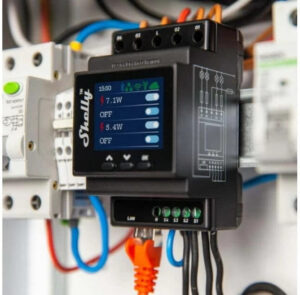
Shelly Pro 4PM

Shelly Pro 4PM. Photo: Stratlec

An example of a Smart Shelly Device is the Shelly Pro 4PM which has 4 channels with Power Monitoring. in addition you can see exactly how many Watts each of the four circuits is using; The Shelly 4 PM supports up to 16A per channel, with a total device limit of 40A and includes professional-grade protection against overpower, overvoltage, and overtemperature.

All the Shelly devices are capable of being live monitored and adjusted on your mobile device WITHOUT a cloud subscription of any kind.

Stratlec also has a range of Shelly Accessories to make installation simpler and faster.

Links:

Boilerplate and Editor’s Notes.
More Info on Who Actually Saves When Smart Meters are Installed? here:
X: https://twitter.com/MyPE
LinkedIn: https://www.linkedin.com/company/stratlec/
Facebook: https://www.facebook.com/StratonElectrical/

CLICK HERE to submit your press release to MyPR.co.za.

Track Your Press Release HERE:

Check Online Visibility

Verify where this release is currently indexed:

Pages: Page 1 Page 2

First Published here: MyPR.co.za

Did You Know?

  • Cradock was founded in 1813 on the banks of the Great Fish River to cater for the migratory farmers who settled in this ruggedly beautiful area with its excellent grazing, abundant water and healthy climate.
  • Cradock was officially renamed Nxuba on 26 August 2022. This change was officially gazetted by the Minister of Sport, Arts and Culture, Nathi Mthethwa, and it was part of a broader effort to rename towns with colonial or apartheid legacies in the Eastern Cape.
  • Home to an actual Harry Potter’s grave: A British soldier with the name Harry Potter, who died during the South African War (Anglo-Boer War), is buried in the Cradock cemetery. His grave was discovered in 2002, long before the fictional character became a global phenomenon.
  • Location of the last surrender of arms in the South African War: Cradock was the final place in South Africa where arms were officially laid down at the end of the South African War, with the event occurring four days after the Peace of Vereeniging was signed in 1902.
  • Birthplace of Afrikaans publication: The first-ever article published in the Afrikaans language appeared in the local newspaper, the Cradock News, on December 4, 1868. This was a report on the separation of the Eastern Cape from the Western Cape, and the paper achieved the largest circulation in the country at the time.
  • Second oldest cricket ground and library in South Africa: Cradock’s cricket ground and library are both the second oldest in the entire country, a testament to the town’s early establishment and development of civic amenities.
  • Host to a total solar eclipse viewing by a Prime Minister: In 1942, the South African statesman and Prime Minister Jan Smuts came specifically to Cradock to witness a total eclipse of the sun, as the town was the best location for viewing the celestial event.
Category: Cradock, NewsTag: MyPR, SA News
13 August 2026 by Alan

Let’s Chat About Special Needs Children (And My Special School Friend)

As a second time around parent to two Special Needs boys – one with mild Autism and one with ADHD deluxe I had a very rude (and earth shattering) awakening to this genre of education. My first two children excelled at traditional schools and went on to honours, masters and jobs that set them up …

As a second time around parent to two Special Needs boys – one with mild Autism and one with ADHD deluxe I had a very rude (and earth shattering) awakening to this genre of education.

My first two children excelled at traditional schools and went on to honours, masters and jobs that set them up for life.

My second time around sons have enabled me to find the depths of patience that I never knew existed. Admittedly they turned my life around – the first major change was getting used to being woken up at 4:00 am day after day, week after week, month after month and year after year. Thankfully that has eased off dramatically and sleep deprivation is slowly being cancelled.

Parents with Special Needs children have major added expenses in their lives – therapy, counselling, special schooling, medications that all result in tens of thousands or rands more per month than a comparable child in a traditional school.

Try R9000 a month per child for schooling that offers one teacher per less than 10 children or over a thousand rand a month for chronic medication that NO private medical aid or government dispensary will cover and you start to see why special needs parents are ‘heads down’ and focused on surviving and creating an environment for their children that will allow them to thrive and join society in a positive manner when they leave school.

The Saints of Elsen:

My school mate, Mark Barclay, is the Headmaster at Elsen Academy and, as I say to him every time we chat; “Mark you are a saint with patience exceeding that of Job!” Imagine a few hundred special needs children under your care and you will understand why Mark and his dedicated staff are candidates for sainthood.

Sainthood is probably an apt term as the Elsen Academy is presently housed in one of Ken Denton’s buildings – the old Holy Rosary Convent, slap bang in the Central area.

Now, Central has lost it’s charm and feeling of safety as the drug dealers and prostitutes roam Bird Street – not something that one wants impressionable children to be exposed to!

In addition there are no grassy fields for the children to play sport on – all they have for football games is an old tennis court with artificial turf thereon.

We all know that Ken marches to the slow beat of his own drum so the school is in a constant state of construction – it has been so since John and Nicholas started there 8 or so years ago. Once again not so wonderful for young children. Let me hasten to add, though, that the work that has been completed is excellent.

Headboy:

I have another friend from the Old Grey Class of ’81 – Michael Jarvis (we know him as Headboy). Now Michael also had a child at Elsen Academy. He recently asked the Class of ’81 if they could assist Elsen Academy with a dream that they have, saying; “You all know the extraordinary work that Mark Barclay has been doing with Elsen in Bird Street. My own son went there from junior school and this year successfully completed his Masters in the UK — a living example of what Mark’s vision, the school’s model and the dedication of his team can achieve.”

Headboy was the Chair of the Elsen Board for many years, and one of the boards great ambitions has always been to create a secure campus — a true home and the heart of the Alma Mater that means so much to all.

As Headboy says; “Despite our best efforts, during my time as Chairman we never quite managed to make that happen. Now, incredibly, the opportunity has presented itself.”

The Bottom Line – Act Fast:

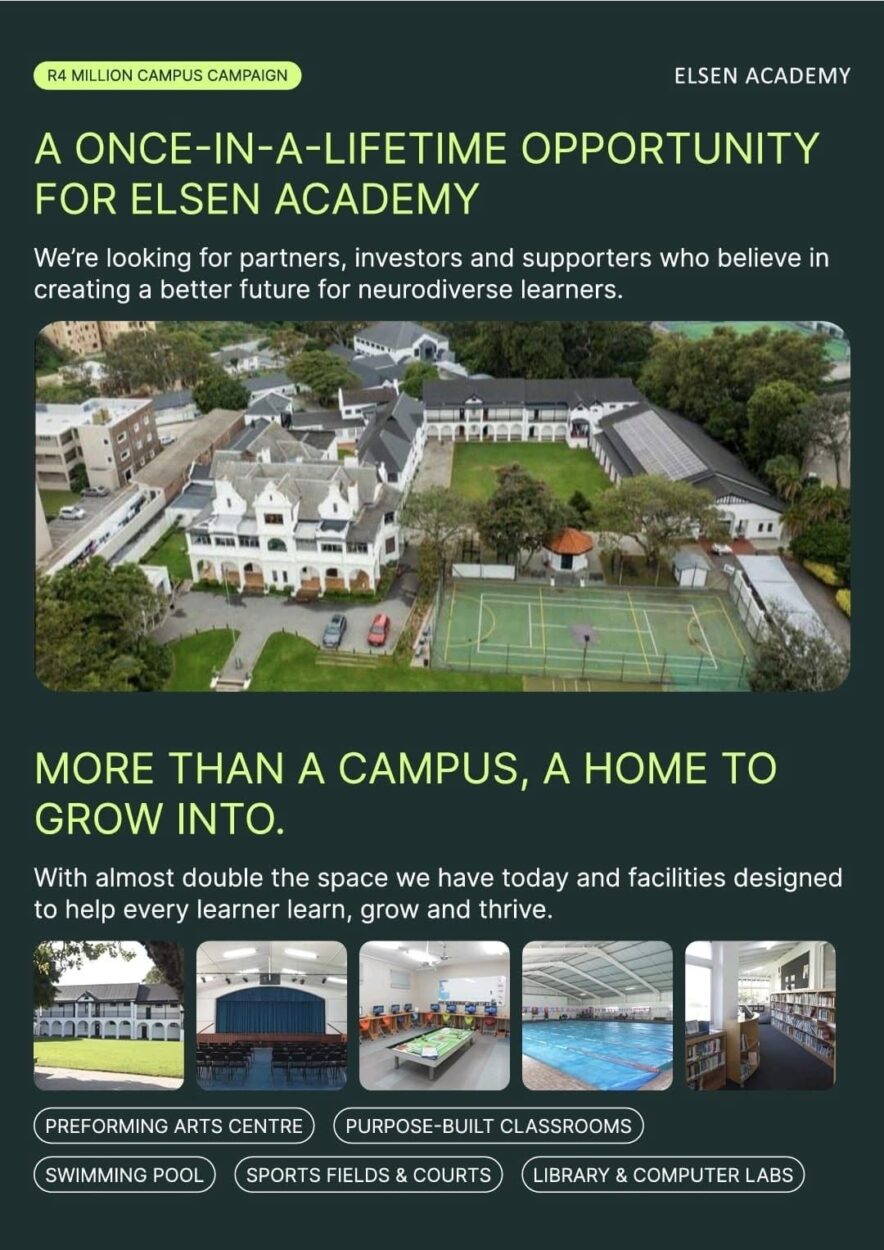
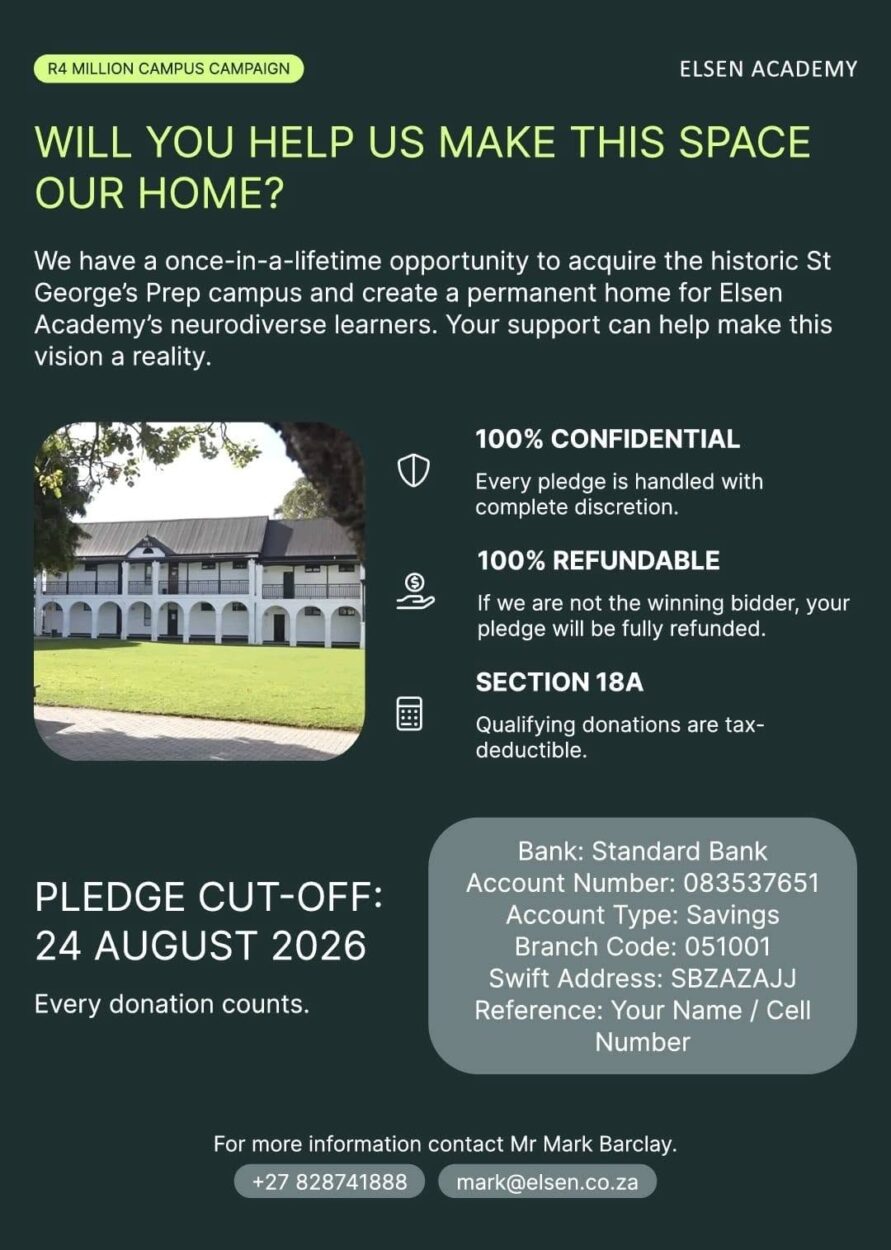
Curro has closed the St. Georges Primary School in Park Drive and put the campus on the market. Elsen Academy made an offer before the auction date but were turned down. Now they estimate that they would have to up their offer by around R4 Million in order to secure the St. Georges Campus for the Elsen Academy and have embarked on a public appeal to the Elsen Community and the South African Public at large to assist with pledges by 24 August 2026 to reach that goal.

Insiders tell me that with the estimated purchase price the school will be paying less per month on a bond than what they pay for rental at present – so keen minds have been applied to make sure that the move is for all the right reasons that include financial!

The chance to acquire the St George’s School campus is not simply a property opportunity. It could be the defining moment in Elsen’s history — creating the secure, permanent campus these children need and giving this very special institution the platform to thrive for generations.

Imagine, if you will, just how much a school with a pool and grass will inspire these children to greater heights.

If you can assist please contact Mark directly on 082 874 1888 or mark@elsen.co.za

Do You Know Jannie Mouton?

Curro Holdings is owned by the Jannie Mouton Foundation, a philanthropic non-profit trust. The foundation acquired the private school network in a R7.2 billion deal that delisted Curro from the Johannesburg Stock Exchange (JSE) and transitioned it into a public benefit organization.

So, if you know Mr Mouton well enough to pick up the phone and have a chat I, for one, would be forever grateful if you could appeal to his kind heart and ask if he is willing to make a private deal with Elsen – no charity, just a deal that will ensure that Gqeberha’s beloved historical St Georges Park Campus will be preserved for generations to come and not fall prey to a developer who will rob future generations of this magnificent building.

The elegant Victorian mansion ‘Knockfierna’ in Park Drive is entirely suitable for Elsen Academy. It ushered in the 20th century as the home of a wealthy wool merchant and farmer, John Daverin. Daverin was also a Member of Parliament and philanthropist (like Jannie Mouton). Now largely forgotten, his legacy endured in the form of the St Georges Preparatory School, let’s continue the properties long standing use as a school and make Elsen Academy’s dream come true.

Images:


Video:

https://www.youtube.com/channel/UCGRtp5-7dZ86DU-pmAiEvqg/

Let’s Chat About Special Needs Children (And my Special School Friend)

Links:

Boilerplate and Editor’s Notes.
More Info on Let’s Chat About Special Needs Children (And my Special School Friend) here:

Facebook: https://www.facebook.com/Elsen.Academy

CLICK HERE to submit your press release to MyPR.co.za.

First Published here: MyPR.co.za

Did You Know?

  • Cradock was founded in 1813 on the banks of the Great Fish River to cater for the migratory farmers who settled in this ruggedly beautiful area with its excellent grazing, abundant water and healthy climate.
  • Cradock was officially renamed Nxuba on 26 August 2022. This change was officially gazetted by the Minister of Sport, Arts and Culture, Nathi Mthethwa, and it was part of a broader effort to rename towns with colonial or apartheid legacies in the Eastern Cape.
  • Home to an actual Harry Potter’s grave: A British soldier with the name Harry Potter, who died during the South African War (Anglo-Boer War), is buried in the Cradock cemetery. His grave was discovered in 2002, long before the fictional character became a global phenomenon.
  • Location of the last surrender of arms in the South African War: Cradock was the final place in South Africa where arms were officially laid down at the end of the South African War, with the event occurring four days after the Peace of Vereeniging was signed in 1902.
  • Birthplace of Afrikaans publication: The first-ever article published in the Afrikaans language appeared in the local newspaper, the Cradock News, on December 4, 1868. This was a report on the separation of the Eastern Cape from the Western Cape, and the paper achieved the largest circulation in the country at the time.
  • Second oldest cricket ground and library in South Africa: Cradock’s cricket ground and library are both the second oldest in the entire country, a testament to the town’s early establishment and development of civic amenities.
  • Host to a total solar eclipse viewing by a Prime Minister: In 1942, the South African statesman and Prime Minister Jan Smuts came specifically to Cradock to witness a total eclipse of the sun, as the town was the best location for viewing the celestial event.
Category: Cradock, NewsTag: MyPR, SA News
12 August 2026 by Alan

Nelson Mandela Bay Dance Festival 2026

Cultural Crossroads: Dance, Heritage and Community Unite at NMBDF Nelson Mandela Bay Dance Festival’s official media photo shoot was held at one of Gqeberha’s iconic historical landmarks – the Nelson Mandela Main Library. It provides a fitting backdrop for an event that celebrates artistic excellence and cultural expression. The heritage architecture and public spaces reflect …

Cultural Crossroads: Dance, Heritage and Community Unite at NMBDF

Nelson Mandela Bay Dance Festival’s official media photo shoot was held at one of Gqeberha’s iconic historical landmarks – the Nelson Mandela Main Library. It provides a fitting backdrop for an event that celebrates artistic excellence and cultural expression. The heritage architecture and public spaces reflect the rich history of the city and its longstanding commitment to the arts.

By showcasing young dancers against this historic setting, the festival highlights the powerful relationship between dance, culture and community heritage. The imagery captures not only the grace and discipline of the performers but also the importance of preserving and celebrating the cultural spaces that continue to inspire creativity across generations.

Nici Lovemore, Chairlady of NMBDF and daughter of one of the founding members of the festival, the late Hermione Ballinger, said that she thought long and hard about assuming the mantle and even sought counsel from a few leaders in the dance world in SA. “When I take something on, I like to do it very intentionally and professionally. My vision for NMBDF is a platform for growth to enable our dancers to stand tall anywhere in the world – a slick, professionally run festival. This, in alignment with beautiful landmarks of our city and in collaboration with other arts facilities. Not only has my Mom’s legacy been protected and elevated, but I believe that this honestly altruistic service adds value to dance in our city, and the image of our city and its community as a whole,” said Lovemore.

Graham Taylor, a representative from the Main Library Friends, said it was a privilege to host the photo shoot at the Main Public Library. “The library provided the perfect photographic setting for the long running dance festival which is a credit to all in the city. As the festival date approaches, we look forward to the release of the spectacular images of the dance festival artists in the library, a timely reminder of the centrality of arts, literature and the library in the city. This centrality further emphasizes the need to reopen the library to the public by completing the renovations that have been outstanding since 2014, despite the availability of budget to complete the renovations. We urge the municipality to stop diverting library budgets and complete the renovations according to the needs of citizens as voiced over more than a decade,” Taylor added.

As dancers from across the region gather at the Savoy Theatre from 24 to 29 August, the festival serves as a reminder that the performing arts are an essential part of Nelson Mandela Bay’s cultural identity, connecting the city’s history with its future through creativity, education and community participation.

NMBDF remains one of the region’s premier performing arts events, bringing together aspiring dancers, respected teachers, families and audiences in a celebration of talent, dedication and the transformative power of the arts.

Images:

SA Dance Academy Photo: Dirk Moggee


NMBDF session times


Dancers Love Dogs

CLICK HERE to submit your press release to MyPR.co.za.

Links:

Boilerplate and Editor’s Notes:

More Info on Nelson Mandela Bay Dance Festival 2026 here: https://www.facebook.com/nelsonmandelabaydancefestival
Facebook: https://www.facebook.com/nelsonmandelabaydancefestival

First Published here: MyPR.co.za

Did You Know?

  • Cradock was founded in 1813 on the banks of the Great Fish River to cater for the migratory farmers who settled in this ruggedly beautiful area with its excellent grazing, abundant water and healthy climate.
  • Cradock was officially renamed Nxuba on 26 August 2022. This change was officially gazetted by the Minister of Sport, Arts and Culture, Nathi Mthethwa, and it was part of a broader effort to rename towns with colonial or apartheid legacies in the Eastern Cape.
  • Home to an actual Harry Potter’s grave: A British soldier with the name Harry Potter, who died during the South African War (Anglo-Boer War), is buried in the Cradock cemetery. His grave was discovered in 2002, long before the fictional character became a global phenomenon.
  • Location of the last surrender of arms in the South African War: Cradock was the final place in South Africa where arms were officially laid down at the end of the South African War, with the event occurring four days after the Peace of Vereeniging was signed in 1902.
  • Birthplace of Afrikaans publication: The first-ever article published in the Afrikaans language appeared in the local newspaper, the Cradock News, on December 4, 1868. This was a report on the separation of the Eastern Cape from the Western Cape, and the paper achieved the largest circulation in the country at the time.
  • Second oldest cricket ground and library in South Africa: Cradock’s cricket ground and library are both the second oldest in the entire country, a testament to the town’s early establishment and development of civic amenities.
  • Host to a total solar eclipse viewing by a Prime Minister: In 1942, the South African statesman and Prime Minister Jan Smuts came specifically to Cradock to witness a total eclipse of the sun, as the town was the best location for viewing the celestial event.
Category: Cradock, NewsTag: MyPR, SA News
17 June 2026 by Alan

MyPR Expands Regional Reach for Tourism Promoters with Exclusive Gqeberha Showcase on MyGQ.co.za

GQEBERHA, Eastern Cape – MyPR, a leading South African press release distribution platform, is pleased to announce a strategic partnership with MyGQ.co.za, a dedicated digital hub for the city of Gqeberha. Effective immediately, tourism-focused press releases submitted to MyPR can now be automatically showcased in a specialized Tourism Hub on MyGQ.co.za. Travel Category: This new …

GQEBERHA, Eastern Cape – MyPR, a leading South African press release distribution platform, is pleased to announce a strategic partnership with MyGQ.co.za, a dedicated digital hub for the city of Gqeberha. Effective immediately, tourism-focused press releases submitted to MyPR can now be automatically showcased in a specialized Tourism Hub on MyGQ.co.za.

Travel Category:

This new integration provides an invaluable and targeted visibility boost for the Eastern Cape’s vibrant tourism sector. To access this feature, tourism promoters, DMOs, accommodation providers, tour operators, and related businesses simply need to submit their releases through MyPR and select the “TRAVEL” category.

When the Travel category is selected, the release is queued for showcase on the MyGQ.co.za Tourism Hub. The showcase will display a designated snippet of the release to capture interest, while crucially preserving all active hyperlinks that lead directly back to the full press release hosted on MyPR. This ensures maximum traffic and SEO benefit for the originator.

“Gqeberha and the Eastern Cape have an incredible story to tell, and this partnership with MyGQ.co.za is a significant step forward in helping local tourism businesses tell it,” said Alan Straton at MyPR. “By simplifying the process to just ‘Submit and Select,’ we are providing a friction-free amplification channel that gets high-quality, relevant tourism news in front of a dedicated regional and national audience.”

This Gqeberha showcase on MyGQ.co.za is a premium addition to MyPR’s existing robust distribution network. All releases, regardless of category, will continue to be published on the primary MyPR platform and MyZA, as part of the Free Plan. Submissions under the Paid Plan retain their established access to a diverse array of various city-focused publications.

The partnership reinforces MyPR’s commitment to providing targeted, localized visibility solutions alongside broad national reach, empowering South African businesses of all sizes to control their narrative and connect with their audience.

About MyPR:

MyPR is a comprehensive press release distribution service in South Africa, offering a straightforward platform for businesses and PR professionals to publish and amplify their news across the digital landscape.

About MyGQ.co.za:

MyGQ.co.za is a focused digital publication and community resource serving the vibrant city of Gqeberha, covering news, lifestyle, and tourism.

Images:

Select the TRAVEL Category on MyPR to be Showcased on the MyGQ Tourismn Hub. Photo: MyPR/Gemini

Links:

Boilerplate and Editor’s Notes.
More Info on MyPR Expands Regional Reach for Tourism Promoters with Exclusive Gqeberha Showcase on MyGQ.co.za here:
X: https://twitter.com/MyPE
Facebook: https://www.facebook.com/StratonElectrical/

CLICK HERE to submit your press release to MyPR.co.za.

First Published here: MyPR.co.za

Did You Know?

  • Cradock was founded in 1813 on the banks of the Great Fish River to cater for the migratory farmers who settled in this ruggedly beautiful area with its excellent grazing, abundant water and healthy climate.
  • Cradock was officially renamed Nxuba on 26 August 2022. This change was officially gazetted by the Minister of Sport, Arts and Culture, Nathi Mthethwa, and it was part of a broader effort to rename towns with colonial or apartheid legacies in the Eastern Cape.
  • Home to an actual Harry Potter’s grave: A British soldier with the name Harry Potter, who died during the South African War (Anglo-Boer War), is buried in the Cradock cemetery. His grave was discovered in 2002, long before the fictional character became a global phenomenon.
  • Location of the last surrender of arms in the South African War: Cradock was the final place in South Africa where arms were officially laid down at the end of the South African War, with the event occurring four days after the Peace of Vereeniging was signed in 1902.
  • Birthplace of Afrikaans publication: The first-ever article published in the Afrikaans language appeared in the local newspaper, the Cradock News, on December 4, 1868. This was a report on the separation of the Eastern Cape from the Western Cape, and the paper achieved the largest circulation in the country at the time.
  • Second oldest cricket ground and library in South Africa: Cradock’s cricket ground and library are both the second oldest in the entire country, a testament to the town’s early establishment and development of civic amenities.
  • Host to a total solar eclipse viewing by a Prime Minister: In 1942, the South African statesman and Prime Minister Jan Smuts came specifically to Cradock to witness a total eclipse of the sun, as the town was the best location for viewing the celestial event.
Category: Cradock, NewsTag: MyPR, SA News
25 April 2026 by Guest

Collapsing Asbestos Classrooms Force Cradock School Closure

School governing body chairperson Lionel Stevens says that Carinus Primary in Cradock, Eastern Cape, was built 60 years ago using asbestos. Now the ceilings are collapsing. Parents at Carinus Primary School in Cradock, Eastern Cape, say the education department put their children at risk by failing to address damaged asbestos in the classrooms. This week …

School governing body chairperson Lionel Stevens says that Carinus Primary in Cradock, Eastern Cape, was built 60 years ago using asbestos. Now the ceilings are collapsing.

Parents at Carinus Primary School in Cradock, Eastern Cape, say the education department put their children at risk by failing to address damaged asbestos in the classrooms.

This week the department promised to fast-track renovations, but parents are sceptical.

Ceilings have collapsed while learners were inside classrooms, exposing them to dilapidated asbestos roofs.

Parents closed the school in protest, but allowed the school feeding scheme to continue.

After meetings with officials, Principal Neville Fleurs says teaching will resume on Tuesday. Until they get new classrooms, the 1,045 learners in grades R to 7 will rotate through 11 classrooms.

“I hope this time the government will heed our calls,” said school governing body chairperson Lionel Stevens.

He said the school was built 60 years ago using asbestos. “Asbestos was banned by the government due to its health risks. This school needs about R1-million to reconstruct it. We only have an annual budget of R38,000.”

Stevens said learners have narrowly avoided injury. In 2012, a roof collapsed. Officials came to assess the safety of the buildings, but nothing further was done.

On 18 March 2026, a ceiling collapsed in what used to be the grade 1 class.

Despite regular cleaning and disinfectants, Stevens says a heavy stench of urine and excrement from learners’ toilets permeates from rotting chipboard walls.

A parent, who asked not to be named, said there had been “discussion for several years with government officials, but they keep lying to us”.

The parent said, “This is one of the reasons small towns have poor pass rates and high crime rates because children don’t get quality education.”

Democratic Alliance shadow MEC for education Horatio Hendricks said, “These [school] closures mean uncertainty, lost teaching time, and growing anxiety about safety. Children are being denied their constitutional right while teachers are placed in untenable conditions.”

Department spokesperson Mali Mtima confirmed that an inspection was done by an infrastructure team.

“They are facilitating replacement of the asbestos issues. Some roofs are cracked. They made a request for an accelerated procurement for the roofs. Additionally, the district had a meeting with stakeholders, including the mayor, to discuss a way forward. We are awaiting recommendations for the next move,” said Mtima.

© 2026 GroundUp. This article is published under the GroundUp Republication Licence Version 1.0. Email [email protected] to request permission to republish.

The #JusticeForRefugees movement advocates for the rights and protection of refugees and asylum seekers.

Read More at the Source

First Published here: MyZA.co.za

Did You Know?

  • Cradock was founded in 1813 on the banks of the Great Fish River to cater for the migratory farmers who settled in this ruggedly beautiful area with its excellent grazing, abundant water and healthy climate.
  • Cradock was officially renamed Nxuba on 26 August 2022. This change was officially gazetted by the Minister of Sport, Arts and Culture, Nathi Mthethwa, and it was part of a broader effort to rename towns with colonial or apartheid legacies in the Eastern Cape.
  • Home to an actual Harry Potter’s grave: A British soldier with the name Harry Potter, who died during the South African War (Anglo-Boer War), is buried in the Cradock cemetery. His grave was discovered in 2002, long before the fictional character became a global phenomenon.
  • Location of the last surrender of arms in the South African War: Cradock was the final place in South Africa where arms were officially laid down at the end of the South African War, with the event occurring four days after the Peace of Vereeniging was signed in 1902.
  • Birthplace of Afrikaans publication: The first-ever article published in the Afrikaans language appeared in the local newspaper, the Cradock News, on December 4, 1868. This was a report on the separation of the Eastern Cape from the Western Cape, and the paper achieved the largest circulation in the country at the time.
  • Second oldest cricket ground and library in South Africa: Cradock’s cricket ground and library are both the second oldest in the entire country, a testament to the town’s early establishment and development of civic amenities.
  • Host to a total solar eclipse viewing by a Prime Minister: In 1942, the South African statesman and Prime Minister Jan Smuts came specifically to Cradock to witness a total eclipse of the sun, as the town was the best location for viewing the celestial event.
Category: Cradock, NewsTag: MyZA, ‘Cradock
14 April 2026 by Alan

Looking For Targeted South African Content?

I have been there – the constant grind looking for relevant South African content for an online publication can be frustrating, time consuming and expensive. MyPR offers a neat solution. The bottom line: Subscribe to the MyPR.co.za newsletter or use MyPR’s targeted RSS feeds for automatic delivery. The long story: In 2010 we established MyPR …

I have been there – the constant grind looking for relevant South African content for an online publication can be frustrating, time consuming and expensive.

MyPR offers a neat solution.

The bottom line:

Subscribe to the MyPR.co.za newsletter or use MyPR’s targeted RSS feeds for automatic delivery.

The long story:

In 2010 we established MyPR for mainly selfish reasons – we needed content for a number of local news sites and brain stormed that conundrum until we came upon a win-win-win-bonus win solution for all.

The concept remains simple to this day:

Win 1:

MyPR offers the opportunity for Public Relations Professionals to self submit press releases to MyPR. We get to publish and distribute those releases to our city specific titles.

Win 2:

The PR Professional gets a press release published and distributed, along with a proof of body of work for existing and potential clients.

Win 3:

Republication by any other content hungry media house is open and free – no permissions required and a handy and free REPUBLISH THIS facility (properly HTML formatted) is displayed alongside every release accessed from our newsletter.

Bonus Win:

MyPR gets to make a few rands when PR Professionals up their game and sign up for our Featured Release service. Whilst PR Professionals get maximum exposure from more publications.

Don’t forget that if you, as a PR Professional, are using media monitoring then your efforts are immediately multiplied 7-Fold with every release submitted to MyPR as a Featured Release.

And that, if you are charging clients per mention, is a HUGE bonus win for you.

First Published here: MyPR.co.za

Did You Know?

  • Cradock was founded in 1813 on the banks of the Great Fish River to cater for the migratory farmers who settled in this ruggedly beautiful area with its excellent grazing, abundant water and healthy climate.
  • Cradock was officially renamed Nxuba on 26 August 2022. This change was officially gazetted by the Minister of Sport, Arts and Culture, Nathi Mthethwa, and it was part of a broader effort to rename towns with colonial or apartheid legacies in the Eastern Cape.
  • Home to an actual Harry Potter’s grave: A British soldier with the name Harry Potter, who died during the South African War (Anglo-Boer War), is buried in the Cradock cemetery. His grave was discovered in 2002, long before the fictional character became a global phenomenon.
  • Location of the last surrender of arms in the South African War: Cradock was the final place in South Africa where arms were officially laid down at the end of the South African War, with the event occurring four days after the Peace of Vereeniging was signed in 1902.
  • Birthplace of Afrikaans publication: The first-ever article published in the Afrikaans language appeared in the local newspaper, the Cradock News, on December 4, 1868. This was a report on the separation of the Eastern Cape from the Western Cape, and the paper achieved the largest circulation in the country at the time.
  • Second oldest cricket ground and library in South Africa: Cradock’s cricket ground and library are both the second oldest in the entire country, a testament to the town’s early establishment and development of civic amenities.
  • Host to a total solar eclipse viewing by a Prime Minister: In 1942, the South African statesman and Prime Minister Jan Smuts came specifically to Cradock to witness a total eclipse of the sun, as the town was the best location for viewing the celestial event.
Category: Cradock, NewsTag: MyPR, SA News
9 April 2026 by Alan

The One Item You Buy Daily Carrying a 250% Markup

After having a look at What it Costs Eskom to Produce and Deliver Electricity we had a look at what average markups are being applied to a number of other consumer goods – the results will further depress or delight you… For comparison we used the Nelson Mandela Bay’s highest (current) Inclined Block Tariff charge …

After having a look at What it Costs Eskom to Produce and Deliver Electricity we had a look at what average markups are being applied to a number of other consumer goods – the results will further depress or delight you…

For comparison we used the Nelson Mandela Bay’s highest (current) Inclined Block Tariff charge of R4.57 per kWh.

The jump from Eskom’s R1.30 generation cost to a consumer price of R4.57 represents a 250% markup.

To answer the burning question: No, this is not in line with standard consumer product markups.

In the retail world, a 250% markup (or a 71% gross margin) is typically reserved for luxury goods, designer fashion, or software-as-a-service (SaaS).

For an “essential utility,” this gap is extraordinarily high, but it is unique because of the Distribution and Debt Burden specific to South Africa’s energy landscape.

Markup Comparison: Electricity vs. Consumer Goods

Industry / Product Typical Markup % Comparison to Electricity
FMCG (Grocery/Food) 8% – 15% Electricity is 16x higher.
Consumer Electronics 15% – 30% Electricity is 8x higher.
Clothing & Apparel 40% – 100% Electricity is 2.5x higher.
Diamonds / Jewelry 100% – 200% Electricity is roughly equal to luxury jewelry.
NMB Electricity (R1.30 to R4.57) 250% Highest “Essential” Markup in SA.

Why is the Electricity Markup so aggressive?

In a standard business (like a clothing store), the markup covers rent, staff, and profit. In the case of an NMB household, that R3.27 “gap” (R4.57 – R1.30) is consumed by three “Hidden Taxes”:

The Municipal Middleman (The “NMB Surcharge”)

Municipalities use electricity sales to cross-subsidize other services (like fixing potholes or clearing refuse). In Gqeberha, the municipality buys bulk from Eskom at a lower rate but adds a significant margin to fund the city’s general operations.

Retail Example: Imagine if your local Spar was forced by the government to charge R100 for a loaf of bread just so the local council could afford to fix the streetlights.

Technical & Non-Technical Losses (The “Leakage”)

Unlike a retail store that might lose 1–2% of stock to “shrinkage” (theft), South African electricity grids suffer from 15% to 30% losses due to illegal connections and aging infrastructure.

Retail Example: For every 10 pairs of jeans a store buys, they only manage to sell 7 because 3 are stolen. To break even, they have to hike the price of the remaining 7.

The Eskom Debt Tranche

A significant portion of the retail price isn’t paying for the coal or the wind; it’s paying the interest on the R400 billion+ debt Eskom incurred building Medupi and Kusile.

Retail Example: This is like a bakery charging extra for every croissant not because flour is expensive, but because they took out a massive loan 10 years ago to buy an oven that still isn’t working at 100%.

Shelly Pro 1PM

The “Measure to Manage” Perspective

The “250% Markup” highlights that the consumer isn’t just paying for power; they are paying for inefficiency.

A Bulletproof Argument:

“If you can’t control the 250% markup the city charges, you MUST control the number of units you use. Every kWh you save isn’t just saving R1.30 of power; it’s saving R4.57 of your hard-earned money.” The Shelly Wave Pro 1 will help you Measure and Manage your consumption.

First Published here: MyPR.co.za

Did You Know?

  • Cradock was founded in 1813 on the banks of the Great Fish River to cater for the migratory farmers who settled in this ruggedly beautiful area with its excellent grazing, abundant water and healthy climate.
  • Cradock was officially renamed Nxuba on 26 August 2022. This change was officially gazetted by the Minister of Sport, Arts and Culture, Nathi Mthethwa, and it was part of a broader effort to rename towns with colonial or apartheid legacies in the Eastern Cape.
  • Home to an actual Harry Potter’s grave: A British soldier with the name Harry Potter, who died during the South African War (Anglo-Boer War), is buried in the Cradock cemetery. His grave was discovered in 2002, long before the fictional character became a global phenomenon.
  • Location of the last surrender of arms in the South African War: Cradock was the final place in South Africa where arms were officially laid down at the end of the South African War, with the event occurring four days after the Peace of Vereeniging was signed in 1902.
  • Birthplace of Afrikaans publication: The first-ever article published in the Afrikaans language appeared in the local newspaper, the Cradock News, on December 4, 1868. This was a report on the separation of the Eastern Cape from the Western Cape, and the paper achieved the largest circulation in the country at the time.
  • Second oldest cricket ground and library in South Africa: Cradock’s cricket ground and library are both the second oldest in the entire country, a testament to the town’s early establishment and development of civic amenities.
  • Host to a total solar eclipse viewing by a Prime Minister: In 1942, the South African statesman and Prime Minister Jan Smuts came specifically to Cradock to witness a total eclipse of the sun, as the town was the best location for viewing the celestial event.
Category: Cradock, NewsTag: MyPR, SA News
2 April 2026 by Alan

Part One: The Great Transition: Why Electric Vehicles?

In this 6 part series we will explore why Gqeberha is at the heart of the EV revolution and how moving to an electric vehicle is about more than just the environment. The Future is Electric (and it’s being built in Gqeberha). The conversation around Electric Vehicles (EVs) has shifted. It is no longer a …

In this 6 part series we will explore why Gqeberha is at the heart of the EV revolution and how moving to an electric vehicle is about more than just the environment.

The Future is Electric (and it’s being built in Gqeberha).

The conversation around Electric Vehicles (EVs) has shifted. It is no longer a “someday” technology for early adopters; it is a “right now” solution for a world facing a perfect storm of energy costs.

In the Eastern Cape, this transition is personal. With local automotive giants pivoting toward EV and Hybrid production, the vehicles of tomorrow are being built in our own backyard.

But why should you make the switch?

Mechanical Simplicity: A standard petrol engine has about 2,000 moving parts. An EV has around 20. This translates to fewer failures and less time in the workshop.

Energy Independence: You can’t refine petrol in your garden, but you can harvest sunlight. An EV paired with solar is the ultimate “off-grid” transport solution.

Performance: The instant torque of an electric motor provides a silent, powerful driving experience that traditional engines simply cannot match.

Reduced Complexity: A standard ICE vehicle has about 2,000 moving parts; an EV has around 20. This leads to drastically lower mechanical failure rates.

The Silent Drive: Beyond zero emissions, the reduction in noise pollution creates a more premium, stress-free driving experience for commuters in the Bay.

Internal Combustion Engine (ICE) vehicles are incredibly inefficient. Only about 30% of the energy in a litre of petrol actually moves the wheels; the other 70% is wasted as heat through the radiator and exhaust.

The “Perfect Storm” of 2026 is here. As fuel prices reach record highs, the question isn’t “Why EV?” but rather “How soon?”

The Solar Multiplier (Straton Solar’s Secret Sauce):

The ultimate “hidden” saving is the ability to de-link your transport costs from the global oil market entirely.

The Saving: You cannot refine your own petrol in your backyard BUT You can harvest your own electricity.

The EV Charger Reality: For homeowners with a Straton Solar and EV Charger installations, an EV becomes a “rolling battery.” By charging during peak sunlight hours, your 5-year “fuel” cost can drop from R250,000 (average for a high-mileage ICE) to essentially zero.

Add Shelly Automation products from Stratlec and you will be able to measure and manage all your electricity consumers and generators without the monthly costs of an app/cloud/hub to function.

EV Charger Articles:

  1. Part One: The Great Transition: Why Electric Vehicles?
  2. Part Two: The 5-Year Horizon: Are EVs Really More Economical?
  3. Part Three: Pro Charger vs. “Granny Cable”: Why Go Dedicated?
  4. Part Four: Fuel Rand vs. EV Rand: The 100km Running Cost Breakdown
  5. Part Five: The Tipping Point—Verifiable Data on the Shift to EV
  6. Part Six: Why Choose Straton Electrical for Your EV Charger Supply and Installation?
Illustrative image of how an EV Charger and Solar ecosystem works

First Published here: MyPR.co.za

Did You Know?

  • Cradock was founded in 1813 on the banks of the Great Fish River to cater for the migratory farmers who settled in this ruggedly beautiful area with its excellent grazing, abundant water and healthy climate.
  • Cradock was officially renamed Nxuba on 26 August 2022. This change was officially gazetted by the Minister of Sport, Arts and Culture, Nathi Mthethwa, and it was part of a broader effort to rename towns with colonial or apartheid legacies in the Eastern Cape.
  • Home to an actual Harry Potter’s grave: A British soldier with the name Harry Potter, who died during the South African War (Anglo-Boer War), is buried in the Cradock cemetery. His grave was discovered in 2002, long before the fictional character became a global phenomenon.
  • Location of the last surrender of arms in the South African War: Cradock was the final place in South Africa where arms were officially laid down at the end of the South African War, with the event occurring four days after the Peace of Vereeniging was signed in 1902.
  • Birthplace of Afrikaans publication: The first-ever article published in the Afrikaans language appeared in the local newspaper, the Cradock News, on December 4, 1868. This was a report on the separation of the Eastern Cape from the Western Cape, and the paper achieved the largest circulation in the country at the time.
  • Second oldest cricket ground and library in South Africa: Cradock’s cricket ground and library are both the second oldest in the entire country, a testament to the town’s early establishment and development of civic amenities.
  • Host to a total solar eclipse viewing by a Prime Minister: In 1942, the South African statesman and Prime Minister Jan Smuts came specifically to Cradock to witness a total eclipse of the sun, as the town was the best location for viewing the celestial event.
Category: Cradock, NewsTag: MyPR, SA News
1 April 2026 by Alan

Part Two: The 5-Year Horizon: Are EVs Really More Economical?

Join Straton Electrical as we look past the sticker price to the “Hidden Savings” that make EVs significantly cheaper over a 5-year ownership period. The Hidden Savings: The True Cost of Ownership When comparing an EV to a petrol car, most people only look at the purchase price. But the real story is told over …

Join Straton Electrical as we look past the sticker price to the “Hidden Savings” that make EVs significantly cheaper over a 5-year ownership period.

The Hidden Savings: The True Cost of Ownership

When comparing an EV to a petrol car, most people only look at the purchase price. But the real story is told over five years of ownership. While the “sticker shock” might be higher, the Total Cost of Ownership (TCO) tells a different story.

Where do the savings hide?

Zero Oil Changes: No spark plugs, no timing belts, and no exhaust systems to rust or replace.

Brake Longevity: Thanks to regenerative braking, EV brake pads can last up to 100,000 km because the motor does the heavy lifting of slowing the car down.

Efficiency: Petrol engines waste 70% of their energy as heat. EVs are 90% efficient, meaning almost every cent you spend on “fuel” actually moves the wheels.

Total Cost of Ownership

Maintenance Savings: Over 5 years, an EV requires no oil changes, spark plugs, timing belts, or exhaust system repairs. Brake pads also last longer due to regenerative braking.

Residual Value: As petrol becomes a “luxury” and global demand for ICE vehicles drops, the resale value of EVs is projected to hold steadier than traditional cars.

The Breakeven Point: Current 2026 data suggests that for a high-mileage driver, the higher upfront cost of an EV is recouped through fuel and maintenance savings within 3.5 to 4 years.

Over five years, a high-mileage driver in the Eastern Cape can expect to save upwards of R200,000 in operating expenses alone.

The Solar Multiplier (Straton Solar’s Secret Sauce):

The ultimate “hidden” saving is the ability to de-link your transport costs from the global oil market entirely.

The Saving: You cannot refine your own petrol in your backyard BUT You can harvest your own electricity.

The EV Charger Reality: For homeowners with a Straton Solar and EV Charger installations, an EV becomes a “rolling battery.” By charging during peak sunlight hours, your 5-year “fuel” cost can drop from R250,000 (average for a high-mileage ICE) to essentially zero.

Add Shelly Automation products from Stratlec and you will be able to measure and manage all your electricity consumers and generators without the monthly costs of an app/cloud/hub to function.

EV Charger Articles:

  1. Part One: The Great Transition: Why Electric Vehicles?
  2. Part Two: The 5-Year Horizon: Are EVs Really More Economical?
  3. Part Three: Pro Charger vs. “Granny Cable”: Why Go Dedicated?
  4. Part Four: Fuel Rand vs. EV Rand: The 100km Running Cost Breakdown
  5. Part Five: The Tipping Point—Verifiable Data on the Shift to EV
  6. Part Six: Why Choose Straton Electrical for Your EV Charger Supply and Installation?

First Published here: MyPR.co.za

Did You Know?

  • Cradock was founded in 1813 on the banks of the Great Fish River to cater for the migratory farmers who settled in this ruggedly beautiful area with its excellent grazing, abundant water and healthy climate.
  • Cradock was officially renamed Nxuba on 26 August 2022. This change was officially gazetted by the Minister of Sport, Arts and Culture, Nathi Mthethwa, and it was part of a broader effort to rename towns with colonial or apartheid legacies in the Eastern Cape.
  • Home to an actual Harry Potter’s grave: A British soldier with the name Harry Potter, who died during the South African War (Anglo-Boer War), is buried in the Cradock cemetery. His grave was discovered in 2002, long before the fictional character became a global phenomenon.
  • Location of the last surrender of arms in the South African War: Cradock was the final place in South Africa where arms were officially laid down at the end of the South African War, with the event occurring four days after the Peace of Vereeniging was signed in 1902.
  • Birthplace of Afrikaans publication: The first-ever article published in the Afrikaans language appeared in the local newspaper, the Cradock News, on December 4, 1868. This was a report on the separation of the Eastern Cape from the Western Cape, and the paper achieved the largest circulation in the country at the time.
  • Second oldest cricket ground and library in South Africa: Cradock’s cricket ground and library are both the second oldest in the entire country, a testament to the town’s early establishment and development of civic amenities.
  • Host to a total solar eclipse viewing by a Prime Minister: In 1942, the South African statesman and Prime Minister Jan Smuts came specifically to Cradock to witness a total eclipse of the sun, as the town was the best location for viewing the celestial event.
Category: Cradock, NewsTag: MyPR, SA News
31 March 2026 by Alan

Part Three: Pro EV Charger vs. “Granny Cable”: Why Go Dedicated?

Don’t settle for slow EV charging. Learn why a dedicated wallbox is safer, faster, and smarter for your home. Stop Filling Your Tank with a Garden Hose Most EVs come with a portable “granny cable.” While handy for emergencies, relying on it daily is like trying to fill a swimming pool with a garden hose. …

Don’t settle for slow EV charging. Learn why a dedicated wallbox is safer, faster, and smarter for your home.

Stop Filling Your Tank with a Garden Hose

Most EVs come with a portable “granny cable.” While handy for emergencies, relying on it daily is like trying to fill a swimming pool with a garden hose.

The Math of Speed

A standard 60kWh battery takes:

  • 26 Hours on a standard 3-pin plug (2.3kW).
  • ~8 Hours on a Straton-installed 7kW Wallbox.

Speed & Efficiency: A standard 2.3kW portable cable can take 20+ hours to charge a 60kWh battery. A 7kW or 22kW dedicated charger from Straton cuts that to a fraction of the time.

Safety First: Dedicated chargers are designed to handle high current for long durations. Using a standard 3-pin plug for years can lead to socket melt or wiring degradation in older homes.

Smart Energy Management: Modern chargers (like those Straton installs) can be integrated with your home’s solar and battery systems to ensure you are “charging with the sun,” essentially driving for free.

Why a Pro Installation Matters:

Safety: Standard sockets aren’t designed for 10+ hours of high-current draw. A dedicated circuit prevents melted wiring and fire risks.

Intelligence: Smart chargers can “talk” to your solar system, ensuring you charge only when the sun is shining.

Protection: Professional installs include surge protection to keep your R1-million investment safe from grid spikes.

By utilizing Smart Home automation (With Shelly gear), you can:

Load Shift: Ensure the car only charges when other heavy appliances are off to stay within lower tiers if possible.

Solar Integration: If you’re pushing solar into the mix, your “fuel” cost can drop to effectively R0.00.

Standard South African 3-pin domestic sockets are designed for intermittent loads (like a kettle or a vacuum cleaner). They are not built to handle a continuous high-current draw for 10 to 15 hours straight.

Sustained charging at 10A or higher can cause heat to accumulate in the socket and the internal wiring, potentially leading to melted plastic or electrical fires.

One of the biggest advantages of a dedicated charger is “intelligence.”

Modern EV Chargers can be programmed to:

Avoid Peak Demand: In regions like the Nelson Mandela Bay Municipality, where the grid faces strain during restoration periods, smart chargers can be set to “stagger” their start times. This prevents your home from contributing to a massive surge that could trip your neighborhood’s substation.

Solar Integration: If you have a PV system, smart chargers can prioritize “excess” solar energy, ensuring you are driving on 100% sunshine rather than drawing from the grid.

Energy Monitoring: High-quality chargers (and integrated hardware like Shelly relays) allow you to track every cent spent on “fueling” your car, which is essential for ROI tracking.

Compliance (SANS 10142-1): A professional installation by an accredited team like Straton Electrical ensures your charger has a dedicated circuit. This includes specialized Residual Current Devices (RCDs) and surge protection to safeguard your car’s sensitive electronics from the “cold inrush” surges often seen when power is restored after a local trip.

Installing a dedicated charger is an investment in your property’s infrastructure. Much like a bore-hole or a solar installation, a certified EV charging point is increasingly viewed as a premium feature by buyers. By ensuring the installation comes with a valid Certificate of Compliance (CoC), you ensure the long-term legality and safety of your home’s electrical system.

The Solar Multiplier (Straton Solar’s Secret Sauce):

The ultimate “hidden” saving is the ability to de-link your transport costs from the global oil market entirely.

The Saving: You cannot refine your own petrol in your backyard BUT You can harvest your own electricity.

The EV Charger Reality: For homeowners with a Straton Solar and EV Charger installations, an EV becomes a “rolling battery.” By charging during peak sunlight hours, your 5-year “fuel” cost can drop from R250,000 (average for a high-mileage ICE) to essentially zero.

Add Shelly Automation products from Stratlec and you will be able to measure and manage all your electricity consumers and generators without the monthly costs of an app/cloud/hub to function.

EV Charger Articles:

  1. Part One: The Great Transition: Why Electric Vehicles?
  2. Part Two: The 5-Year Horizon: Are EVs Really More Economical?
  3. Part Three: Pro Charger vs. “Granny Cable”: Why Go Dedicated?
  4. Part Four: Fuel Rand vs. EV Rand: The 100km Running Cost Breakdown
  5. Part Five: The Tipping Point—Verifiable Data on the Shift to EV
  6. Part Six: Why Choose Straton Electrical for Your EV Charger Supply and Installation?

First Published here: MyPR.co.za

Did You Know?

  • Cradock was founded in 1813 on the banks of the Great Fish River to cater for the migratory farmers who settled in this ruggedly beautiful area with its excellent grazing, abundant water and healthy climate.
  • Cradock was officially renamed Nxuba on 26 August 2022. This change was officially gazetted by the Minister of Sport, Arts and Culture, Nathi Mthethwa, and it was part of a broader effort to rename towns with colonial or apartheid legacies in the Eastern Cape.
  • Home to an actual Harry Potter’s grave: A British soldier with the name Harry Potter, who died during the South African War (Anglo-Boer War), is buried in the Cradock cemetery. His grave was discovered in 2002, long before the fictional character became a global phenomenon.
  • Location of the last surrender of arms in the South African War: Cradock was the final place in South Africa where arms were officially laid down at the end of the South African War, with the event occurring four days after the Peace of Vereeniging was signed in 1902.
  • Birthplace of Afrikaans publication: The first-ever article published in the Afrikaans language appeared in the local newspaper, the Cradock News, on December 4, 1868. This was a report on the separation of the Eastern Cape from the Western Cape, and the paper achieved the largest circulation in the country at the time.
  • Second oldest cricket ground and library in South Africa: Cradock’s cricket ground and library are both the second oldest in the entire country, a testament to the town’s early establishment and development of civic amenities.
  • Host to a total solar eclipse viewing by a Prime Minister: In 1942, the South African statesman and Prime Minister Jan Smuts came specifically to Cradock to witness a total eclipse of the sun, as the town was the best location for viewing the celestial event.
Category: Cradock, NewsTag: MyPR, SA News
30 March 2026 by Alan

Part Four: Fuel Rand vs. EV Rand: The 100km Running Cost Breakdown

As we approach April 1, 2026, the South African energy landscape is shifting from “concerning” to what many experts are calling a “national disaster.” With the single largest fuel price hike in history hitting next week—pushing Petrol toward R26.00/L and Diesel to a record-breaking R30.00/L—the math behind the internal combustion engine (ICE) simply no longer …

As we approach April 1, 2026, the South African energy landscape is shifting from “concerning” to what many experts are calling a “national disaster.” With the single largest fuel price hike in history hitting next week—pushing Petrol toward R26.00/L and Diesel to a record-breaking R30.00/L—the math behind the internal combustion engine (ICE) simply no longer adds up.

For this exercise we used NMB Municipality’s highest electricity tariffs to prove that EVs are still 60% cheaper to run than petrol.

In the Nelson Mandela Bay Municipality (NMBM), we operate on an Inclining Block Tariff (IBT). This means the more you use, the more you pay per unit. For this comparison, we are assuming you are already a high-energy household (using over 500 kWh/month) and charging your EV entirely at the most expensive rate.

What It Costs to Drive 100km in March 2026

With the massive fuel hike hitting on April 1st, we’ve run the numbers using the highest Inclining Block Tariff (IBT) in Gqeberha (R3.98/kWh). Even at this “worst-case” rate, the ICE engine loses.

Vehicle Type Consumption Cost per 100km
Petrol (95 ULP) 8.5L / 100km R219.30
Diesel (50ppm) 6.5L / 100km R191.75
Electric (Grid-Max) 18kWh / 100km R71.64
Electric (Solar) 18kWh / 100km R0.00

Even on the most expensive municipal electricity, you are saving R147 per 100km compared to petrol. For a daily commuter, that’s over R3,000 a month back in your pocket.

The Solar Multiplier (Straton Solar’s Secret Sauce):

The ultimate “hidden” saving is the ability to de-link your transport costs from the global oil market entirely.

The Saving: You cannot refine your own petrol in your backyard BUT You can harvest your own electricity.

The EV Charger Reality: For homeowners with a Straton Solar and EV Charger installations, an EV becomes a “rolling battery.” By charging during peak sunlight hours, your 5-year “fuel” cost can drop from R250,000 (average for a high-mileage ICE) to essentially zero.

Add Shelly Automation products from Stratlec and you will be able to measure and manage all your electricity consumers and generators without the monthly costs of an app/cloud/hub to function.

EV Charger Articles:

  1. Part One: The Great Transition: Why Electric Vehicles?
  2. Part Two: The 5-Year Horizon: Are EVs Really More Economical?
  3. Part Three: Pro Charger vs. “Granny Cable”: Why Go Dedicated?
  4. Part Four: Fuel Rand vs. EV Rand: The 100km Running Cost Breakdown
  5. Part Five: The Tipping Point—Verifiable Data on the Shift to EV
  6. Part Six: Why Choose Straton Electrical for Your EV Charger Supply and Installation?

First Published here: MyPR.co.za

Did You Know?

  • Cradock was founded in 1813 on the banks of the Great Fish River to cater for the migratory farmers who settled in this ruggedly beautiful area with its excellent grazing, abundant water and healthy climate.
  • Cradock was officially renamed Nxuba on 26 August 2022. This change was officially gazetted by the Minister of Sport, Arts and Culture, Nathi Mthethwa, and it was part of a broader effort to rename towns with colonial or apartheid legacies in the Eastern Cape.
  • Home to an actual Harry Potter’s grave: A British soldier with the name Harry Potter, who died during the South African War (Anglo-Boer War), is buried in the Cradock cemetery. His grave was discovered in 2002, long before the fictional character became a global phenomenon.
  • Location of the last surrender of arms in the South African War: Cradock was the final place in South Africa where arms were officially laid down at the end of the South African War, with the event occurring four days after the Peace of Vereeniging was signed in 1902.
  • Birthplace of Afrikaans publication: The first-ever article published in the Afrikaans language appeared in the local newspaper, the Cradock News, on December 4, 1868. This was a report on the separation of the Eastern Cape from the Western Cape, and the paper achieved the largest circulation in the country at the time.
  • Second oldest cricket ground and library in South Africa: Cradock’s cricket ground and library are both the second oldest in the entire country, a testament to the town’s early establishment and development of civic amenities.
  • Host to a total solar eclipse viewing by a Prime Minister: In 1942, the South African statesman and Prime Minister Jan Smuts came specifically to Cradock to witness a total eclipse of the sun, as the town was the best location for viewing the celestial event.
Category: Cradock, NewsTag: MyPR, SA News
29 March 2026 by Alan

Part Five: The Tipping Point – Verifiable Data on the Shift to EV

The “Perfect Storm” isn’t just a catchy phrase; it’s a measurable market phenomenon. In the 48 hours following the CEF’s announcement of the R10.00 Diesel hike, market data has shown a seismic shift in South African consumer behavior. Search Volume Spikes: Google Trends data for South Africa shows that searches for “Electric Vehicles for sale” …

The “Perfect Storm” isn’t just a catchy phrase; it’s a measurable market phenomenon. In the 48 hours following the CEF’s announcement of the R10.00 Diesel hike, market data has shown a seismic shift in South African consumer behavior.

Search Volume Spikes: Google Trends data for South Africa shows that searches for “Electric Vehicles for sale” and “EV home charging cost” have increased by 420% since mid-March 2026.

The “Fuel Hike” Correlation: Historical data shows that every time fuel crosses a R2.00/L increase threshold, inquiry rates for New Energy Vehicles (NEVs) at Eastern Cape dealerships jump by 35%. With a R5–R10 hike, we are entering uncharted territory where the “interest” is turning into “urgent acquisition.”

Local Manufacturing: Gqeberha is at the heart of this. With local giants ramping up EV/Hybrid production and imports, the supply chain is shortening. Verifiable sales data from 2025 showed NEV sales growing by 71% year-on-year, and 2026 is projected to double that as the “fuel-pain” threshold is finally breached.

There is a direct statistical link between fuel price announcements and the volume of inquiries at Gqeberha dealerships. Consumers are no longer just “curious” – they are transitioning out of necessity.

The “Perfect Storm” has turned the EV from a luxury into a logical financial hedge.

Powering the Eastern Cape: The Straton Advantage

You wouldn’t let an amateur service your car – why let one wire your charger? At Straton Electrical, we don’t just install plugs; we build energy ecosystems.

Trusted by the Best: We are the authorized installation partners for National Brands, industrial and automotive giants.

Smart Integration: As Shelly experts, we can integrate your charger with your home automation, allowing for peak-shaving and intelligent solar-tracking.

The CoC Guarantee: Every installation is fully certified, ensuring your home insurance remains valid and your system meets SANS safety standards.

From East London to Gqeberha, we are the Eastern Cape’s leading choice for the electric vehicle transition.

The Solar Multiplier (Straton Solar’s Secret Sauce):

The ultimate “hidden” saving is the ability to de-link your transport costs from the global oil market entirely.

The Saving: You cannot refine your own petrol in your backyard BUT You can harvest your own electricity.

The EV Charger Reality: For homeowners with a Straton Solar and EV Charger installations, an EV becomes a “rolling battery.” By charging during peak sunlight hours, your 5-year “fuel” cost can drop from R250,000 (average for a high-mileage ICE) to essentially zero.

Add Shelly Automation products from Stratlec and you will be able to measure and manage all your electricity consumers and generators without the monthly costs of an app/cloud/hub to function.

EV Charger Articles:

  1. Part One: The Great Transition: Why Electric Vehicles?
  2. Part Two: The 5-Year Horizon: Are EVs Really More Economical?
  3. Part Three: Pro Charger vs. “Granny Cable”: Why Go Dedicated?
  4. Part Four: Fuel Rand vs. EV Rand: The 100km Running Cost Breakdown
  5. Part Five: The Tipping Point—Verifiable Data on the Shift to EV
  6. Part Six: Why Choose Straton Electrical for Your EV Charger Supply and Installation?

First Published here: MyPR.co.za

Did You Know?

  • Cradock was founded in 1813 on the banks of the Great Fish River to cater for the migratory farmers who settled in this ruggedly beautiful area with its excellent grazing, abundant water and healthy climate.
  • Cradock was officially renamed Nxuba on 26 August 2022. This change was officially gazetted by the Minister of Sport, Arts and Culture, Nathi Mthethwa, and it was part of a broader effort to rename towns with colonial or apartheid legacies in the Eastern Cape.
  • Home to an actual Harry Potter’s grave: A British soldier with the name Harry Potter, who died during the South African War (Anglo-Boer War), is buried in the Cradock cemetery. His grave was discovered in 2002, long before the fictional character became a global phenomenon.
  • Location of the last surrender of arms in the South African War: Cradock was the final place in South Africa where arms were officially laid down at the end of the South African War, with the event occurring four days after the Peace of Vereeniging was signed in 1902.
  • Birthplace of Afrikaans publication: The first-ever article published in the Afrikaans language appeared in the local newspaper, the Cradock News, on December 4, 1868. This was a report on the separation of the Eastern Cape from the Western Cape, and the paper achieved the largest circulation in the country at the time.
  • Second oldest cricket ground and library in South Africa: Cradock’s cricket ground and library are both the second oldest in the entire country, a testament to the town’s early establishment and development of civic amenities.
  • Host to a total solar eclipse viewing by a Prime Minister: In 1942, the South African statesman and Prime Minister Jan Smuts came specifically to Cradock to witness a total eclipse of the sun, as the town was the best location for viewing the celestial event.
Category: Cradock, NewsTag: MyPR, SA News
28 March 2026 by Alan

Part Six: Why Choose Straton Electrical for Your EV Charger Supply and Installation?

Trust the experts who power the Eastern Cape. Straton is the gold standard for EV charger installations. Powering the Eastern Cape: The Straton Advantage You wouldn’t let an amateur service your car – why let one wire your charger? At Straton Electrical, we don’t just install plugs; we build energy ecosystems. Trusted by the Best: …

Trust the experts who power the Eastern Cape. Straton is the gold standard for EV charger installations.

Powering the Eastern Cape: The Straton Advantage

You wouldn’t let an amateur service your car – why let one wire your charger? At Straton Electrical, we don’t just install plugs; we build energy ecosystems.

Trusted by the Best: We are the authorized installation partners for National Brands, industrial and automotive giants.

Smart Integration: As Shelly experts, we can integrate your charger with your home automation, allowing for peak-shaving and intelligent solar-tracking.

The CoC Guarantee: Every installation is fully certified, ensuring your home insurance remains valid and your system meets SANS safety standards.

Our History: Established in 1966 by the late George Weston Straton (21 September 1938 to 5 June 1988) and now under the stewardship of his sons there probably isn’t a business in Gqeberha that hasn’t at some time benefitted from our service.

George W. Straton was a pivotal figure in the Gqeberha (then Port Elizabeth) business community. While his father, John Weston Straton, had established a successful plumbing business, George decided to forge his own path in the electrical sector.

In 1966, he founded Straton Electrical. His vision laid the groundwork for what has become a multi-generational family legacy in the Nelson Mandela Bay area.

The business he started nearly 60 years ago has evolved significantly, expanding into renewable energy (Solar), smart home automation (Shelly), and even returning to its roots with the recent addition of Straton Plumbing.

From East London to Gqeberha, we are the Eastern Cape’s leading choice for the electric transition.

The storm is here, but the solution is already on your roof and in your garage. From Gqeberha to the rest of the Eastern Cape, Straton is ready to help you navigate the transition.

The Solar Multiplier (Straton Solar’s Secret Sauce):

The ultimate “hidden” saving is the ability to de-link your transport costs from the global oil market entirely.

The Saving: You cannot refine your own petrol in your backyard BUT You can harvest your own electricity.

The EV Charger Reality: For homeowners with a Straton Solar and EV Charger installations, an EV becomes a “rolling battery.” By charging during peak sunlight hours, your 5-year “fuel” cost can drop from R250,000 (average for a high-mileage ICE) to essentially zero.

Add Shelly Automation products from Stratlec and you will be able to measure and manage all your electricity consumers and generators without the monthly costs of an app/cloud/hub to function.

EV Charger Articles:

  1. Part One: The Great Transition: Why Electric Vehicles?
  2. Part Two: The 5-Year Horizon: Are EVs Really More Economical?
  3. Part Three: Pro Charger vs. “Granny Cable”: Why Go Dedicated?
  4. Part Four: Fuel Rand vs. EV Rand: The 100km Running Cost Breakdown
  5. Part Five: The Tipping Point—Verifiable Data on the Shift to EV
  6. Part Six: Why Choose Straton Electrical for Your EV Charger Supply and Installation?
Illustrative image of how an EV Charger and Solar ecosystem works

First Published here: MyPR.co.za

Did You Know?

  • Cradock was founded in 1813 on the banks of the Great Fish River to cater for the migratory farmers who settled in this ruggedly beautiful area with its excellent grazing, abundant water and healthy climate.
  • Cradock was officially renamed Nxuba on 26 August 2022. This change was officially gazetted by the Minister of Sport, Arts and Culture, Nathi Mthethwa, and it was part of a broader effort to rename towns with colonial or apartheid legacies in the Eastern Cape.
  • Home to an actual Harry Potter’s grave: A British soldier with the name Harry Potter, who died during the South African War (Anglo-Boer War), is buried in the Cradock cemetery. His grave was discovered in 2002, long before the fictional character became a global phenomenon.
  • Location of the last surrender of arms in the South African War: Cradock was the final place in South Africa where arms were officially laid down at the end of the South African War, with the event occurring four days after the Peace of Vereeniging was signed in 1902.
  • Birthplace of Afrikaans publication: The first-ever article published in the Afrikaans language appeared in the local newspaper, the Cradock News, on December 4, 1868. This was a report on the separation of the Eastern Cape from the Western Cape, and the paper achieved the largest circulation in the country at the time.
  • Second oldest cricket ground and library in South Africa: Cradock’s cricket ground and library are both the second oldest in the entire country, a testament to the town’s early establishment and development of civic amenities.
  • Host to a total solar eclipse viewing by a Prime Minister: In 1942, the South African statesman and Prime Minister Jan Smuts came specifically to Cradock to witness a total eclipse of the sun, as the town was the best location for viewing the celestial event.
Category: Cradock, NewsTag: MyPR, SA News
23 March 2026 by Guest

Khampepe Commission Should Hear From “Prime Evil”

GOOD Statement by Brett Herron, Unite for Change Leadership Council Member and GOOD Secretary-General: Notorious apartheid-era security police mass murderer Eugene de Kock has information that neither old nor new order political leaders want South Africans to know. The information relates to old-order command structures and the complicity of high-level politicians in human rights violations. …

GOOD Statement by Brett Herron, Unite for Change Leadership Council Member and GOOD Secretary-General:

Notorious apartheid-era security police mass murderer Eugene de Kock has information that neither old nor new order political leaders want South Africans to know.

The information relates to old-order command structures and the complicity of high-level politicians in human rights violations. This information has been suppressed since the dawn of democracy.

Appearing as a witness at the reopened inquest into the killing of the so-called Cradock Four in 1985 today, De Kock said he was not involved in planning or executing the Cradock Four murders but described himself as an accessory after the fact.

His initial evidence on command structures was quickly objected to by lawyers representing parties implicated in the matter. The lawyer leading De Kock’s evidence said his client wanted to tell the truth.

Among the names De Kock mentioned in respect of a separate mass murder, as an adjournment was called, was that of former President FW De Klerk. After the adjournment, the court did not return to this evidence.

Just before his death in November 2021, De Klerk’s foundation issued a statement revealing an alleged agreement between the NP and ANC on no-prosecutions. Former President Thabo Mbeki denies that such an agreement exists.

The Khampepe Commission was appointed by President Cyril Ramaphosa to probe whether there had been political interference in prosecutorial decisions not to proceed with cases recommended for further investigation by the TRC. The TRC submitted final recommendations to the Government 23 years ago.

If there was political interference, it directly violated the Truth and Reconciliation Commission process that was established to grant amnesty to perpetrators of human rights violations in exchange for their telling the truth. It points to a layer of secrets and compromising information that has never been revealed.

Former Presidents Mbeki and Jacob Zuma are presently involved in litigation in a bid to force the recusal of Judge Sisi Khampepe from the commission. President Ramaphosa, who appointed her, has asked Khampepe to stand down.

De Kock won’t know much about the ANC’s secrets but does know about many of the cases that the NPA has delayed prosecuting, including the chain of command – information that gets to the heart of the secrets.

Why is this important, now? Because it’s about the fundamentals of our integrity, as a nation, the integrity of those who have been leading us, and that of our dysfunctional criminal justice system.

South Africans agreed to a process of national unity and reconciliation on the foundations of truth and justice, only to see these foundations collapse. It’s important that we understand why and return to the tasks of developing a fairer and more inclusive nation.

*De Kock was sentenced to two life terms plus 212 years for a series of crimes including murder. He was paroled in 2015 after serving nearly 20 years. He is one of a tiny group of apartheid-era State criminals ever convicted for their crimes.

GOOD Manifesto on Transport Infrastructure: Advocating for improvements in public transport systems.

Read More at the Source

First Published here: MyZA.co.za

Did You Know?

  • Cradock was founded in 1813 on the banks of the Great Fish River to cater for the migratory farmers who settled in this ruggedly beautiful area with its excellent grazing, abundant water and healthy climate.
  • Cradock was officially renamed Nxuba on 26 August 2022. This change was officially gazetted by the Minister of Sport, Arts and Culture, Nathi Mthethwa, and it was part of a broader effort to rename towns with colonial or apartheid legacies in the Eastern Cape.
  • Home to an actual Harry Potter’s grave: A British soldier with the name Harry Potter, who died during the South African War (Anglo-Boer War), is buried in the Cradock cemetery. His grave was discovered in 2002, long before the fictional character became a global phenomenon.
  • Location of the last surrender of arms in the South African War: Cradock was the final place in South Africa where arms were officially laid down at the end of the South African War, with the event occurring four days after the Peace of Vereeniging was signed in 1902.
  • Birthplace of Afrikaans publication: The first-ever article published in the Afrikaans language appeared in the local newspaper, the Cradock News, on December 4, 1868. This was a report on the separation of the Eastern Cape from the Western Cape, and the paper achieved the largest circulation in the country at the time.
  • Second oldest cricket ground and library in South Africa: Cradock’s cricket ground and library are both the second oldest in the entire country, a testament to the town’s early establishment and development of civic amenities.
  • Host to a total solar eclipse viewing by a Prime Minister: In 1942, the South African statesman and Prime Minister Jan Smuts came specifically to Cradock to witness a total eclipse of the sun, as the town was the best location for viewing the celestial event.
Category: Cradock, NewsTag: MyZA, ‘Cradock
23 March 2026 by Alan

Shocking NMB Water Waste Woes: Is the Municipality Drowning in Apathy?

South Africans and thirsty Nelson Mandela Bay residents, the numbers are in, and they paint a critical picture of Nelson Mandela Bay’s water supply. Whilst one significant dam level has increased, the biggest leak isn’t in the Western Region; it’s in our municipal infrastructure. Here are the facts: 65% of Nelson Mandela Bay’s water comes …

South Africans and thirsty Nelson Mandela Bay residents, the numbers are in, and they paint a critical picture of Nelson Mandela Bay’s water supply. Whilst one significant dam level has increased, the biggest leak isn’t in the Western Region; it’s in our municipal infrastructure.

Here are the facts:

  • 65% of Nelson Mandela Bay’s water comes from the Gariep Dam, which saw rising levels throughout 2025.
  • Nelson Mandela Bay has a TOTAL reliance on external water sources (Free State and Sarah Baartman Districts).
  • 35% of the municipalities water comes from dams to the west, four of which fall within the Sarah Baartman District.
  • BUT… 60% of that water is lost BEFORE it reaches consumers taps due to municipal infrastructure failure.

What does that mean? The municipality is responsible for wasting 223 Million Liters per day (MLD).

That is equivalent to losing 90 OLYMPIC-SIZED SWIMMING POOLS DAILY.

We are importing water from across the country, only for more than half of it to disappear through broken pipes. We cannot afford this waste.

How We Fight Back:

We must turn this data into collective action. We can’t wait for the municipality to fix it; we have to develop our own pressure map.

  1. Join the Discussion: What is the water pressure like in your street? Have you reported a leak with zero feedback?
  2. Report the Leaks: Share your municipal reference number on the forum. We use this data to escalate entire neighborhoods, bypassing the call center queue.

Don’t just watch the 90 Olympic size pools drain daily. Take control.

Join the MyNMB Forum to express your feelings, share solutions and vent!

#NelsonMandelaBay #Gqeberha #NMBWaterCrisis #ServiceDelivery #CommunityAction #TheMyNMBWay

Infographic:

Where Nelson Mandela Bay Gets It’s Water From

Links:

  • MyNMB Forum
  • NMB Drought Status: The Big Con

First Published here: MyPR.co.za

Did You Know?

  • Cradock was founded in 1813 on the banks of the Great Fish River to cater for the migratory farmers who settled in this ruggedly beautiful area with its excellent grazing, abundant water and healthy climate.
  • Cradock was officially renamed Nxuba on 26 August 2022. This change was officially gazetted by the Minister of Sport, Arts and Culture, Nathi Mthethwa, and it was part of a broader effort to rename towns with colonial or apartheid legacies in the Eastern Cape.
  • Home to an actual Harry Potter’s grave: A British soldier with the name Harry Potter, who died during the South African War (Anglo-Boer War), is buried in the Cradock cemetery. His grave was discovered in 2002, long before the fictional character became a global phenomenon.
  • Location of the last surrender of arms in the South African War: Cradock was the final place in South Africa where arms were officially laid down at the end of the South African War, with the event occurring four days after the Peace of Vereeniging was signed in 1902.
  • Birthplace of Afrikaans publication: The first-ever article published in the Afrikaans language appeared in the local newspaper, the Cradock News, on December 4, 1868. This was a report on the separation of the Eastern Cape from the Western Cape, and the paper achieved the largest circulation in the country at the time.
  • Second oldest cricket ground and library in South Africa: Cradock’s cricket ground and library are both the second oldest in the entire country, a testament to the town’s early establishment and development of civic amenities.
  • Host to a total solar eclipse viewing by a Prime Minister: In 1942, the South African statesman and Prime Minister Jan Smuts came specifically to Cradock to witness a total eclipse of the sun, as the town was the best location for viewing the celestial event.
Category: Cradock, NewsTag: MyPR, SA News
14 March 2026 by Alan

Beat The Electricity Price Hike With a Shelly Pro 1PM: The Professional Single Phase Energy Monitor

With households scrambling to save money on electricity costs ahead of Eskom’s looming price hike many are turning to Solar Systems as a solution. The concerns with Solar are mainly around cost to install and speed of installation. The principle around saving electricity is a simple one; “If you can measure it, you can manage …

With households scrambling to save money on electricity costs ahead of Eskom’s looming price hike many are turning to Solar Systems as a solution.

The concerns with Solar are mainly around cost to install and speed of installation.

The principle around saving electricity is a simple one; “If you can measure it, you can manage and control it!”

Shelly Devices:

The Shelly Pro 1PM is the professional, DIN-rail mountable version of the 1PM series. Photo: Stratlec

Shelly Devices offer you a very cost effective way to constantly measure your consumption and control it – on an entire premises OR single device basis – via your smartphone and WITHOUT ongoing monthly connection costs. Your device, your data, your privacy – sorted.

Take absolute control of your electricity bill with the Shelly Pro 1PM. Designed for the professional environment and high-demand South African households, this DIN-rail mountable 1-phase energy meter provides 1% billing accuracy.

In the Nelson Mandela Bay area, crossing into the “Block 3” tariff will spike your costs to R4.57 per unit (ecl. VAT). The Shelly Pro 1PM allows you to track consumption in real-time, identifying exactly which phase or appliance is pushing you toward that expensive 500kWh threshold.

The Shelly Pro 1PM is the gold standard for automating the single biggest energy consumer in your home: the geyser. Capable of switching up to 16A (3.5kW), this compact relay fits directly into your existing isolator box or DB board.

Unlike traditional mechanical timers, the Plus 1PM provides precise power measurement, allowing you to see exactly how much each shower or bath is costing you. By automating your geyser to heat during off-peak hours and utilizing “thermal mass” strategies, you can significantly reduce your monthly consumption and avoid high-tier municipal penalties.

Why Shelly Pro1 PM:

  • Overpower Protection: Integrated temperature and power sensors for peace of mind.
  • Advanced Scheduling: Create complex 7-day schedules or use “Sunrise/Sunset” logic.
  • Connectivity: Works via Wi-Fi and Bluetooth—no expensive hub required.

Why Buy Shelly Products From an Authorised Reseller and Installer such as Stratlec?

As an Authorized Shelly Reseller, Stratlec ensures that every device is genuine, ICASA-approved, and backed by full technical support tailored to the South African electrical grid.

  • Local Support: Expert advice on NMBM tariff optimization.
  • Warranty: Full local warranty and replacement support.
  • Expertise: We don’t just sell the hardware; we help you build the solution.

Descriptive words: Energy Monitoring South Africa, 1-Phase Power Meter, Shelly Pro 1PM, NMBM Electricity Tariffs, Solar System Integration.

Video:

https://youtu.be/XzUUJGwJ5Zg?si=XSqeh33vnW12rvAi
Beat The Electricity Price Hike With a Shelly Pro 1PM: The Professional Single Phase Energy Monitor

Links:

Boilerplate and Editor’s Notes.
More Info on Beat The Electricity Price Hike With a Shelly Pro 1PM: The Professional Single Phase Energy Monitor here:
X: https://twitter.com/MyPE
Facebook: https://www.facebook.com/StratonElectrical/

CLICK HERE to submit your press release to MyPR.co.za.

First Published here: MyPR.co.za

Did You Know?

  • Cradock was founded in 1813 on the banks of the Great Fish River to cater for the migratory farmers who settled in this ruggedly beautiful area with its excellent grazing, abundant water and healthy climate.
  • Cradock was officially renamed Nxuba on 26 August 2022. This change was officially gazetted by the Minister of Sport, Arts and Culture, Nathi Mthethwa, and it was part of a broader effort to rename towns with colonial or apartheid legacies in the Eastern Cape.
  • Home to an actual Harry Potter’s grave: A British soldier with the name Harry Potter, who died during the South African War (Anglo-Boer War), is buried in the Cradock cemetery. His grave was discovered in 2002, long before the fictional character became a global phenomenon.
  • Location of the last surrender of arms in the South African War: Cradock was the final place in South Africa where arms were officially laid down at the end of the South African War, with the event occurring four days after the Peace of Vereeniging was signed in 1902.
  • Birthplace of Afrikaans publication: The first-ever article published in the Afrikaans language appeared in the local newspaper, the Cradock News, on December 4, 1868. This was a report on the separation of the Eastern Cape from the Western Cape, and the paper achieved the largest circulation in the country at the time.
  • Second oldest cricket ground and library in South Africa: Cradock’s cricket ground and library are both the second oldest in the entire country, a testament to the town’s early establishment and development of civic amenities.
  • Host to a total solar eclipse viewing by a Prime Minister: In 1942, the South African statesman and Prime Minister Jan Smuts came specifically to Cradock to witness a total eclipse of the sun, as the town was the best location for viewing the celestial event.
Category: Cradock, NewsTag: MyPR, SA News
13 March 2026 by Alan

Beat The Electricity Price Hike With a Shelly 1 Mini Gen4: Small Form Factor, Big Control

Specifically engineered for tight spaces, the Shelly 1 Mini Gen4 is the world’s smallest smart switch. Its ultra-compact size makes it the ideal solution for South African 2×4 or 4×4 wall boxes, where space is often at a premium. With households scrambling to save money on electricity costs ahead of Eskom’s looming price hike many …

Specifically engineered for tight spaces, the Shelly 1 Mini Gen4 is the world’s smallest smart switch. Its ultra-compact size makes it the ideal solution for South African 2×4 or 4×4 wall boxes, where space is often at a premium.

With households scrambling to save money on electricity costs ahead of Eskom’s looming price hike many are turning to Solar Systems as a solution.

The concerns with Solar are mainly around cost to install and speed of installation.

The principle around saving electricity is a simple one; “If you can measure it, you can manage and control it!”

Shelly Devices:

If your wall box is full of thick wires or you have a shallow “European style” box, the Mini is often the only device that will fit without chiseling out the wall. Photo: Stratlec

Shelly Devices also offer you a very cost effective way to constantly measure your consumption – on an entire premises OR single device basis – via your smartphone and WITHOUT ongoing monthly connection costs. Your device, your data, your privacy – sorted.

Whether you are automating a lighting circuit, a small fountain pump, or a gate motor, the Shelly 1 Mini Gen4 provides full smart functionality without requiring a major electrical overhaul. Despite its size, it supports the latest Gen4 hardware, offering faster processing, improved Wi-Fi stability, and Matter compatibility for the future.

Why Shelly 1 Mini Gen4:

  • Retrofit Friendly: Fits behind almost any existing wall switch.
  • Dry Contacts: Supports a wide range of voltages (AC and DC) for versatile applications.
  • Scripting: Run local scripts directly on the device for advanced “If-This-Then-That” logic.

The Shelly 1 Mini Gen4 is for the smart home enthusiast who wants Matter and Zigbee compatibility without the bulk. It is perfect for lighting circuits, garage door triggers, and small appliance automation where space is at a premium.

Descriptive words: Mini Smart Switch, Retrofit Home Automation, Shelly 1 Mini Gen4, Smart Lighting South Africa, Authorized Shelly Reseller.

Why Buy Shelly Products From an Authorised Reseller and Installer such as Stratlec?

As an Authorized Shelly Reseller, Stratlec ensures that every device is genuine, ICASA-approved, and backed by full technical support tailored to the South African electrical grid.

  • Local Support: Expert advice on NMBM tariff optimization.
  • Warranty: Full local warranty and replacement support.
  • Expertise: We don’t just sell the hardware; we help you build the solution.

Video:

https://youtu.be/XzUUJGwJ5Zg?si=XSqeh33vnW12rvAi
Beat The Electricity Price Hike With a Shelly 1 Mini Gen4: Small Form Factor, Big Control

Links:

Boilerplate and Editor’s Notes.
More Info on Beat The Electricity Price Hike With a Shelly 1 Mini Gen4: Small Form Factor, Big Control here:
X: https://twitter.com/MyPE
Facebook: https://www.facebook.com/StratonElectrical/

CLICK HERE to submit your press release to MyPR.co.za.

First Published here: MyPR.co.za

Did You Know?

  • Cradock was founded in 1813 on the banks of the Great Fish River to cater for the migratory farmers who settled in this ruggedly beautiful area with its excellent grazing, abundant water and healthy climate.
  • Cradock was officially renamed Nxuba on 26 August 2022. This change was officially gazetted by the Minister of Sport, Arts and Culture, Nathi Mthethwa, and it was part of a broader effort to rename towns with colonial or apartheid legacies in the Eastern Cape.
  • Home to an actual Harry Potter’s grave: A British soldier with the name Harry Potter, who died during the South African War (Anglo-Boer War), is buried in the Cradock cemetery. His grave was discovered in 2002, long before the fictional character became a global phenomenon.
  • Location of the last surrender of arms in the South African War: Cradock was the final place in South Africa where arms were officially laid down at the end of the South African War, with the event occurring four days after the Peace of Vereeniging was signed in 1902.
  • Birthplace of Afrikaans publication: The first-ever article published in the Afrikaans language appeared in the local newspaper, the Cradock News, on December 4, 1868. This was a report on the separation of the Eastern Cape from the Western Cape, and the paper achieved the largest circulation in the country at the time.
  • Second oldest cricket ground and library in South Africa: Cradock’s cricket ground and library are both the second oldest in the entire country, a testament to the town’s early establishment and development of civic amenities.
  • Host to a total solar eclipse viewing by a Prime Minister: In 1942, the South African statesman and Prime Minister Jan Smuts came specifically to Cradock to witness a total eclipse of the sun, as the town was the best location for viewing the celestial event.
Category: Cradock, NewsTag: MyPR, SA News
11 March 2026 by Guest

Volunteers Turn Derelict Historic Building into a Thriving Community Centre

A once derelict heritage building in Welcome Glen in Glencairn Valley, Cape Town, has been turned into a thriving community centre through a partnership between government and local volunteers. Welcome Cottage, an early 19th?century Cape Dutch homestead, was declared a national monument in 1985 and is protected by the National Heritage Resources Act. According to …

A once derelict heritage building in Welcome Glen in Glencairn Valley, Cape Town, has been turned into a thriving community centre through a partnership between government and local volunteers.

Welcome Cottage, an early 19th?century Cape Dutch homestead, was declared a national monument in 1985 and is protected by the National Heritage Resources Act.

According to the Welcome Glen Community Voluntary Association (WGCVA), the farmhouse was built between 1810 and 1812. The property was leased to Johannes Henricus Brand by the Cape Government.

The farm has, over the years, produced vegetables, flowers, bark for tanning purposes, dairy produce and corn.

Around 1820, Brand built a watermill on the Else River. This mill was in use until at least 1842, with the local farmers bringing their wheat to make bread for a nearby bakery.

Since 1993, the farmhouse has been in disrepair.

The cottage is now called the Welcome Glen Farmhouse.

WGCVA chairperson Conway Lotter said the building had long been “an eyesore”. About five years ago, the association had approached the South African Heritage Resources Agency (SAHRA), the custodian of the building, and developed a proposal to revive it.

“We’ve now been here for nine months,” said Lotter.

As part of the restoration project, the association worked with the Simon’s Town Museum and the Fish Hoek Valley Museum to research the site’s history.

In the entrance to the farmhouse there is now a community notice board for local events and a display where small businesses can advertise. There is a nursery and a small coffee shop.

The farmhouse has been used for book launches, neighbourhood watch meetings, memorials and other community events.

Bridgette Wirth, who hosts workshops for children at the cottage, said, “I think it’s fantastic that this place has turned around to be something that the whole community can access.”

“There are so many derelict buildings all around the country that could be better used.”

SAHRA has leased out several heritage properties to ensure they are maintained. The Old Congregational Church in Cradock, for example, is leased to Hello Cradock in partnership with the local church council.

Ben Mwasinga, a senior manager at SAHRA, said the lease agreement with Welcome Glen Community Voluntary Association is a standard three?year commercial lease. The tenant covers operating costs and maintains the property, and all upgrades must comply with the National Heritage Resources Act.

“SAHRA supports initiatives where a heritage property can shift from disuse to meaningful activity that benefits both the community and the long?term conservation of the site,” he said.

Indigenous plants and herbs are for sale at the nursery.

© 2026 GroundUp. This article is licensed under a Creative Commons Attribution-NoDerivatives 4.0 International License.

You may republish this article, so long as you credit the authors and GroundUp, and do not change the text. Please include a link back to the original article.

We put an invisible pixel in the article so that we can count traffic to republishers. All analytics tools are solely on our servers. We do not give our logs to any third party. Logs are deleted after two weeks. We do not use any IP address identifying information except to count regional traffic. We are solely interested in counting hits, not tracking users. If you republish, please do not delete the invisible pixel.

Lack of affordable transportation: High cost of transportation.

Read More at the Source

First Published here: MyZA.co.za

Did You Know?

  • Cradock was founded in 1813 on the banks of the Great Fish River to cater for the migratory farmers who settled in this ruggedly beautiful area with its excellent grazing, abundant water and healthy climate.
  • Cradock was officially renamed Nxuba on 26 August 2022. This change was officially gazetted by the Minister of Sport, Arts and Culture, Nathi Mthethwa, and it was part of a broader effort to rename towns with colonial or apartheid legacies in the Eastern Cape.
  • Home to an actual Harry Potter’s grave: A British soldier with the name Harry Potter, who died during the South African War (Anglo-Boer War), is buried in the Cradock cemetery. His grave was discovered in 2002, long before the fictional character became a global phenomenon.
  • Location of the last surrender of arms in the South African War: Cradock was the final place in South Africa where arms were officially laid down at the end of the South African War, with the event occurring four days after the Peace of Vereeniging was signed in 1902.
  • Birthplace of Afrikaans publication: The first-ever article published in the Afrikaans language appeared in the local newspaper, the Cradock News, on December 4, 1868. This was a report on the separation of the Eastern Cape from the Western Cape, and the paper achieved the largest circulation in the country at the time.
  • Second oldest cricket ground and library in South Africa: Cradock’s cricket ground and library are both the second oldest in the entire country, a testament to the town’s early establishment and development of civic amenities.
  • Host to a total solar eclipse viewing by a Prime Minister: In 1942, the South African statesman and Prime Minister Jan Smuts came specifically to Cradock to witness a total eclipse of the sun, as the town was the best location for viewing the celestial event.
Category: Community, Cradock, Events, NewsTag: MyZA, ‘Cradock
28 February 2026 by Alan

Volvo Car South Africa Expands XC40 Lineup With New B3 Essential

Entry-level XC40 brings Volvo’s signature blend of safety and Scandinavian luxury to a more accessible price point. Volvo Car South Africa has expanded its compact SUV range with the introduction of the new XC40 B3 Essential, broadening access to the premium Scandinavian brand. The XC40 B3 Essential is driven by a mild-hybrid 2.0-litre petrol engine …

Entry-level XC40 brings Volvo’s signature blend of safety and Scandinavian luxury to a more accessible price point.

  • Volvo Car South Africa has expanded its compact SUV range with the introduction of the new XC40 B3 Essential, broadening access to the premium Scandinavian brand.
  • The XC40 B3 Essential is driven by a mild-hybrid 2.0-litre petrol engine producing 110 kW and 265 N.m, paired with an eight-speed automatic transmission.
  • Priced from R750,000, the new derivative includes a comprehensive five-year/100,000 km maintenance plan and warranty, along with five years of unlimited roadside assistance, reinforcing Volvo’s commitment to peace of mind ownership.

Volvo Car South Africa (VCSA) has expanded its XC40 range with the introduction of the new B3 Essential, an entry-level derivative designed to deliver the core attributes of the award-winning compact SUV at a more accessible price point.

The reintroduction of this model, the continued focus on expanding our dealer network and the upcoming launches of the ES90 and EX60 show our commitment to Mzansi, says Grant Locke, MD of Volvo Cars South Africa.

The XC40 B3 Essential is powered by a mild-hybrid 2.0-litre four-cylinder petrol engine producing 110 kW and 265 N.m of torque. Power is delivered to the front wheels via an eight-speed Geartronic automatic transmission. The B3 Essential accelerates from 0–100 km/h in 10.1 seconds, while the top speed is electronically limited to 180 km/h in line with Volvo’s global safety commitment.

With a 54-litre fuel tank and a combined fuel consumption figure of 7.1 L/100 km, the XC40 B3 Essential offers an estimated driving range of approximately 760 km, making it well suited to both urban commuting and longer-distance travel.

Despite its positioning as the most attainable XC40 derivative, the B3 Essential maintains Volvo’s hallmark blend of Scandinavian design, comfort and advanced technology. Standard specification includes 18-inch five-spoke glossy silver alloy wheels, a panoramic sunroof and Charcoal leather upholstery. Buyers may alternatively specify Premium Grey Melange City Block Textile at no additional cost.

The newcomer also features front and rear park assist, keyless entry with a hands-free powered tailgate, and a nine-inch infotainment system with Google built-in, incorporating Google Assistant, Google Maps and access to the Google Play Store.

“The introduction of the XC40 B3 Essential allows us to welcome even more customers to the Volvo brand without compromising on the premium experience we are known for,” commented Grant Locke, Managing Director of VCSA. “It offers the safety, technology and Scandinavian design our customers expect, now at a more accessible price point. We believe it strikes the right balance between value and luxury in the compact SUV segment.”

Pricing for the XC40 B3 Essential starts at R750,000. Customers can further personalise their vehicles with a selection of optional extras, including the Power Seats package (R9,200), Harman Kardon Premium sound system (R11,200), 360-degree camera (R23,700) and Pixel LED headlights (R25,400).

The R750,000 retail price includes Volvo’s five-year/100,000 km maintenance plan and warranty, as well as five years of unlimited roadside assistance. The XC40 B3 Essential is available on a to-order basis, with customers encouraged to contact their nearest Volvo dealership for further information.

CLICK HERE to submit your press release to MyPR.co.za.

Author: Press Release from Have Your Say ZA on behalf of Have Your Say ZA.

First Published here: MyPR.co.za

Did You Know?

  • Cradock was founded in 1813 on the banks of the Great Fish River to cater for the migratory farmers who settled in this ruggedly beautiful area with its excellent grazing, abundant water and healthy climate.
  • Cradock was officially renamed Nxuba on 26 August 2022. This change was officially gazetted by the Minister of Sport, Arts and Culture, Nathi Mthethwa, and it was part of a broader effort to rename towns with colonial or apartheid legacies in the Eastern Cape.
  • Home to an actual Harry Potter’s grave: A British soldier with the name Harry Potter, who died during the South African War (Anglo-Boer War), is buried in the Cradock cemetery. His grave was discovered in 2002, long before the fictional character became a global phenomenon.
  • Location of the last surrender of arms in the South African War: Cradock was the final place in South Africa where arms were officially laid down at the end of the South African War, with the event occurring four days after the Peace of Vereeniging was signed in 1902.
  • Birthplace of Afrikaans publication: The first-ever article published in the Afrikaans language appeared in the local newspaper, the Cradock News, on December 4, 1868. This was a report on the separation of the Eastern Cape from the Western Cape, and the paper achieved the largest circulation in the country at the time.
  • Second oldest cricket ground and library in South Africa: Cradock’s cricket ground and library are both the second oldest in the entire country, a testament to the town’s early establishment and development of civic amenities.
  • Host to a total solar eclipse viewing by a Prime Minister: In 1942, the South African statesman and Prime Minister Jan Smuts came specifically to Cradock to witness a total eclipse of the sun, as the town was the best location for viewing the celestial event.
Category: Cradock, NewsTag: MyPR, SA News
  • Page 1
  • Page 2
  • Page 3
  • Interim pages omitted …
  • Page 8
  • Next
WE LOVE CRADOCK.

COPYRIGHT MyCradock · DESIGN BY REACH TRUST
All Rights Reserved · Powered by Straton Solar