• Skip to main content
  • Skip to header right navigation
  • Skip to site footer

My Cradock

My Cradock

Cradock News Classifieds and Directory

  • Home
  • About
  • Accommodation
  • Business
  • Events
  • Free Business Advert
  • Submit News
You are here: Home / Archives for Alan

Alan

19 November 2015 by Alan

The Owl House – Nieu Bethesda – Nieu Bethesda

The Owl House – Nieu Bethesda Image by South African Tourism Sculptures at the famous Owl House – Nieu Bethesda in South Africa. Nieu-Bethesda, set in a fertile valley of the Sneeuberg Mountains, lies in the heart of the vast, arid and dramatic territory known as the Great Karoo. The town was once a small …

The Owl House – Nieu Bethesda
Nieu Bethesda
Image by South African Tourism
Sculptures at the famous Owl House – Nieu Bethesda in South Africa.

Nieu-Bethesda, set in a fertile valley of the Sneeuberg Mountains, lies in the heart of the vast, arid and dramatic territory known as the Great Karoo. The town was once a small but vibrant centre for the local farming community, but in the 1940’s and 50’s the village became eclipsed by the larger towns in the district and went into decline.

In this obscure town lived a reclusive artist, Helen Martin, who, over a twelve year period, created a breathtaking display of works from concrete and hand-ground glass. This she did in the own backyard of her own home, which is now called the Owl House.

This Nieu Bethesda image was automatically curated and published with WP Robot plugin – CLICK HERE to learn more about WP Robot for Wordpress – a massive time and money saver.

Category: ImagesTag: Bethesda, House, Nieu
19 November 2015 by Alan

Outdoor fun comes inside for winter

Outdoor fun comes inside for winter Most people head for downtown Detroit to get a little nightlife, go to a museum or a concert. … Inside the 41,000-square-foot facility, you'll find exhibits on the Great Lakes and the Detroit River and native species of fish including a 3,000-gallon … Read more on Noise This The …

Outdoor fun comes inside for winter

Most people head for downtown Detroit to get a little nightlife, go to a museum or a concert. … Inside the 41,000-square-foot facility, you'll find exhibits on the Great Lakes and the Detroit River and native species of fish including a 3,000-gallon …

Read more on Noise

This The Great Fish River museum Yahoo news snippet was automatically curated and published with WP Robot plugin – CLICK HERE to learn more about WP Robot for Wordpress – a massive time and money saver.

Visit the MyPE YouTube Channel.

Category: NewsTag: comes, inside, Outdoor, winter
19 November 2015 by Alan

Tam Safaris – Buffalo hunt

A MyZA Tam Safaris selected video for you: Todd Malecha hunting Cape Buffalo with Peter Tam of Tam Safaris in the Eastern Cape of South Africa. Filmed and produced by Hunt Productions. This Tam Safaris video – Tam Safaris – Buffalo hunt was automatically curated and published with WP Robot plugin – CLICK HERE to …

A MyZA Tam Safaris selected video for you:

Todd Malecha hunting Cape Buffalo with Peter Tam of Tam Safaris in the Eastern Cape of South Africa. Filmed and produced by Hunt Productions.

This Tam Safaris video – Tam Safaris – Buffalo hunt was automatically curated and published with WP Robot plugin – CLICK HERE to learn more about WP Robot for Wordpress – a massive time and money saver.
Visit the MyPE YouTube Channel.

Category: VideoTag: Buffalo, hunt, Safaris
19 November 2015 by Alan

Above Graaff-Reinet

Above Graaff-Reinet Image by CharlesFred Fred looking down onto the town of Graff-Reinet, the fourth oldest in South Africa, a real gem. This Gem of the Karoo image was automatically curated and published with WP Robot plugin – CLICK HERE to learn more about WP Robot for WordPress – a massive time and money saver.

Above Graaff-Reinet
Gem of the Karoo
Image by CharlesFred
Fred looking down onto the town of Graff-Reinet, the fourth oldest in South Africa, a real gem.

This Gem of the Karoo image was automatically curated and published with WP Robot plugin – CLICK HERE to learn more about WP Robot for Wordpress – a massive time and money saver.
Category: ImagesTag: Above, GraaffReinet
Dinokeng Cheetah to MZNP
12 August 2015 by Alan

Dinokeng Cheetah Settles in at MZNP

A new female cheetah was released into Mountain Zebra National Park outside Cradock in the Eastern Cape today – introducing new genes into the park in the process. The four year-old female arrived in the Park from the Dinokeng Game Reserve in Gauteng on Wednesday 15 July. She has been in a boma since, acclimatising …

Dinokeng Cheetah to MZNP

A new female cheetah was released into Mountain Zebra National Park outside Cradock in the Eastern Cape today – introducing new genes into the park in the process.
The four year-old female arrived in the Park from the Dinokeng Game Reserve in Gauteng on Wednesday 15 July. She has been in a boma since, acclimatising to the area before her release. She was also fitted with a tracking collar so that park management can monitor her movements and her interaction with other animals.

“The new cheetah represents a valuable addition to our cheetah population in the Park, as she brings a new mix of genes which will improve genetic health,” said Park Manager, Megan Taplin.

Her introduction is part of the Endangered Wildlife Trust’s (EWT) Cheetah Metapopulation Project. Established in 2011, it is a co-ordinated approach for the management of about 300 cheetah in over 50 reserves across the country. Project co-ordinator, Vincent van der Merwe, says a managed population is a set of geographically isolated populations of the same species that exchange individuals through human-controlled movement. Fenced metapopulations need to be managed to prevent the undesired effects of inbreeding. The project is a collaborative effort between all cheetah reserves in South Africa, co-ordinated by the EWT and funded by National Geographic, St Louis Zoo, Columbus Zoo, Scoville Zoo and generous donations.

“Over the past eight years, Mountain Zebra National Park has been the biggest contributor to the country’s metapopulation, making 24 of their cheetah available. During this time, park management has only requested two cheetah from the project in order to alleviate genetic concerns,” says van der Merwe.

Mountain Zebra National Park first introduced cheetah into the Park in July 2007 – two males and two females. Over the next three years, the Park’s cheetah population rose to 33. To prevent in-breeding, sub-adult cheetah as well as some cheetah females with their cubs were captured and relocated to other reserves across South Africa. The latest release brings to eight the number of cheetah currently in the Park.

Taplin said that the new female would not be contracepted in the hope that any cubs she might produce would be moved to other national parks and game reserves in the future to boost cheetah metapopulation numbers.

Female cheetah have been allowed to breed in the past two years to ensure that any effect of predation by lions – which are known to kill cheetah to reduce competition for prey – is mitigated. “This new female has been able to rear a litter of cubs successfully in the presence of other predators including lion in her previous home, so we hope that she will be able to do so once again in Mountain Zebra National Park,” Taplin continued.

Mountain Zebra National Park will be providing a sub-adult female cheetah to Dinokeng Game Reserve in the next few months, once capture is possible, as part of their ongoing involvement in the EWT cheetah project.

Category: NewsTag: Cheetah, mznp
Megan Taplin
10 July 2015 by Alan

Best Performing Park

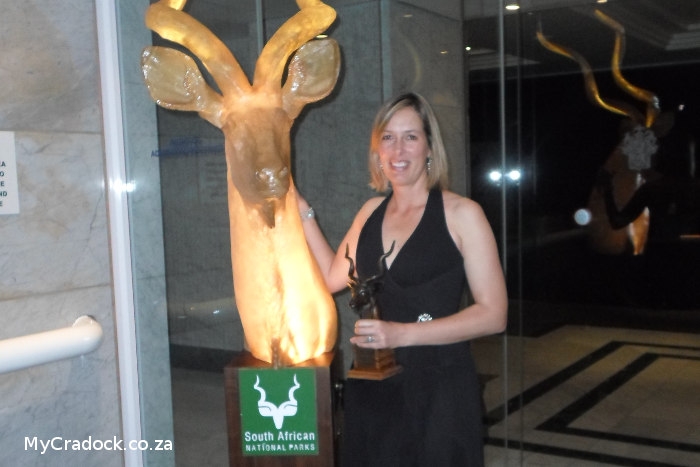
For the second consecutive year, Mountain Zebra National Park (MZNP) outside Cradock walked away with the most prestigious award at the recent 2014/15 Frontier Regional Achievement Awards. Park Manager Megan Taplin accepted the Best Performing Park Award on behalf of her colleagues at the ceremony hosted in Addo Elephant National Park. The awards evening is …

Megan Taplin
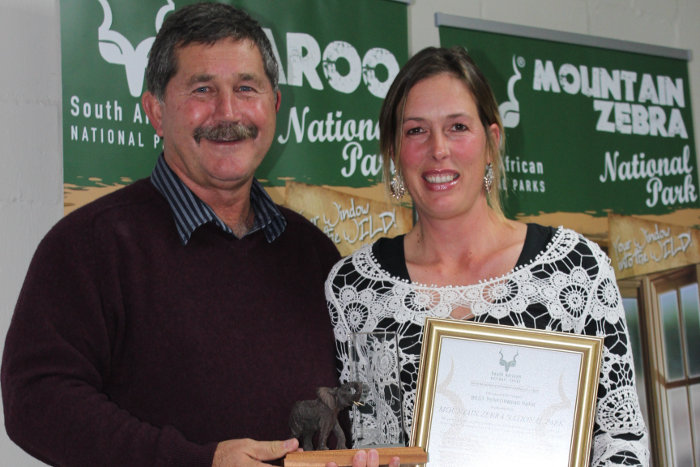
Mountain Zebra National Park Manager, Megan Taplin, receiving the Best Park Certificate and Trophy from Frontier Regional General Manager, Dries Engelbrecht.
For the second consecutive year, Mountain Zebra National Park (MZNP) outside Cradock walked away with the most prestigious award at the recent 2014/15 Frontier Regional Achievement Awards. Park Manager Megan Taplin accepted the Best Performing Park Award on behalf of her colleagues at the ceremony hosted in Addo Elephant National Park.

The awards evening is an annual event to celebrate the top individual and team achievements from the four national parks in the region – namely Addo Elephant, Mountain Zebra, Camdeboo and Karoo National Parks, and is a precursor to the annual South African National Parks (SANParks) Kudu Awards to be held in Gauteng later this year. Last year Mountain Zebra won in the same category at the national event – and currently proudly boasts with the title of top park within SANParks.

The Best Performing Park Award is for excellent achievements in Conservation, Tourism and People & Conservation – SANParks’ three core business areas – over the period under review.

In Conservation, some of the highlights were: The Park made another contribution to South Africa’s cheetah metapopulation with the translocation of two male and one female cheetah to Selati Game Reserve. This brings to 24 the number of cheetah contributed by MZNP to the cheetah metapopulation since 2010 and makes MZNP the top contributor of cheetah to the metapopulation in South Africa through the Endangered Wildlife Trust’s programme. At the same time, populations such as black wildebeest and red hartebeest were also managed effectively by means of translocations.

For MZNP, Tourism achievements during the 2014/15 financial year included: Visitor numbers increased by 4% in comparison to the same period last year. Unit occupancy showed a 2.6% increase while camping increased by 5% compared to the same period last year. Mountain cottage occupancy showed a 13% increase. Activities showed a good increase of 11.3% with night guided drives and cheetah tracking being the most popular activities. A new activity, guided sunset drives, was introduced successfully in December.

On the People and Conservation front: A total of 4 354 learners were addressed during environmental education programmes during the course of last year. This represents a 30% improvement on the previous financial year’s achievement, when 3 354 learners were reached. There was also a 37% improvement in the number of people who entered for free during the annual SA National Parks Week in September last year – from 615 in 2013/14 to 845.

Taplin once again attributed the Park’s success to excellent team work and the dedication of staff on the ground and thanked them for all their hard work.

Category: NewsTag: megan taplin
7 April 2015 by Alan

The neglected and forgotten Cradock Four Memorial

Cradock – Four concrete pillars, towering up into the sky, capture the imagination of travellers approaching Cradock along the N10 from Bedford. Questions about their purpose spring to mind as they encroach upon the skyline. This is the first impression of the Cradock Four memorial, erected to honour Matthew Goniwe, Fort Calata, Sparrow Mkhonto and …

Cradock – Four concrete pillars, towering up into the sky, capture the imagination of travellers approaching Cradock along the N10 from Bedford. Questions about their purpose spring to mind as they encroach upon the skyline.

This is the first impression of the Cradock Four memorial, erected to honour Matthew Goniwe, Fort Calata, Sparrow Mkhonto and Sicelo Mhlauli, four anti-apartheid activists assassinated by the South African Secret Police during the height of apartheid in 1985.

Goniwe was a popular teacher in Cradock, as was Calata. The two of them were rumoured to be on a secret police hit list for their active participation in the struggle. Mkonto, a railway union activist, and Mhlauli, a visiting headmaster and childhood friend, were also in the car when it was stopped just outside of Port Elizabeth. They were never seen alive again.

The Cradock Four were labelled “true heroes of the struggle” by none other than former president Nelson Mandela himself, but, as you turn off the freeway and try to find your way to the monument, you can’t help but wonder if these struggle icons would feel honoured.

There is no signage to direct you to the monument at all, and most local residents would not be able to give you directions, were you to ask.

If you do find your way onto the gravel road leading to the memorial, a broken gate greets you upon arrival. Large portions of the palisade boundary fence have been stolen, or have simply collapsed due to neglect.

There is no activity at the memorial at all. A vacant reception area greets you as you climb out your vehicle. It is clear that the memorial is not in use.

Progress beyond the reception area up to the main memorial by vehicle is impossible, with the tarred road almost indistinguishable from the surrounding veld. Weeds and indigenous plants sprout up through giant cracks in the tar.

A closer inspection reveals unfinished buildings with missing doors, smashed windows and missing roofs. Weeds push through the paving and have overgrown the once landscaped gardens.

Inside electrical cables have been ripped from walls and pipes sticking out of the wall are the only indication of where toilets used to be. Light fittings are gone, or, where they could not be removed, they have been smashed beyond repair.

Outside, a beautiful wooden deck has slowly been removed, piece by piece, with half the covered area now laid bare. The only indication that the deck was ever there is a few support beams and fittings rising up out of the concrete slab.

This is the Cradock Four memorial. It is a sad indictment against those responsible for the preservation of our country’s heritage.

News24

Category: NewsTag: Cradock Four Memorial
Megan Taplin
2 December 2014 by Alan

Accolades for MZNP

Cradock’s Mountain Zebra National Park won the SANParks Chief Executive Award in the category: Best Performing Park at the 10th annual Kudu Awards ceremony in Johannesburg last week (Thursday 27 November). This is the first year the park has won the award, outperforming much larger and better-known parks in the process. South African National Parks …

Megan Taplin
Megan Taplin

Cradock’s Mountain Zebra National Park won the SANParks Chief Executive Award in the category: Best Performing Park at the 10th annual Kudu Awards ceremony in Johannesburg last week (Thursday 27 November). This is the first year the park has won the award, outperforming much larger and better-known parks in the process.

South African National Parks (SANParks) supported by First National Bank (FNB) and Total South Africa, recognises deserving parks, departments and staff members at the awards evening every year.

The award was bestowed on the park for their performance during the previous financial year: 2013/14. Mountain Zebra National Park achieved excellent performance in all three of SANParks’ core business areas of Conservation, Tourism and People & Conservation over this time. Some of these achievements were:

Conservation

  • Three lions were successfully introduced, improving the biodiversity of the Park, improving predator-prey dynamics (especially in terms of large herbivores) and restoring a species to its natural habitat after an absence of more than 130 years.
  • The cheetah population was managed effectively through contraception and monitoring. New cheetah genes were brought into the small population through an effective swop with a reserve in Kwa-Zulu Natal.
  • Due to regular fence patrols, no breakouts of predators took place. Despite 50km worth of the 72km boundary fence line being inaccessible to vehicles (and hence must be patrolled on foot), fences were checked in entirety once per week.

Tourism

  • Visitor numbers increased by more than 14% in comparison to the same period the previous year (from 20 529 in 2012/13 to 23 484 in 2013/14).
  • Unit occupancy showed a 6.6% increase (from 69.9% in 2012/13 to 76.5% in 2013/14).
  • Camping showed a 4.2% increase (from 45.4% in 2012/13 to 49.6% in 2013/14).
  • Activities booked showed an increase of 43% with night guided drives and cheetah tracking being the most popular drives.

People & Conservation

  • A total of 3 354 learners were addressed during environmental education programmes. This represents a 165% improvement on the previous financial year’s achievement (3 354 learners during 2013/14 compared to 2 036 learners during 2012/13).
  • There was a 185% improvement in the number of people who entered for free during South African National Parks Week (615 in 2013/14 compared to 329 in 2012/13).

A number of other outstanding areas of performance, such in financial management and human resources, also played a role in the awarding of the prize to the park.

Park Manager, Megan Taplin, couldn’t be prouder. “This is a real achievement for every one of the team at Mountain Zebra National Park. I am very proud of the dedicated, friendly and efficient team we have here at the park and this award is a real testament to their ongoing efforts. I hope the Best Performing Park award will also encourage new visitors to the park to join the ranks of those who claim Mountain Zebra is their favourite national park,” she said.

Earlier this year the park won in the same category at the SANParks Regional Awards evening.

Category: NewsTag: megan taplin, mznp
Mountain Zebra Sunset Drive
2 December 2014 by Alan

Go for a Karoo Sunset Drive

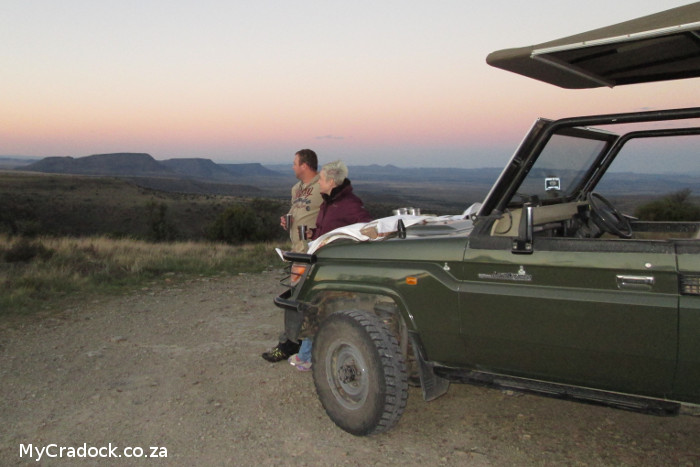
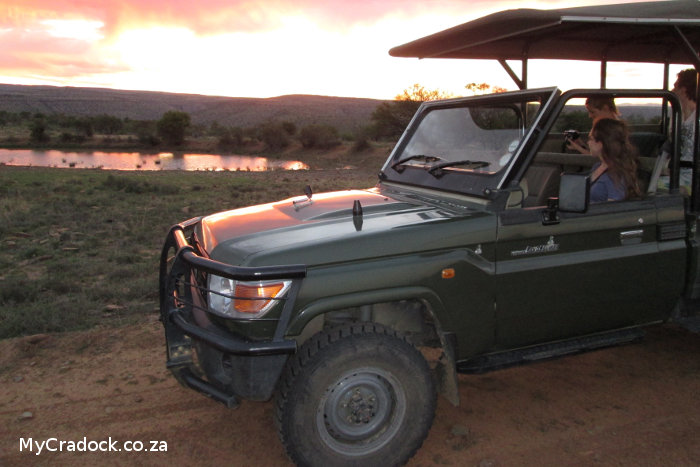
Guests to Mountain Zebra National Park (MZNP) can now enjoy the spectacular colour display as the Karoo sky changes from day to night on the newly-introduced sunset game drive. Launched on Monday 1 December, it is the only sunset drive offered by any of the national parks in the karoo, and gives visitors a unique …

Mountain Zebra Sunset Drive

Guests to Mountain Zebra National Park (MZNP) can now enjoy the spectacular colour display as the Karoo sky changes from day to night on the newly-introduced sunset game drive.

Launched on Monday 1 December, it is the only sunset drive offered by any of the national parks in the karoo, and gives visitors a unique view of the setting sun over the vast Eastern Cape landscape.

The two-hour drive departs from the Reception parking lot at 17:00 daily.  At a stop along the way, guests will have the opportunity to get out of the vehicle and enjoy a selection of light snacks (such as South African favourites biltong and dried fruit, nuts and biscuits) and their choice of beverage (soft drink, beer or wine).   Guests have the chance of spotting some of the park’s day-time species as well as some of the nocturnal species such as aardwolf and porcupine.

The Park’s ever-popular night drive will remain on offer, but will depart at 19:30, a bit later than the usual time.

A minimum of four and a maximum of nine visitors can go out on a sunset drive.  Children need to be at least six years old to participate.  The cost of the drive, including snacks and drinks, is R237.35 per adult and R118.68 per child under the age of 12 years (prices valid until October 2015).

Mountain Zebra Sunset Drive
Category: NewsTag: karro, mznp, sunset
2 December 2014 by Alan

Holiday fun at Mountain Zebra National Park

Guided game drives and walks, identifying birds, visits to rock painting sites and animal tracking are just some of the activities geared to keep the youngsters entertained at Mountain Zebra National Park this December. Day visitors and overnight guests with children between the ages of six and 16 will be pleased to know that the …

Guided game drives and walks, identifying birds, visits to rock painting sites and animal tracking are just some of the activities geared to keep the youngsters entertained at Mountain Zebra National Park this December.

Day visitors and overnight guests with children between the ages of six and 16 will be pleased to know that the park will once again offer a two-week long holiday programme from 8 to 21 December. Aimed at both the young as well as the young at heart, most activities are free of charge, except for the game drives, which are offered only to the youngsters at a reduced rate.

DATE

TIME

ACTIVITY

Monday 8 December

08h00 – 10h00

A guided game drive at a cost of R75 per child

Tuesday 9 December

08h10 – 10h10

A guided 1km walk on the Imbila hiking trail inside the fenced area of the park

Wednesday 10 December

10h00 – 12h00

DVD morning (such as Madagascar)

Thursday 11 December

11h00 – 12h00

A guided game drive to a rock painting site inside the park at a cost of R75 per child

Friday 12 December

12h00 – 13h00

Get to know your birds

Saturday 13 December

17h00 – 20h00

DVD evening (such as African cats and the Story of an African Farm)

Sunday 14 December

09h00 – 11h30

A guided walk on the 2.5km Black Eagle hiking trail inside the fenced area of the park. Wear a sun hat, good walking shoes and sunblock

Monday 15 December

10h00 – 12h30

Signs of the wild: animal tracks and tracking

Tuesday 16 December

09h00 – 10h00

Environmental games for kids: are you a mammal or reptile?

Wednesday 17 December

09h10 – 11h10

A guided game drive at a cost of R75 per child

Thursday 18 December

10h00 – 12h00

Story telling session: the history of the park and animal folk stories

Friday 19 December

11h00 – 12h00

A guided game drive to a rock painting site inside the park at a cost of R75 per child

Saturday 20 December

09h00 – 11h30

A guided walk on the 2.5km Black Eagle hiking trail inside the fenced area of the park. Wear a sun hat, good walking shoes and sunblock

Sunday 21 December

10h00 – 12h30

Signs of the wild: animal tracks and tracking

Please note that some of the activities may be cancelled due to bad weather conditions. Entry/conservation fees are payable upon entry for all visitors, including holiday programme participants. Bookings are essential due to limited numbers. For further information or for bookings, please contact 048 881 2427 or 071 4691 050.

Category: NewsTag: Mountain Zebra National Park
1 December 2014 by Alan

As others cower, now is time to book Africa safari

Buy Photo The Masai Mara in Kenya is not affected by Ebola. Inset: Tour operator William Cowger.(Photo: Ellen Creager/Detroit Free Press)Buy Photo Story Highlights Safari country not near Ebola outbreak, but business still plunges Now’s the best time to book a safari Safari business in east Africa and south Africa has dried up, plunging an …

Buy Photo

The Masai Mara in Kenya is not affected by Ebola. Inset: Tour operator William Cowger.(Photo: Ellen Creager/Detroit Free Press)Buy Photo

Story Highlights

  • Safari country not near Ebola outbreak, but business still plunges
  • Now’s the best time to book a safari

Safari business in east Africa and south Africa has dried up, plunging an estimated 20% to 70% since the Ebola virus hit west Africa. Operators have seen cancellations galore even though the part of Africa hit by Ebola is nowhere near safari country.

“My business is down 50%,” says William Cowger, a Troy photographer who runs photo safaris to Tanzania, traveling there 28 times since 2005. “People are nervous. A lot of Americans don’t really recognize the geography. People think Africa is a country, not a continent.”

Don’t be one of those people.

While the confused and the scaredy-cats wimp out, now’s the best time to book a safari.

3,400 miles away

First, take a look at a map. Arusha, Tanzania, where many safaris and treks to Mt. Kilimanjaro begin, is 3,400 miles from Monrovia, Liberia, scene of the Ebola outbreak.

That is the same distance as Anchorage to Atlanta, except without a single road between them. There is no Ebola in east Africa.

(Similarly, it’s 3,300 miles from Liberia to Nairobi, Kenya, and 3,500 miles to Johannesburg, South Africa, two other safari starting points.)

Even so, Cowger has already canceled one February departure when participants got cold feet. He said it is not the avid photographers who are canceling but their spouses or partners, nervous about Africa in the first place, “so something like this is enough to tip them over the edge.” His other trips are still being offered.

Tour operator William Cowger of Birmingham says his Africa tour business is down 50%.(Photo: William Cowger)

The Economist magazine reports empty safari camps in Botswana, Namibia, South Africa, Kenya and Tanzania, calling the situation “the biggest drop in business in living memory” for safari operators because of an “epidemic of ignorance” about geography among travelers and about Ebola.

West Africa has no safaris and few big game animals. Only east Africa and south Africa do.

Lack of tourism is worse than just an economic jolt to the nations. It may lead to increased poaching.

“Protection of wildlife is 90%-plus funded by tourism,” Cowger says. “When tourism drops, their seemingly insurmountable task of protecting their wildlife from poaching and development becomes even more difficult.”

Discounts on the way

An African safari is not cheap. Not including the $2,000 airfare from Michigan, a good east Africa safari usually costs about $5,000 to $7,000. This is one destination where you should not pinch pennies; look for a safari that includes some travel by small plane to reach game drive areas, nice tented camps and travel during prime migration times.

But the plummeting business in Africa for tourists will put price pressure on airfares and safaris.

“My trip is more expensive because I only put four people in the car instead of eight. We see so much wildlife. I have my own private photo camps now with private chefs, beautiful tented camps,” says Cowger, whose trips attract tourists from all over the world and cost about $7,800 for 13 days.

“I’m just considering offering a discount for the first time ever. I haven’t done it yet. If it would put some people over the top then I would do that.”

Watch for other operators to do the same.

If you want to learn more about the tourism situation in east Africa, you can hear Cowger speak at 2 p.m. Jan. 4 at the Troy Public Library, which also has an exhibit of his work.

You also can look at other safaris offered on the clearinghouse website www.safaribookings.com, although I would consult with a travel agent before booking them.

A few years ago when I was on safari, the concern in east Africa was whether too many tourists were crowding the animals.

Now, the animals are probably wondering where the humans went.

Contact Detroit Free Press Travel Writer Ellen Creager, the Michigan Traveler, at ecreager@freepress.com, 313-222-6498 or follow her on Twitter @ellencreager.

Category: NewsTag: africa, karoo, safari
27 November 2014 by Alan

Steam safari on world’s most luxurious train

As soon as passengers arrive at the Rovos Rail station in Pretoria, South Africa, it’s clear this won’t be a typical train journey. No crowds, just fellow guests — and only a few dozen of them — heading on a three-day trip to Cape Town. Inside the meticulously restored building, champagne flows freely and ceiling …

As soon as passengers arrive at the Rovos Rail station in Pretoria, South Africa, it’s clear this won’t be a typical train journey.

No crowds, just fellow guests — and only a few dozen of them — heading on a three-day trip to Cape Town.

Inside the meticulously restored building, champagne flows freely and ceiling fans turn leisurely.

Occasionally the resident peacocks squawk as they preen around the platform, until they scatter with the arrival of the steaming locomotive.

Yes, steaming, as if it was headed to Hogwarts, because that’s what this pretty much is: a storybook rail safari through Africa.

Rovos Rail offers a series of journeys across South Africa and beyond that allow passengers to encounter the region’s spectacular scenery and some of the big beasts that roam it.

Itineraries include trips between the South African cities of Pretoria and Durban that take in the Nambiti Conservancy (a Big Five retreat in KwaZulu-Natal) or to Victoria Falls via Botswana, Zimbabwe and the Hwange National Park wildlife sanctuary.

Hot tub on rails

The trains are billed as the most luxurious in the world.

That’s hard to dispute.

In the 16-square-meter (172-square-foot) Royal Suite, there’s a double bed, richly upholstered armchairs and a full Victorian bath for lounging in the tub and watching the world roll by.

The room for this short trip carries a price tag of 28,600 rand ($2,570) a person, but there’s a seven-square-meter Pullman for half that, or a Deluxe Suite that lands somewhere in between.

There are few modern nuisances to distract from the landscape views.

No televisions, no Wi-Fi.

Cell phones are discouraged and laptops forbidden outside of suites.

“We don’t want any work being done in public,” Rovos founder Rohan Vos tells passengers before they board. “Ambiance and good conversation, that’s what this train is all about.”

To encourage this, the journey from Pretoria begins with high tea.

The observation car is at the rear of the train. One portion is glassed off to protect the smokers, who have a tendency to wander off when they leave the train to grab a puff.

It’s not the prime place to be in any case.

It’s best to claim a spot at the very rear of the car, which is gloriously exposed so passengers can sit on a long bench or lean over the railing to claim uninterrupted views of the goldfields, the Karoo and eventually the mountains and winelands that surround Cape Town.

Dinner gong

It’s good to take it easy at high tea.

Before long a gong sounds to call guests to the dining cars for a seven-course meal, each with a wine pairing.

The food leans heavily toward local fare, both game and produce, all of it meticulously prepared.

The Cape Town journey is one of the shortest, but includes two stops.

The first is at Kimberley, the diamond mining town known for the “Big Hole,” the largest excavation in the world, a mile wide and going down seemingly forever.

The other stop is in Matjiesfontein, in the middle of the Karoo.

The entire town is a national heritage site, preserving the Victorian village that was founded as a railway rest stop but became a health spa once frequented by South Africa’s elite.

Although the train is sometimes pulled by a more modern locomotive, the oldest of Rovos Rail’s carriages date to 1930, two years before Agatha Christie imagined the Belgian detective, Hercule Poirot, sleuthing across Europe.

Most were once owned by South African Railways, and were bought as rusting and decrepit shells.

Before leaving Pretoria, it’s worth taking a look at the original carriages, if only to appreciate how beautifully restored they are.

As much as Rovos Rail envelops its passengers in a time warp, they’re not shielded from all modern headaches.

The growing pains of South Africa’s rails mean delays can and do happen.

“I ask you to please accept the fact that we are never on time,” Vos quips. “However, we will get you to Cape Town this week, and that’s what matters.”

On Rovos Rail’s longer, international journeys into Namibia, Zimbabwe, Zambia and Tanzania, the logistics of African travel can interfere.

Slow tourism

The train stops for border posts (waits can be lengthy) and poorly maintained tracks in some regions keep the speeds slow.

Despite all that, this is the best imaginable way to make an overland trip.

The 15-day route from Cape Town to Dar es Salaam is a train lover’s dream, taking a meandering route from the Cape through the heart of South Africa, up to the Madikwe Game Reserve and then onto Zimbabwe for an overnight stay at the Victoria Falls Hotel.

Crossing the Zambezi River on its landmark bridge is like living on a movie set, the mist of the falls thundering upward on one side, the dark rocks of the gorge plunging down on the other.

The train then crosses the length of Zambia, sometimes churning, sometimes crawling until it reaches Chishimba Falls in the rarely visited Northern Province.

Here, hikers can explore the sacred cave behind the falls, where the nature spirit Chishimba is believed to live.

This is a place of prayer and offerings, so the Zambia Tourism Authority has strict instructions for visitors: “Because of the sacred nature of the Falls, no sexual intercourse, arrogance and quarrelsomeness is allowed in the vicinity of the Falls.”

Passengers should plan their time accordingly.

This is literally a high point of the journey.

The rest of the trip is a descent into the Rift Valley, winding through tunnels and along viaducts, with a stop for a game drive in Selous Reserve, the largest in Africa.

Rovos runs this route five times a year, and it’s their most popular option, according to Brenda Vos, Rohan’s daughter who works in what’s now a family business.

Regardless of the itinerary, she says for many passengers the train itself is the destination.

“We want guests to get on board, and it doesn’t matter where they’re going.”

Rovos Rail, Paul Kruger Street, Pretoria, South Africa; +27 12 315 8242

Category: NewsTag: africa, karoo, safari
10 November 2014 by Alan

Karoo Space

Karoo Space is the leading website on the Karoo, South Africa’s Heartland. We produce print books and e-books on the Karoo. Contact Karoo Space: PO Box 835 Cradock 5880, No 6 Naested St 048 881 2660 http://www.karoospace.co.za Speak to: Chris Marais

Karoo Space is the leading website on the Karoo, South Africa’s Heartland. We produce print books and e-books on the Karoo.

Contact Karoo Space:

  • PO Box 835 Cradock 5880, No 6 Naested St
  • 048 881 2660
  • http://www.karoospace.co.za
  • Speak to: Chris Marais

E-Bookstore in the Karoo.

Category: BusinessTag: 101 Karoo Towns, Karoo Keepsakes I, Karoo Keepsakes II, Knapsak vol Karoo I, Knapsak vol Karoo II
9 November 2014 by Alan

The Top 3 Horse Safaris in South Africa

There are few greater thrills than exploring the African bush on horseback. It’s a surreal way to experience the sights, sounds, and serenity of the bush, but more than that, you’ll be able to get very close to the wildlife that would otherwise avoid loud vehicles. Here are 3 recommended horseback safaris in South Africa: …

There are few greater thrills than exploring the African bush on horseback. It’s a surreal way to experience the sights, sounds, and serenity of the bush, but more than that, you’ll be able to get very close to the wildlife that would otherwise avoid loud vehicles. Here are 3 recommended horseback safaris in South Africa:

Big 5 Safari with Wait A Little

If you’re looking for a Big 5 adventure like no other, Wait A Little offers highly personalized and specialized horse riding safaris for experienced riders in the Karongwe Private Game Reserve, close to the famous Kruger National Park. With years of experience, the horses are able to keep calm at even a few metres away from big game. A high standard of riding and small groups of only 7 guests ensures each person receives individual attention, up close game sightings, and sporty riding.

The Big 5 Safari is the most popular of Wait A Little’s 3 horseback tours, which range from 5 to 10 days long and cover 35 000ha of African wilderness. The 7 night Big 5 Safari starts with 3 nights at Wait A Little main camp, which offers a selection of tented camps overlooking the river and a garden rondavel. On day 4, guests ride to Beacon Rock, a sleep out camp on top of a rock formation with spectacular sunrise views. The next 2 nights are spent at XiDulu Private Camp in the Greater Makalali Game Reserve. XiDulu is only used by its owners and Wait A Little guests. XiDulu is situated on a large dam and guests can spot the resident hippos from the infinity pool and viewing decks of the camp’s main area.

Read more

Copyright © 2014 by A Luxury Travel Blog. This article was written by Marcel Van de Ghinste  and originally published on aluxurytravelblog.com

Category: NewsTag: africa, karoo, safari
22 August 2014 by Alan

Are you ready for the 2014 Fish?

The 33rd edition of the Hansa Fish Canoe Marathon which takes place in Cradock on Friday, 10 and Saturday, 11 October 2014, will welcome canoeists from every corner of the country, and the world. The popularity of this annual event looks set to grow exponentially with the innovative addition of a new “short course” option …

The 33rd edition of the Hansa Fish Canoe Marathon which takes place in Cradock on Friday, 10 and Saturday, 11 October 2014, will welcome canoeists from every corner of the country, and the world. The popularity of this annual event looks set to grow exponentially with the innovative addition of a new “short course” option to the famous two-day race.

The race, which starts on Grassridge Dam Friday October 10, 2014 at 07:00, will end the first day 45,8km further, 1km below Knutsford Bridge. This is the start of Day 2 of the race on Saturday 11 October 2014 at 07h00, with the race ending 36 km further at the Sports Complex in Cradock.

The two-day event attracts enthusiasts from the whole of South Africa and the world to the small town of Cradock. The timing of this year’s event also allows the elite paddlers who will be participating in the World Marathon Championships in the USA enough recovery time to give their all and aim for success at 2014 Hansa Fish River Canoe Marathon.

Also to look out for in branded Hansa K3s at this year’s race will be former Springbok rugby players, Corné Krige and Tiaan Strauss. The two will again be supporting the event’s efforts of raising funds for the underprivileged children. This year’s Charity Batch will be open to the first 50 paddlers willing to pay an additional R800 for their entry. This will be donated to the Vukasebenza Shelter in Cradock as well as the underprivileged children of the area. Bidding for places in the Charity Batch will start on 15 September and close at midday on Tuesday 30 September. You will have to have already entered to bid for a place in the Charity Batch.

The theme for this year’s Hansa Fish Pimp My Ride competition is “BLING SAFARI!”. This is the ultimate “Go Big or Go Home” theme! From pith-helmets, animal onesies, camo-designs on your boat, binos, foliage – to some serious Grootwild. The participants are expected to go large. And the prize! – The combined bodyweight of the winning crew in Hansa Pilsener!

The ever popular Hansa Music Festival will feature acts such as LOCNVILLE on the Friday evening with ShortStraw and Gangs of Ballet to close the weekend on a high when they perform on the Gig Rig on Saturday evening. Entry fees for non-paddlers at the Sport Complex is R10 per adult; R5 per child under 12, until 18:00, thereafter R60 per adult and R30 per child, these apply for both Friday and Saturday.

Category: SportTag: Canoe, fish river, hansa
22 August 2014 by Alan

SEE IT: Texas Tech cheerleader, 19, loves shooting big game in Africa — and …

Kendall Jones/Via Facebook One Facebook user asked how well the teen would do if she were dropped into a lions’ den … without a gun. Pretty in pink. Deadly in camo. Animal rights activists aren’t pleased with a Texas Tech University cheerleader’s hunting trips that have left trails of blood throughout Africa. The pictures of …

One Facebook user asked how well the teen would do if she were dropped into a lions' den ... without a gun.Kendall Jones/Via Facebook One Facebook user asked how well the teen would do if she were dropped into a lions’ den … without a gun.

Pretty in pink. Deadly in camo.

Animal rights activists aren’t pleased with a Texas Tech University cheerleader’s hunting trips that have left trails of blood throughout Africa.

The pictures of her beaming beside dead animal carcasses have caused an uproar heard around the Internet.

Kendall Jones, 19, of Cleburne, Tex., has been uploading these controversial pictures to Facebook to promote her hunting career and hopes to host a TV show on hunting.

“I’d love to drop kick you into a lions’ den, see how you do without your gun,” someone commented on a picture of her smiling over the body of a leopard she just killed.

Another disheartened Facebook user offered a more measured response: “No matter how you look at it, seeing people smiling over the dead body of such a majestic animal is just sad.”

If she’s aiming to please, she’s missed the mark.

Jones, however, views herself as a conservationist and argues that hunting rare animals is counterintuitively the best way to ensure their survival.

“Hunters are the biggest conservationists there are,” she said. “We want animal populations to grow and thrive!”

After accompanying her dad on hunting trips, Kendall Jones finally shot a rhino.Kendall Jones/Via Facebook After accompanying her dad on hunting trips, Kendall Jones finally shot a rhino.

According to Jones, whose family raises exotic animals, these rare beasts’ value to hunters is the incentive for animal keepers to maintain the population.

“How would farmers be able to afford monthly feed and vet bills (over $15,000 a month) if there was no value on the animals? Come on people think about these things,” she said.

But many Africans have criticized Jones’ line of thinking.

Kieron Brown, a South African from Cape Town, started a petition on change.org to stop Jones from hunting on the continent. He accuses Jones of using “endangered and helpless” animals as a stepping stone to greater popularity online.

Another petition on AZAAZ.org, hoping to have Jones’ Facebook page taken down for animal cruelty, has already garnered more than 40,000 signatures.

The 19-year-old is hoping to turn her passion for big game into a TV show. Kendall Jones/Via Facebook The 19-year-old is hoping to turn her passion for big game into a TV show. Enlarge
Kendall Jones, whose family raises exotic animals, poses with a zebra she killed. Kendall Jones/Via Facebook Kendall Jones, whose family raises exotic animals, poses with a zebra she killed. Enlarge

Jones fell in love with hunting and the culture surrounding it when she accompanied her father on a trip to Zimbabwe in 2004.

“As badly as I wanted to shoot something, I was just too small to hold the guns my dad had brought,” she wrote in her Facebook bio.

Four years later, at just 13, Jones traveled to South Africa to start hunting the Big Five: African lion, African elephant, Cape buffalo, African leopard and African rhino. Hunters value killing these large animals because they’re the most difficult to bag.

The first animal Jones ever shot was a white rhino with a .416 Remington.

This Texan is anything but gun-shy!Kendall Jones/Via Facebook This Texan is anything but gun-shy!

“On this trip I also took some plains game, such as impala, kudu and mountain reedbuck home,” she said.

Jones returned to Africa the following summer to check off the rest of the Big Five on a 28-day safari. She killed an elephant, buffalo and lion but failed to kill a leopard —so she returned two weeks later for a 14-day safari.

“This time I got my leopard, and also took down a hippo to get 6 of the Dangerous 7 at the age of 14!” she gloated.

Jones is a sophomore pursuing a degree in marketing and sports therapy.

“This is absolutely despicable. How can you kill such a majestic animal?” another Facebook user commented on a picture of Jones holding her pink arrows over a dead lion in the Kalahari Desert. “You are absolute scum. I hope a gorgeous African animal takes its own revenge on you one day for all the beautiful souls you have shot.”

mwalsh@nydailynews.com

On a mobile device? Click to watch the video.

Related Gallery:

$esc.html($image.alt)

View Gallery Animal fights

Related Gallery:

$esc.html($image.alt)

View Gallery Animals caught unguarded in the wild

Category: NewsTag: africa, karoo, safari
22 August 2014 by Alan

Texas Tech cheerleader’s safari hunt stirs firestorm

We live in a world where emotion and outrage have increasingly trumped rational thought. The most vivid example comes with the recent story of Texas Tech cheerleader Kendall Jones. Jones,19, posted pictures on her Facebook page from her recent safari in Africa. One of the pictures is posted here. Somebody complained to Facebook and they …

Texas Tech cheerleader Kendall Jones with one of the animals she bagged on a recent African safari

We live in a world where emotion and outrage have increasingly trumped rational thought. The most vivid example comes with the recent story of Texas Tech cheerleader Kendall Jones.

Jones,19, posted pictures on her Facebook page from her recent safari in Africa. One of the pictures is posted here. Somebody complained to Facebook and they took down her page claiming it was a violation of their policy.

“We remove reported content that promotes poaching of endangered species, the sale of animals for organized fight or content that includes extreme acts of animal abuse,” Facebook stated, although it did not comment further.

One picture showed her with a rare white rhino, which is endangered. However, it turns out she didn’t kill it, but hunted it with a team of researchers and tranquilized the beast to allow veterinarians to treat the animal for a leg injury. Such activity is called a “green hunt.” It’s literally catch-and-release hunting.

Some of the animals she bagged were identified as nuisance animals that had been preying on local livestock herds, such as her leopard. The predators would have been killed by locals or destroyed by wildlife control officers. Instead permits were sold and generated badly needed revenue for the poor economies of Zimbabwe and South Africa where she hunted to take the same action.  Her trip provided much needed jobs to many local residents who made their living guiding and tracking foreign hunters.

None of the animals was being sold or trained for organized fighting and responsible and regulated hunting is not an extreme act of animal abuse. However, the consideration is lost on those who would vilify this young lady.

Reports indicate the Texas native had all necessary permits which were drawn in lottery fashion. She paid all fees and license costs and all of the animals were taken in a manner which is legal according to local game management laws. She did everything “by the book.”

The problem is, to some none of this matters. Animal rights groups lash out without the benefit of rational thought. They consider man is always the problem and never the solution. Animals are in nearly all ways superior to mankind in the minds of many of these individuals. Their line of thinking is revealed in some of the overwhelmingly hateful vitriol spewed forth by some of those who commented on Jones’ pictures.

“Come to South Africa and try to hunt our endangered animals, you will be shot on sight and believe me, there will be celebrations.”

“I hope you get eaten by a lion, you cow,”

“How about we have a real hunger games? I vote we hunt this horrible woman down first.”

Just a sample of the blow back the young hunter saw flooding her Facebook page in the wake of posting her pictures, something most of us have done. Some even went so far as to create the ” Official Kendall Jones Hate Page” on Facebook. Posts there doubled down on hateful remarks and death threats. Facebook wisely saw the problem and took their site down as well.

There is no reasoning with unreasonable people. The extreme members of the animal rights movement are unreasonable and in some cases have even been classified as terrorists. My experience has been there’s no use to argue with them because facts and data are meaningless in their minds. However, others who are not as hard lined, are rational thinking people who simply have a soft spot in their heart for animals. They desire to do what they can for wildlife and all animals, but often are misguided in their efforts.

The truth is hunters have done more for animal conservation than any other group. Hunters spend millions every year on equipment, license, and other associated costs to enjoy the activity. A high percentage of those dollars wind up being poured back into game management. The dollars spent on hunting in some communities both here in the United States and abroad are vital to local economies. Lawful hunting produces a means of healthy and organic food sources.

If someone wants to celebrate those attributes with what would otherwise be a discarded head on their living room wall or with pictures shared on Facebook, there’s nothing wrong with it. But some will never be convinced otherwise.

Chris Lawrence

Category: NewsTag: africa, karoo, safari
Donovan Harmse
12 August 2014 by Alan

Ensuring a good night’s sleep for Graaff-Reinet learners

South African National Parks (SANParks) delivered on its vision of ‘Connecting to Society’ at the official handover of 80 beds and mattresses at Spandau High School’s girls’ dormitory in Graaff-Reinet today. The town of Graaff-Reinet in the Eastern Cape finds itself surrounded by Camdeboo National Park. Park staff realised the dire need for this necessity, …

South African National Parks (SANParks) delivered on its vision of ‘Connecting to Society’ at the official handover of 80 beds and mattresses at Spandau High School’s girls’ dormitory in Graaff-Reinet today.

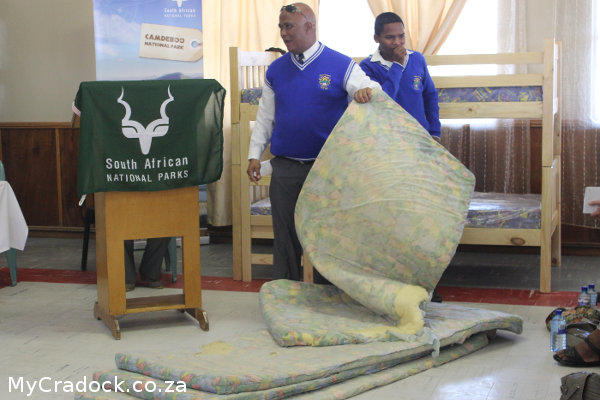
The town of Graaff-Reinet in the Eastern Cape finds itself surrounded by Camdeboo National Park. Park staff realised the dire need for this necessity, when, on a routine visit to the dormitory earlier this year, they noticed the lack of proper mattresses the learners were forced to make use of. They were sleeping on up to four or five thin mattresses at a time, many with numerous holes in them, forcing the children to improvise by stacking one upon another and another in order to get a good night’s sleep.

Park management then wrote a letter of motivation for the furniture to SANParks’ Corporate Social Investment (CSI) department at Head Office. After a site visit to the school to inspect the exact extent of the problem, the go-ahead was given for the purchase of the beds.

Speaking at the handover ceremony, Park Manager, Peter Burdett, said, “We all know how important a good night’s sleep is, and more especially so for our children. Sleep is the power source that keeps one’s mind alert and calm. Every night, sleep recharges the brain’s battery. Sleeping well increases brain power just as weight lifting builds stronger muscles, because doing so increases your attention span and allows you to be physically relaxed and mentally alert at the same time. Then you are at your personal best.”

The project, valued at R125 000, will go a long way towards improving the learning and development of leaners at the school. “We hope that today’s handover will go a long way in seeing these youngsters excel in their education and flourish in their day-to-day lives,” Burdett continued.

Elizabeth Mhlongo, Senior General Manager – CSI, said “As part of our new positioning and living up to our vision of ‘South African National Parks Connecting to Society’, SANParks initiated a CSI programme as a way to align with and contribute to government’s mandate towards social development”.

“A dedicated community levy was established to ensure SANParks’ tangible benefit to communities living adjacent to national parks in bettering their livelihoods. In partnership with government departments, municipalities, local communities and other key stakeholders, SANParks is investing resources in the establishment of legacy projects in communities, particularly in rural areas where our national parks are located,” Mhlongo continued.

The official handover of the beds at Spandau High School is an indication of the promise SANParks has made to ‘Connect to Society’, and follows other projects handed over in Limpopo, Mpumalanga, Northern Cape and Eastern Cape – with the handover of a computer laboratory in Paterson close to Addo Elephant National Park last year.

“Through these programmes and many others, we will continue to develop reciprocal relationships between protected areas and neighbouring communities, making our national parks a true mirror of our society’s environmental values,” Mhlongo concluded.

Donovan Harmse
House master, Donovan Harmse and a learner showing guests what the youngsters have been sleeping on to-date, sometimes having to stack more than one on top of another to make up for gaping holes in them.
Category: NewsTag: graaff reinet, sanparks
Cheetah Cubs
9 June 2014 by Alan

Images of Mountain Zebra’s Cheetah Cubs

The Mountain Zebra National Park’s seven cheetah cubs are a few months old now and they’re all doing well. Samara’s three cubs were born at end December or beginning January and have been moving around quite a bit with their mother. The three, who make up her first litter, were born in the mountainous Kranskop …

The Mountain Zebra National Park’s seven cheetah cubs are a few months old now and they’re all doing well.

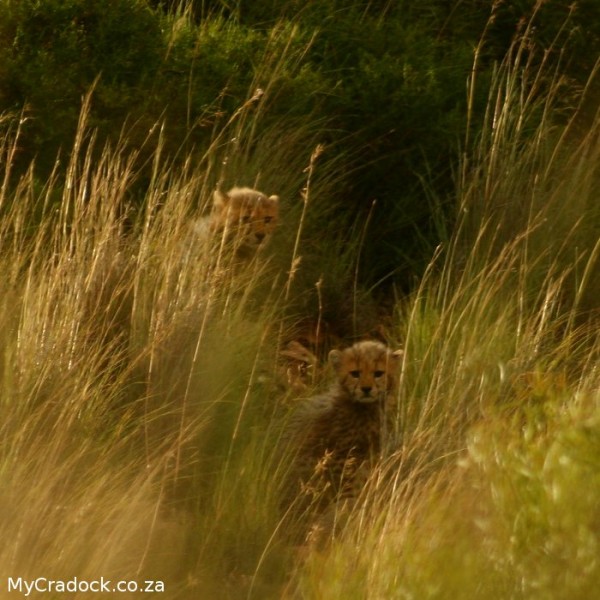
Samara’s three cubs were born at end December or beginning January and have been moving around quite a bit with their mother. The three, who make up her first litter, were born in the mountainous Kranskop area.

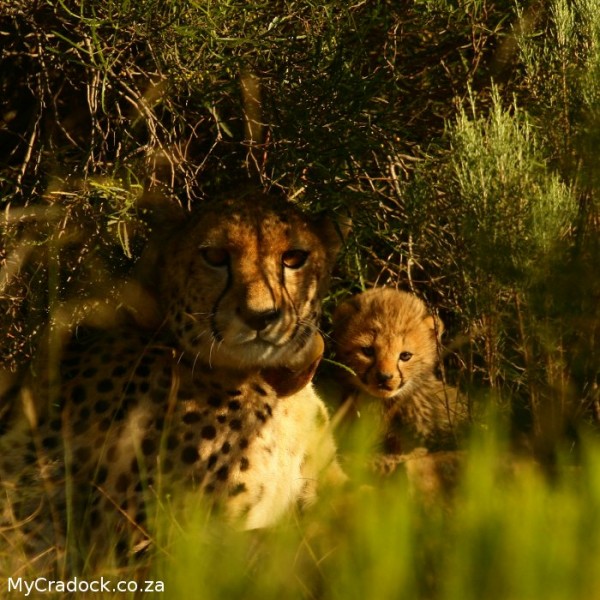
Nixi’s four cubs were born in February and spent most of their first months in the den, which is also in the south-western Kranskop area. With both cheetah, the dens used were not a hole in the ground (as people might imagine) but under a dense shrub which protected them from the elements and other predators.

The fact that the cheetah mothers chose the remote and mountainous area of the Park to have their cubs is most likely a reaction to the presence of lions, which do not frequent the southern mountainous slopes.

It’s not yet known if the little ones are male or female since this is difficult to establish from a distance in the long grass. The Park’s animals are not handled as they are wild and SANParks practices a policy of minimum interference in nature. Interference and handling with the purpose of assisting an animal is only allowed if a threatened species – such as cheetah – is in danger due to injury or if it is necessary to manage the population.

Both litters of cubs are fathered by Phinda, a male introduced from a KwaZulu-Natal reserve in June last year as part of a genetic exchange programme to introduce new genes into the Park’s cheetah population.

All of the Park’s cheetah were on contraception to limit the population from increasing too quickly but three females were taken off contraception so that they could have cubs. After introducing lions in April 2013, there was a possibility of conflict between the two predators which might lead to cheetah numbers declining, hence the decision was made to allow the population to expand. These cubs mean that the cheetah have successfully come off contraception (cheetah are quite sensitive and in some cases do not breed that easily after contraception) and also that the genetic health of the population has been improved. There are now 12 cheetah in the Park (including the cubs).

Recently, a number of visitors have been lucky enough to spot the cheetah cubs while on drives in the Park. The cubs have been seen on various occasions on the Rooiplaat Loop, along the main entrance road and on the Juriesdam 4×4 loop. Some visitors have even posted photos of the cubs on the Park’s Facebook group: SANParks – Mountain Zebra National Park.

Visitors have the chance of spotting cheetah on one of the Park’s cheetah tracking activities (where a cheetah is tracked by means of radio telemetry on foot with an experienced guide), a guided game drive or a self-drive game viewing outing.

Cheetah Cubs
Two of Samara’s cubs. Photographer: Rhodes University’s Dr. Charlene Bissett who has been conducting an on-going research project, along with Dan van de Vyver, on the predators and their habitat and prey utilisation
Cheetah Cubs
Nixi and one of her cubs. Photographer: Rhodes University’s Dr. Charlene Bissett who has been conducting an on-going research project, along with Dan van de Vyver, on the predators and their habitat and prey utilisation
Category: NewsTag: Cheetah Cubs, Mountain Zebra National Park
Lion Kill
6 June 2014 by Alan

Mountain Zebra Lion Kill

All indications are that the three lion introduced into Mountain Zebra National Park outside Cradock in April last year have settled down well in their new home. The three, one lioness and two males became the first free-roaming lions in the area after an absence of over 130 years. They were the third predator species …

All indications are that the three lion introduced into Mountain Zebra National Park outside Cradock in April last year have settled down well in their new home.
The three, one lioness and two males became the first free-roaming lions in the area after an absence of over 130 years. They were the third predator species in the Park – after the introduction of cheetah in 2007 and brown hyena in 2008.

Park Manager, Megan Taplin, says it appears as if the two feline species are co-existing peacefully. “We allowed the cheetah to first establish themselves in the Park before introducing lion which may have competed with the cheetah for food. The numbers of large herbivores in the Park such as black wildebeest, red hartebeest, eland and gemsbok have sustained the lion population while cheetah tend to focus on smaller species such as springbok and young antelope,” she said.

Taplin says monitoring has shown that cheetah tended to avoid areas where lion roamed. Although the two species had encountered one another, there appears to have been no major incidents yet, with the cheetah fleeing from the lion when conflict arose.

The lone lioness was sourced from Karoo National Park outside Beaufort West, while the two males were brought in from Welgevonden Game Reserve in Limpopo. The decision to introduce lion into the Park was mainly for biodiversity reasons. “Lions occurred here historically and it is SANParks’ policy to reintroduce the wildlife species which would have occurred in an area before hunting or habitat loss forced them to local extinction in earlier centuries. They are also occupying the niche of large predator in the ecosystem, keeping the numbers of larger herbivores in the Park in check,” said Taplin.

The three were collared so that Park Management could monitor them and rangers and researchers could observe which habitats they use and which species they prey on. After their release, the brothers were mostly seen together, while the lioness has been exploring the Park on her own most of the time and only occasionally meeting up with them.

Apart from their biodiversity value, the introduction of the lion has also added to Mountain Zebra’s tourism value, offering visitors a new species to look out for in the Park.  Guests to the Park over the past year have increased by over 14%, compared to the year heading up to the lions’ introduction. Unit occupancy has increased by nearly seven percent while camp site occupancy recorded a four percent increase.

“We are very happy with what our statistics are telling us. Although our primary reason for introducing the lions wasn’t to increase tourism, it’s certainly a welcome effect. The draw card of the lions has introduced more people to the Park’s wonderful landscapes and great game viewing potential. We look forward to building on this in the future as the word spreads and more people are drawn to both the Park and the region,” Taplin concluded.

Lion Kill
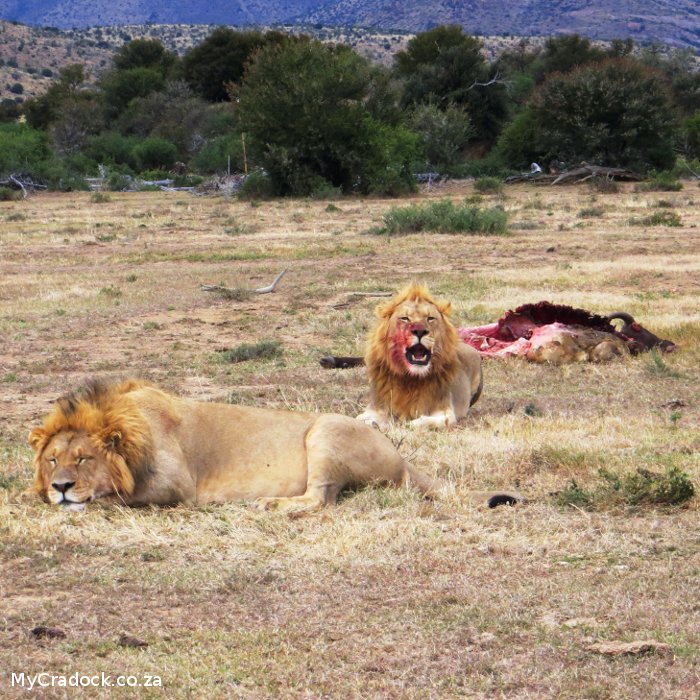
This photograph was taken on Thursday 5 June, after the brothers successfully took down a buffalo in the Ebenaezer area of the Park the day before.
Category: NewsTag: Buffalo, Lions, Mountain Zebra National Park
  • Previous
  • Page 1
  • Interim pages omitted …
  • Page 84
  • Page 85
  • Page 86
  • Page 87
  • Page 88
  • Interim pages omitted …
  • Page 100
  • Next
WE LOVE CRADOCK.

COPYRIGHT MyCradock · DESIGN BY REACH TRUST
All Rights Reserved · Powered by Straton Solar