• Skip to main content
  • Skip to header right navigation
  • Skip to site footer

My Cradock

My Cradock

Cradock News Classifieds and Directory

  • Home
  • About
  • Accommodation
  • Business
  • Events
  • Free Business Advert
  • Submit News
You are here: Home / Archives for graaff reinet

graaff reinet

15 February 2026 by Guest

Petition Against Name Changes For Graaff-Reinet And Others Exceeds 21,000 And Increasing

Statement by Samantha Graham-Maré MP/Leander Kruger MPL – Dr Beyers Naude Constituency Leader/Buffalo City Constituency Leader: Just nine days after the objection period for the proposed name changes to five towns in the Eastern Cape was gazetted – following approval by the Minister of Sport, Arts and Culture and president of the Patriotic Alliance, Gayton …

Statement by Samantha Graham-Maré MP/Leander Kruger MPL – Dr Beyers Naude Constituency Leader/Buffalo City Constituency Leader:

Just nine days after the objection period for the proposed name changes to five towns in the Eastern Cape was gazetted – following approval by the Minister of Sport, Arts and Culture and president of the Patriotic Alliance, Gayton McKenzie – the Democratic Alliance (DA) has already received over 21,000 online and countless hardcopy objection letters.

The name changes were gazetted on 6 February 2026 marking the start of the formal objection phase, during which members of the public have until 6 March 2026 to make their voices heard.

The DA in the Dr Beyers Naude Constituency have been fighting the proposed name changes to Graaff-Reinet, Aberdeen and Adendorp since 2023 and we are not about to give up now.

Our resolve only grew after Minister McKenzie brazenly misled and betrayed the people of the Eastern Cape. Just a year and a half ago, he told the media he would not approve the name change for Graaff-Reinet, insisting the province faced far more urgent crises.

Despite this he signed off on the name changes of Graaff-Reinet to Robert Sobukwe, East London to KuGompo City, Aberdeen to Xamdeboo, Adendorp to Bishop Limba and Barkly East to Ekhephini.

Gayton McKenzie is well known for making empty promises and, without any compulsion, went back on his word by signing off on name changes the people clearly did not want.

Since the gazetting the DA has been providing individual objection letters for residents to complete and also online objection forms available for those who are unable to visit us in person.

Thus far, there have been 21,117 online objections and the number is still climbing. Graaff-Reinet accounts for 12,803 objections, followed by East London (4,365), Aberdeen (1,716), Adendorp (1,258) and Barkly East (975). These numbers are expected to rise significantly over the next 19 days.

All completed objections will be submitted to the Director-General of the Department of Sport, Arts and Culture and Minister McKenzie’s Chief of Staff within the prescribed one-month objection period. It is critical that as many objections as possible are lodged within this timeframe.

The DA supports redress, reconciliation and nation-building in South Africa. But forced, poorly consulted name changes do not unite people. They only divide communities and deepen mistrust. The fact that Minister McKenzie is so tone-deaf as to rubber-stamp these name changes only highlights just how out of touch he is with the will of the people.

At a time when communities are struggling, government should be focused on changing lives, not changing names.

We call on all affected residents to participate in this objection process and to stand with the DA in demanding accountable governance, proper consultation and a government focused on delivering real improvements to people’s lives

Category: NewsTag: graaff reinet
19 November 2025 by Guest

Fancy Horse wins prestigious international Lazendorf-National Geographic PaleoArt Prize for Karoo Origins fossil exhibit

Historic first for South Africa as Karoo Origins exhibit earns global recognition for groundbreaking palaeontological storytelling. Cape Town-based Fancy Horse Studios has been awarded the international Lanzendorf Paleo Art Prize Digital Modeling and Animation award by the Society of Vertebrate Paleontology, marking the first time a South African project has won this prestigious international honour. …

Historic first for South Africa as Karoo Origins exhibit earns global recognition for groundbreaking palaeontological storytelling.

Cape Town-based Fancy Horse Studios has been awarded the international Lanzendorf Paleo Art Prize Digital Modeling and Animation award by the Society of Vertebrate Paleontology, marking the first time a South African project has won this prestigious international honour.

The winning exhibit is a CG animation depicting life at a waterhole in the Permian period, staged to represent a time, 255 million years ago, long before the dinosaurs, when mammal ancestors called therapsids dominated the land. The waterhole, consisting of a CG animation, is housed at Karoo Origins: the Fossil Centre, a palaeontological research, exhibition and public outreach centre in Graaff-Reinet that presents the rich fossil record of the area and interprets it in exciting new ways for modern audiences. Fancy Horse Studios was the production company responsible for the design, development, modelling, script and direction of the entire piece. They worked closely with local animators from Ferin Animation and sound engineers at Sound Foundry.

On awarding the prize, the Society of Vertebrate Paleontology’s President, Stuart Sumida, said, “The Lanzendorf Awards are SVP’s highest awards for artistic achievement. We’re excited to have Fancy Horse Studios join that prestigious group of winners.”

An exhibit at the Karoo Origins Fossil Centre created by Fancy Horse Studios

Translating Deep Time into Living Stories

The Award acknowledges Fancy Horse’s extraordinary ability to bridge the gap between complex scientific research and compelling public experience. Fancy Horse co-founders Dianne Makings and Colin Payne worked with Professor Bruce Rubidge to immerse themselves in the fossil record of the Karoo Supergroup — one of Earth’s richest windows into prehistoric life — extracting narratives from millennia-old data and transforming dense academic research into an emotionally resonant journey through deep time. The reconstructions of the creatures were sent to experts in the field (including scientists from South Africa, the United Kingdom, USA and Russia for peer review.) Using their feedback, the research and the creative talent in South Africa, Fancy Horse were able to deliver what is considered to be the most up-to-date reconstruction of these Permian Creatures.

The filmed scene was incredibly complex to make, with no cuts or zooms in order to create the feeling of looking out into the landscape of the Graaff-Reinet area 255 million years ago. The scene runs for a full 6 minutes and 15 seconds, then loops perfectly, creating a seamless experience, featuring 6 species interacting in an accurate environment at a Permian waterhole. The physical installation is life size – the Gorgonopsian appears on screen at 2.9 m long (its actual size). The movements and behaviours of the animals was based on the most recent research into both the ecosystems of the time and the biomechanics understood from the fossils. Similar to the extraordinary Walking with Dinosaurs show, a variety of modern animals were studied and referenced in order to inform how the extinct creatures should be animated. The performance of the animated Gorgonopsian, for instance, was informed in part by a lion and a Komodo Dragon. Fossil trackways, studied alongside the fossil bones, were used to determine the creature’s posture, gait, and how it would have moved.

“Our goal has always been to make complex ideas feel relatable and alive,” said Colin Payne, co-founder and creative director at Fancy Horse. “We wanted this to be beautiful, but also as scientifically accurate as possible. To be recognised by the Society of Vertebrate Paleontology is extremely validating, and a great honour.”

The studio’s approach to the museum combined multiple disciplines: handcrafted sculpture, 2D and 3D animation and immersive installations that blur the boundaries between education and wonder. The result is an exhibition that doesn’t just display fossils but transports visitors to the banks of ancient rivers where the earliest ancestors of modern mammals once thrived.

A World-Class Museum in the Karoo

Karoo Origins showcases 107 holotype specimens from the renowned Rubidge Collection — fossils that have shaped our understanding of life on Earth during the Permian period, 255 million years ago. The centre features a groundbreaking animated waterhole exhibit, the first of its kind globally, that brings the Permian landscape vividly to life.

The fossil collection was begun by the previous Director of the Evolutionary Studies Institute at Wits University’s Professor Bruce Rubidge’s family. On hearing the news about the Award he said, “I’m so excited that Karoo Origins has been awarded this very prestigious international prize as it is a great boon to South Africa. I especially wish to pay tribute to the design company Fancy Horse and its directors, Colin Payne and Dianne Makings, for creating this world-class palaeontological display in South Africa to showcase our enormous fossil heritage.”

Since opening in April, Karoo Origins has welcomed over 1,100 visitors monthly, with numbers expected to reach 2,000 as word spreads of this extraordinary new attraction. The centre not only tells the story of ancient extinctions but connects them to contemporary conservation challenges — making the Karoo’s fossil record urgently relevant to today’s biodiversity crisis. The Karoo Origins Centre will be open throughout the holiday season closing only on Christmas and New Year’s Day.

The Beginnings of the Collection

The Rubidge Collection itself has a remarkable origin story. In 1934, a 10-year-old girl (Professor Bruce Rubidge’s aunt) asked her father what fossils were, sparking a family picnic that led to the discovery of a 250-million-year-old skull. That simple question ignited decades of fossil collecting by the Rubidge family, creating one of South Africa’s pioneering paleontological collections.

Fancy Horse’s design honours this legacy while making it accessible to new generations. Through carefully crafted exhibitions, visitors discover that 255 million years ago, during the age of supercontinent Pangaea, Graaff-Reinet stood at the very heart of Earth’s connected landmass — making the town, as Professor Rubidge notes, “the hometown of all mammals, including us.”

About the Lanzendorf–National Geographic PaleoArt Prize

The Lanzendorf–National Geographic PaleoArt Prize, established by John J. Lanzendorf, is the only art award presented by the scientific community that recognises achievements in paleontological visualisation and communication. It honours artists and studios whose work bridges the gap between scientific accuracy and creative expression, making the deep past tangible to modern audiences. https://vertpaleo.org/lanzendorf-national-geographic-paleoart-prize/

About Fancy Horse Studios

Fancy Horse Studios is a South African creative studio working at the intersection of animation, sculpture and immersive storytelling. With a tech-agnostic approach and a focus on story-driven design, the studio transforms complex academic material into accessible, emotionally resonant experiences. Their work spans museum exhibitions, animated documentaries, educational content and original IP development. Fancy Horse is currently in production on a stylised 2D short film. https://www.fancyhorsestudios.com

Visit Karoo Origins

Karoo Origins is located in Graaff-Reinet, Eastern Cape and is open to visitors year-round. The centre features world-class exhibits, educational programmes and research facilities. For more information, visit https://fossilcentre.co.za

Category: NewsTag: Fossil Center, graaff reinet
28 January 2021 by Guest

The Magic Bird, a noble ostrich of the Karoo

Photograph by Chris Marais (Image supplied) The Karoo ostrich might have had its updrafts and hard landings, but its legends still fly high. First published in Karoo Space. All photographs by Chris Marais. If you ever found yourself on the party streets of New Orleans on Mardi Gras Day, you might be lucky enough to …


Photograph by Chris Marais (Image supplied)

The Karoo ostrich might have had its updrafts and hard landings, but its legends still fly high.

First published in Karoo Space. All photographs by Chris Marais.

If you ever found yourself on the party streets of New Orleans on Mardi Gras Day, you might be lucky enough to spot a Big Chief Indian in full glorious spate.

This wondrous apparition, clad from head to toe in sequins, beads, rhinestones, velvet and constantly-wavy ostrich plumes, would be accompanied by his Spyboy, his Flagboy, a whole bunch of drummers, a street-walking jazz band and a few hundred dancing followers.

Down south in Rio de Janeiro, the annual Carnival would also be in progress, with thousands of lovely Samba Girls of the Copacabana dressed in a couple of sequins and very little else besides their beloved ostrich feathers.

Showgirls and their feathers

Across the sea in Belgium, the little coal-mining town of Binche has its traditional Gilles characters parading on Shrove Tuesday. During what some call “the world’s weirdest Mardi Gras”, the Gille is restricted to wearing his elaborate costume, wooden clogs and fancy ostrich feather headdress within the confines of Binche – and only on this day.

On most nights not too far from here, you might be in the Moulin Rouge Theatre in the Montmartre district of Paris, completely bedazzled by a large troupe of leggy performers, tantalising the audience behind their brightly dyed ostrich feather arrangements.

Their trans-Atlantic match is the legendary Las Vegas Showgirl, motionless (legally, she had to stand really still to appear before you in her birthday suit), bedecked all about in ostrich plumes and jewels.

But all that marvellous carnival glitz and glamour, all those high-priced gin joints and chorus-line saloons cannot match the true Romance Dance of the Plume down here in the Karoo when a male ostrich with blood-red shins begins to court his darling-to-be.

The ostrich romance dance

Monsieur will drop to the ground, spread his gorgeous wings before Madame and, with his head flung back, he will begin to thrum and gyrate, making a loud booming noise. Then, lifting himself on the tips of his toes like Baryshnikov, he will puff up all his feathers and run daintily around the eyelash-batting object of his affections.

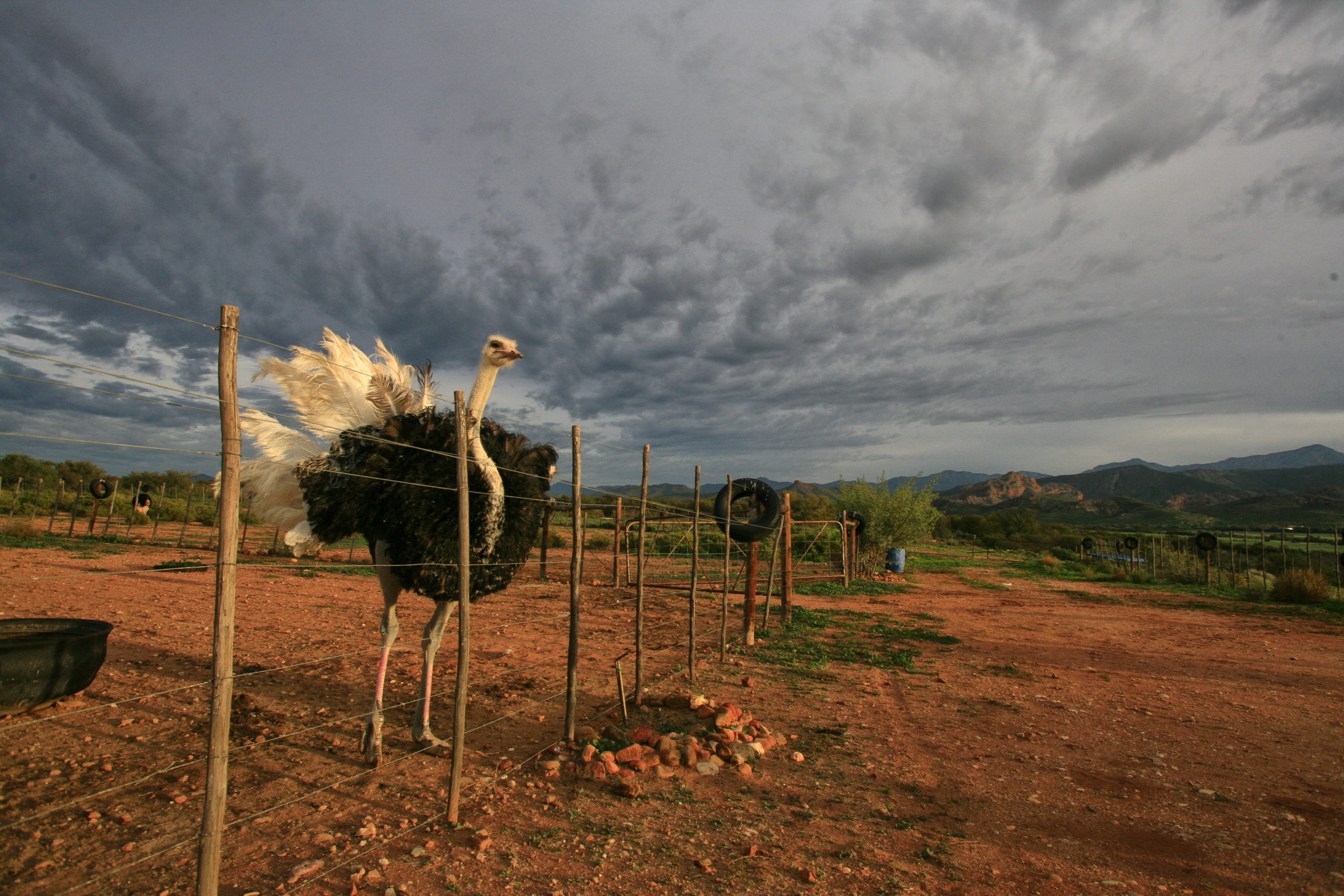
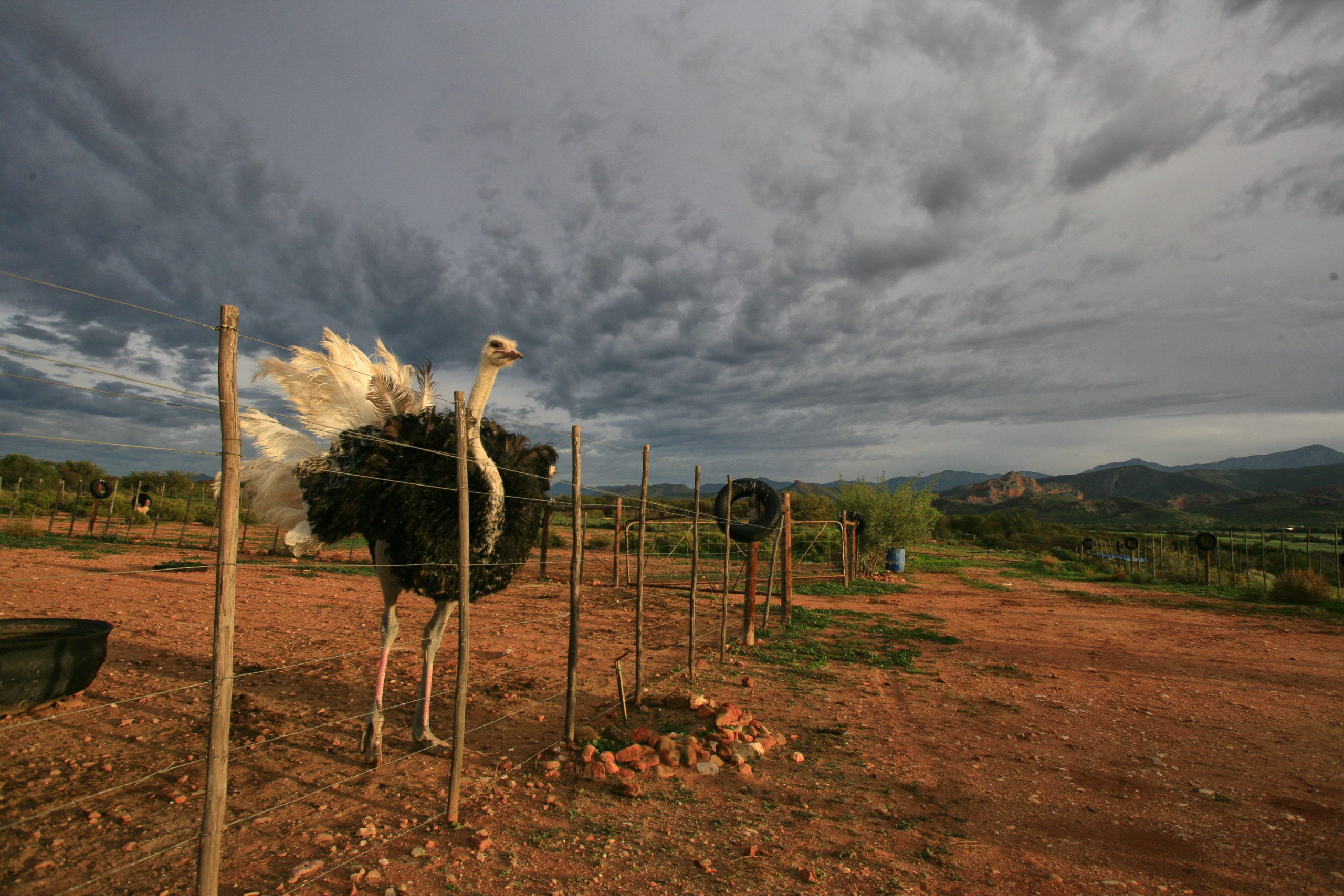
Handsome male ostrich patrolling the fenceline at Rietfontein Farm outside Oudtshoorn.
There are few birds as curious as a ‘wobble’ of young ostriches at the gate.
Ostriches – both male and female – generally make for great parents who share the baby-sitting duties.

If she likes the guy, Madame will modestly lower her head as she walks, shivering her grey wing feathers in approval. She will find a spot, sit down and let the games begin.

Such is the enduring inter-continental romantic lure of the ostrich, its delightful courtship moves and the gorgeous flightless feathers that line its wings.

Rietfontein Ostrich Palace

Now should you ever need a handy time portal while road-tripping along Route 62 in the Little Karoo, here’s how you get there.

Driving from Cape Town, you head through Calitzdorp on the Oudtshoorn road and continue eastwards for about 18km. Approaching the Karoo Boom farm stall on your right, look sharp left at the Red Stone Hills.

At the base of those stark crimson outcrops streaked with green algae, framed by tall blue gums and old date trees, is a palace fit for a Victorian-era royal in exile. The domed cupola gives it away.

Instantly, the mind’s eye wanders to an age of cavalry officers in uniform, ladies in big bonnet dresses, horse-drawn carriages in the driveway and kick-ass parties in the ballroom. With scandal and intrigue sure to follow.

Welcome to Rietfontein Ostrich Palace, the legendary home of the Potgieter family. Now let’s dart through that portal to a day in 1845 and a small clump of wagons outspanned about 200km west of here.

The stately Rietfontein Ostrich Palace in the distance, framed by the timeless Red Stone Hills at the base of the Swartberg range of mountains.
Rietfontein Ostrich Palace in the pink light of a Karoo dawn.
Dinner at the Rietfontein Ostrich Palace – ostrich fillet on the menu.

The pioneering Potgieters

Young Armaans Potgieter is a wagon driver who goes hunting for the pot in his down-time. He returns with an antelope of sorts and a couple of wild ostriches bagged along the way.

Armaans saves the tail and wing feathers of the birds and hopes he might flog them to a passing hide trader (smous) for a couple of pennies. Instead, gold coins fall into his hand along with some equally valuable advice from the smous:

“Buy land and farm with ostriches.”

And that’s how Armaans Potgieter becomes one of the world pioneers of ostrich farming, raising these glorious birds which had been hunted and killed (the lucky ones were simply stripped and sent off naked) for thousands of years before this.

Millennia ago, when Egypt was a major power, one of its many deities was the goddess Ma’at. This rather fetching young beauty was all about order, truth, justice and harmony. Her headdress contained a single white ostrich feather, and when you died your heart was weighed against that plume in the Afterworld. If you had lived a decent life, your ticker was lighter than the Feather of Truth and your chances of gaining entry to Paradise were fair. If not, well…

An ancient obsession

The Romans appeared to be a little more irreverent about the ostrich. Heliogabalus, who definitely would have failed the Egyptian Feather Test, was arguably the worst-behaved Roman teenage emperor of them all – quite a feat back then.

Heliogabalus fancied a three-day orgy with a very colourful menu. He once ordered 600 ostriches to be decapitated so he could serve their brains to his guests as teaspoon-sized appetisers. However, you do have to see this act of culinary insanity in its context: on occasion, the teenage potentate also ordered up platters of flamingo brains, parrot heads and peacock tongues. And you don’t want to know what these overfed gentryfolk did between courses.

He ran his empire in this macabre fashion from the age of 14 for four years until his granny, Julia Maesa, had enough of the brat and ordered the Praetorian Guard to dispose of him one night. You can read all about this royal rogue in The Fat Man’s Food Drink Compendium by Tony Grumley-Grennan.

Biblical Noah, charged with loading his Ark full of breeding pairs of various beasts, also had to pack an astonishing variety of feed for them. Various religious texts claim that he even stashed a supply of glass for the two ostriches in the hold of his vast cargo ship before the floods arrived.

Medieval literature has it that the female ostrich possessed the ultimate “lazy eye”, and could make her eggs hatch by simply staring hard at them for a while.

Fashion and the feathers

In those crazy Victorian times, women wore all kinds of dead-bird feathers on their hats, the most popular being ostrich plumes. In fact, if you look carefully at old photographs of various potentates through history, you’ll note that the guys wore ostrich plumes on their ceremonial helmets, and the 12 black horses that pulled the Duke of Wellington’s funeral wagon in 1852 all had clumps of black ostrich feathers on their heads.

Modern fashion displays using ostrich feathers – politician Helen Zille in the line-up at the CP Nel Museum.

And, possibly inspired by the vaguely erotic dance rituals of the ostrich, the plumes thus became an essential part of a showgirl’s costume from Paris to Rio de Janeiro. Big Chiefs at the New Orleans Mardi Gras and the various Junkanoos of the Caribbean islands wore them as well.

Someone simply had to start farming these wondrous birds. You couldn’t just keep killing them off for their wing feathers.

The rise of Veldskoendorp

In the first half of the 19th century, Oudtshoorn was a hardscrabble village described by its detractors rather haughtily as Veldskoendorp – a place of poor man’s shoes. It was officially named Oudtshoorn in honour of a newly-appointed Cape governor who never made it to these shores – he perished on the sea voyage out.

The 1860s began with a killer drought and ended in the Golden Age of the Ostrich. The ostrich farming frenzy really took hold when one Arthur Douglass invented the incubator in 1869, and production was vastly increased.

Farmers had to find markets for their feathers, and so a host of Jewish Lithuanian feather merchants criss-crossed the Little Karoo as middle-men in this fledgling industry.

Oom Swepie’s story

Oom Swepie le Roux of Doornkraal Farm east of Oudtshoorn, is every bit the baronial storyteller, who comes complete with his own family feather palace and a tasty brand of sparkling muscadel-grape rose called Tickled Pink. The front label sports a running ostrich and the back-label speaks of spicy food, good company and naughty women.

Well into his 80s, Oom Swepie tells the story of his Oupa Gert, his Ouma Maggie and the various smouse who visited Doornkraal.

Oom Swepie le Roux comes from a long line of Little Karoo ostrich farmers.

“They came for the feathers, the fare and the brandy cellar,” he says. “They would arrive from their dusty journeys, and Ouma would make them bathe first. She was also a devout Christian whose life’s ambition was to convert at least one Jewish pedlar, so she’d make them attend a service before dinner.

“After supper, Oupa and the smous would go down to the brandy cellar, light the lamps, share a drink and discuss the feathers, laid out for inspection. Then the haggling would begin.”

Oupa Gert may have prospered from his lamplight negotiations but Ouma Maggie, they say, had no luck converting the smouse.

There are ostrich palaces scattered about the Eastern Cape, but they really do seem to have a nest in the Calitzdorp-Oudtshoorn-De Rust district of the Little Karoo.

The feather boom mansions

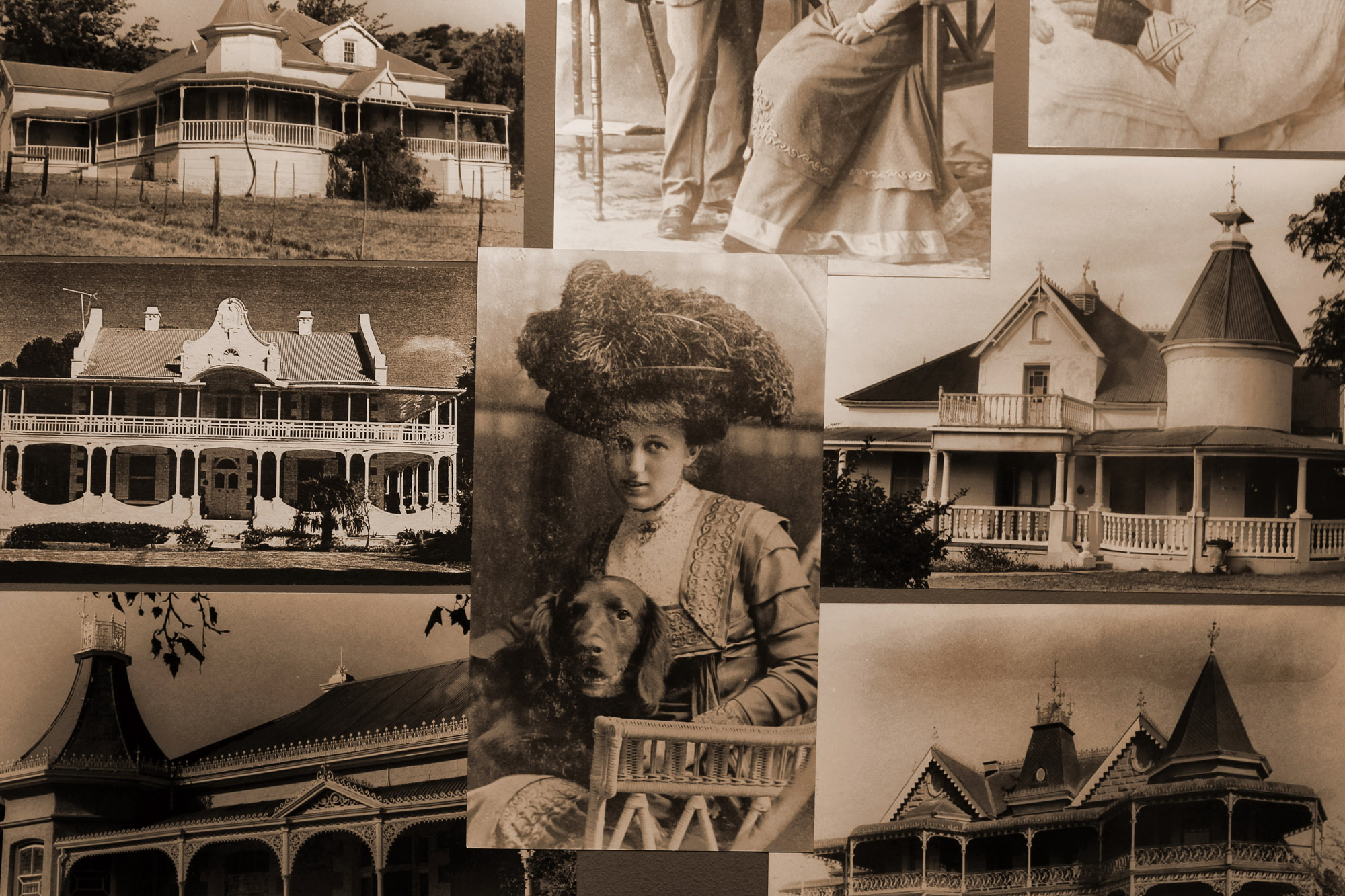
Back in the heyday of the ostrich industry, when a prime wing feather was worth more than its weight in gold, the new dry land millionaires wanted to tell the world of their riches. The Feather Boom Nouveaux Riche set had massive mansions built of local sandstone, sparing no expense on architectural shout-outs like turrets and parapets that served no practical purpose. Suddenly families had to have ballrooms, homes with 20 bedrooms and coach houses, all built in an eccentric froth of styles that drew from the Edwardian, Tudor, Elizabethan and Victorian eras.

The days of feathers, mansions and fine things on display at Oudtshoorn’s CP Nel Museum.
Ostrich feathers – at one time worth a fortune.

The two architects who made serious names for themselves here were Charles Bullock and Johannes Egbertus Vixseboxse. You see their handiwork all over Oudtshoorn, in the form of mansions that have been repurposed into old age homes, museums, little businesses and, of late, guest houses.

Dining rooms for 100 guests, marble baths that held 1,500 litres of water, Italian ceramic tiles around the fireplaces, mahogany inlaid libraries, Carrara marble in the kitchen, Delft and teak fancies, broekielace (cast iron railings) and burnt bricks, endless verandahs, stained glass windows, big lion carvings and other expensive doo-dahs from all corners of the Earth – it was not the Age of Minimalism. The diamond magnates of Kimberley and the gold barons of the Witwatersrand stood back in envy.

You can only imagine how the mail order catalogue business flourished in those days, how goods-laden ships flowed endlessly back and forth between continents while ostrich barons’ bank accounts just grew fatter and fatter with every plucking.

Adventure on the Niger

This saga of the South African ostrich industry comes with its own exotic adventure story, worthy of an Indiana Jones film or an Allan Quatermain classic.

Despite all these profits, the ostrich farmed in the Little Karoo was just so-so. It simply did not possess the ultimate plume quality to match that of the Barbary Bird, found somewhere in North Africa. There was a need to enrich the South African breeding stock with the Barbary, to give the locals an edge over their rivals, the USA. The magical feather everyone was after went by the name of Evans-Lovemore. It was blunt, strong and double-fluff dense.

So a small and discrete party, led by Russell Thornton of Grootfontein Agricultural College in Middelburg, set out in September 1911 on a steamship up the Niger River in the general direction of Timbuktu.

The Thornton Expedition travelled towards Timbuktu on the fabled Niger River. Photo by Chris Marais

A couple of train journeys later, they were based in Kano, northern Nigeria. They offered a reward for a sample of the Evans-Lovemore, located a likely source from Fort Zinder in French Sudan territory, recruited more than 100 porters, kept an eagle eye out for Tuareg raiders and hit the desert with gusto.

Thornton begged the French fort commander at Zinder to allow them to export some of the indigenous ostriches. The answer was a firm non, and so they returned to Nigeria and put out a general appeal for Barbaries once more.

Ostriches from all over the region were presented to the South Africans and gradually, bird by bird, they gathered a flock of Barbaries to take home. Nearly 150 specimens were carefully trucked back to the coast and shipped down to South Africa. Thornton was hailed as a local hero, the SA breeding herds were enriched and the Americans were full of envy.

The parties

In fact, so entrenched was the South African grip on the ostrich trade that, when the Titanic sank in 1912, part of its most valuable on-board cargo was a shipment of our feathers bound for New York markets, insured for millions of dollars.

The next two years of Oudtshoorn’s rather eccentric existence can be described for millennials as the old-time equivalent of the dot.com billionaire boom of Silicon Valley, California. The prime feathers from three ostriches could buy you a Model T Ford. One really perfect plume could be traded for a Union Castle berth from Cape Town to Southampton. It was The Great Gatsby before The Great Gatsby.

Bullock and Vixseboxse went into overdrive, servicing the architectural whims of the various ostrich overlords and their bigwig wives.

The Ostrich industry in its boom time, just before the crash of 1914.

The hangover

In 1914 it all came crashing down. World War I turned the globe away from the light-heartedness of party feathers; the open-top automobile made the wearing of big hats impractical, if not downright dangerous; it became a mark of shame to wear any body part of a bird on your head. It was the inevitable perfect storm of misfortune for this vanity-based industry and its kingpins. In so many ways, the carnival was over.

It was recorded that one feather dealer had a cheque for £100,000 honoured by his bank in early 1914 and a cheque for £1 rejected the next year. There were suicides, bankruptcies, mysterious disappearances and empty mansions on the Karoo veld.

The Karoo ostrich: gorgeous as ever, grubby beak and all.
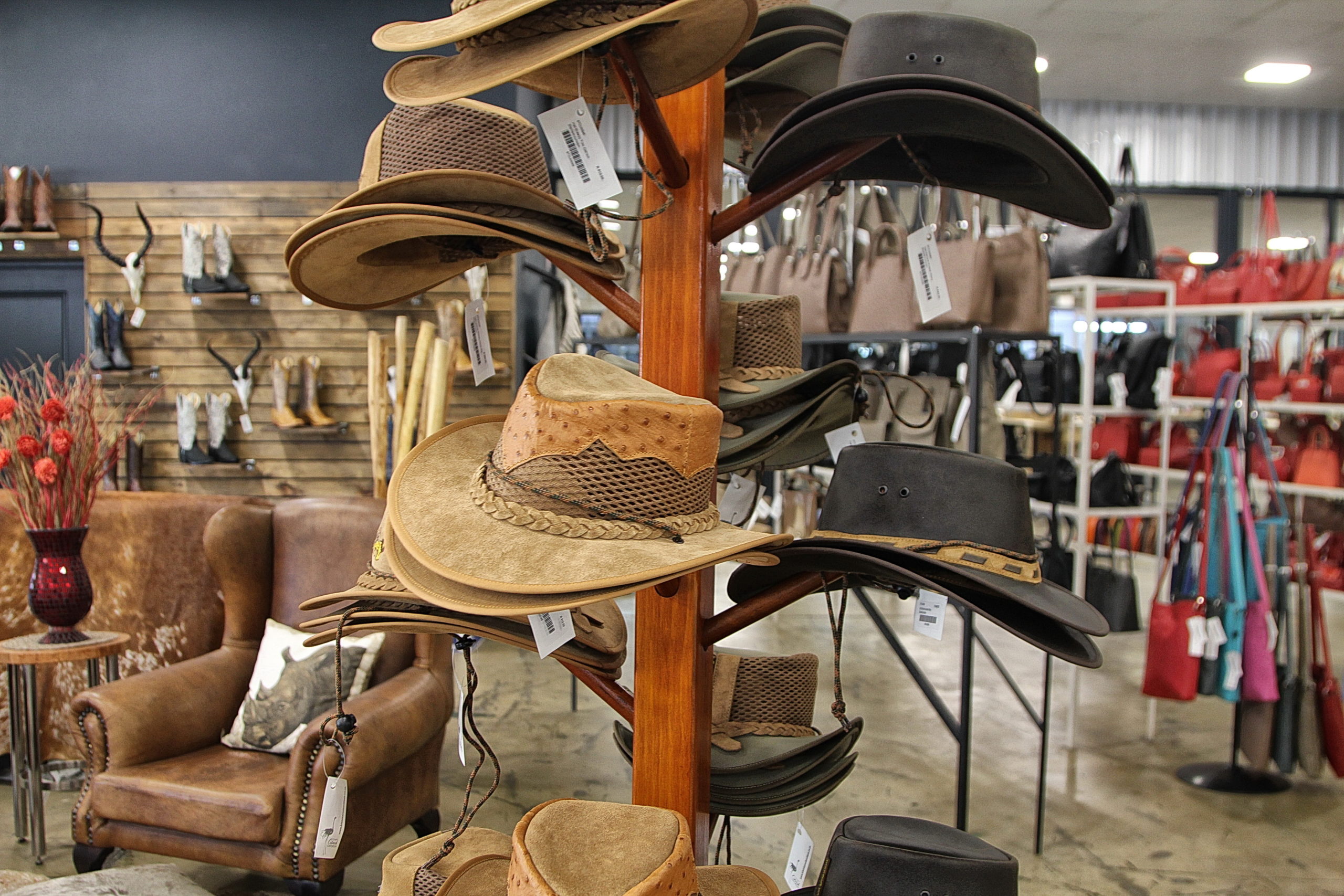
The ostrich skin cowboy hat – part of modern Western Wear.
The ostrich feather duster sellers outside the CP Nel Museum in Oudtshoorn.

In the past century since the Feather Fall of 1914, the ostrich industry has had a roller coaster ride consisting of a resurgent plume market, a growing taste for ostrich meat and a wider use for ostrich leather. And do not discount the ongoing boom in feather dusters.

Bird flu scares and European Union bans have come and gone, and the present southern African drought has also added to the decimation of the formerly vast ostrich flocks of the Little Karoo.

The ostrich arises

The Oudtshoorn ostrich flocks have been diminished due to the long drought – but they will return.

Now, however, the industry shows signs of innovation. The Klein Karoo Ostrich Emporium in Oudtshoorn has an extensive workshop where crafters fashion a variety of ostrich goods. Ostrich show-farms like Safari, Highgate and Cango tell the big bird story every day to busloads of tourists from everywhere.

And the palaces are being spruced up again. At Rietfontein, where it all began, you can stay in elegant accommodations within spitting distance of the old feather mansion and be hosted by Kobus Potgieter, descendant of The Original Armaans, and his wife, Elmarie.

The Rietfontein flock has been reduced to one rather feisty male and his two wives in a paddock out back. But they do a really good job of representing their legendary species, and the memory of their many flightless ancestors. DM/ ML

The Magic Bird is a chapter in Karoo Roads – Tales from South Africa’s Heartland, by Chris Marais and Julienne du Toit (MLM Publishers, 320 pages, 201 black and white images, 1 Karoo Map). To purchase, either order from www.karoospace.co.za or email [email protected] for details.

Chris Marais is a storyteller from Karoo Space.

Useful Links:

  1. Oudtshoorn Tourism: www.oudtshoorn.co.za
  2. Rietfontein Ostrich Palace: www.rop.co.za
  3. Safari Ostrich Farm: www.safariostrich.co.za
  4. Highgate Ostrich Show Farm: www.highgate.co.za
  5. Cango Ostrich Show Farm: www.cangoostrich.co.za
  6. Klein Karoo Ostrich Emporium: www.capekarooshop.co.za

Gallery


Comments – share your knowledge and experience

Please note you must be a Maverick Insider to comment. Sign up here or sign in if you are already an Insider.

Everybody has an opinion but not everyone has the knowledge and the experience to contribute meaningfully to a discussion. That’s what we want from our members. Help us learn with your expertise and insights on articles that we publish. We encourage different, respectful viewpoints to further our understanding of the world. View our comments policy here.

All Comments 3

  • Patricia Sidley says:

    Chris Marais always wrote beautifully — from the Rand Daily Mail days. And it’s a delight to read this. I had relatives who must have been traders in Oudtshoorn and I’m sure were never converted! There was a museum in Oudtshoorn with part of it devoted to the Jewish community there — but which curiously never made any mention anywhere in the museum, of black people. I was told that was because they “did not have a history there”. With a bit of luck that has changed.

    • Trevor Hall says:

      It has changed Pat and for the better, to be much more inclusive but retaining all the old grandeur. A superb museum, well run well staffed from our experience of a visit last March.

  • Brett Bard says:

    Dreamily romantic notions, but for the sake of human folly unbearable cruelty continues to be meted out unabated on these ‘magic’, ‘noble’, ‘glorious’ and essentially wild birds. On farms the pathetic majority spend their entire, rather short and unnatural lives crammed into bleak, leafless feedlots where they endure the humiliation and pain of captivity exposed to searing daytime temperatures. Annually around solstice, numerous ostriches in the Karoo succumb to the intense heat because no shade is provided. In effect this means that most days throughout the long, hot summers these poor birds are teetering on the brink of death, until the final horror of the day they’re trucked off to the abattoir to be unceremoniously slain.

    It’s not surprising that under such an assault on the natural order of things there have been several outbreaks of numerous strains of avian influenza (including H5N2 and H7N1) and it’s just a matter of time before…well we know how the story unfolds.

  • Category: NewsTag: cradock, graaff reinet, hofmeyer, karoo, news
    27 January 2021 by Guest

    The Magic Bird, a noble ostrich of The Karoo

    Photograph by Chris Marais (Image supplied) The Karoo ostrich might have had its updrafts and hard landings, but its legends still fly high. First published in Karoo Space. All photographs by Chris Marais. If you ever found yourself on the party streets of New Orleans on Mardi Gras Day, you might be lucky enough to …


    Photograph by Chris Marais (Image supplied)

    The Karoo ostrich might have had its updrafts and hard landings, but its legends still fly high.

    First published in Karoo Space. All photographs by Chris Marais.

    If you ever found yourself on the party streets of New Orleans on Mardi Gras Day, you might be lucky enough to spot a Big Chief Indian in full glorious spate.

    This wondrous apparition, clad from head to toe in sequins, beads, rhinestones, velvet and constantly-wavy ostrich plumes, would be accompanied by his Spyboy, his Flagboy, a whole bunch of drummers, a street-walking jazz band and a few hundred dancing followers.

    Down south in Rio de Janeiro, the annual Carnival would also be in progress, with thousands of lovely Samba Girls of the Copacabana dressed in a couple of sequins and very little else besides their beloved ostrich feathers.

    Showgirls and their feathers

    Across the sea in Belgium, the little coal-mining town of Binche has its traditional Gilles characters parading on Shrove Tuesday. During what some call “the world’s weirdest Mardi Gras”, the Gille is restricted to wearing his elaborate costume, wooden clogs and fancy ostrich feather headdress within the confines of Binche – and only on this day.

    On most nights not too far from here, you might be in the Moulin Rouge Theatre in the Montmartre district of Paris, completely bedazzled by a large troupe of leggy performers, tantalising the audience behind their brightly dyed ostrich feather arrangements.

    Their trans-Atlantic match is the legendary Las Vegas Showgirl, motionless (legally, she had to stand really still to appear before you in her birthday suit), bedecked all about in ostrich plumes and jewels.

    But all that marvellous carnival glitz and glamour, all those high-priced gin joints and chorus-line saloons cannot match the true Romance Dance of the Plume down here in the Karoo when a male ostrich with blood-red shins begins to court his darling-to-be.

    The ostrich romance dance

    Monsieur will drop to the ground, spread his gorgeous wings before Madame and, with his head flung back, he will begin to thrum and gyrate, making a loud booming noise. Then, lifting himself on the tips of his toes like Baryshnikov, he will puff up all his feathers and run daintily around the eyelash-batting object of his affections.

    Handsome male ostrich patrolling the fenceline at Rietfontein Farm outside Oudtshoorn.
    There are few birds as curious as a ‘wobble’ of young ostriches at the gate.
    Ostriches – both male and female – generally make for great parents who share the baby-sitting duties.

    If she likes the guy, Madame will modestly lower her head as she walks, shivering her grey wing feathers in approval. She will find a spot, sit down and let the games begin.

    Such is the enduring inter-continental romantic lure of the ostrich, its delightful courtship moves and the gorgeous flightless feathers that line its wings.

    Rietfontein Ostrich Palace

    Now should you ever need a handy time portal while road-tripping along Route 62 in the Little Karoo, here’s how you get there.

    Driving from Cape Town, you head through Calitzdorp on the Oudtshoorn road and continue eastwards for about 18km. Approaching the Karoo Boom farm stall on your right, look sharp left at the Red Stone Hills.

    At the base of those stark crimson outcrops streaked with green algae, framed by tall blue gums and old date trees, is a palace fit for a Victorian-era royal in exile. The domed cupola gives it away.

    Instantly, the mind’s eye wanders to an age of cavalry officers in uniform, ladies in big bonnet dresses, horse-drawn carriages in the driveway and kick-ass parties in the ballroom. With scandal and intrigue sure to follow.

    Welcome to Rietfontein Ostrich Palace, the legendary home of the Potgieter family. Now let’s dart through that portal to a day in 1845 and a small clump of wagons outspanned about 200km west of here.

    The stately Rietfontein Ostrich Palace in the distance, framed by the timeless Red Stone Hills at the base of the Swartberg range of mountains.
    Rietfontein Ostrich Palace in the pink light of a Karoo dawn.
    Dinner at the Rietfontein Ostrich Palace – ostrich fillet on the menu.

    The pioneering Potgieters

    Young Armaans Potgieter is a wagon driver who goes hunting for the pot in his down-time. He returns with an antelope of sorts and a couple of wild ostriches bagged along the way.

    Armaans saves the tail and wing feathers of the birds and hopes he might flog them to a passing hide trader (smous) for a couple of pennies. Instead, gold coins fall into his hand along with some equally valuable advice from the smous:

    “Buy land and farm with ostriches.”

    And that’s how Armaans Potgieter becomes one of the world pioneers of ostrich farming, raising these glorious birds which had been hunted and killed (the lucky ones were simply stripped and sent off naked) for thousands of years before this.

    Millennia ago, when Egypt was a major power, one of its many deities was the goddess Ma’at. This rather fetching young beauty was all about order, truth, justice and harmony. Her headdress contained a single white ostrich feather, and when you died your heart was weighed against that plume in the Afterworld. If you had lived a decent life, your ticker was lighter than the Feather of Truth and your chances of gaining entry to Paradise were fair. If not, well…

    An ancient obsession

    The Romans appeared to be a little more irreverent about the ostrich. Heliogabalus, who definitely would have failed the Egyptian Feather Test, was arguably the worst-behaved Roman teenage emperor of them all – quite a feat back then.

    Heliogabalus fancied a three-day orgy with a very colourful menu. He once ordered 600 ostriches to be decapitated so he could serve their brains to his guests as teaspoon-sized appetisers. However, you do have to see this act of culinary insanity in its context: on occasion, the teenage potentate also ordered up platters of flamingo brains, parrot heads and peacock tongues. And you don’t want to know what these overfed gentryfolk did between courses.

    He ran his empire in this macabre fashion from the age of 14 for four years until his granny, Julia Maesa, had enough of the brat and ordered the Praetorian Guard to dispose of him one night. You can read all about this royal rogue in The Fat Man’s Food Drink Compendium by Tony Grumley-Grennan.

    Biblical Noah, charged with loading his Ark full of breeding pairs of various beasts, also had to pack an astonishing variety of feed for them. Various religious texts claim that he even stashed a supply of glass for the two ostriches in the hold of his vast cargo ship before the floods arrived.

    Medieval literature has it that the female ostrich possessed the ultimate “lazy eye”, and could make her eggs hatch by simply staring hard at them for a while.

    Fashion and the feathers

    In those crazy Victorian times, women wore all kinds of dead-bird feathers on their hats, the most popular being ostrich plumes. In fact, if you look carefully at old photographs of various potentates through history, you’ll note that the guys wore ostrich plumes on their ceremonial helmets, and the 12 black horses that pulled the Duke of Wellington’s funeral wagon in 1852 all had clumps of black ostrich feathers on their heads.

    Modern fashion displays using ostrich feathers – politician Helen Zille in the line-up at the CP Nel Museum.

    And, possibly inspired by the vaguely erotic dance rituals of the ostrich, the plumes thus became an essential part of a showgirl’s costume from Paris to Rio de Janeiro. Big Chiefs at the New Orleans Mardi Gras and the various Junkanoos of the Caribbean islands wore them as well.

    Someone simply had to start farming these wondrous birds. You couldn’t just keep killing them off for their wing feathers.

    The rise of Veldskoendorp

    In the first half of the 19th century, Oudtshoorn was a hardscrabble village described by its detractors rather haughtily as Veldskoendorp – a place of poor man’s shoes. It was officially named Oudtshoorn in honour of a newly-appointed Cape governor who never made it to these shores – he perished on the sea voyage out.

    The 1860s began with a killer drought and ended in the Golden Age of the Ostrich. The ostrich farming frenzy really took hold when one Arthur Douglass invented the incubator in 1869, and production was vastly increased.

    Farmers had to find markets for their feathers, and so a host of Jewish Lithuanian feather merchants criss-crossed the Little Karoo as middle-men in this fledgling industry.

    Oom Swepie’s story

    Oom Swepie le Roux of Doornkraal Farm east of Oudtshoorn, is every bit the baronial storyteller, who comes complete with his own family feather palace and a tasty brand of sparkling muscadel-grape rose called Tickled Pink. The front label sports a running ostrich and the back-label speaks of spicy food, good company and naughty women.

    Well into his 80s, Oom Swepie tells the story of his Oupa Gert, his Ouma Maggie and the various smouse who visited Doornkraal.

    Oom Swepie le Roux comes from a long line of Little Karoo ostrich farmers.

    “They came for the feathers, the fare and the brandy cellar,” he says. “They would arrive from their dusty journeys, and Ouma would make them bathe first. She was also a devout Christian whose life’s ambition was to convert at least one Jewish pedlar, so she’d make them attend a service before dinner.

    “After supper, Oupa and the smous would go down to the brandy cellar, light the lamps, share a drink and discuss the feathers, laid out for inspection. Then the haggling would begin.”

    Oupa Gert may have prospered from his lamplight negotiations but Ouma Maggie, they say, had no luck converting the smouse.

    There are ostrich palaces scattered about the Eastern Cape, but they really do seem to have a nest in the Calitzdorp-Oudtshoorn-De Rust district of the Little Karoo.

    The feather boom mansions

    Back in the heyday of the ostrich industry, when a prime wing feather was worth more than its weight in gold, the new dry land millionaires wanted to tell the world of their riches. The Feather Boom Nouveaux Riche set had massive mansions built of local sandstone, sparing no expense on architectural shout-outs like turrets and parapets that served no practical purpose. Suddenly families had to have ballrooms, homes with 20 bedrooms and coach houses, all built in an eccentric froth of styles that drew from the Edwardian, Tudor, Elizabethan and Victorian eras.

    The days of feathers, mansions and fine things on display at Oudtshoorn’s CP Nel Museum.
    Ostrich feathers – at one time worth a fortune.

    The two architects who made serious names for themselves here were Charles Bullock and Johannes Egbertus Vixseboxse. You see their handiwork all over Oudtshoorn, in the form of mansions that have been repurposed into old age homes, museums, little businesses and, of late, guest houses.

    Dining rooms for 100 guests, marble baths that held 1,500 litres of water, Italian ceramic tiles around the fireplaces, mahogany inlaid libraries, Carrara marble in the kitchen, Delft and teak fancies, broekielace (cast iron railings) and burnt bricks, endless verandahs, stained glass windows, big lion carvings and other expensive doo-dahs from all corners of the Earth – it was not the Age of Minimalism. The diamond magnates of Kimberley and the gold barons of the Witwatersrand stood back in envy.

    You can only imagine how the mail order catalogue business flourished in those days, how goods-laden ships flowed endlessly back and forth between continents while ostrich barons’ bank accounts just grew fatter and fatter with every plucking.

    Adventure on the Niger

    This saga of the South African ostrich industry comes with its own exotic adventure story, worthy of an Indiana Jones film or an Allan Quatermain classic.

    Despite all these profits, the ostrich farmed in the Little Karoo was just so-so. It simply did not possess the ultimate plume quality to match that of the Barbary Bird, found somewhere in North Africa. There was a need to enrich the South African breeding stock with the Barbary, to give the locals an edge over their rivals, the USA. The magical feather everyone was after went by the name of Evans-Lovemore. It was blunt, strong and double-fluff dense.

    So a small and discrete party, led by Russell Thornton of Grootfontein Agricultural College in Middelburg, set out in September 1911 on a steamship up the Niger River in the general direction of Timbuktu.

    The Thornton Expedition travelled towards Timbuktu on the fabled Niger River. Photo by Chris Marais

    A couple of train journeys later, they were based in Kano, northern Nigeria. They offered a reward for a sample of the Evans-Lovemore, located a likely source from Fort Zinder in French Sudan territory, recruited more than 100 porters, kept an eagle eye out for Tuareg raiders and hit the desert with gusto.

    Thornton begged the French fort commander at Zinder to allow them to export some of the indigenous ostriches. The answer was a firm non, and so they returned to Nigeria and put out a general appeal for Barbaries once more.

    Ostriches from all over the region were presented to the South Africans and gradually, bird by bird, they gathered a flock of Barbaries to take home. Nearly 150 specimens were carefully trucked back to the coast and shipped down to South Africa. Thornton was hailed as a local hero, the SA breeding herds were enriched and the Americans were full of envy.

    The parties

    In fact, so entrenched was the South African grip on the ostrich trade that, when the Titanic sank in 1912, part of its most valuable on-board cargo was a shipment of our feathers bound for New York markets, insured for millions of dollars.

    The next two years of Oudtshoorn’s rather eccentric existence can be described for millennials as the old-time equivalent of the dot.com billionaire boom of Silicon Valley, California. The prime feathers from three ostriches could buy you a Model T Ford. One really perfect plume could be traded for a Union Castle berth from Cape Town to Southampton. It was The Great Gatsby before The Great Gatsby.

    Bullock and Vixseboxse went into overdrive, servicing the architectural whims of the various ostrich overlords and their bigwig wives.

    The Ostrich industry in its boom time, just before the crash of 1914.

    The hangover

    In 1914 it all came crashing down. World War I turned the globe away from the light-heartedness of party feathers; the open-top automobile made the wearing of big hats impractical, if not downright dangerous; it became a mark of shame to wear any body part of a bird on your head. It was the inevitable perfect storm of misfortune for this vanity-based industry and its kingpins. In so many ways, the carnival was over.

    It was recorded that one feather dealer had a cheque for £100,000 honoured by his bank in early 1914 and a cheque for £1 rejected the next year. There were suicides, bankruptcies, mysterious disappearances and empty mansions on the Karoo veld.

    The Karoo ostrich: gorgeous as ever, grubby beak and all.
    The ostrich skin cowboy hat – part of modern Western Wear.
    The ostrich feather duster sellers outside the CP Nel Museum in Oudtshoorn.

    In the past century since the Feather Fall of 1914, the ostrich industry has had a roller coaster ride consisting of a resurgent plume market, a growing taste for ostrich meat and a wider use for ostrich leather. And do not discount the ongoing boom in feather dusters.

    Bird flu scares and European Union bans have come and gone, and the present southern African drought has also added to the decimation of the formerly vast ostrich flocks of the Little Karoo.

    The ostrich arises

    The Oudtshoorn ostrich flocks have been diminished due to the long drought – but they will return.

    Now, however, the industry shows signs of innovation. The Klein Karoo Ostrich Emporium in Oudtshoorn has an extensive workshop where crafters fashion a variety of ostrich goods. Ostrich show-farms like Safari, Highgate and Cango tell the big bird story every day to busloads of tourists from everywhere.

    And the palaces are being spruced up again. At Rietfontein, where it all began, you can stay in elegant accommodations within spitting distance of the old feather mansion and be hosted by Kobus Potgieter, descendant of The Original Armaans, and his wife, Elmarie.

    The Rietfontein flock has been reduced to one rather feisty male and his two wives in a paddock out back. But they do a really good job of representing their legendary species, and the memory of their many flightless ancestors. DM/ ML

    The Magic Bird is a chapter in Karoo Roads – Tales from South Africa’s Heartland, by Chris Marais and Julienne du Toit (MLM Publishers, 320 pages, 201 black and white images, 1 Karoo Map). To purchase, either order from www.karoospace.co.za or email [email protected] for details.

    Chris Marais is a storyteller from Karoo Space.

    Useful Links:

    1. Oudtshoorn Tourism: www.oudtshoorn.co.za
    2. Rietfontein Ostrich Palace: www.rop.co.za
    3. Safari Ostrich Farm: www.safariostrich.co.za
    4. Highgate Ostrich Show Farm: www.highgate.co.za
    5. Cango Ostrich Show Farm: www.cangoostrich.co.za
    6. Klein Karoo Ostrich Emporium: www.capekarooshop.co.za

    Gallery


    Comments – share your knowledge and experience

    Please note you must be a Maverick Insider to comment. Sign up here or sign in if you are already an Insider.

    Everybody has an opinion but not everyone has the knowledge and the experience to contribute meaningfully to a discussion. That’s what we want from our members. Help us learn with your expertise and insights on articles that we publish. We encourage different, respectful viewpoints to further our understanding of the world. View our comments policy here.

    No Comments, yet

    Category: NewsTag: cradock, graaff reinet, hofmeyer, karoo, news
    25 January 2021 by Guest

    Arms caches could be buried all over South Africa by freedom fighters and right-wingers

    Graphic: Rudi Louw The stashes of weapons, the stories go, were to be used when either side felt the time was right to go ahead with a battle. First published in the Daily Maverick 168 weekly newspaper. The saying “There must be something in the water” is often used to describe a situation involving several …


    Graphic: Rudi Louw

    The stashes of weapons, the stories go, were to be used when either side felt the time was right to go ahead with a battle.

    First published in the Daily Maverick 168 weekly newspaper.

    The saying “There must be something in the water” is often used to describe a situation involving several people with similar quirks or traits. It implies the link between them is something in the shared water source they drink from.

    In the Klein Karoo town of Oudtshoorn the saying has taken on a more literal meaning because something intriguing was recently found in a source of water supplying the town: a cache of firearms and ammunition – some of it rusty, some of it in relatively sturdy-looking small cardboard boxes, and some of it shiny and looking quite new.

    For several years, tales have floated around in police and political circles of how, decades ago, those fighting for democracy in South Africa buried mounds of firearms and ammunition in places that included cemeteries and national parks.

    Similar tales of right-wingers having done the same have also surfaced.

    The stashes of weapons, the stories go, were to be used when either side felt the time was right to go ahead with a battle. That point has never been reached and so the caches remain hidden across South Africa.

    If any of these firearms were found today, or within the next week or so, handing them over to police would not necessarily result in prosecution, because SA still has a firearms amnesty in place, which ends on 31 January.

    SA Police Service (SAPS) guidelines describe this as “An opportunity for members of the public to surrender unwanted firearms or firearms they possess illegally, as well as ammunition and/or firearm parts to [SAPS] without fear of being prosecuted for the unlawful possession of this equipment.”

    Intriguing

    This all makes the discovery of the firearms and ammunition in the dam outside Oudtshoorn, home to a military base, especially intriguing.

    It appears that, if the cache was hidden rather than handed over to the police under the amnesty, the items may not be licensed, and the owner may be intentionally trying to avoid scrutiny. But there are other theories about the firearms and ammunition.

    When Southern Cape police spokesperson Malcolm Pojie announced the discovery of the cache, he said a municipal worker had spotted the weapons during a routine inspection of the Koos Raubenheimer Dam in early January. It is understood the dam – which, according to a document on the Western Cape government’s website, was built in 1971 and is managed by the Oudtshoorn Municipality – had been closed to the public.

    The municipal worker returned to the dam on 7 January after the water level had dropped further – and discovered more ammunition.

    The police were alerted and a team of experienced investigators, as well as police divers and bomb disposal experts, were dispatched to the dam where they retrieved the firearms and ammunition. They found more of them.

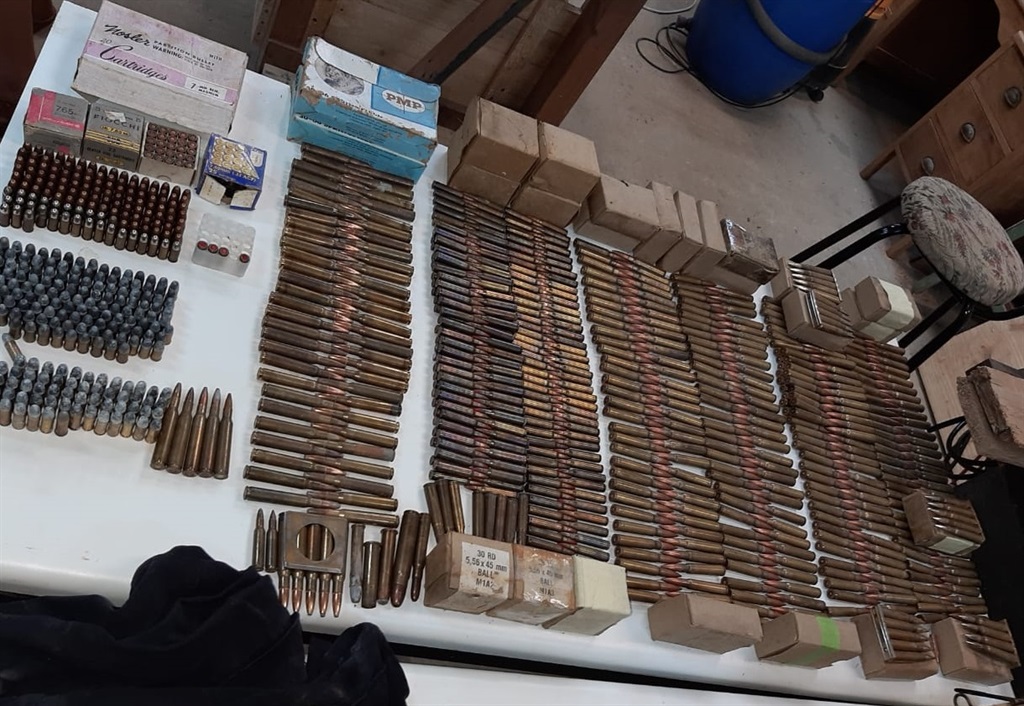
    According to police, the discovery included three Martini-Henry rifles, a BSA rifle, a .303 rifle, an antique shotgun, two revolvers and 8,820 rounds of ammunition of various calibres.

    Pojie said: “Investigation into this discovery continues and [it] is expected that more ammunition could be retrieved. We appeal to any person that could assist to trace the person responsible for dumping these items to please come forward…”

    Several photographs of the recovered firearms and ammunition were attached to Pojie’s statement that was issued to the media.

    DM168 tried, via firearms industry experts, to identify the age and origin of the discovered items.

    Some said it was not possible to do so, because the serial numbers were not visible in the photographs. They said some of the ammunition looked more modern than the firearms, suggesting police investigators would focus on this. Others provided some clues as to where the items could have originated.

    John Welch, the chair of the National Arms and Ammunition Collectors’ Confederation of South Africa, said he did not want to speculate on how the items had ended up in the dam, but instead focused on what had been discovered.

    Welch said: “The various photos in fact depict rifles, a handgun (revolver), a shotgun pistol, a variety of ammunition, ranging from .22 Rimfire to 12-gauge shotgun, and even a self-propelled rocket, which appears to be an RPG-7 that was fired (discharged) but either failed to detonate or was deactivated.”

    He added that “the Russian/Cuban/Chinese/East German/Romanian/etc RPG-7 was used by Angolan and Cuban forces during the so-called Border War and had (still has) a reputation as an armoured vehicle destroyer”.

    The Martini-Henry rifles were developed in the 1870s.

    “The Martini-Henry was used by both sides during the first Anglo-Boer War and to some extent even during the second Anglo-Boer War,” Welch said. “It also was used extensively by British forces during the Anglo-Zulu War and various conflicts.

    “The revolver also appears to emanate from that era. The ammunition for the Martini-Henry rifle is obsolete, but staunch collectors will reload their own ammunition since most well-looked after rifles are shootable, and … [it] still makes a good hunting rifle.”

    Welch said Lee-Enfield rifles, used in both world wars, were manufactured between 1907 and the 1940s.

    “Good quality Martini-Henri and Lee Enfield rifles are sought after by collectors … Many of these rifles are family heirlooms in the hands of licensed firearm owners … used primarily for target shooting and hunting.”

    He said the shotgun appeared to be a typical farmer’s one dating to the previous turn of the century and that these were most often family heirlooms or to be found in museums.

    The discovered ammunition, Welch said, appeared to be both military and commercial, “some of which is of recent history”. Except for one type found, it appeared none of the ammunition would fit the firearms depicted in the photographs issued by police.

    Training gear

    Sias Fourie, a former police warrant officer involved in tactical training and public order policing, said that there appeared to be R5 rifle ammunition and various single bullets that seemed to be part of a collection for the purposes of training. He said the RPG-7 rocket was not highly significant.

    “In the area where I come from … most of the trainers organised training aids such as that so the trainees could be shown what an RPG-7 rocket looked like in a safe manner.

    “I really believe that [the cache] could have been a collection of old rifles and ammunition from a trainer who most probably died and left his family to try [to] deal with the situation by dumping the lot in the dam…”

    There have been other firearm cache discoveries in SA over the years – some with suspected links to gangs and other crimes. On 2 December last year, a cache of firearms was discovered in a room on a farm in Kouga in the Eastern Cape, and a 58-year-old man was arrested.

    “Several firearms including two different calibres of rifles, two different calibres of shotgun, a pistol, a rifle shotgun combination and … various rounds of ammunition were found,” a police statement said. “Investigators are working with ballistics to determine ownership … as the serial numbers on some of them had been filed off.”

    In December 2019, police in Vanderbijlpark in Gauteng discovered 43 firearms and about 2,000 rounds of ammunition in a home. A 31-year-old was arrested “after he could not provide satisfactory answers or prove the validity of such a large quantity of firearms and ammunition”. DM168

    This story first appeared in our weekly Daily Maverick 168 newspaper which is available for free to Pick n Pay Smart Shoppers at these Pick n Pay stores.

    Gallery


    Comments – share your knowledge and experience

    Please note you must be a Maverick Insider to comment. Sign up here or sign in if you are already an Insider.

    Everybody has an opinion but not everyone has the knowledge and the experience to contribute meaningfully to a discussion. That’s what we want from our members. Help us learn with your expertise and insights on articles that we publish. We encourage different, respectful viewpoints to further our understanding of the world. View our comments policy here.

    All Comments 4

  • Chris Skinner says:

    A rather weak article under an eye catching heading

  • Peter Brierley says:

    What a storm in a teacup. These look like historic weapons at best. Arms cache… what a joke.

  • Chris Skinner says:

    And an inert/blank RPG7 added into the mix for the sensationalism he he

  • Andrew Johnson says:

    Come on Maverick, I expected somethin a bit more juicy on a Monday morning.

  • Category: NewsTag: cradock, graaff reinet, hofmeyer, karoo, news
    24 January 2021 by Guest

    Saturday’s weather: Thundershowers, heatwaves forecast across the country

    The South African Weather Service is advising of severe thunderstorms in some parts of the country, in what is forecast to be a mostly warm to hot Saturday.  Impact-based warnings Yellow Level 1 warning for severe thunderstorms, with heavy downpours, gusty winds and excessive lightning. It will result in localised damage to settlements (formal/informal), vehicles …

    The South African Weather Service is advising of severe thunderstorms in some parts of the country, in what is forecast to be a mostly warm to hot Saturday. 

    Impact-based warnings

    Yellow Level 1 warning for severe thunderstorms, with heavy downpours, gusty winds and excessive lightning. It will result in localised damage to settlements (formal/informal), vehicles and a short-term disruption to power over the eastern interior, spreading to the coastline.

    Fire danger warning

    Extremely high fire danger conditions are expected over the western and central interior of the Western Cape and southern parts of the Namakwa District of the Northern Cape.

    Advisories

    – Extremely hot conditions are expected over Khai-Ma in the Northern Cape, Central Karoo District, Langeberg municipality of the Western Cape as well as the western half of the Eastern Cape.

    – A heat wave, with persistently high temperatures, is expected over the Matzikama municipality and the southern parts of Namakwa Districts of the Northern Cape, central and the eastern interior of the Western Cape province as well as the western and northern interior of the Eastern Cape.      

    The weather in your province

    Gauteng will be fine and hot.

    The expected UVB sunburn index is low.

    In Mpumalanga, it will be partly cloudy and warm, with isolated showers and thundershowers in the north-east, but scattered in the extreme north-east. 

    Limpopo will be partly cloudy and warm, with isolated showers and thundershowers, except in the south-west, where it will be hot. It will become cloudy, with scattered showers and thundershowers in the lowveld. 

    In the North West, it will be fine and hot, becoming partly cloudy, with isolated showers and thundershowers in the extreme west from the afternoon.

    The Free State will be warm in the east, otherwise fine and hot, but partly cloudy in the west, spreading eastwards in the afternoon. Isolated showers and thundershowers are expected in the west from the afternoon.

    Conditions in the Northern Cape will be cloudy and warm along the coast in the morning, otherwise partly cloudy to fine and hot to very hot, but extremely hot in places over the northern interior.

    There will be isolated evening thundershowers in the north-east.

    The wind along the coast will be moderate to fresh southerly to south-easterly, becoming strong in the afternoon.

    In the Western Cape, it will be cloudy, with fog along the coast in the morning, otherwise partly cloudy and warm to hot, but very hot to extremely hot over the Little and Central Karoo.

    There will be isolated evening thundershowers in places.

    It will become cloudy, with light rain over the south-western parts and south coast from the evening.

    The wind along the coast will be moderate to fresh westerly to south-westerly, but strong along the south-coast in the afternoon.

    The expected UVB sunburn index is extreme.

    The western half of the Eastern Cape will be cloudy, with morning fog along the coast and adjacent interior, but partly cloudy and hot to very hot, with isolated showers and thundershowers from the afternoon.

    The wind along the coast will be light to moderate south-westerly, becoming moderate to fresh from the afternoon.

    In the eastern half of the Eastern Cape, it will be partly cloudy and hot, with scattered showers and thundershowers in the afternoon, but isolated in the north.

    The wind along the coast will be moderate to fresh north-easterly, becoming south-westerly from the south in the afternoon.

    KwaZulu-Natal can expect morning fog over the interior, otherwise fine and hot, but very hot in the north.

    It will become partly cloudy, with isolated showers and thundershowers in the south-west.

    The wind along the coast will be moderate northerly to north-easterly, becoming fresh in places in the afternoon.

    The expected UVB sunburn index is extreme.

    Click here to see the specific forecast for your city over the next few days.

    Category: NewsTag: cradock, graaff reinet, hofmeyer, karoo, news
    22 January 2021 by Guest

    Friday’s weather: Severe thunderstorms headed for Eastern Cape

    The South African Weather Service has issued a warning to the Eastern Cape for severe thunderstorms, while the rest of the country can look forward to warm to hot conditions with isolated thundershowers. Impact-based warnings Yellow level 2 warning for severe thunderstorms with heavy downpours, gusty winds, hail and excessive lightning resulting in localised damages …

    The South African Weather Service has issued a warning to the Eastern Cape for severe thunderstorms, while the rest of the country can look forward to warm to hot conditions with isolated thundershowers.

    Impact-based warnings

    Yellow level 2 warning for severe thunderstorms with heavy downpours, gusty winds, hail and excessive lightning resulting in localised damages to settlements formal/informal, vehicles and a short-term disruption to power over the eastern interior of the Eastern Cape.

    Fire danger warnings

    Extremely high fire danger conditions are expected over the western and central interior of the Western Cape and southern parts of Namakwa district of the Northern Cape.

    Advisories

    – Extremely hot conditions are expected over Khai-Ma in the Northern Cape, Central Karoo District as well as Langeberg municipality in the Western Cape tomorrow.

    – A heatwave with persistently high temperatures is expected over the Matzikama municipality and the southern parts of Namakwa district in the Northern Cape until tomorrow, but over the central and the eastern interior of the Western Cape, and western and northern interior of the Eastern Cape until Saturday.

    The weather in your province

    Gauteng will be partly cloudy and hot.

    The expected UVB sunburn index is moderate.

    In Mpumalanga, there will be morning fog patches over the escarpment, otherwise partly cloudy and warm.

    In Limpopo, it will be partly cloudy and warm to hot.

    The North West will be fine and warm to hot, becoming partly cloudy with isolated showers and thundershowers, except in the north-east.

    It will be fine in the east of the Free State at first, otherwise partly cloudy and warm to hot with isolated showers and thundershowers, except in the extreme east.

    The Northern Cape will be partly cloudy and hot to very hot with isolated showers and thundershowers in the central and eastern parts. It will be extremely hot in the south. The wind along the coast will be moderate to fresh southerly to south-westerly.

    In the Western Cape, it will be cloudy with morning fog along the south coast at first, otherwise fine and warm along the coastal areas, but hot to very hot over the western interior and extremely hot over the central and eastern interior.

    The wind along the coast will be moderate easterly along the south coast in the morning, otherwise fresh to strong south-easterly.

    The expected UVB sunburn index is extreme.

    The western half of the Eastern Cape will be cloudy and warm with morning fog in places in the south, otherwise partly cloudy and hot to very hot with isolated thunderstorms over the north-east.

    The wind along the coast will be moderate to fresh south-easterly, reaching strong east of Port Elizabeth in the afternoon.

    The eastern half of the Eastern Cape will be cloudy and warm with morning fog south of the escarpment, otherwise partly cloudy and hot with isolated thunderstorms over the interior from the afternoon.

    The wind along the coast will be moderate to fresh north-easterly, and strong in the evening.

    You can expect morning fog over the interior in KwaZulu-Natal, otherwise partly cloudy and warm, but hot in places in the north. Afternoon isolated showers and thundershowers are expected in the south western parts.

    The wind along the coast will be moderate northerly to north-easterly in the morning, becoming fresh.

    The expected UVB sunburn index is extreme.

    w

    Click here to see the specific forecast for your city over the next few days.

    – Compiled by Kamva Somdyala

    Category: NewsTag: cradock, graaff reinet, hofmeyer, karoo, news
    21 January 2021 by Guest

    Map: COVID-19 hotspots in South Africa

    On Monday, President Cyril Ramaphosa declared various districts across the country as COVID-19 hotspots. He said municipalities defined as hotspots will be subject to additional restrictions until there is a clear and sustained decline in infections. “Those living in the hotspot districts are strongly encouraged to minimise their travel within the district to essential travel …

    On Monday, President Cyril Ramaphosa declared various districts across the country as COVID-19 hotspots. He said municipalities defined as hotspots will be subject to additional restrictions until there is a clear and sustained decline in infections.

    “Those living in the hotspot districts are strongly encouraged to minimise their travel within the district to essential travel so as to minimise contact with other people,” said the President.

    Provincial COVID-19 hotspots 

    EASTERN CAPE:

    Chris Hani District, Buffalo City, Amathole District, Alfred Nzo District and the OR Tambo District. These are in addition to the Nelson Mandela Bay Metro and the Sarah Baartman District, which have already been declared hotspots.

    WESTERN CAPE:

    The West Coast District, Overberg District, Winelands District, Cape Town, Central Karoo District. This is in addition to the Garden Route District.

    KWAZULU-NATAL:

    eThekwini, Umgungundlovu District, Ugu District, Harry Gwala District, King Cetshwayo District and Ilembe District.

    GAUTENG:

    The West Rand District, Tshwane, Ekurhuleni and Johannesburg are declared hotspots.

    NORTH WEST:

    Bojanala District

    LIMPOPO:

    The Waterberg District and the Capricorn District.

    Loading...

    Loading…

    Category: NewsTag: cradock, graaff reinet, hofmeyer, karoo, news
    19 January 2021 by Guest

    Researchers make astonishing galactic find with SA’s MeerKAT telescope

    By Robin-Lee Francke 17h ago Share this article: ShareTweetShareShareShareEmailShare Cape Town – Researchers are floating on cloud nine after two giant radio galaxies were discovered using South Africa’s powerful MeerKAT telescope. The MeerKAT telescope is located in the Karoo region of South Africa and comprises 64 radio dishes. It was inaugurated in July 2018. MeerKAT …

    By Robin-Lee Francke 17h ago

    Share this article:

    Cape Town – Researchers are floating on cloud nine after two giant radio galaxies were discovered using South Africa’s powerful MeerKAT telescope.

    The MeerKAT telescope is located in the Karoo region of South Africa and comprises 64 radio dishes. It was inaugurated in July 2018.

    MeerKAT is managed by the South African Radio Astronomy Observatory (SARAO), which is a facility of the National Research Foundation.

    In a statement, the University of Cape Town (UCT) said these galaxies are among the largest single objects in the universe and are thought to be quite rare.

    The discovery has been published in the Monthly Notices of the Royal Astronomical Society.

    It is said the discovery of these galaxies in a small patch of the sky may suggest these scarce giant radio galaxies may be more common than previously thought.

    The discovery will give astronomers essential clues about how galaxies have evolved and changed throughout history.

    “Many galaxies have supermassive black holes residing in their midst. When large amounts of interstellar gas start to orbit and fall in towards the black hole, the black hole becomes active and huge amounts of energy are released from this region of the galaxy.

    “In some active galaxies, charged particles interact with the strong magnetic fields near the black hole and release huge beams, or ‘jets’ of radio light.

    “The radio jets of these so-called ‘radio galaxies’ can be many times larger than the galaxy itself and can extend vast distances into intergalactic space,” the university said in the statement.

    Research fellow at UCT and lead author of the work Dr Jacinta Delhaize said many hundreds of thousands of radio galaxies have already been discovered, but only 800 of these have radio jets exceeding 700 kilo-parsecs in size or around 22 times the size of the Milky Way, and the truly enormous systems are called giant radio galaxies.

    “We found these giant radio galaxies in a region of sky which is only about four times the area of the full moon. Based on our current knowledge of the density of giant radio galaxies in the sky, the probability of finding two of them in this region is extremely small.

    “This means that giant radio galaxies are probably far more common than we thought,” Delhaize said.

    Part of the MIGHTEE radio map of the sky. A zoom-in of each giant radio galaxy is shown in grey scale. Photo: Dr Ian Heywood (Oxford/Rhodes/SARAO)

    Research fellow at the University of the Western Cape and co-author Dr Matthew Prescott said these two galaxies are special because they are much bigger than many other radio galaxies.

    “They are more than 2 mega-parsecs across, which is around 6.5 million light years or about 62 times the size of the Milky Way. Yet they are fainter than others of the same size.

    “We suspect that many more galaxies like these should exist, because of the way we think galaxies should grow and change over their lifetimes,” Prescott said.

    The giant radio galaxies were spotted in new radio maps of the sky created by the MeerKAT International Gigahertz Tiered Extragalactic Exploration (MIGHTEE) survey.

    It is one of the large survey projects under way with South Africa’s MeerKAT radio telescope and involves a team of astronomers from around the world. Its overall goal is to study the evolution and formation of galaxies.

    The sky region in which the two giant galaxies were discovered have been observed before by other radio telescopes from the USA and India but have never been identified.

    Co-author at the University of Oxford, Dr Ian Heywood, said the MeerKAT telescope is the best of its kind in the world and that because of MeerKAT they have managed to identify these giant radio galaxies for the first time. This is due to MeerKAT’s unprecedented sensitivity to faint and diffuse radio light.

    “This made it possible to detect features that haven’t been seen before. We found large-scale radio jets coming from the central galaxies, as well as fuzzy cloud-like lobes at the ends of the jets.

    “We know that these galaxies are several billion light years away, and so it was the discovery of these jets and lobes in the MIGHTEE map that allowed us to confidently identify the objects as giant radio galaxies,” Heywood said.

    Delhaize said the existence of the two MIGHTEE giant radio galaxies provide tantalising evidence that a large population of faint, very extended giant radio galaxies may exist.

    She said that in the past this population of galaxies had been hidden from sight by the technical limitations of radio telescopes. However, it is now being revealed thanks to the capabilities of new-generation telescopes.

    “We hope to uncover more of these giant galaxies in the MIGHTEE survey as it progresses.

    “We also expect to find many more with the future Square Kilometre Array (SKA) telescope. The SKA will reveal larger populations of radio galaxies than ever before and revolutionise our understanding of galaxy evolution,” Delhaize added.

    Construction of the transcontinental SKA telescope is expected to commence in South Africa and Australia in 2021 and will continue until 2027.

    The giant radio galaxies discovered are 2.08 billion light-years and 3.8 billion light-years in distance, respectively.

    African News Agency (ANA)

    Category: NewsTag: cradock, graaff reinet, hofmeyer, karoo, news
    18 January 2021 by Guest

    Seven SA spots that’ll make you feel like you’re on an overseas holiday

    FOR DIZZY HEIGHTS The Grand Canyon, US, vs the Blyde River Canyon.. This article is reserved for Sunday Times subscribers. A subscription gives you full digital access to all Sunday Times content. Already subscribed? Simply sign in below. Registered on the BusinessLIVE, Business Day or Financial Mail websites? Sign in with the same details. Subscribe …

    FOR DIZZY HEIGHTS

    The Grand Canyon, US, vs the Blyde River Canyon..

    This article is reserved for Sunday Times subscribers.

    A subscription gives you full digital access to all Sunday Times content.

    Already subscribed? Simply sign in below.

    Registered on the BusinessLIVE, Business Day or Financial Mail websites? Sign in with the same details.

    helpdesk@timeslive.co.za or call 0860 52 52 00.

    Category: NewsTag: cradock, graaff reinet, hofmeyer, karoo, news
    16 January 2021 by Guest

    PICS | Guns and ammo found in dam near Oudtshoorn

    A stash of firearms and ammunition was found in a dam near Oudtshoorn.  The ammo was discovered during a routine dam inspection by a municipal worker.  More ammunition and also weapons were found when the water level dropped.  A stash of firearms and ammunition was discovered at the Raubenheimer Dam near Oudtshoorn following a routine …

    • A stash of firearms and ammunition was found in a dam near Oudtshoorn. 
    • The ammo was discovered during a routine dam inspection by a municipal worker. 
    • More ammunition and also weapons were found when the water level dropped. 

    A stash of firearms and ammunition was discovered at the Raubenheimer Dam near Oudtshoorn following a routine inspection by a municipal worker.

    Police spokesperson Malcolm Poje said the municipal worker reported the discovery and when he returned on Thursday, water levels had dropped and more ammunition was visible in the dam better known as a picturesque fishing spot. 

    A team of experienced investigators, the K9 unit, police divers and Crime Intelligence members were sent to the deep, rocky dam in the Little Karoo and the firearms, firearms parts, and ammunition were recovered from the water.

    Some of the items’ patina suggested it had been in the water for a while, said Poje.

    The items they found included:  

    • Three Martini-Henry rifles
    • A BSA rifle
    • An antique shotgun
    • Two revolvers
    • A 303 Rifle        
    • 8 820 rounds of ammunition of various calibres

    FirearmsAmmunitionAmmunitionRaubenheimer DamRaubenheimer Dam

    Poje said Garden Route district commissioner, Major General Oswald Reddy, visited the scene in person and had “nothing but praise” for those involved in the find and for the retrieving of the cache from the water. 

    “Investigation into this discovery continues and is expected that more ammunition could be retrieved,” said Poje. 

    Police are appealing for help in tracing the person who dumped the items. Information can be passed on in confidence to the Oudtshoorn police at 044 203 9000 or Crime Stop at 0860 10111 or via the MySAPS app. 

    Category: NewsTag: cradock, graaff reinet, hofmeyer, karoo, news
    14 January 2021 by Guest

    WATCH: Local TV series explores beauty of the Karoo and its people

    By Travel Reporter Jan 5, 2021 Share this article: ShareTweetShareShareShareEmailShare To outsiders the Karoo may look like a dense landscape with scatterings of people who dare to make a life of it. But for those who call it home, the semi-desert natural region of South Africa is an oasis with its cloudless skies that sometimes …

    By Travel Reporter Jan 5, 2021

    Share this article:

    To outsiders the Karoo may look like a dense landscape with scatterings of people who dare to make a life of it.

    But for those who call it home, the semi-desert natural region of South Africa is an oasis with its cloudless skies that sometimes reveals its gems to those who are patient enough to hang around for long.

    New kykNET series ’Karoobewoners’ hopes to uncover the magic of the Karoo. After all, it’s a place that inspires poets and artists, and a place that visitor return to again and again.

    ’Karoobewoners’ shares personal stories about a place that appears to have remain unchanged over the years.

    There will be visits to some of the Karoo’s lifelong inhabitants, and its newer residents. Viewers can find out more about the loves, passions and everyday existence of these people in the arid, wide open spaces of the Karoo.

    The series kicks off in Montagu where Petrus and Liana are living the dream, raising their family at Kogman Keisie. Jacques and Hein share how they have lovingly restored a 1854 Cape Dutch house.

    In the second programme, viewers are given a look inside the Magpie Collective in Barrydale where artists have a passion for the environment and restoration.

    Rosheen Kriegler swapped the buzz of the big city for a more peaceful existence on a farm outside Calitzdorp. We learn more about her experiences in the third programme, before stopping over in Zoar to meet tour guide and storyteller, Alistair Reizenberg, who shares his love of language and history with us.

    Other episodes in the series will feature the world-renowned ceramic artist, Hylton Nel, the Prince Albert Reeldancers, Lizzy Snoek and her traditional food, as well as a couple who have transformed an abandoned house into an oasis for artists.

    South Africans seem to have an immense capacity for change; for spotting its opportunities and embracing fresh ways of thinking and being,“ said BrightRock’s deputy CEO, Suzanne Stevens.

    The financial services company is the producer and partner to the series.

    “Karoobewoners showcases the stories of some of its diverse people, who are doing new and interesting things. It explores their journeys, their ability to adapt to change, why they’ve made the Karoo their home, and even how some of them have achieved global recognition from the apparent stillness and desolation of the Karoo. We hope viewers will find their stories as compelling and inspiring as we do,” concluded Stevens.

    ’Karoobewoners’ airs from January 5, 2021 at 9pm on kykNET (DStv-channel 144)

    Category: NewsTag: cradock, graaff reinet, hofmeyer, karoo, news
    14 January 2021 by Guest

    Police arrest Karoo traveller with luggage containing 160kg of dagga

    Police have arrested a suspected drug dealer for travelling on a taxi with 160kg of dagga. The suspect had six bags of dagga, worth about R320,000, concealed in tog bags and stashed in the taxi trailer, police said in a statement on Saturday. He was undone by a police vehicle checkpoint outside Beaufort West in …

    Police have arrested a suspected drug dealer for travelling on a taxi with 160kg of dagga.

    The suspect had six bags of dagga, worth about R320,000, concealed in tog bags and stashed in the taxi trailer, police said in a statement on Saturday. He was undone by a police vehicle checkpoint outside Beaufort West in the Karoo.

    Police said the suspect would appear in the Beaufort West magistrate’s court on Monday on drug dealing charges.

    TimesLIVE

    Category: NewsTag: cradock, graaff reinet, hofmeyer, karoo, news
    13 January 2021 by Guest

    Karoo municipality slammed for ‘political’ appointments, massive service contract

    One of the country’s poorest municipalities is planning to outsource the provision of electricity and water services at a cost of R735m, the Western Cape government said on Monday. However, the province is mounting a legal challenge to stop the Kannaland municipality in the central Karoo from “incurring massive liabilities that it simply cannot afford”, …

    One of the country’s poorest municipalities is planning to outsource the provision of electricity and water services at a cost of R735m, the Western Cape government said on Monday.

    However, the province is mounting a legal challenge to stop the Kannaland municipality in the central Karoo from “incurring massive liabilities that it simply cannot afford”, the provincial government said.

    “There are ongoing efforts to push through a contract with a private entity for the provision of electricity and water services and infrastructure at a cost of hundreds of millions of rand that would bind the municipality for more than 25 years,” said Anton Bredell, Western Cape minister for local government, environmental affairs and development planning.

    “This when the national and provincial treasuries have advised the municipality that they have not followed due process nor ensured the process followed was fair, transparent, competitive and cost-effective,” Bredell said.

    “It appears the project will come at a cost of R735m, which is clearly not affordable when the municipality’s entire available operating budget for 2020/21 is R174m,” he said.

    Category: NewsTag: cradock, graaff reinet, hofmeyer, karoo, news
    11 January 2021 by Guest

    Karoo municipality slammed for ‘political’ appointments, massive service contract

    One of the country’s poorest municipalities is planning to outsource the provision of electricity and water services at a cost of R735m, the Western Cape government said on Monday. However, the province is mounting a legal challenge to stop the Kannaland municipality in the central Karoo from “incurring massive liabilities that it simply cannot afford”, …

    One of the country’s poorest municipalities is planning to outsource the provision of electricity and water services at a cost of R735m, the Western Cape government said on Monday.

    However, the province is mounting a legal challenge to stop the Kannaland municipality in the central Karoo from “incurring massive liabilities that it simply cannot afford”, the provincial government said.

    “There are ongoing efforts to push through a contract with a private entity for the provision of electricity and water services and infrastructure at a cost of hundreds of millions of rand that would bind the municipality for more than 25 years,” said Anton Bredell, Western Cape minister for local government, environmental affairs and development planning.

    “This when the national and provincial treasuries have advised the municipality that they have not followed due process nor ensured the process followed was fair, transparent, competitive and cost-effective,” Bredell said.

    “It appears the project will come at a cost of R735m, which is clearly not affordable when the municipality’s entire available operating budget for 2020/21 is R174m,” he said.

    Category: NewsTag: cradock, graaff reinet, hofmeyer, karoo, news
    10 January 2021 by Guest

    Arms cache discovered in Oudtshoorn dam

    A team of investigators has been assembled to probe the discovery of an arms cache recovered by police from the Raubenheimer Dam, outside Oudtshoorn, in the Little Karoo, over the past two days, Western Cape police said. “Members attached to the Attaqua K9, police divers and Crime Intelligence were dispatched to the scene where the …

    A team of investigators has been assembled to probe the discovery of an arms cache recovered by police from the Raubenheimer Dam, outside Oudtshoorn, in the Little Karoo, over the past two days, Western Cape police said.

    “Members attached to the Attaqua K9, police divers and Crime Intelligence were dispatched to the scene where the cache of firearms, firearm parts as well as ammunition were recovered from the water,” police said.

    They said the investigation into the find was continuing and it was expected that more ammunition could be retrieved.

    No further details were immediately available.

    “We appeal to the any person that could assist to trace the person responsible for dumping these items to please come forward. All information will be treated with utmost confidentiality and any person with information may contact the Oudtshoorn Police at 044 2039000 or Crime Stop at 08600 10111. Information could also be shared on the MySAPS app,” police said.

    TimesLIVE

    Category: NewsTag: cradock, graaff reinet, hofmeyer, karoo, news
    8 January 2021 by Guest

    Here’s Ottneil Emile Graham Baartman, another Klein Karoo region paceman

    Ottneil Baartman is the latest from the Klein Karoo region that’s starting to churn out quick bowlers He’s a steady operator who’s moved from the Knights to the Dolphins From a depth building perspective, he’s become part of SA’s fast-bowling rebuilding project. If the South-Western Districts and Oudtshoorn have been firmly looked at as Ostrich …

    • Ottneil Baartman is the latest from the Klein Karoo region that’s starting to churn out quick bowlers
    • He’s a steady operator who’s moved from the Knights to the Dolphins
    • From a depth building perspective, he’s become part of SA’s fast-bowling rebuilding project.

    If the South-Western Districts and Oudtshoorn have been firmly looked at as Ostrich and Cango Caves country, this may need to change a bit, especially with the pacemen the region is unobtrusively producing.

    While Glenton Stuurman unfortunately having to cool his heels for the better part of the home international summer before injury got in the way, there’s the small consolation of his slightly younger homeboy Ottneil Emile Graham Baartman breaking into the Test squad for the Pakistan tour later this month.

    Should the 27-year-old be fortunate enough to get a crack into the match-day 11 for the first Test in Karachi on January 26, which looks unlikely considering how the Test bowling attack fared in the Sri Lanka series despite the glaring lack of Test experience, he will have completed a round six years of first-class cricket since he made his bow for SWD against North-West in Potchefstroom.

    Like most debuts, he was unremarkable, returning match figures of 1-107 in 29 overs in a high scoring draw.

    However, it’s been the bulk of the work he’s done at the Knights and the Dolphins as a highly calibrated opening fast medium bowler that’s caught the eye of the selectors.

    While squads have to be justifiably big to combat Covid-19 outbreaks as bio-secure environments and isolation periods on arrival means the jetting in and out of players becomes a problem, it also affords fringe players an opportunity to gel with senior squad members.

    Fast bowling and its mechanics are intensive and impactful on the body, meaning the opportunity for play can always be created by injury.

    The ongoing Test series between India and Australia is just one example, with the former burning through its fast bowling resources with one more match to play in what has become an engrossing series.

    Back to Baartman, 28 First-Class matches over five years doesn’t sound like a lot, but he has featured regularly in franchise matches.

    His last outing was the Covid-19 curtailed Titans/Dolphins game at SuperSport Park where he took 1/56 in 15 overs.

    One profitable season for him was the 2018/19 campaign where he collected 17 scalps at 22.76 in five matches for the Knights

    82 wickets at 26.84 with an economy rate of 3.18 speak of an ability to attack and defend assuredly.

    It’s a necessity on the sub-continent; especially against a Pakistan side who’s batting misfired badly in New Zealand.

    Mount Maunganui and Christchurch are moons and mountains apart from Karachi and Rawalpindi and it’s still winter in Pakistan.

    It’s a time where fast bowling can, for some stretches of the game, still have a say.

    Pakistan’s batting group was shorn of Babar Azam’s batting talents, but with less bounce and lateral movement, they become a different breed at home where inexperienced fast bowlers become cannon-fodder.

    The depth-building in South African fast-bowling is continuing at good speed and once South Africa A get an opportunity to play, the competition for places will be very healthy.

    Players like Baartman, who give their all week in and out for their franchises, will be the biggest winners of these tour experiences.

    Category: NewsTag: cradock, graaff reinet, hofmeyer, karoo, news
    7 January 2021 by Guest

    Your weather: Cape Town set for a scorcher with a high of 30°C, while scattered showers persist throughout SA

    A fairly cool to warm Thursday is expected, says the South African Weather Service, with impact-based rain leading to localised flooding expected in Limpopo. Impact-based warning Yellow (Level 2) warning for heavy rainfall leading to localised flooding of formal and informal roads or settlements, low-lying areas and bridges and difficult driving conditions is expected over …

    A fairly cool to warm Thursday is expected, says the South African Weather Service, with impact-based rain leading to localised flooding expected in Limpopo.

    Impact-based warning

    Yellow (Level 2) warning for heavy rainfall leading to localised flooding of formal and informal roads or settlements, low-lying areas and bridges and difficult driving conditions is expected over the western and south-western parts of Limpopo.

    The weather in your province

    Gauteng will be cloudy and cool to warm with widespread showers and thundershowers. The expected UVB sunburn index is low.

    Mpumalanga will be cloudy and cool with scattered showers and thundershowers, but widespread in the west.

    In Limpopo, it will be cloudy and warm with scattered showers and thundershowers, but widespread in the west and south.

    The North West will be partly cloudy and warm to hot with isolated showers and thundershowers, but scattered in the east.

    Conditions in the Free State will be partly cloudy and warm to hot with isolated showers and thundershowers, except in the west. Scattered showers and thundershowers are expected in the north-east.

    In the Northern Cape, it will be fine in the south at first, otherwise partly cloudy and warm to hot, but very hot in the north, becoming fine in the afternoon.

    The wind along the coast will be moderate to fresh southerly to south-easterly.

    The Western Cape will be cloudy over the Overberg District in the morning, otherwise fine and warm to hot, but very hot over the Little and Central Karoo where it will become partly cloudy in the afternoon. 

    The wind along the coast will be moderate to fresh southerly to south-easterly, but strong along the West Coast in the afternoon.

    The expected UVB sunburn index is extreme.

    The western half of the Eastern Cape will be partly cloudy in places in the morning, otherwise fine and hot.

    The wind along the coast will be moderate to fresh south-easterly.

    In the eastern half of the Eastern Cape, it will be cloudy along the coast, otherwise partly cloudy and warm, but fine and hot in the west with fog patches south of the escarpment in the morning.

    Isolated showers and thundershowers can be expected along the eastern escarpment in the afternoon.

    The wind along the coast will be light to moderate north-easterly, freshening from late morning.

    KwaZulu-Natal can expect morning fog over the interior, otherwise cloudy and cool, but warm in places in the north. Isolated showers and thundershowers are expected in the south-western and western parts.

    The wind along the coast will be moderate to fresh south-westerly, becoming easterly north-easterly in the south in the afternoon

    The expected UVB sunburn index is very high.

    Click here to see the specific forecast for your city over the next few days.

    – Compiled by Kamva Somdyala

    Category: NewsTag: cradock, graaff reinet, hofmeyer, karoo, news
    5 January 2021 by Guest

    WATCH: Local TV series explores beauty of the Karoo and its people

    By Travel Reporter 11h ago Share this article: ShareTweetShareShareShareEmailShare To outsiders the Karoo may look like a dense landscape with scatterings of people who dare to make a life of it. But for those who call it home, the semi-desert natural region of South Africa is an oasis with its cloudless skies that sometimes reveals …

    By Travel Reporter 11h ago

    Share this article:

    To outsiders the Karoo may look like a dense landscape with scatterings of people who dare to make a life of it.

    But for those who call it home, the semi-desert natural region of South Africa is an oasis with its cloudless skies that sometimes reveals its gems to those who are patient enough to hang around for long.

    New kykNET series ’Karoobewoners’ hopes to uncover the magic of the Karoo. After all, it’s a place that inspires poets and artists, and a place that visitor return to again and again.

    ’Karoobewoners’ shares personal stories about a place that appears to have remain unchanged over the years.

    There will be visits to some of the Karoo’s lifelong inhabitants, and its newer residents. Viewers can find out more about the loves, passions and everyday existence of these people in the arid, wide open spaces of the Karoo.

    The series kicks off in Montagu where Petrus and Liana are living the dream, raising their family at Kogman Keisie. Jacques and Hein share how they have lovingly restored a 1854 Cape Dutch house.

    In the second programme, viewers are given a look inside the Magpie Collective in Barrydale where artists have a passion for the environment and restoration.

    Rosheen Kriegler swapped the buzz of the big city for a more peaceful existence on a farm outside Calitzdorp. We learn more about her experiences in the third programme, before stopping over in Zoar to meet tour guide and storyteller, Alistair Reizenberg, who shares his love of language and history with us.

    Other episodes in the series will feature the world-renowned ceramic artist, Hylton Nel, the Prince Albert Reeldancers, Lizzy Snoek and her traditional food, as well as a couple who have transformed an abandoned house into an oasis for artists.

    South Africans seem to have an immense capacity for change; for spotting its opportunities and embracing fresh ways of thinking and being,“ said BrightRock’s deputy CEO, Suzanne Stevens.

    The financial services company is the producer and partner to the series.

    “Karoobewoners showcases the stories of some of its diverse people, who are doing new and interesting things. It explores their journeys, their ability to adapt to change, why they’ve made the Karoo their home, and even how some of them have achieved global recognition from the apparent stillness and desolation of the Karoo. We hope viewers will find their stories as compelling and inspiring as we do,” concluded Stevens.

    ’Karoobewoners’ airs from January 5, 2021 at 9pm on kykNET (DStv-channel 144)

    Category: NewsTag: cradock, graaff reinet, hofmeyer, karoo, news
    4 January 2021 by Guest

    Your weather: Thundershowers to hit several parts of the country

    The South African Weather Service predicts a rainy day for most of the country on Monday. Impact-based warnings: A yellow (level 2) warning for thunderstorms with possible impacts – including localised damage to infrastructure, property as well as livestock – is expected in places over the Namakwa District of the Northern Cape and Central Karoo …

    The South African Weather Service predicts a rainy day for most of the country on Monday.

    Impact-based warnings:

    A yellow (level 2) warning for thunderstorms with possible impacts – including localised damage to infrastructure, property as well as livestock – is expected in places over the Namakwa District of the Northern Cape and Central Karoo District of the Western Cape as well as in places over the interior of the Eastern Cape.

    The weather in your region:

    Gauteng will be partly cloudy and warm with isolated showers and thundershowers.

    The expected UVB sunburn index is extreme.

    Mpumalanga will be cloudy in the east in the morning with fog patches in the escarpment, otherwise partly cloudy and warm to hot with isolated showers and thundershowers but scattered on the Highveld.

    Limpopo will be cloudy in the east in the morning with fog patches in the escarpment, otherwise partly cloudy and warm to hot with isolated showers and thundershowers, except in the west.

    The North West will be partly cloudy and cool to warm with isolated showers and thundershowers.

    The Free State will be cloudy and cool with scattered showers and thundershowers.

    The Northern Cape will be cloudy and cool to warm with widespread to scattered showers and thundershowers, but isolated along the coast. The wind along the coast will be light to moderate southerly to south-easterly.

    The Western Cape will be fine and hot to extremely hot over the western parts, becoming cloudy along the south coast with fog patches in the evening. Isolated to scattered thundershowers are expected in places in the afternoon.

    The wind along the coast will be moderate to fresh easterly to south-easterly, becoming strong southerly off Cape Columbine in the afternoon.

    The expected UVB sunburn index is extreme.

    The western half of the Eastern Cape will be partly cloudy to cloudy and warm to hot, with scattered showers and thundershowers, but isolated along the coast. The wind along the coast will be light to moderate westerly east of Algoa Bay at first, otherwise light to moderate easterly, becoming south-easterly in the afternoon.

    The eastern half of the Eastern Cape will be fine in places at first, otherwise partly cloudy to cloudy and warm to hot, with scattered showers and thundershowers, but isolated along the coast.

    The wind along the coast will be light to moderate westerly in the morning, otherwise light to moderate easterly, becoming fresh north-easterly in the afternoon.

    KwaZulu-Natal will see morning fog over the interior, otherwise partly cloudy and warm with isolated afternoon showers and thundershowers but scattered over the interior.

    The wind along the coast will be moderate to fresh north-easterly.

    The expected UVB sunburn index is extreme.

    weather

    Category: NewsTag: cradock, graaff reinet, hofmeyer, karoo, news
    • Page 1
    • Page 2
    • Page 3
    • Interim pages omitted …
    • Page 93
    • Next
    WE LOVE CRADOCK.

    COPYRIGHT MyCradock · DESIGN BY REACH TRUST
    All Rights Reserved · Powered by Straton Solar