• Skip to main content
  • Skip to header right navigation
  • Skip to site footer

My Cradock

My Cradock

Cradock News Classifieds and Directory

  • Home
  • About
  • Accommodation
  • Business
  • Events
  • Free Business Advert
  • Submit News
You are here: Home / Archives for cradock

cradock

28 July 2021 by Guest

Lukhanyo Calata’s last stand for justice for the Cradock Four

Cradock in the News: Lukhanyo Calata has resorted to the courts to compel the Hawks to finalise their investigation into the 1985 murders of his father Fort Calata, Matthew Goniwe, Sicelo Mhlauli and Sparrow Mkonto. Read more on: “Cradock” – BingNews DO you know I died? I had wings but God took them back and …

Cradock in the News:

Lukhanyo Calata has resorted to the courts to compel the Hawks to finalise their investigation into the 1985 murders of his father Fort Calata, Matthew Goniwe, Sicelo Mhlauli and Sparrow Mkonto.

Read more on: “Cradock” – BingNews

DO you know I died? I had wings but God took them back and said I needed to come back because his people need me.”.

Read more on: “Cradock” – BingNews

Lukhanyo Calata has resorted to the courts to compel the Hawks to finalise their investigation into the 1985 murders of his father Fort Calata, Matthew Goniwe, Sicelo Mhlauli and Sparrow Mkonto.

Read more on: “Cradock” – BingNews

If you prefer the snow over the sand, sea and sun, these Southern African locations off the beaten path are just the place to go.

Read more on: “Cradock” – BingNews
Category: NewsTag: Calata’s, cradock, Four, Justice, last, Lukhanyo, stand
27 July 2021 by Guest

Lukhanyo Calata continues to fight for justice for the Cradock Four

Cradock in the News: Pippa Hudson speaks to Lukhanyo Calata, son of Fort Calata who was tortured and murdered by Apartheid security forces in 1985. Read more on: “Cradock” – BingNews

Cradock in the News:

Pippa Hudson speaks to Lukhanyo Calata, son of Fort Calata who was tortured and murdered by Apartheid security forces in 1985.

Read more on: “Cradock” – BingNews

Category: NewsTag: Calata, continues, cradock, fight, Four, Justice, Lukhanyo
26 July 2021 by Guest

Drugs, alcohol, seized in Cradock

Cradock in the News: The accused were arrested at the taxi rank in Cradock after a tip-off from an anonymous source. J534 fines were also issued for the failure to wear masks, and for the transportation of illegal alcohol … Read more on: “Cradock” – BingNews

Cradock in the News:

The accused were arrested at the taxi rank in Cradock after a tip-off from an anonymous source. J534 fines were also issued for the failure to wear masks, and for the transportation of illegal alcohol …

Read more on: “Cradock” – BingNews

Category: NewsTag: alcohol, cradock, Drugs, seized
25 July 2021 by Guest

The Cradock Four: A son’s quest for justice for Fort Calata and fellow activists

Cradock in the News: It’s been 36 years of waiting for answers about Fort Calata’s murder and trying to understand why the party the Cradock Four fought for would betray them. Read more on: “Cradock” – BingNews

Cradock in the News:

It’s been 36 years of waiting for answers about Fort Calata’s murder and trying to understand why the party the Cradock Four fought for would betray them.

Read more on: “Cradock” – BingNews

Category: NewsTag: activists, Calata, cradock, fellow, Fort, Four, Justice, quest, Son’s
24 July 2021 by Guest

Cradock Four: Families launch fresh legal bid to reopen case

Cradock in the News: The killing of the Cradock Four was done in an official police operation, sanctioned by state security. Known as the Cradock Four, Matthew Goniwe, Sicelo Mhlauli, Sparrow Mkhonto and Fort Calata may … Read more on: “Cradock” – BingNews While the clouds are expected to clear around Nelson Mandela Bay at …

Cradock in the News:

The killing of the Cradock Four was done in an official police operation, sanctioned by state security. Known as the Cradock Four, Matthew Goniwe, Sicelo Mhlauli, Sparrow Mkhonto and Fort Calata may …

Read more on: “Cradock” – BingNews

While the clouds are expected to clear around Nelson Mandela Bay at the weekend, there are still snow spots in the Eastern and Western Cape for families to experience one of the wonders of winter. On …

Read more on: “Cradock” – BingNews

With snowfall predictions this weekend, it’s a great time to visit some delightful spots across the country that are in high snowfall areas.

Read more on: “Cradock” – BingNews

Category: NewsTag: case, cradock, Families, Four, fresh, launch, legal, reopen
23 July 2021 by Guest

One step closer to justice for the Cradock Four

Cradock in the News: OPINION: The wheels of justice may turn very slowly, but eventually there is a reckoning, even if many of the perpetrators of apartheid era crimes have passed on, writes Shannon Ebrahim. Read more on: “Cradock” – BingNews With snowfall predicted over the next few days, Gumtree has compiled a list of …

Cradock in the News:

OPINION: The wheels of justice may turn very slowly, but eventually there is a reckoning, even if many of the perpetrators of apartheid era crimes have passed on, writes Shannon Ebrahim.

Read more on: “Cradock” – BingNews

With snowfall predicted over the next few days, Gumtree has compiled a list of the best spots to catch the snow this …

Read more on: “Cradock” – BingNews

At least 60mm of rain was recorded across Nelson Mandela Bay’s catchment areas by 9am on Thursday, though falls were uneven, with good rains in Kareedouw but just 2mm at the Kouga dam.

Read more on: “Cradock” – BingNews

Nelson Mandela Bay has received a lot of rain over the past two days with a total of 39.4 mm measured at the airport and 37.8 mm at 3rd avenue dip in Newton Park.

Read more on: “Cradock” – BingNews

Category: NewsTag: closer, cradock, Four, Justice, step
21 July 2021 by Guest

Cradock Four families describe NPA’s snail’s pace in bringing justice as a deep betrayal

Cradock in the News: Families of the Cradock Four, activists killed by apartheid operatives in 1985, have described the NPA and police’s snail’s pace in bringing to justice those responsible for their deaths as a deep … Read more on: “Cradock” – BingNews Lukhanyo Calata, son of slain activist Fort Calata, has resorted to court …
Cradock in the News:

Families of the Cradock Four, activists killed by apartheid operatives in 1985, have described the NPA and police’s snail’s pace in bringing to justice those responsible for their deaths as a deep …

Read more on: “Cradock” – BingNews

Lukhanyo Calata, son of slain activist Fort Calata, has resorted to court in a bid to compel the National Prosecuting Authority (NPA) to make a decision on whether it will prosecute those suspected of …

Read more on: “Cradock” – BingNews

When Andy Warhol advised a critic-scarred Duran Duran not to read their press cuttings but to weigh them he unwittingly set a new PR template for our …

Read more on: “Cradock” – BingNews

The Fort Calata Foundation has filed an application in the high court in Tshwane to compel the National Prosecuting Authority, police ministry and Hawks to finalise their investigations into the …

Read more on: “Cradock” – BingNews

Former president FW de Klerk is cited as the 13th respondent in the case, which paints a damning picture of how the National Prosecuting Authority (NPA) and police have failed, for over two …

Read more on: “Cradock” – BingNews

On 20 July 1985, South Africa saw one of its largest political funerals when Fort Calata, Matthew Goniwe, Sparrow Mkonto and Sicelo Mhlauli were buried in Cradock, in the Eastern Cape. Today …

Read more on: “Cradock” – BingNews

Category: NewsTag: betrayal, bringing, cradock, deep, describe, Families, Four, Justice, NPA’s, pace, snail’s
28 June 2021 by Guest

South Africa: Cradock Four Families Denied the Right to Truth and Justice for 36 Years

Cradock in the News: Analysis – June 27 is the 36th anniversary of the murder of the Cradock Four. Their families are still awaiting the prosecution of their killers. They have joined the call for an independent … Read more on: “Cradock” – BingNews June 27 is the 36th anniversary of the murder of the …

Cradock in the News:

Analysis – June 27 is the 36th anniversary of the murder of the Cradock Four. Their families are still awaiting the prosecution of their killers. They have joined the call for an independent …

Read more on: “Cradock” – BingNews
June 27 is the 36th anniversary of the murder of the Cradock Four. Their families are still awaiting the prosecution of their killers. They have joined the call for an independent commission of …

Read more on: “Cradock” – BingNews

Today marks 36 years since the killing of the so-called Cradock Four by apartheid state security forces. Fort Calata, Matthew Goniwe, Sparrow Mkonto and Sicelo Mhlauli were on their way home from a …

Read more on: “Cradock” – BingNews

Category: NewsTag: africa, cradock, Denied, Families, Four, Justice, right, South, Truth, years
30 May 2021 by Guest

Two arrested in Cradock for possession of cellphone tower batteries

Cradock in the News: Eastern Cape police have arrested two suspects in Cradock for the illegal possession of cellphone tower batteries valued at R250 000. Read more on: “Cradock” – BingNews Vodacom tower batteries valued at R250 000-00 was confiscated. Two males aged 27 and 29 were arrested and will appear before the Cradock Magistrates …

Cradock in the News:

Eastern Cape police have arrested two suspects in Cradock for the illegal possession of cellphone tower batteries valued at R250 000.

Read more on: “Cradock” – BingNews

Vodacom tower batteries valued at R250 000-00 was confiscated. Two males aged 27 and 29 were arrested and will appear before the Cradock Magistrates Court on Monday, 31 May 2021on charges relating …

Read more on: “Cradock” – BingNews

Category: NewsTag: arrested, batteries, cellphone, cradock, possession, Tower
16 May 2021 by Guest

Cradock War Memorial

Cradock in the News: The recently completed Cradock Memorial Garden Shelter now houses two picnic table settings and two wartime information plaques setting out Australia’s commitment during both World … Read more on: “Cradock” – BingNews

Cradock in the News:

The recently completed Cradock Memorial Garden Shelter now houses two picnic table settings and two wartime information plaques setting out Australia’s commitment during both World …

Read more on: “Cradock” – BingNews

Category: NewsTag: cradock, Memorial
14 April 2021 by Guest

Woman robbed in Cradock Street

Cradock in the News: GEORGE NEWS – George Police are searching for four men after an alleged robbery at a house in Cradock Street on Friday 9 April at approximately 20:00. According to Southern Cape police spokesperson, … Read more on: “Cradock” – BingNews

Cradock in the News:

GEORGE NEWS – George Police are searching for four men after an alleged robbery at a house in Cradock Street on Friday 9 April at approximately 20:00. According to Southern Cape police spokesperson, …

Read more on: “Cradock” – BingNews

Category: NewsTag: cradock, robbed, Street, woman
9 April 2021 by Guest

Sanral announces R1.2bn three-year Cradock and Middelburg road construction projects

Cradock in the News: The South African National Roads Agency Limited (Sanral) is investing about R1.2-billion in road construction projects in Cradock and Middelburg, in the Eastern Cape, over the next three years. The … Read more on: “Cradock” – BingNews We are witnessing the collapse or near collapse of key museums and heritage institutions …

Cradock in the News:

The South African National Roads Agency Limited (Sanral) is investing about R1.2-billion in road construction projects in Cradock and Middelburg, in the Eastern Cape, over the next three years. The …

Read more on: “Cradock” – BingNews

We are witnessing the collapse or near collapse of key museums and heritage institutions in South Africa. How do we remedy this?

Read more on: “Cradock” – BingNews

Category: NewsTag: announces, construction, cradock, Middelburg, projects, R1.2bn, Road, Sanral, threeyear
27 March 2021 by Guest

South Africa: An Invitation to Dinner in Cradock

Cradock in the News: It all began with an email from TGIFood editor Tony Jackman, aka The Foodie, to visit him and Diane Cassere (The Foodie’s Wife) in Cradock. This is an example of the modern miracle that is Daily … Read more on: “Cradock” – BingNews Nearly half of South Africa consists of flat …

Cradock in the News:

It all began with an email from TGIFood editor Tony Jackman, aka The Foodie, to visit him and Diane Cassere (The Foodie’s Wife) in Cradock. This is an example of the modern miracle that is Daily …

Read more on: “Cradock” – BingNews

Nearly half of South Africa consists of flat semi-desert which can be both terrifying and alluring. Don Pinnock went exploring the heart of the Nuweveldberg Plateau in search of hazy memories and a …

Read more on: “Cradock” – BingNews

The rest is how it happened. It all began with an email from TGIFood editor Tony Jackman, aka The Foodie, to visit him and Diane Cassere (The Foodie’s Wife) in Cradock. This is an example of the …

Read more on: “Cradock” – BingNews

Category: NewsTag: africa, cradock, Dinner, Invitation, South
24 February 2021 by Guest

Cradock SA Luxury Guest House Accommodation For Business Travellers Launched

Cradock in the News: Amali Guest Houses, a boutique accommodation firm in the historic town of Cradock, situated in the Eastern Cape of South Africa, are now providing luxury guest house options for … Read more on: “Cradock” – BingNews

Cradock in the News:

Amali Guest Houses, a boutique accommodation firm in the historic town of Cradock, situated in the Eastern Cape of South Africa, are now providing luxury guest house options for …

Read more on: “Cradock” – BingNews

Category: NewsTag: accommodation, Business, cradock, Guest, House, Launched, Luxury, Travellers
19 February 2021 by Guest

Foundation laments sad state of Cradock Four memorial

Cradock in the News: Uncut grass, corroding concrete and material pieces with names of the monument’s honourees scattered on the ground describe the eyesore that the Cradock Four Garden of Remembrance has become … Read more on: “Cradock” – BingNews

Cradock in the News:

Uncut grass, corroding concrete and material pieces with names of the monument’s honourees scattered on the ground describe the eyesore that the Cradock Four Garden of Remembrance has become …

Read more on: “Cradock” – BingNews

Category: NewsTag: cradock, Foundation, Four, laments, Memorial, state
18 February 2021 by Guest

Foundation laments sad state of Cradock memorial

Cradock in the News: Uncut grass, corroding concrete and material pieces with names of the monument’s honourees scattered on the ground describe the eyesore that the Cradock Four Garden of Remembrance has become. Read more on: “Cradock” – BingNews A skate shop in Portsmouth is using its influence to help not only keep a local …

Cradock in the News:

Uncut grass, corroding concrete and material pieces with names of the monument’s honourees scattered on the ground describe the eyesore that the Cradock Four Garden of Remembrance has become.

Read more on: “Cradock” – BingNews

A skate shop in Portsmouth is using its influence to help not only keep a local skate park open, but encourage younger skaters to follow their dreams. Toney Herndon …

Read more on: “Cradock” – BingNews

The Democratic Alliance (DA) believes it can save Eastern Cape Karoo towns like Cradock and Graaff-Reinet, and govern the municipalities of Inxuba Yethemba and Dr Beyers Naude after the 2021 Local …

Read more on: “Cradock” – BingNews

Category: NewsTag: cradock, Foundation, laments, Memorial, state
28 January 2021 by Guest

Australian captain cricket: South Africa Test squad leaves us in the dark on future captain | The

No Cookies To use this website, cookies must be enabled in your browser. To enable cookies, follow the instructions for your browser below. Facebook App: Open links in External Browser There is a specific issue with the Facebook in-app browser intermittently making requests to websites without cookies that had previously been set. This appears to …

No Cookies

To use this website, cookies must be enabled in your browser. To enable cookies, follow the instructions for your browser below.

Facebook App: Open links in External Browser

There is a specific issue with the Facebook in-app browser intermittently making requests to websites without cookies that had previously been set. This appears to be a defect in the browser which should be addressed soon. The simplest approach to avoid this problem is to continue to use the Facebook app but not use the in-app browser. This can be done through the following steps:

1. Open the settings menu by clicking the hamburger menu in the top right
2. Choose “App Settings” from the menu
3. Turn on the option “Links Open Externally” (This will use the device’s default browser)

Enabling Cookies in Internet Explorer 7, 8 9

1. Open the Internet Browser
2. Click Tools Internet Options Privacy Advanced
3. Check Override automatic cookie handling
4. For First-party Cookies and Third-party Cookies click Accept
5. Click OK and OK

Enabling Cookies in Firefox
1. Open the Firefox browser
2. Click Tools Options Privacy Use custom settings for history
3. Check Accept cookies from sites
4. Check Accept third party cookies
5. Select Keep until: they expire
6. Click OK

Enabling Cookies in Google Chrome
1. Open the Google Chrome browser
2. Click Tools Options Privacy Options Under the Hood Content Settings
3. Check Allow local data to be set
4. Uncheck Block third-party cookies from being set
5. Uncheck Clear cookies
6. Close all

Enabling Cookies in Mobile Safari (iPhone, iPad)
1. Go to the Home screen by pressing the Home button or by unlocking your phone/iPad
2. Select the Settings icon.
3. Select Safari from the settings menu.
4. Select ‘accept cookies’ from the safari menu.
5. Select ‘from visited’ from the accept cookies menu.
6. Press the home button to return the the iPhone home screen.
7. Select the Safari icon to return to Safari.
8. Before the cookie settings change will take effect, Safari must restart. To restart Safari press and hold the Home button (for around five seconds) until the iPhone/iPad display goes blank and the home screen appears.
9. Select the Safari icon to return to Safari.

Category: NewsTag: cradock, news, online, south africa
28 January 2021 by Guest

The Magic Bird, a noble ostrich of the Karoo

Photograph by Chris Marais (Image supplied) The Karoo ostrich might have had its updrafts and hard landings, but its legends still fly high. First published in Karoo Space. All photographs by Chris Marais. If you ever found yourself on the party streets of New Orleans on Mardi Gras Day, you might be lucky enough to …


Photograph by Chris Marais (Image supplied)

The Karoo ostrich might have had its updrafts and hard landings, but its legends still fly high.

First published in Karoo Space. All photographs by Chris Marais.

If you ever found yourself on the party streets of New Orleans on Mardi Gras Day, you might be lucky enough to spot a Big Chief Indian in full glorious spate.

This wondrous apparition, clad from head to toe in sequins, beads, rhinestones, velvet and constantly-wavy ostrich plumes, would be accompanied by his Spyboy, his Flagboy, a whole bunch of drummers, a street-walking jazz band and a few hundred dancing followers.

Down south in Rio de Janeiro, the annual Carnival would also be in progress, with thousands of lovely Samba Girls of the Copacabana dressed in a couple of sequins and very little else besides their beloved ostrich feathers.

Showgirls and their feathers

Across the sea in Belgium, the little coal-mining town of Binche has its traditional Gilles characters parading on Shrove Tuesday. During what some call “the world’s weirdest Mardi Gras”, the Gille is restricted to wearing his elaborate costume, wooden clogs and fancy ostrich feather headdress within the confines of Binche – and only on this day.

On most nights not too far from here, you might be in the Moulin Rouge Theatre in the Montmartre district of Paris, completely bedazzled by a large troupe of leggy performers, tantalising the audience behind their brightly dyed ostrich feather arrangements.

Their trans-Atlantic match is the legendary Las Vegas Showgirl, motionless (legally, she had to stand really still to appear before you in her birthday suit), bedecked all about in ostrich plumes and jewels.

But all that marvellous carnival glitz and glamour, all those high-priced gin joints and chorus-line saloons cannot match the true Romance Dance of the Plume down here in the Karoo when a male ostrich with blood-red shins begins to court his darling-to-be.

The ostrich romance dance

Monsieur will drop to the ground, spread his gorgeous wings before Madame and, with his head flung back, he will begin to thrum and gyrate, making a loud booming noise. Then, lifting himself on the tips of his toes like Baryshnikov, he will puff up all his feathers and run daintily around the eyelash-batting object of his affections.

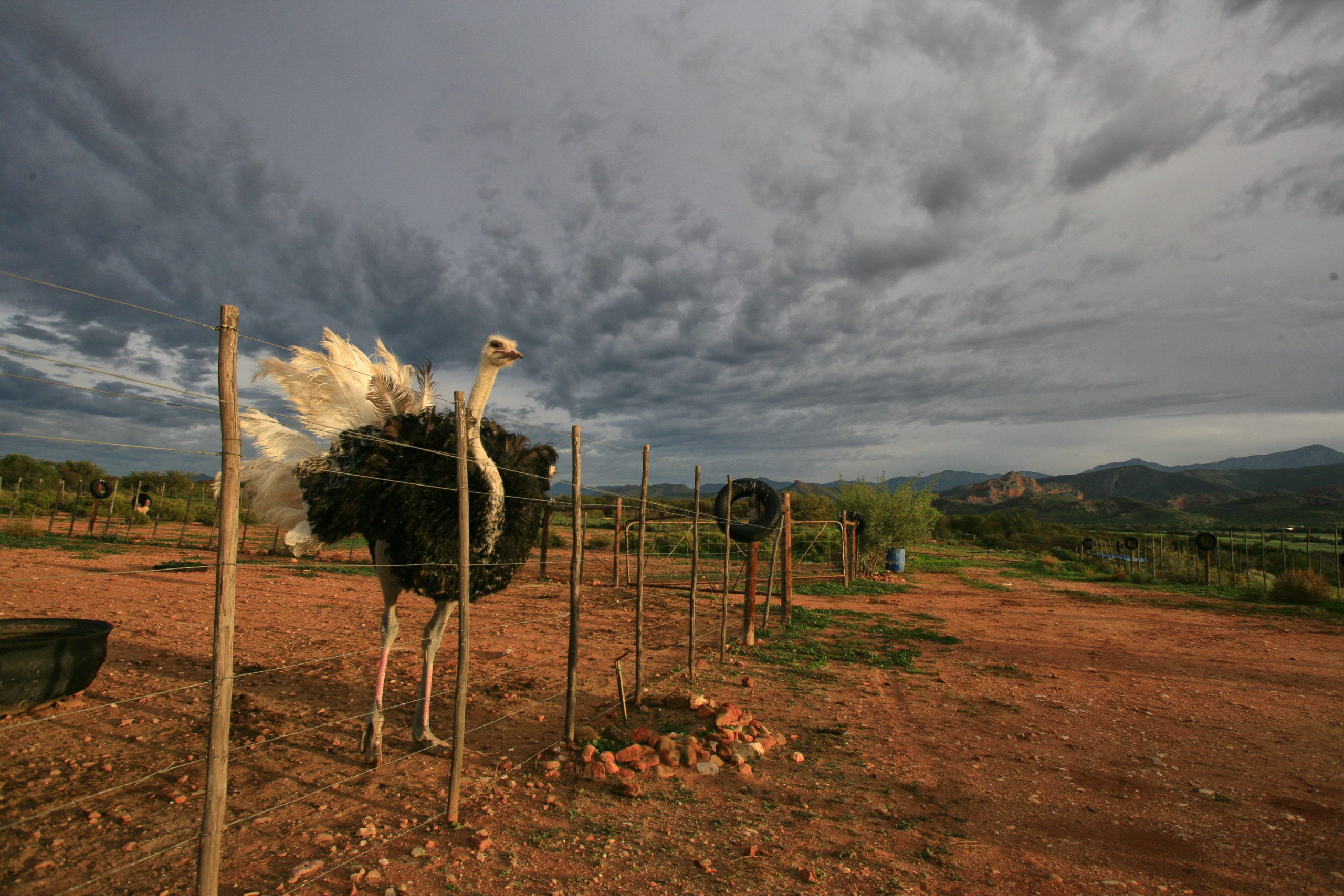
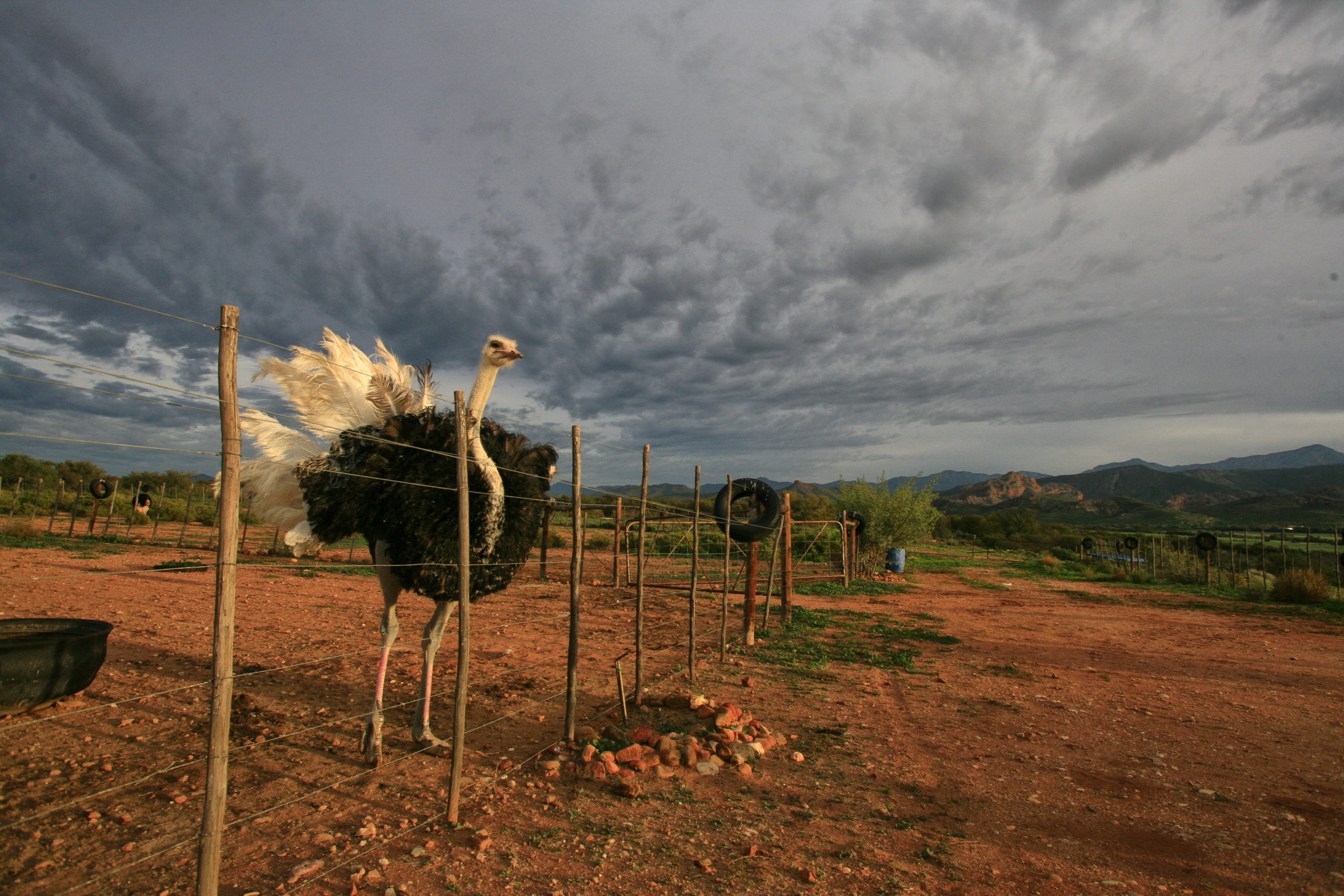
Handsome male ostrich patrolling the fenceline at Rietfontein Farm outside Oudtshoorn.
There are few birds as curious as a ‘wobble’ of young ostriches at the gate.
Ostriches – both male and female – generally make for great parents who share the baby-sitting duties.

If she likes the guy, Madame will modestly lower her head as she walks, shivering her grey wing feathers in approval. She will find a spot, sit down and let the games begin.

Such is the enduring inter-continental romantic lure of the ostrich, its delightful courtship moves and the gorgeous flightless feathers that line its wings.

Rietfontein Ostrich Palace

Now should you ever need a handy time portal while road-tripping along Route 62 in the Little Karoo, here’s how you get there.

Driving from Cape Town, you head through Calitzdorp on the Oudtshoorn road and continue eastwards for about 18km. Approaching the Karoo Boom farm stall on your right, look sharp left at the Red Stone Hills.

At the base of those stark crimson outcrops streaked with green algae, framed by tall blue gums and old date trees, is a palace fit for a Victorian-era royal in exile. The domed cupola gives it away.

Instantly, the mind’s eye wanders to an age of cavalry officers in uniform, ladies in big bonnet dresses, horse-drawn carriages in the driveway and kick-ass parties in the ballroom. With scandal and intrigue sure to follow.

Welcome to Rietfontein Ostrich Palace, the legendary home of the Potgieter family. Now let’s dart through that portal to a day in 1845 and a small clump of wagons outspanned about 200km west of here.

The stately Rietfontein Ostrich Palace in the distance, framed by the timeless Red Stone Hills at the base of the Swartberg range of mountains.
Rietfontein Ostrich Palace in the pink light of a Karoo dawn.
Dinner at the Rietfontein Ostrich Palace – ostrich fillet on the menu.

The pioneering Potgieters

Young Armaans Potgieter is a wagon driver who goes hunting for the pot in his down-time. He returns with an antelope of sorts and a couple of wild ostriches bagged along the way.

Armaans saves the tail and wing feathers of the birds and hopes he might flog them to a passing hide trader (smous) for a couple of pennies. Instead, gold coins fall into his hand along with some equally valuable advice from the smous:

“Buy land and farm with ostriches.”

And that’s how Armaans Potgieter becomes one of the world pioneers of ostrich farming, raising these glorious birds which had been hunted and killed (the lucky ones were simply stripped and sent off naked) for thousands of years before this.

Millennia ago, when Egypt was a major power, one of its many deities was the goddess Ma’at. This rather fetching young beauty was all about order, truth, justice and harmony. Her headdress contained a single white ostrich feather, and when you died your heart was weighed against that plume in the Afterworld. If you had lived a decent life, your ticker was lighter than the Feather of Truth and your chances of gaining entry to Paradise were fair. If not, well…

An ancient obsession

The Romans appeared to be a little more irreverent about the ostrich. Heliogabalus, who definitely would have failed the Egyptian Feather Test, was arguably the worst-behaved Roman teenage emperor of them all – quite a feat back then.

Heliogabalus fancied a three-day orgy with a very colourful menu. He once ordered 600 ostriches to be decapitated so he could serve their brains to his guests as teaspoon-sized appetisers. However, you do have to see this act of culinary insanity in its context: on occasion, the teenage potentate also ordered up platters of flamingo brains, parrot heads and peacock tongues. And you don’t want to know what these overfed gentryfolk did between courses.

He ran his empire in this macabre fashion from the age of 14 for four years until his granny, Julia Maesa, had enough of the brat and ordered the Praetorian Guard to dispose of him one night. You can read all about this royal rogue in The Fat Man’s Food Drink Compendium by Tony Grumley-Grennan.

Biblical Noah, charged with loading his Ark full of breeding pairs of various beasts, also had to pack an astonishing variety of feed for them. Various religious texts claim that he even stashed a supply of glass for the two ostriches in the hold of his vast cargo ship before the floods arrived.

Medieval literature has it that the female ostrich possessed the ultimate “lazy eye”, and could make her eggs hatch by simply staring hard at them for a while.

Fashion and the feathers

In those crazy Victorian times, women wore all kinds of dead-bird feathers on their hats, the most popular being ostrich plumes. In fact, if you look carefully at old photographs of various potentates through history, you’ll note that the guys wore ostrich plumes on their ceremonial helmets, and the 12 black horses that pulled the Duke of Wellington’s funeral wagon in 1852 all had clumps of black ostrich feathers on their heads.

Modern fashion displays using ostrich feathers – politician Helen Zille in the line-up at the CP Nel Museum.

And, possibly inspired by the vaguely erotic dance rituals of the ostrich, the plumes thus became an essential part of a showgirl’s costume from Paris to Rio de Janeiro. Big Chiefs at the New Orleans Mardi Gras and the various Junkanoos of the Caribbean islands wore them as well.

Someone simply had to start farming these wondrous birds. You couldn’t just keep killing them off for their wing feathers.

The rise of Veldskoendorp

In the first half of the 19th century, Oudtshoorn was a hardscrabble village described by its detractors rather haughtily as Veldskoendorp – a place of poor man’s shoes. It was officially named Oudtshoorn in honour of a newly-appointed Cape governor who never made it to these shores – he perished on the sea voyage out.

The 1860s began with a killer drought and ended in the Golden Age of the Ostrich. The ostrich farming frenzy really took hold when one Arthur Douglass invented the incubator in 1869, and production was vastly increased.

Farmers had to find markets for their feathers, and so a host of Jewish Lithuanian feather merchants criss-crossed the Little Karoo as middle-men in this fledgling industry.

Oom Swepie’s story

Oom Swepie le Roux of Doornkraal Farm east of Oudtshoorn, is every bit the baronial storyteller, who comes complete with his own family feather palace and a tasty brand of sparkling muscadel-grape rose called Tickled Pink. The front label sports a running ostrich and the back-label speaks of spicy food, good company and naughty women.

Well into his 80s, Oom Swepie tells the story of his Oupa Gert, his Ouma Maggie and the various smouse who visited Doornkraal.

Oom Swepie le Roux comes from a long line of Little Karoo ostrich farmers.

“They came for the feathers, the fare and the brandy cellar,” he says. “They would arrive from their dusty journeys, and Ouma would make them bathe first. She was also a devout Christian whose life’s ambition was to convert at least one Jewish pedlar, so she’d make them attend a service before dinner.

“After supper, Oupa and the smous would go down to the brandy cellar, light the lamps, share a drink and discuss the feathers, laid out for inspection. Then the haggling would begin.”

Oupa Gert may have prospered from his lamplight negotiations but Ouma Maggie, they say, had no luck converting the smouse.

There are ostrich palaces scattered about the Eastern Cape, but they really do seem to have a nest in the Calitzdorp-Oudtshoorn-De Rust district of the Little Karoo.

The feather boom mansions

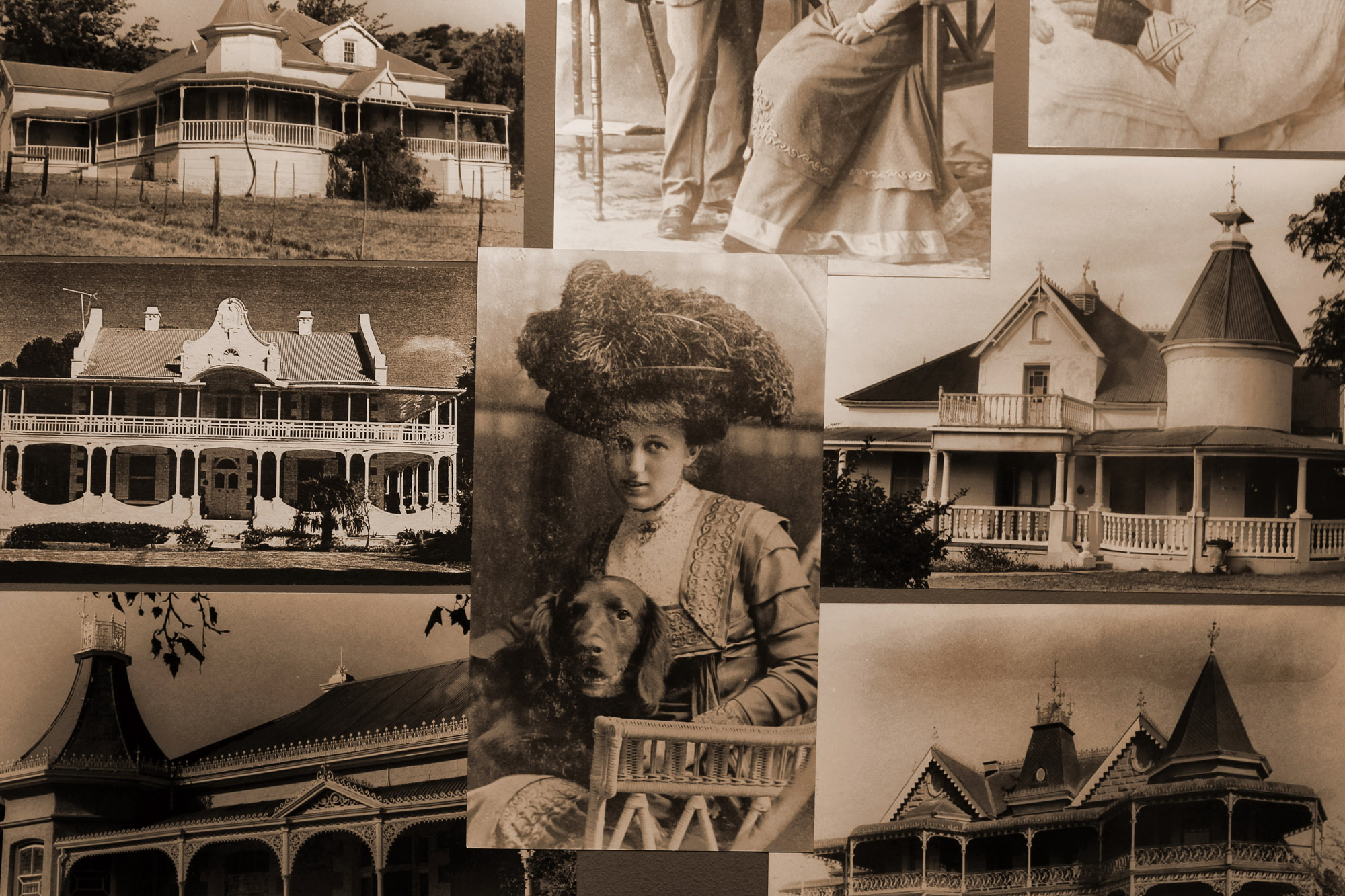
Back in the heyday of the ostrich industry, when a prime wing feather was worth more than its weight in gold, the new dry land millionaires wanted to tell the world of their riches. The Feather Boom Nouveaux Riche set had massive mansions built of local sandstone, sparing no expense on architectural shout-outs like turrets and parapets that served no practical purpose. Suddenly families had to have ballrooms, homes with 20 bedrooms and coach houses, all built in an eccentric froth of styles that drew from the Edwardian, Tudor, Elizabethan and Victorian eras.

The days of feathers, mansions and fine things on display at Oudtshoorn’s CP Nel Museum.
Ostrich feathers – at one time worth a fortune.

The two architects who made serious names for themselves here were Charles Bullock and Johannes Egbertus Vixseboxse. You see their handiwork all over Oudtshoorn, in the form of mansions that have been repurposed into old age homes, museums, little businesses and, of late, guest houses.

Dining rooms for 100 guests, marble baths that held 1,500 litres of water, Italian ceramic tiles around the fireplaces, mahogany inlaid libraries, Carrara marble in the kitchen, Delft and teak fancies, broekielace (cast iron railings) and burnt bricks, endless verandahs, stained glass windows, big lion carvings and other expensive doo-dahs from all corners of the Earth – it was not the Age of Minimalism. The diamond magnates of Kimberley and the gold barons of the Witwatersrand stood back in envy.

You can only imagine how the mail order catalogue business flourished in those days, how goods-laden ships flowed endlessly back and forth between continents while ostrich barons’ bank accounts just grew fatter and fatter with every plucking.

Adventure on the Niger

This saga of the South African ostrich industry comes with its own exotic adventure story, worthy of an Indiana Jones film or an Allan Quatermain classic.

Despite all these profits, the ostrich farmed in the Little Karoo was just so-so. It simply did not possess the ultimate plume quality to match that of the Barbary Bird, found somewhere in North Africa. There was a need to enrich the South African breeding stock with the Barbary, to give the locals an edge over their rivals, the USA. The magical feather everyone was after went by the name of Evans-Lovemore. It was blunt, strong and double-fluff dense.

So a small and discrete party, led by Russell Thornton of Grootfontein Agricultural College in Middelburg, set out in September 1911 on a steamship up the Niger River in the general direction of Timbuktu.

The Thornton Expedition travelled towards Timbuktu on the fabled Niger River. Photo by Chris Marais

A couple of train journeys later, they were based in Kano, northern Nigeria. They offered a reward for a sample of the Evans-Lovemore, located a likely source from Fort Zinder in French Sudan territory, recruited more than 100 porters, kept an eagle eye out for Tuareg raiders and hit the desert with gusto.

Thornton begged the French fort commander at Zinder to allow them to export some of the indigenous ostriches. The answer was a firm non, and so they returned to Nigeria and put out a general appeal for Barbaries once more.

Ostriches from all over the region were presented to the South Africans and gradually, bird by bird, they gathered a flock of Barbaries to take home. Nearly 150 specimens were carefully trucked back to the coast and shipped down to South Africa. Thornton was hailed as a local hero, the SA breeding herds were enriched and the Americans were full of envy.

The parties

In fact, so entrenched was the South African grip on the ostrich trade that, when the Titanic sank in 1912, part of its most valuable on-board cargo was a shipment of our feathers bound for New York markets, insured for millions of dollars.

The next two years of Oudtshoorn’s rather eccentric existence can be described for millennials as the old-time equivalent of the dot.com billionaire boom of Silicon Valley, California. The prime feathers from three ostriches could buy you a Model T Ford. One really perfect plume could be traded for a Union Castle berth from Cape Town to Southampton. It was The Great Gatsby before The Great Gatsby.

Bullock and Vixseboxse went into overdrive, servicing the architectural whims of the various ostrich overlords and their bigwig wives.

The Ostrich industry in its boom time, just before the crash of 1914.

The hangover

In 1914 it all came crashing down. World War I turned the globe away from the light-heartedness of party feathers; the open-top automobile made the wearing of big hats impractical, if not downright dangerous; it became a mark of shame to wear any body part of a bird on your head. It was the inevitable perfect storm of misfortune for this vanity-based industry and its kingpins. In so many ways, the carnival was over.

It was recorded that one feather dealer had a cheque for £100,000 honoured by his bank in early 1914 and a cheque for £1 rejected the next year. There were suicides, bankruptcies, mysterious disappearances and empty mansions on the Karoo veld.

The Karoo ostrich: gorgeous as ever, grubby beak and all.
The ostrich skin cowboy hat – part of modern Western Wear.
The ostrich feather duster sellers outside the CP Nel Museum in Oudtshoorn.

In the past century since the Feather Fall of 1914, the ostrich industry has had a roller coaster ride consisting of a resurgent plume market, a growing taste for ostrich meat and a wider use for ostrich leather. And do not discount the ongoing boom in feather dusters.

Bird flu scares and European Union bans have come and gone, and the present southern African drought has also added to the decimation of the formerly vast ostrich flocks of the Little Karoo.

The ostrich arises

The Oudtshoorn ostrich flocks have been diminished due to the long drought – but they will return.

Now, however, the industry shows signs of innovation. The Klein Karoo Ostrich Emporium in Oudtshoorn has an extensive workshop where crafters fashion a variety of ostrich goods. Ostrich show-farms like Safari, Highgate and Cango tell the big bird story every day to busloads of tourists from everywhere.

And the palaces are being spruced up again. At Rietfontein, where it all began, you can stay in elegant accommodations within spitting distance of the old feather mansion and be hosted by Kobus Potgieter, descendant of The Original Armaans, and his wife, Elmarie.

The Rietfontein flock has been reduced to one rather feisty male and his two wives in a paddock out back. But they do a really good job of representing their legendary species, and the memory of their many flightless ancestors. DM/ ML

The Magic Bird is a chapter in Karoo Roads – Tales from South Africa’s Heartland, by Chris Marais and Julienne du Toit (MLM Publishers, 320 pages, 201 black and white images, 1 Karoo Map). To purchase, either order from www.karoospace.co.za or email [email protected] for details.

Chris Marais is a storyteller from Karoo Space.

Useful Links:

  1. Oudtshoorn Tourism: www.oudtshoorn.co.za
  2. Rietfontein Ostrich Palace: www.rop.co.za
  3. Safari Ostrich Farm: www.safariostrich.co.za
  4. Highgate Ostrich Show Farm: www.highgate.co.za
  5. Cango Ostrich Show Farm: www.cangoostrich.co.za
  6. Klein Karoo Ostrich Emporium: www.capekarooshop.co.za

Gallery


Comments – share your knowledge and experience

Please note you must be a Maverick Insider to comment. Sign up here or sign in if you are already an Insider.

Everybody has an opinion but not everyone has the knowledge and the experience to contribute meaningfully to a discussion. That’s what we want from our members. Help us learn with your expertise and insights on articles that we publish. We encourage different, respectful viewpoints to further our understanding of the world. View our comments policy here.

All Comments 3

  • Patricia Sidley says:

    Chris Marais always wrote beautifully — from the Rand Daily Mail days. And it’s a delight to read this. I had relatives who must have been traders in Oudtshoorn and I’m sure were never converted! There was a museum in Oudtshoorn with part of it devoted to the Jewish community there — but which curiously never made any mention anywhere in the museum, of black people. I was told that was because they “did not have a history there”. With a bit of luck that has changed.

    • Trevor Hall says:

      It has changed Pat and for the better, to be much more inclusive but retaining all the old grandeur. A superb museum, well run well staffed from our experience of a visit last March.

  • Brett Bard says:

    Dreamily romantic notions, but for the sake of human folly unbearable cruelty continues to be meted out unabated on these ‘magic’, ‘noble’, ‘glorious’ and essentially wild birds. On farms the pathetic majority spend their entire, rather short and unnatural lives crammed into bleak, leafless feedlots where they endure the humiliation and pain of captivity exposed to searing daytime temperatures. Annually around solstice, numerous ostriches in the Karoo succumb to the intense heat because no shade is provided. In effect this means that most days throughout the long, hot summers these poor birds are teetering on the brink of death, until the final horror of the day they’re trucked off to the abattoir to be unceremoniously slain.

    It’s not surprising that under such an assault on the natural order of things there have been several outbreaks of numerous strains of avian influenza (including H5N2 and H7N1) and it’s just a matter of time before…well we know how the story unfolds.

  • Category: NewsTag: cradock, graaff reinet, hofmeyer, karoo, news
    27 January 2021 by Guest

    Craddock: Our most gripping series since ’05 Ashes

    The temptation is to say Australia lacks a killer punch but tackling this Indian team is like boxing Floyd Mayweather. You spot a bare chin and wind up for the haymaker only to connect with nothing but thin air. You see a dropped guard and go for broke – only to graze an ear. You …

    The temptation is to say Australia lacks a killer punch but tackling this Indian team is like boxing Floyd Mayweather.

    You spot a bare chin and wind up for the haymaker only to connect with nothing but thin air.

    You see a dropped guard and go for broke – only to graze an ear. You move them into a corner then they spin on a sixpence and vanish.

    Surely they must crack eventually?

    What a magnificent series this has been. Both teams deserve great credit.

    Even if India do not retain the Border-Gavaskar Trophy they have made the cricket world think about going the road less travelled with selections, collective mindsets … everything.

    The admirable way they chose five bowlers in this Test confirmed a cavalier spirit which never used to be their trademark.

    Watch Australia v India Test Series Live Ad-Break Free During Play with the Fox Cricket commentary team. New to Kayo? Get your free trial now start streaming instantly


    The fact that they have only two players – Cheteshwar Pujara and Ajinkya Rahane – surviving from the first Test of the series proved you can leave blood on the floor in the selection room and still have team harmony.

    India don’t die wondering.

    It’s true that many of their players were dropped through injury but several significant others like Prithvi Shaw and Mayank Agarwal were dropped through poor form without a hint of disruption.

    Through it all they looked like cricket’s version of the NFL’s New England Patriots, about whom it was once said that their game plans were so well absorbed throughout the organisation that you could put the car park ticket-seller in as quarterback and he would know all the plays.

    It used to be said that win in Australia you had to have an Australian style alpha male captain like South Africa’s Graeme Smith or Faf du Plessis but that has all changed with the calm, measured, unsung Rahane keeping his team in the fight.


    This is a very unusual series because Australia barely ever does arm wrestles on its own soil. Its speciality is the brutal backslam and when that does not happen it is often backslammed itself.

    But it is rare and special to see two teams with hands locked around each other’s throats.

    This is the most gripping Test series Australia has played in since the 2005 Ashes but it could have an even more profound impact on the game.

    The 2005 Ashes, in which England won 2-1 after a series of spell binding twists and turns, became the instant yardstick by which all other compelling series are measured.

    Its impact on the game was such that cricket gear sellers in Australia broke records when the 2005-06 summer started a couple of months after the team returned home.

    But that was when Test cricket was the unchallenged king of the castle.


    Twenty20 has since swept the globe and is the game of the future.

    Now the Test match game is under siege, not simply from the razzle dazzle forces of T20 cricket but just the extreme financial demands of supporting first class systems that produce Test players.

    If you’re India, Australia and England you’re doing fine but the rest of the world is struggling.

    South African cricket is a financial basket-case and even New Zealand needed a helping hand to generate some cash so Australia will send a mixture of second and third XI players there next month to play white ball games while the Test side in in South Africa.

    This Test should ensure that India stays in love with Test cricket and that is all Test cricket needs to live on indefinitely.

    Originally published as Craddock: Our most gripping series since ’05 Ashes

    Category: NewsTag: cradock, news, online, south africa
    27 January 2021 by Guest

    The Magic Bird, a noble ostrich of The Karoo

    Photograph by Chris Marais (Image supplied) The Karoo ostrich might have had its updrafts and hard landings, but its legends still fly high. First published in Karoo Space. All photographs by Chris Marais. If you ever found yourself on the party streets of New Orleans on Mardi Gras Day, you might be lucky enough to …


    Photograph by Chris Marais (Image supplied)

    The Karoo ostrich might have had its updrafts and hard landings, but its legends still fly high.

    First published in Karoo Space. All photographs by Chris Marais.

    If you ever found yourself on the party streets of New Orleans on Mardi Gras Day, you might be lucky enough to spot a Big Chief Indian in full glorious spate.

    This wondrous apparition, clad from head to toe in sequins, beads, rhinestones, velvet and constantly-wavy ostrich plumes, would be accompanied by his Spyboy, his Flagboy, a whole bunch of drummers, a street-walking jazz band and a few hundred dancing followers.

    Down south in Rio de Janeiro, the annual Carnival would also be in progress, with thousands of lovely Samba Girls of the Copacabana dressed in a couple of sequins and very little else besides their beloved ostrich feathers.

    Showgirls and their feathers

    Across the sea in Belgium, the little coal-mining town of Binche has its traditional Gilles characters parading on Shrove Tuesday. During what some call “the world’s weirdest Mardi Gras”, the Gille is restricted to wearing his elaborate costume, wooden clogs and fancy ostrich feather headdress within the confines of Binche – and only on this day.

    On most nights not too far from here, you might be in the Moulin Rouge Theatre in the Montmartre district of Paris, completely bedazzled by a large troupe of leggy performers, tantalising the audience behind their brightly dyed ostrich feather arrangements.

    Their trans-Atlantic match is the legendary Las Vegas Showgirl, motionless (legally, she had to stand really still to appear before you in her birthday suit), bedecked all about in ostrich plumes and jewels.

    But all that marvellous carnival glitz and glamour, all those high-priced gin joints and chorus-line saloons cannot match the true Romance Dance of the Plume down here in the Karoo when a male ostrich with blood-red shins begins to court his darling-to-be.

    The ostrich romance dance

    Monsieur will drop to the ground, spread his gorgeous wings before Madame and, with his head flung back, he will begin to thrum and gyrate, making a loud booming noise. Then, lifting himself on the tips of his toes like Baryshnikov, he will puff up all his feathers and run daintily around the eyelash-batting object of his affections.

    Handsome male ostrich patrolling the fenceline at Rietfontein Farm outside Oudtshoorn.
    There are few birds as curious as a ‘wobble’ of young ostriches at the gate.
    Ostriches – both male and female – generally make for great parents who share the baby-sitting duties.

    If she likes the guy, Madame will modestly lower her head as she walks, shivering her grey wing feathers in approval. She will find a spot, sit down and let the games begin.

    Such is the enduring inter-continental romantic lure of the ostrich, its delightful courtship moves and the gorgeous flightless feathers that line its wings.

    Rietfontein Ostrich Palace

    Now should you ever need a handy time portal while road-tripping along Route 62 in the Little Karoo, here’s how you get there.

    Driving from Cape Town, you head through Calitzdorp on the Oudtshoorn road and continue eastwards for about 18km. Approaching the Karoo Boom farm stall on your right, look sharp left at the Red Stone Hills.

    At the base of those stark crimson outcrops streaked with green algae, framed by tall blue gums and old date trees, is a palace fit for a Victorian-era royal in exile. The domed cupola gives it away.

    Instantly, the mind’s eye wanders to an age of cavalry officers in uniform, ladies in big bonnet dresses, horse-drawn carriages in the driveway and kick-ass parties in the ballroom. With scandal and intrigue sure to follow.

    Welcome to Rietfontein Ostrich Palace, the legendary home of the Potgieter family. Now let’s dart through that portal to a day in 1845 and a small clump of wagons outspanned about 200km west of here.

    The stately Rietfontein Ostrich Palace in the distance, framed by the timeless Red Stone Hills at the base of the Swartberg range of mountains.
    Rietfontein Ostrich Palace in the pink light of a Karoo dawn.
    Dinner at the Rietfontein Ostrich Palace – ostrich fillet on the menu.

    The pioneering Potgieters

    Young Armaans Potgieter is a wagon driver who goes hunting for the pot in his down-time. He returns with an antelope of sorts and a couple of wild ostriches bagged along the way.

    Armaans saves the tail and wing feathers of the birds and hopes he might flog them to a passing hide trader (smous) for a couple of pennies. Instead, gold coins fall into his hand along with some equally valuable advice from the smous:

    “Buy land and farm with ostriches.”

    And that’s how Armaans Potgieter becomes one of the world pioneers of ostrich farming, raising these glorious birds which had been hunted and killed (the lucky ones were simply stripped and sent off naked) for thousands of years before this.

    Millennia ago, when Egypt was a major power, one of its many deities was the goddess Ma’at. This rather fetching young beauty was all about order, truth, justice and harmony. Her headdress contained a single white ostrich feather, and when you died your heart was weighed against that plume in the Afterworld. If you had lived a decent life, your ticker was lighter than the Feather of Truth and your chances of gaining entry to Paradise were fair. If not, well…

    An ancient obsession

    The Romans appeared to be a little more irreverent about the ostrich. Heliogabalus, who definitely would have failed the Egyptian Feather Test, was arguably the worst-behaved Roman teenage emperor of them all – quite a feat back then.

    Heliogabalus fancied a three-day orgy with a very colourful menu. He once ordered 600 ostriches to be decapitated so he could serve their brains to his guests as teaspoon-sized appetisers. However, you do have to see this act of culinary insanity in its context: on occasion, the teenage potentate also ordered up platters of flamingo brains, parrot heads and peacock tongues. And you don’t want to know what these overfed gentryfolk did between courses.

    He ran his empire in this macabre fashion from the age of 14 for four years until his granny, Julia Maesa, had enough of the brat and ordered the Praetorian Guard to dispose of him one night. You can read all about this royal rogue in The Fat Man’s Food Drink Compendium by Tony Grumley-Grennan.

    Biblical Noah, charged with loading his Ark full of breeding pairs of various beasts, also had to pack an astonishing variety of feed for them. Various religious texts claim that he even stashed a supply of glass for the two ostriches in the hold of his vast cargo ship before the floods arrived.

    Medieval literature has it that the female ostrich possessed the ultimate “lazy eye”, and could make her eggs hatch by simply staring hard at them for a while.

    Fashion and the feathers

    In those crazy Victorian times, women wore all kinds of dead-bird feathers on their hats, the most popular being ostrich plumes. In fact, if you look carefully at old photographs of various potentates through history, you’ll note that the guys wore ostrich plumes on their ceremonial helmets, and the 12 black horses that pulled the Duke of Wellington’s funeral wagon in 1852 all had clumps of black ostrich feathers on their heads.

    Modern fashion displays using ostrich feathers – politician Helen Zille in the line-up at the CP Nel Museum.

    And, possibly inspired by the vaguely erotic dance rituals of the ostrich, the plumes thus became an essential part of a showgirl’s costume from Paris to Rio de Janeiro. Big Chiefs at the New Orleans Mardi Gras and the various Junkanoos of the Caribbean islands wore them as well.

    Someone simply had to start farming these wondrous birds. You couldn’t just keep killing them off for their wing feathers.

    The rise of Veldskoendorp

    In the first half of the 19th century, Oudtshoorn was a hardscrabble village described by its detractors rather haughtily as Veldskoendorp – a place of poor man’s shoes. It was officially named Oudtshoorn in honour of a newly-appointed Cape governor who never made it to these shores – he perished on the sea voyage out.

    The 1860s began with a killer drought and ended in the Golden Age of the Ostrich. The ostrich farming frenzy really took hold when one Arthur Douglass invented the incubator in 1869, and production was vastly increased.

    Farmers had to find markets for their feathers, and so a host of Jewish Lithuanian feather merchants criss-crossed the Little Karoo as middle-men in this fledgling industry.

    Oom Swepie’s story

    Oom Swepie le Roux of Doornkraal Farm east of Oudtshoorn, is every bit the baronial storyteller, who comes complete with his own family feather palace and a tasty brand of sparkling muscadel-grape rose called Tickled Pink. The front label sports a running ostrich and the back-label speaks of spicy food, good company and naughty women.

    Well into his 80s, Oom Swepie tells the story of his Oupa Gert, his Ouma Maggie and the various smouse who visited Doornkraal.

    Oom Swepie le Roux comes from a long line of Little Karoo ostrich farmers.

    “They came for the feathers, the fare and the brandy cellar,” he says. “They would arrive from their dusty journeys, and Ouma would make them bathe first. She was also a devout Christian whose life’s ambition was to convert at least one Jewish pedlar, so she’d make them attend a service before dinner.

    “After supper, Oupa and the smous would go down to the brandy cellar, light the lamps, share a drink and discuss the feathers, laid out for inspection. Then the haggling would begin.”

    Oupa Gert may have prospered from his lamplight negotiations but Ouma Maggie, they say, had no luck converting the smouse.

    There are ostrich palaces scattered about the Eastern Cape, but they really do seem to have a nest in the Calitzdorp-Oudtshoorn-De Rust district of the Little Karoo.

    The feather boom mansions

    Back in the heyday of the ostrich industry, when a prime wing feather was worth more than its weight in gold, the new dry land millionaires wanted to tell the world of their riches. The Feather Boom Nouveaux Riche set had massive mansions built of local sandstone, sparing no expense on architectural shout-outs like turrets and parapets that served no practical purpose. Suddenly families had to have ballrooms, homes with 20 bedrooms and coach houses, all built in an eccentric froth of styles that drew from the Edwardian, Tudor, Elizabethan and Victorian eras.

    The days of feathers, mansions and fine things on display at Oudtshoorn’s CP Nel Museum.
    Ostrich feathers – at one time worth a fortune.

    The two architects who made serious names for themselves here were Charles Bullock and Johannes Egbertus Vixseboxse. You see their handiwork all over Oudtshoorn, in the form of mansions that have been repurposed into old age homes, museums, little businesses and, of late, guest houses.

    Dining rooms for 100 guests, marble baths that held 1,500 litres of water, Italian ceramic tiles around the fireplaces, mahogany inlaid libraries, Carrara marble in the kitchen, Delft and teak fancies, broekielace (cast iron railings) and burnt bricks, endless verandahs, stained glass windows, big lion carvings and other expensive doo-dahs from all corners of the Earth – it was not the Age of Minimalism. The diamond magnates of Kimberley and the gold barons of the Witwatersrand stood back in envy.

    You can only imagine how the mail order catalogue business flourished in those days, how goods-laden ships flowed endlessly back and forth between continents while ostrich barons’ bank accounts just grew fatter and fatter with every plucking.

    Adventure on the Niger

    This saga of the South African ostrich industry comes with its own exotic adventure story, worthy of an Indiana Jones film or an Allan Quatermain classic.

    Despite all these profits, the ostrich farmed in the Little Karoo was just so-so. It simply did not possess the ultimate plume quality to match that of the Barbary Bird, found somewhere in North Africa. There was a need to enrich the South African breeding stock with the Barbary, to give the locals an edge over their rivals, the USA. The magical feather everyone was after went by the name of Evans-Lovemore. It was blunt, strong and double-fluff dense.

    So a small and discrete party, led by Russell Thornton of Grootfontein Agricultural College in Middelburg, set out in September 1911 on a steamship up the Niger River in the general direction of Timbuktu.

    The Thornton Expedition travelled towards Timbuktu on the fabled Niger River. Photo by Chris Marais

    A couple of train journeys later, they were based in Kano, northern Nigeria. They offered a reward for a sample of the Evans-Lovemore, located a likely source from Fort Zinder in French Sudan territory, recruited more than 100 porters, kept an eagle eye out for Tuareg raiders and hit the desert with gusto.

    Thornton begged the French fort commander at Zinder to allow them to export some of the indigenous ostriches. The answer was a firm non, and so they returned to Nigeria and put out a general appeal for Barbaries once more.

    Ostriches from all over the region were presented to the South Africans and gradually, bird by bird, they gathered a flock of Barbaries to take home. Nearly 150 specimens were carefully trucked back to the coast and shipped down to South Africa. Thornton was hailed as a local hero, the SA breeding herds were enriched and the Americans were full of envy.

    The parties

    In fact, so entrenched was the South African grip on the ostrich trade that, when the Titanic sank in 1912, part of its most valuable on-board cargo was a shipment of our feathers bound for New York markets, insured for millions of dollars.

    The next two years of Oudtshoorn’s rather eccentric existence can be described for millennials as the old-time equivalent of the dot.com billionaire boom of Silicon Valley, California. The prime feathers from three ostriches could buy you a Model T Ford. One really perfect plume could be traded for a Union Castle berth from Cape Town to Southampton. It was The Great Gatsby before The Great Gatsby.

    Bullock and Vixseboxse went into overdrive, servicing the architectural whims of the various ostrich overlords and their bigwig wives.

    The Ostrich industry in its boom time, just before the crash of 1914.

    The hangover

    In 1914 it all came crashing down. World War I turned the globe away from the light-heartedness of party feathers; the open-top automobile made the wearing of big hats impractical, if not downright dangerous; it became a mark of shame to wear any body part of a bird on your head. It was the inevitable perfect storm of misfortune for this vanity-based industry and its kingpins. In so many ways, the carnival was over.

    It was recorded that one feather dealer had a cheque for £100,000 honoured by his bank in early 1914 and a cheque for £1 rejected the next year. There were suicides, bankruptcies, mysterious disappearances and empty mansions on the Karoo veld.

    The Karoo ostrich: gorgeous as ever, grubby beak and all.
    The ostrich skin cowboy hat – part of modern Western Wear.
    The ostrich feather duster sellers outside the CP Nel Museum in Oudtshoorn.

    In the past century since the Feather Fall of 1914, the ostrich industry has had a roller coaster ride consisting of a resurgent plume market, a growing taste for ostrich meat and a wider use for ostrich leather. And do not discount the ongoing boom in feather dusters.

    Bird flu scares and European Union bans have come and gone, and the present southern African drought has also added to the decimation of the formerly vast ostrich flocks of the Little Karoo.

    The ostrich arises

    The Oudtshoorn ostrich flocks have been diminished due to the long drought – but they will return.

    Now, however, the industry shows signs of innovation. The Klein Karoo Ostrich Emporium in Oudtshoorn has an extensive workshop where crafters fashion a variety of ostrich goods. Ostrich show-farms like Safari, Highgate and Cango tell the big bird story every day to busloads of tourists from everywhere.

    And the palaces are being spruced up again. At Rietfontein, where it all began, you can stay in elegant accommodations within spitting distance of the old feather mansion and be hosted by Kobus Potgieter, descendant of The Original Armaans, and his wife, Elmarie.

    The Rietfontein flock has been reduced to one rather feisty male and his two wives in a paddock out back. But they do a really good job of representing their legendary species, and the memory of their many flightless ancestors. DM/ ML

    The Magic Bird is a chapter in Karoo Roads – Tales from South Africa’s Heartland, by Chris Marais and Julienne du Toit (MLM Publishers, 320 pages, 201 black and white images, 1 Karoo Map). To purchase, either order from www.karoospace.co.za or email [email protected] for details.

    Chris Marais is a storyteller from Karoo Space.

    Useful Links:

    1. Oudtshoorn Tourism: www.oudtshoorn.co.za
    2. Rietfontein Ostrich Palace: www.rop.co.za
    3. Safari Ostrich Farm: www.safariostrich.co.za
    4. Highgate Ostrich Show Farm: www.highgate.co.za
    5. Cango Ostrich Show Farm: www.cangoostrich.co.za
    6. Klein Karoo Ostrich Emporium: www.capekarooshop.co.za

    Gallery


    Comments – share your knowledge and experience

    Please note you must be a Maverick Insider to comment. Sign up here or sign in if you are already an Insider.

    Everybody has an opinion but not everyone has the knowledge and the experience to contribute meaningfully to a discussion. That’s what we want from our members. Help us learn with your expertise and insights on articles that we publish. We encourage different, respectful viewpoints to further our understanding of the world. View our comments policy here.

    No Comments, yet

    Category: NewsTag: cradock, graaff reinet, hofmeyer, karoo, news
    • Previous
    • Page 1
    • Page 2
    • Page 3
    • Page 4
    • Interim pages omitted …
    • Page 152
    • Next
    WE LOVE CRADOCK.

    COPYRIGHT MyCradock · DESIGN BY REACH TRUST
    All Rights Reserved · Powered by Straton Solar