
Image from page 480 of “The Andes and the Amazon :|bor across the continent of South America” (1876)
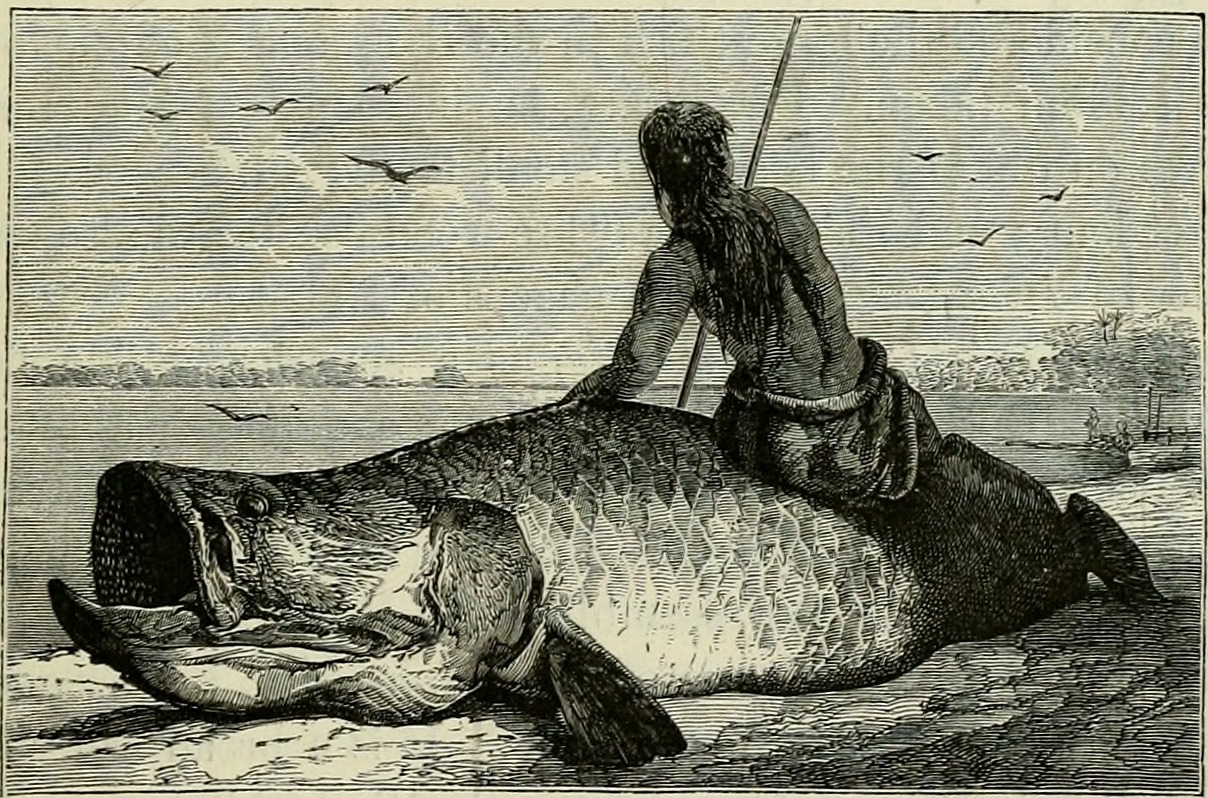
Image by Internet Archive Book Images
Identifier: andesamazonborac76orto
Title: The Andes and the Amazon :|bor across the continent of South America
Year: 1876 (1870s)
Authors: Orton, James
Subjects:
Publisher: New York: Harper
Contributing Library: Natural History Museum Library, London
Digitizing Sponsor: Natural History Museum Library, London
View Book Page: Book Viewer
About This Book: Catalog Entry
View All Images: All Images From Book
Click here to view book online to see this illustration in context in a browseable online version of this book.
Text Appearing Before Image:
variety. The great majority * Alligators are better travelers, being found .nbove the Falls of the Ma-deira, far up the Mamore and Beni. t Consequently the females almost exclusively are taken. The males aresmaller, and go by different names. Thus, the male of the large turtle iscalled Capitari; of the Tracaja, Anaiurt, or Taricaia, in Peru. (See p. 297.) Amazonian Fishes. 479 belong to the Cat-fish family (Siluridce), naked with bar-bels, and mainly to the group Pimelodina. The Lorica-7-ias, or cuirassed Silurids, are also comparatively numer-ous. Scale-fish seem tobe most abundant above the fallson the tributaries, and the skin-fish below. They are usu-ally captured by poisoning the water (as with baibasco ),and by means of spears, arrows, and hooks. A novel meth-od I witnessed on the Tapajos: two Indians di-agged a ca-noe lengthwise down stream, while a third followed afterwith a long palm-branch which provoked the fishes to leapout of the water, most of which fell into the canoe.
Text Appearing After Image:
The Pira-rucd. Pii-a-rucii, Payshi, or Anatto {Arapaima gigas), the Cod-fish of the Amazons, is the unixersal diet on the river, and,after rubber and cacao, the most important article of trade.It is sometimes found, but rarely, ten feet long, weighing300 pounds. It is covered with large, hard, red scales;has a smooth head, wide mouth, no barbels, and bands ofrasp-like teeth in various parts of the mouth. It aboundsin iagunes and clear water. Places, usually dry sand-banks. 480 The Andes and the Amazons. where salting this fish for the market is made a business,are called feitorias—about the only factories on the river.The fish is coarse, and not relished by foreigners. Pescada, a scaly, silvery fish, attaining six pounds, hasa delicious, white, flaky flesh, resembling fresh Cod-fish;abounds in the Solimoens and Tapajos. Tambaqui, calledGamitana on the Maranon {Myletes, one of the Gharaci-nidoB), is a very fine, large fish, found from the Negro tothe Ucayali. It is often a yard long,
Note About Images
Please note that these images are extracted from scanned page images that may have been digitally enhanced for readability – coloration and appearance of these illustrations may not perfectly resemble the original work.
This The Great Fish River museum image was automatically curated and published with WP Robot plugin – CLICK HERE to learn more about WP Robot for WordPress – a massive time and money saver.