• Skip to main content
  • Skip to header right navigation
  • Skip to site footer

My Cradock

My Cradock

Cradock News Classifieds and Directory

  • Home
  • About
  • Accommodation
  • Business
  • Events
  • Free Business Advert
  • Submit News
You are here: Home / Archives for America

America

31 March 2018 by Alan

Image from page 508 of “American fishes; a popular treatise upon the game and food fishes of North America, with especial reference to habits and methods of capture” (1888) – The Great Fish River Museum

Image from page 508 of “American fishes; a popular treatise upon the game and food fishes of North America, with especial reference to habits and methods of capture” (1888) Image by Internet Archive Book Images Identifier: americanfishespo1888good Title: American fishes; a popular treatise upon the game and food fishes of North America, with especial reference …

Image from page 508 of “American fishes; a popular treatise upon the game and food fishes of North America, with especial reference to habits and methods of capture” (1888)
The Great Fish River museum
Image by Internet Archive Book Images
Identifier: americanfishespo1888good
Title: American fishes; a popular treatise upon the game and food fishes of North America, with especial reference to habits and methods of capture
Year: 1888 (1880s)
Authors: Goode, G. Brown (George Brown), 1851-1896
Subjects: Fishes — North America
Publisher: New York, Standard book company
Contributing Library: Harvard University, Museum of Comparative Zoology, Ernst Mayr Library
Digitizing Sponsor: Harvard University, Museum of Comparative Zoology, Ernst Mayr Library

View Book Page: Book Viewer
About This Book: Catalog Entry
View All Images: All Images From Book

Click here to view book online to see this illustration in context in a browseable online version of this book.

Text Appearing Before Image:
h, or Silver Salmon, Oncorhynclius kisuich, writes Jordan, isalmost everywhere known by the name of Silver Salmon. It has alsoa series of local names. In Kamtchatka it is still known by the nameKisutch, in use in Pennants time, a hundred years ago. The name Bielaya Ryba, or A\hite-fish, is also ascribed to it. On FrazerRiver it is known by the INIusquaw name of Coho; at Seattle, by theNisciually name of Skowitz ; about Cape Flattery by the Makah nameof Hoopid ; on the Columbia it is called Silver Salmon or ^^hiteSalmon, and southward the same names prevail. It reaches a weight oftwenty pounds, the usual range being from seven to ten. The SilverSalmon enters all the rivers from Sacramento to Behring Island and Kamt-chatka. In the fall it is abundant in probably all the rivers. Few ornone, however, are seen in the spring. They are often taken with seinesin Puget Sound at all seasons. Like the other fall-running Salmon, theyseldom ascend the rivers to any great distance. ypsn^fi^^-^^^Sf.

Text Appearing After Image:

Note About Images
Please note that these images are extracted from scanned page images that may have been digitally enhanced for readability – coloration and appearance of these illustrations may not perfectly resemble the original work.

This The Great Fish River museum image was automatically curated and published with WP Robot plugin – CLICK HERE to learn more about WP Robot for Wordpress – a massive time and money saver.

Category: ImagesTag: 1888, America, American, capture, especial, Fish, fishes, food, from, Game, great, habits, image, methods, Museum, North, page, popular, reference, River, treatise, upon
29 March 2018 by Alan

Image from page 458 of “American fishes; a popular treatise upon the game and food fishes of North America, with especial reference to habits and methods of capture” (1888) – The Great Fish River Museum

Image from page 458 of “American fishes; a popular treatise upon the game and food fishes of North America, with especial reference to habits and methods of capture” (1888) Image by Internet Archive Book Images Identifier: americanfishespo1888good Title: American fishes; a popular treatise upon the game and food fishes of North America, with especial reference …

Image from page 458 of “American fishes; a popular treatise upon the game and food fishes of North America, with especial reference to habits and methods of capture” (1888)
The Great Fish River museum
Image by Internet Archive Book Images
Identifier: americanfishespo1888good
Title: American fishes; a popular treatise upon the game and food fishes of North America, with especial reference to habits and methods of capture
Year: 1888 (1880s)
Authors: Goode, G. Brown (George Brown), 1851-1896
Subjects: Fishes — North America
Publisher: New York, Standard book company
Contributing Library: Harvard University, Museum of Comparative Zoology, Ernst Mayr Library
Digitizing Sponsor: Harvard University, Museum of Comparative Zoology, Ernst Mayr Library

View Book Page: Book Viewer
About This Book: Catalog Entry
View All Images: All Images From Book

Click here to view book online to see this illustration in context in a browseable online version of this book.

Text Appearing Before Image:
ght to add that I tasted the dish again whencold next morning at breakfast, and that it had lost nothing of its relish,and I do not think that many who sat down before it without prejudicewould come to any other than such a favorable conclusion. Perhaps\inegar instead of lemon might cheapen the dish, but as the recipe isgiven, it may be classed as economical. The common Brook Sucker, Catostonius Coiiuiicrsoiii. or the • AVhiteSucker, is the most familiar and generally abundant of the group. It CARP, DACE AND MINNOW. 435 inhabits all bodies of water, large and small, from New England to Colo-rado. In the great lakes it reaches a length of two feet or more. In smallbrooks it is mature at eight or ten inches. It varies much in size, colorand form in the different streams. It bites freely, ami is one of the fisheswith which the unambitious brook angler is well contented. When takenout of clear water, ])roperly cared for and well washed, it is an excellentpan-fish, like most of its kind.

Text Appearing After Image:
THE BROOK SUCKER—CATOSTOMlS COMMERSOXI. All the lakes and rivers of the Rocky Mountains and the Pacific slope,says Jordan, are inhabited by species of this genus, or of the alliedgenera Chasmistes and Pantostcus. In Utah Lake, said to be the greatestSucker-pond in the world, are found Caiostoimis fcciiinitis and ardcns,Chasmistes liorus and PantostcusplatyrliyncJius, all in abundance. In LakeTahoe Catostoinus tahoensis; in the Sacramento C. occidcntalis; in theColumbia C. macrochilus; in Klamath Lake Chasmistes luxatus and CJi.hrevirostiis, abound, while in the great lakes and all waters thence toAlaska and Arctic Ocean C. loiigirostris is an important food-fish. The Stone-roller, Hog Sucker, Stone Toter or Hammer-head Sucker, Catostomus nigricans, abounds in most waters from the greatlakes southward. The Stone-roller is extremely abundant in every run-ning stream in the North and West, where its singular, almost comical formis familiar to every school-boy. It delights in rapids and

Note About Images
Please note that these images are extracted from scanned page images that may have been digitally enhanced for readability – coloration and appearance of these illustrations may not perfectly resemble the original work.

This The Great Fish River museum image was automatically curated and published with WP Robot plugin – CLICK HERE to learn more about WP Robot for Wordpress – a massive time and money saver.

Category: ImagesTag: 1888, America, American, capture, especial, Fish, fishes, food, from, Game, great, habits, image, methods, Museum, North, page, popular, reference, River, treatise, upon
24 March 2018 by Alan

Image from page 683 of “Conquering the wilderness; or, New pictorial history of the life and times of the pioneer heroes and heroines of America, a full account of the romantic deeds, lofty achievements, and marvellous adventures of Boone, Kenton, Clark,

Image from page 683 of “Conquering the wilderness; or, New pictorial history of the life and times of the pioneer heroes and heroines of America, a full account of the romantic deeds, lofty achievements, and marvellous adventures of Boone, Kenton, Clark, Image by Internet Archive Book Images Identifier: conqueringwilder00tripuoft Title: Conquering the wilderness; or, New …

Image from page 683 of “Conquering the wilderness; or, New pictorial history of the life and times of the pioneer heroes and heroines of America, a full account of the romantic deeds, lofty achievements, and marvellous adventures of Boone, Kenton, Clark,
Valley of Desolation
Image by Internet Archive Book Images
Identifier: conqueringwilder00tripuoft
Title: Conquering the wilderness; or, New pictorial history of the life and times of the pioneer heroes and heroines of America, a full account of the romantic deeds, lofty achievements, and marvellous adventures of Boone, Kenton, Clark, Logan, Harrod, the Wetzel brothers, the Bradys, Poe and other celebrated frontiersmen and Indian fighters … with picturesque skteches of border life past and present, backwoods camp-meeting, schools and Sunday-schools; heoric fortitude and noble deeds of the pioneer wives and mothers, flatboating, the overland route and its horrors; the gold fever and filibustering expeditions; … eccentricities and self-sacrificing labors of Cartwright, Axley and other celebrated pioneer preachers, and describing life and adventure on the plains ..
Year: 1895 (1890s)
Authors: Triplett, Frank
Subjects: Indians of North America Frontier and pioneer life
Publisher: Chicago, Werner
Contributing Library: Robarts – University of Toronto
Digitizing Sponsor: MSN

View Book Page: Book Viewer
About This Book: Catalog Entry
View All Images: All Images From Book

Click here to view book online to see this illustration in context in a browseable online version of this book.

Text Appearing Before Image:
mining expert, named Byron Cole, was travel-ing through Central America looking for mines for an Americancompany. He had known Walker in San Francisco and knew ofhis desperate attempt to filibuster Lower California and Sonora inthe autumn of 1853. He had heard Walker talk of the golden empire he intended tofound in some of the Spanish-American States and had himselfbecome an enthusiast on the subject. He had heard of Walkersheroic attempt already alluded to and felt that he was destined toachieve a glorious name and this, he thought, would be an opportuneopening for him. The raid on Sonora had failed, it was true, but I ^ CONQUERING THE WILDERNESS. that was inevitable from the first. Leavins^San Francisco in a lis:htschooner, with some fifty followers, Walker landed at a small porton the Pacific Coast of Lower California. Here he met with a feebleresistance and marching into the interior, he invaded Sonora andpresented the singular spectacle of an invasion failing for the wantof foes.

Text Appearing After Image:
COLONEL BYRON COLE. Pressing on through sparsely settled valleys and inhospitabledeserts, he was conquered by the desolation everywhere i:)revalent.Without supplies of food and unable to find subsistence in thecountrv, his followers soon become a raofged and worn out lot of • CO half-starved specters who had easily brushed away every one of theii DESCRIPTION OF XICAHAGl A AND ITS AFFAIRS. 07!) outnumbering ioLs, bul were uiuiblc to contend again.st the tliiist andfamine of the desert and at last, with starved and wasted forms,shoeless and nearly naked, their feet lacerated with the sharp rocksand their hands mangled with thorns and cacti, they staggci-ed acrossthe frontier of Sonora into the golden State, sweeping from theirpathway at one wild, reckless charge three hundred Mexican cav-alry Avho had been sent to intercept them. They were ragged, worn,starved, parched with tropic heat and burning fever, but they hadthe courage of their pioneer sires that never wavered, and stagger-in

Note About Images
Please note that these images are extracted from scanned page images that may have been digitally enhanced for readability – coloration and appearance of these illustrations may not perfectly resemble the original work.

This Valley of Desolation image was automatically curated and published with WP Robot plugin – CLICK HERE to learn more about WP Robot for Wordpress – a massive time and money saver.

Category: ImagesTag: account, achievements, adventures, America, Boone, Clark, Conquering, deeds, from, full, heroes, heroines, History, image, Kenton, Life, lofty, marvellous, page, pictorial, pioneer, romantic, times, Wilderness
17 March 2018 by Alan

Image from page 104 of “Art in America; a critical and historical sketch” (1880) – Valley Of Desolation

Image from page 104 of “Art in America; a critical and historical sketch” (1880) Image by Internet Archive Book Images Identifier: artinamericacri00benj Title: Art in America; a critical and historical sketch Year: 1880 (1880s) Authors: Benjamin, S. G. W. (Samuel Greene Wheeler), 1837-1914 Subjects: Art, American Art Publisher: New York, Harper & Brothers Contributing Library: …

Image from page 104 of “Art in America; a critical and historical sketch” (1880)
Valley of Desolation
Image by Internet Archive Book Images
Identifier: artinamericacri00benj
Title: Art in America; a critical and historical sketch
Year: 1880 (1880s)
Authors: Benjamin, S. G. W. (Samuel Greene Wheeler), 1837-1914
Subjects: Art, American Art
Publisher: New York, Harper & Brothers
Contributing Library: Smithsonian Libraries
Digitizing Sponsor: Smithsonian Libraries

View Book Page: Book Viewer
About This Book: Catalog Entry
View All Images: All Images From Book

Click here to view book online to see this illustration in context in a browseable online version of this book.

Text Appearing Before Image:

Text Appearing After Image:
z . Kail tj^ >- – ~ fin® Mi view on the kern river.—[a. bierstadt.] as, for example, bits from the Forest of Fontainebleau. One of his mostremarkable New England landscapes represents the avalanche in the Notchof the White Mountains, which was attended with such disastrous resultsto the dwellers in the valley. Bnt Mr. Hill will be identified in futurewith California, where he has become a resident, and has devoted his ener-gies to painting some of the magnificent scenery of that marvellous region,where the roar of the whirlwind and the roll of the thunder reverberatelike the tread of the countless millions who evermore march to the west-ward. As he sat on the edge of the precipice, the forerunner of coming 100 ART IN AMERICA. ages, and painted the sublime, solitary depths of the Yosemite, did theartist realize that with every stroke of the brush he was aiding the ad-vance guard of civilization, and driving away the desolation which gaveadditional grandeur to one of the most extr

Note About Images
Please note that these images are extracted from scanned page images that may have been digitally enhanced for readability – coloration and appearance of these illustrations may not perfectly resemble the original work.

This Valley of Desolation image was automatically curated and published with WP Robot plugin – CLICK HERE to learn more about WP Robot for Wordpress – a massive time and money saver.

Category: ImagesTag: 1880., America, critical, DESOLATION, from, historical, image, page, sketch, VALLEY
14 January 2018 by Alan

Image from page 521 of “Picturesque America; or, The land we live in. A delineation by pen and pencil of the mountains, rivers, lakes, forests, water-falls, shores, cañons, valleys, cities, and other picturesque features of our country” (1872) – Valley Of Desolation

Image from page 521 of “Picturesque America; or, The land we live in. A delineation by pen and pencil of the mountains, rivers, lakes, forests, water-falls, shores, cañons, valleys, cities, and other picturesque features of our country” (1872) Image by Internet Archive Book Images Identifier: picturesqueameri01brya Title: Picturesque America; or, The land we live in. …

Image from page 521 of “Picturesque America; or, The land we live in. A delineation by pen and pencil of the mountains, rivers, lakes, forests, water-falls, shores, cañons, valleys, cities, and other picturesque features of our country” (1872)
Valley of Desolation
Image by Internet Archive Book Images
Identifier: picturesqueameri01brya
Title: Picturesque America; or, The land we live in. A delineation by pen and pencil of the mountains, rivers, lakes, forests, water-falls, shores, cañons, valleys, cities, and other picturesque features of our country
Year: 1872 (1870s)
Authors: Bryant, William Cullen, 1794-1878, editor Bunce, Oliver Bell, 1828-1890
Subjects:
Publisher: New York, D. Appleton
Contributing Library: University Library, University of North Carolina at Chapel Hill
Digitizing Sponsor: University of North Carolina at Chapel Hill

View Book Page: Book Viewer
About This Book: Catalog Entry
View All Images: All Images From Book

Click here to view book online to see this illustration in context in a browseable online version of this book.

Text Appearing Before Image:
Indians making Chemuck. Capitan are magnificent masses, at whose feet the debris are comparatively shght; butthat part known as the Union Rocks, between the Cathedral and Sentinel Rocks, hassuffered very much from disintegration. Great cliffs have fallen, and avalanches of rockhave ploughed their way down the slope to the bottom of the valley. While climbingin such surroundings, the wreck of some world is suggested, so vast the ruin and sopigmy the climber. No words can convey other than a feeble impression of the effectsof mountains of granite, sharp and fresh in fracture, piled one upon the other, the tornfragments of a forest underneath, or strewed about, as though the greatest had been but ><–., / ^ IP

Text Appearing After Image:
Horse-Racing. THE YOSEMITE. 483 as straws tossed in the wind. A broad track of desolation leads away up to the heightsfrom which these rocks have been thrown. The attention may be diverted from cliffs and torrents to the human element char-acteristic of the place, poor though that element be, and in the change find much thatis interesting in the few Indians that straggle, vagrant and worthless, through the region.They seem to be without tribal organization, although they still have pow-wows, wheretheir leading men, conscious of the inevitable decay of the race, strive to reorganize themand arouse their dying spirit; but the red-men are now hopelessly debauched and demor-alized. In general appearance, they are robust, and even inclined to be fleshy; this latteris accounted for by the fact that acorns, their staple of food, are extremely fattening.There were at times as many as fifty Indians of all descriptions, male and female, oldand young, living in the valley in the most primitive f

Note About Images
Please note that these images are extracted from scanned page images that may have been digitally enhanced for readability – coloration and appearance of these illustrations may not perfectly resemble the original work.

This Valley of Desolation image was automatically curated and published with WP Robot plugin – CLICK HERE to learn more about WP Robot for Wordpress – a massive time and money saver.

Category: ImagesTag: 1872, America, cañons, cities, country, delineation, DESOLATION, features, forests, from, image, lakes, Land, Live, Mountains, page, pencil, Picturesque, rivers, shores, VALLEY, valleys, waterfalls
20 October 2017 by Alan

Image from page 53 of “American fishes; a popular treatise upon the game and food fishes of North America, with especial reference to habits and methods of capture” (1888)

Image from page 53 of “American fishes; a popular treatise upon the game and food fishes of North America, with especial reference to habits and methods of capture” (1888) Image by Internet Archive Book Images Identifier: americanfishespo1888good Title: American fishes; a popular treatise upon the game and food fishes of North America, with especial reference …

Image from page 53 of “American fishes; a popular treatise upon the game and food fishes of North America, with especial reference to habits and methods of capture” (1888)
The Great Fish River museum
Image by Internet Archive Book Images
Identifier: americanfishespo1888good
Title: American fishes; a popular treatise upon the game and food fishes of North America, with especial reference to habits and methods of capture
Year: 1888 (1880s)
Authors: Goode, G. Brown (George Brown), 1851-1896
Subjects: Fishes — North America
Publisher: New York, Standard book company
Contributing Library: Harvard University, Museum of Comparative Zoology, Ernst Mayr Library
Digitizing Sponsor: Harvard University, Museum of Comparative Zoology, Ernst Mayr Library

View Book Page: Book Viewer
About This Book: Catalog Entry
View All Images: All Images From Book

Click here to view book online to see this illustration in context in a browseable online version of this book.

Text Appearing Before Image:
is kept at the clubhouse of the daily catch, by whom caught, where taken, on what station,the number of fish, weight, and date. Some members of the CuttyhunkClub also belong to the West Island Club, which controls only five acresof land. The West Island Club is limited to thirty members, witli an ad-mission fee of ,000. Professor Leith Adams has drawn a vivid pen-i)icture of Indian Bass-fish-ing in New Brunswick. The Indians (on the St. Johns River) pursue them at spawningtime. The scene on a beautiful summer afternoon is extremely ex-citing. There a i^w canoes containing remnants of the Melicitatribe may be seen dropping quietly down the river, each with an Indianin the prow, spear in hand, and another at the stern paddling gently; thena sudden splash close by calls for his utmost exertions, and like an arrowthe birch-bark skiff is shot towards the spot, when the man in front, rest-ing on his knees, with much force and dexterity sends his three-prongedharpoon straight on the fish.

Text Appearing After Image:
THE WHITE BASS. ROCCUS CHRTSOPS. THE WHITE BASS AND THE YELLOW BASS. Subtle. Has he bit? Has he bit? Face. And swallowed too, my Subtle. I have given him line, and now he pkys i faith. Subtle. And shall we twitch him ? Face. Through both the gills. Ben. Jonson, The Alche7nist, 1611, Act. ii, ?c. i. T^HE White Bass, or Striped Lake Bass, Roccus chrysops, is often con-founded with the Striped Bass, which it closely resembles. It mayeasily be distinguished by the presence of thirteen, instead of eleven, softrays in the anal fin, as well as by the greater size of its scales, of whichthere are about fifty-five rows, instead of sixty or more. It is most abundant in the Great Lake region, although it has a widedistribution in the Ohio and upper tributaries of the Mississippi, and isfound in many streams farther south. It frequents chiefly the lakes andponds and the deeper parts of the rivers. It feeds upon minnows and thelike, usually taking the hook readily, and is considered gamy by theano

Note About Images
Please note that these images are extracted from scanned page images that may have been digitally enhanced for readability – coloration and appearance of these illustrations may not perfectly resemble the original work.

This The Great Fish River museum image was automatically curated and published with WP Robot plugin – CLICK HERE to learn more about WP Robot for Wordpress – a massive time and money saver.

Category: ImagesTag: 1888, America, American, capture, especial, fishes, food, from, Game, habits, image, methods, North, page, popular, reference, treatise, upon
10 April 2016 by Alan

Image from page 260 of “The Andes and the Amazon :|bor across the continent of South America” (1876) – The Great Fish River Museum

Image from page 260 of “The Andes and the Amazon :|bor across the continent of South America” (1876) Image by Internet Archive Book Images Identifier: andesamazonborac76orto Title: The Andes and the Amazon :|bor across the continent of South America Year: 1876 (1870s) Authors: Orton, James Subjects: Publisher: New York: Harper Contributing Library: Natural History Museum …

Image from page 260 of “The Andes and the Amazon :|bor across the continent of South America” (1876)
The Great Fish River museum
Image by Internet Archive Book Images
Identifier: andesamazonborac76orto
Title: The Andes and the Amazon :|bor across the continent of South America
Year: 1876 (1870s)
Authors: Orton, James
Subjects:
Publisher: New York: Harper
Contributing Library: Natural History Museum Library, London
Digitizing Sponsor: Natural History Museum Library, London

View Book Page: Book Viewer
About This Book: Catalog Entry
View All Images: All Images From Book

Click here to view book online to see this illustration in context in a browseable online version of this book.

Text Appearing Before Image:
ewhat it was when Wallace and Bates entered it twentyyears ago. It is the largest city on the largest river in theworld, and the capital of a province ten times the size ofNew York State. The enterprising, wealthy class consistsof Portuguese and pure Brazilians, with a few English,Germans, French, and North Americans. The multitude isan amalgamation of Portuguese, Indian, and Negro. Thediversity of races, and the mingled dialects of the Ama-zon and Europe, make an attractive street scene. Side byside we see the corpulent Brazilian planter, the swarthyPortuguese trader, the merry Negro porter, and the apa-thetic Indian boatman. Some of the more recent off-spring are dressed a la Adam before the fall; numberswear only a shirt or skirt; the negro girls who go aboutthe streets with trays of sweetmeats, on their heads areloosely yet prettily dressed in pure white, with massivegilded chains and earrings; but the middle and upperclasses generally follow Paris fashions. The mechanic Paea. 259

Text Appearing After Image:
Fruit Peddlers. arts are in tlie hands of free Ne-groes and Indians, mulattoes andmaraelncos.* Commerce is car-ried on almost exclusively byPorti:guese and other foreigners.Dry-goods come chiefly fromEngland and France; groceriesfrom Portugal; flour and hard-ware from the United States.The principal exports are rub-ber, cacao, coffee,t sugar, cotton,Brazil nuts, sarsaparilla, vanilla, farina, copaiba, tobacco,rum, hides, fish, parrots, and monkeys.:{: Para exceeds inthe number of its indigenous commodities any other portin the world, but the trade at jDresent is insignificant whenwe consider the vast extent and resources of the country.The city can never have a rival at the mouth of the Ama-zon, and is destined to become a great emporium. ButBrazilian legislation stands in the way. Heavy import du-ties are charged—from 35 to 45 per cent.; and on the 1stof January, 1868, it was ordered that 15 per cent, must bepaid in English gold. The consequence has been that goldhas risen from 28

Note About Images
Please note that these images are extracted from scanned page images that may have been digitally enhanced for readability – coloration and appearance of these illustrations may not perfectly resemble the original work.

This The Great Fish River museum image was automatically curated and published with WP Robot plugin – CLICK HERE to learn more about WP Robot for Wordpress – a massive time and money saver.
Category: ImagesTag: 1876, across, Amazon, America, Andes, continent, Fish, from, great, image, Museum, page, River, South, |bor
15 February 2016 by Alan

Image from page 422 of “American fishes; a popular treatise upon the game and food fishes of North America, with especial reference to habits and methods of capture” (1888)

Image from page 422 of “American fishes; a popular treatise upon the game and food fishes of North America, with especial reference to habits and methods of capture” (1888) Image by Internet Archive Book Images Identifier: americanfishespo1888good Title: American fishes; a popular treatise upon the game and food fishes of North America, with especial reference …

Image from page 422 of “American fishes; a popular treatise upon the game and food fishes of North America, with especial reference to habits and methods of capture” (1888)
The Great Fish River museum
Image by Internet Archive Book Images
Identifier: americanfishespo1888good
Title: American fishes; a popular treatise upon the game and food fishes of North America, with especial reference to habits and methods of capture
Year: 1888 (1880s)
Authors: Goode, G. Brown (George Brown), 1851-1896
Subjects: Fishes — North America
Publisher: New York, Standard book company
Contributing Library: Harvard University, Museum of Comparative Zoology, Ernst Mayr Library
Digitizing Sponsor: Harvard University, Museum of Comparative Zoology, Ernst Mayr Library

View Book Page: Book Viewer
About This Book: Catalog Entry
View All Images: All Images From Book

Click here to view book online to see this illustration in context in a browseable online version of this book.

Text Appearing Before Image:
>ifm

Text Appearing After Image:
TUE ELKUlEAN SUAD. It is very closely allied to the European species, but is a much finer fish.The English care little for their shad, though in France the same speciesis highly esteemed. The following account of our Shad is from the pen of Col. MarshallMacDonald, who has made it a subject of special study for many years : The Shad is found along the whole Atlantic coast of the United States,and its capture constitutes one of the most important fisheries in all thestreams draining into the Atlantic between the Gulf of St. Lawrence andthe St. Johns River, Florida. It is but rarely seen on the Atlantic coast of Nova Scotia, but occurs inthe Gulf of St. Lawrence, the various rivers of which it ascends as farnorth as the Miramichi, which seems to be its limit in that direction, nonehaving been seen in the Bay of Chaleur. Throughout its entire range the Shad is found in sufficient quantities togive rise to fisheries of great commercial value. There is no run of Shadin any of the rivers dra

Note About Images
Please note that these images are extracted from scanned page images that may have been digitally enhanced for readability – coloration and appearance of these illustrations may not perfectly resemble the original work.

This The Great Fish River museum image was automatically curated and published with WP Robot plugin – CLICK HERE to learn more about WP Robot for Wordpress – a massive time and money saver.

Category: ImagesTag: 1888, America, American, capture, especial, fishes, food, from, Game, habits, image, methods, North, page, popular, reference, treatise, upon
6 January 2016 by Alan

Image from page 480 of “The Andes and the Amazon :|bor across the continent of South America” (1876)

Image from page 480 of “The Andes and the Amazon :|bor across the continent of South America” (1876) Image by Internet Archive Book Images Identifier: andesamazonborac76orto Title: The Andes and the Amazon :|bor across the continent of South America Year: 1876 (1870s) Authors: Orton, James Subjects: Publisher: New York: Harper Contributing Library: Natural History Museum …

Image from page 480 of “The Andes and the Amazon :|bor across the continent of South America” (1876)
The Great Fish River museum
Image by Internet Archive Book Images
Identifier: andesamazonborac76orto
Title: The Andes and the Amazon :|bor across the continent of South America
Year: 1876 (1870s)
Authors: Orton, James
Subjects:
Publisher: New York: Harper
Contributing Library: Natural History Museum Library, London
Digitizing Sponsor: Natural History Museum Library, London

View Book Page: Book Viewer
About This Book: Catalog Entry
View All Images: All Images From Book

Click here to view book online to see this illustration in context in a browseable online version of this book.

Text Appearing Before Image:
variety. The great majority * Alligators are better travelers, being found .nbove the Falls of the Ma-deira, far up the Mamore and Beni. t Consequently the females almost exclusively are taken. The males aresmaller, and go by different names. Thus, the male of the large turtle iscalled Capitari; of the Tracaja, Anaiurt, or Taricaia, in Peru. (See p. 297.) Amazonian Fishes. 479 belong to the Cat-fish family (Siluridce), naked with bar-bels, and mainly to the group Pimelodina. The Lorica-7-ias, or cuirassed Silurids, are also comparatively numer-ous. Scale-fish seem tobe most abundant above the fallson the tributaries, and the skin-fish below. They are usu-ally captured by poisoning the water (as with baibasco ),and by means of spears, arrows, and hooks. A novel meth-od I witnessed on the Tapajos: two Indians di-agged a ca-noe lengthwise down stream, while a third followed afterwith a long palm-branch which provoked the fishes to leapout of the water, most of which fell into the canoe.

Text Appearing After Image:
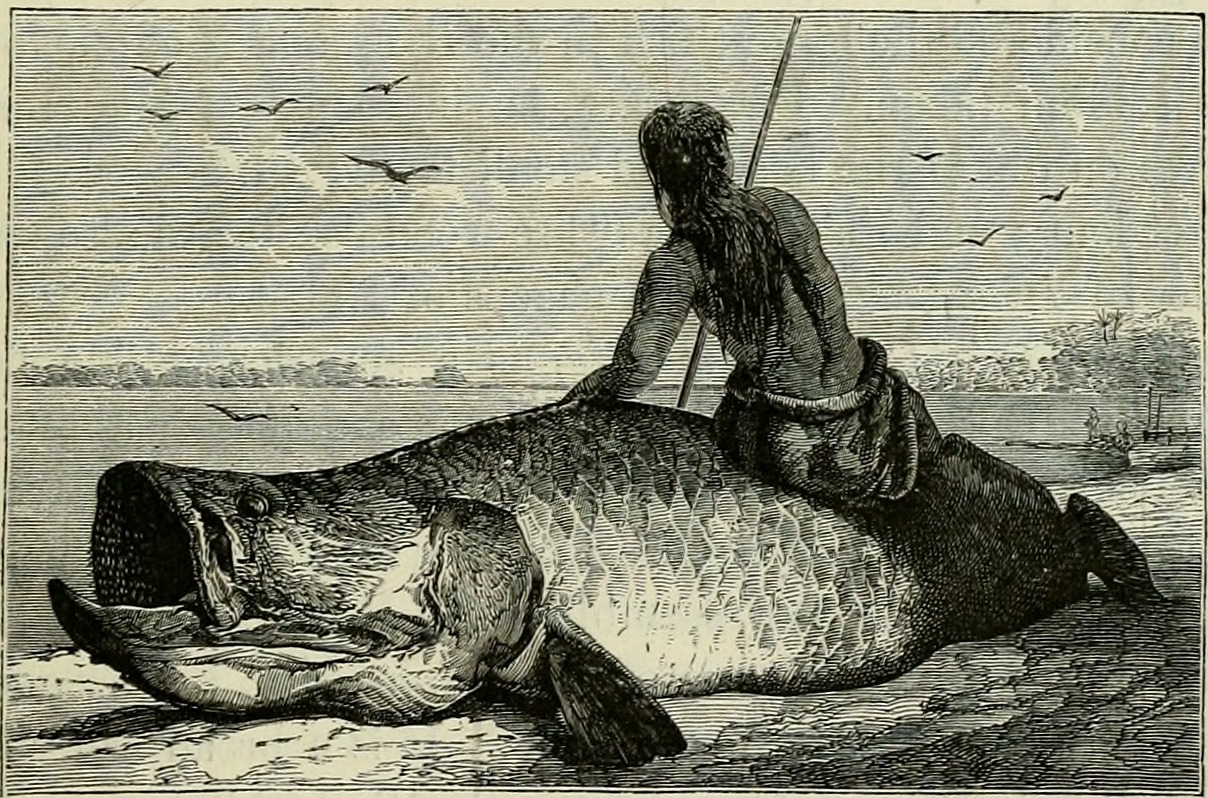
The Pira-rucd. Pii-a-rucii, Payshi, or Anatto {Arapaima gigas), the Cod-fish of the Amazons, is the unixersal diet on the river, and,after rubber and cacao, the most important article of trade.It is sometimes found, but rarely, ten feet long, weighing300 pounds. It is covered with large, hard, red scales;has a smooth head, wide mouth, no barbels, and bands ofrasp-like teeth in various parts of the mouth. It aboundsin iagunes and clear water. Places, usually dry sand-banks. 480 The Andes and the Amazons. where salting this fish for the market is made a business,are called feitorias—about the only factories on the river.The fish is coarse, and not relished by foreigners. Pescada, a scaly, silvery fish, attaining six pounds, hasa delicious, white, flaky flesh, resembling fresh Cod-fish;abounds in the Solimoens and Tapajos. Tambaqui, calledGamitana on the Maranon {Myletes, one of the Gharaci-nidoB), is a very fine, large fish, found from the Negro tothe Ucayali. It is often a yard long,

Note About Images
Please note that these images are extracted from scanned page images that may have been digitally enhanced for readability – coloration and appearance of these illustrations may not perfectly resemble the original work.

This The Great Fish River museum image was automatically curated and published with WP Robot plugin – CLICK HERE to learn more about WP Robot for Wordpress – a massive time and money saver.

Category: ImagesTag: 1876, across, Amazon, America, Andes, continent, from, image, page, South, |bor
WE LOVE CRADOCK.

COPYRIGHT MyCradock · DESIGN BY REACH TRUST
All Rights Reserved · Powered by Straton Solar