• Skip to main content
  • Skip to header right navigation
  • Skip to site footer

My Cradock

My Cradock

Cradock News Classifieds and Directory

  • Home
  • About
  • Accommodation
  • Business
  • Events
  • Free Business Advert
  • Submit News
You are here: Home / Archives for cradock

cradock

14 December 2020 by Guest

Programme announced for pop-up Karoo Writers Festival in Cradock

This year’s edition of the Schreiner Karoo Writers Festival (SKWF) will be hosted as a pop-up event with the ticket price at only R50 per person to attend. “Run away to the Karoo! Relax and refresh yourself,” is the open invitation from festival organiser Lisa Ker. “There’ll be lots of space and fresh air, new …

This year’s edition of the Schreiner Karoo Writers Festival (SKWF) will be hosted as a pop-up event with the ticket price at only R50 per person to attend.

“Run away to the Karoo! Relax and refresh yourself,” is the open invitation from festival organiser Lisa Ker.

“There’ll be lots of space and fresh air, new ideas, live music, regional food and the warmest of  hospitality within a framework of scrupulous health safety protocols,” Ker added.

SKWF ‘more affordable than ever’

According to Ker, they have been able to lock down ticket prices and make this year’s pop-up festival “more affordable than ever” with the support of the Amazwi South African Museum of Literature.

Session tickets, (morning or afternoon) cost R50 each per person (workshops, meals and refreshments excluded).

Amazwi is the founding sponsor of SKWF and in a special Friday afternoon programme at Schreiner House, Amazwi director Beverley Thomas will present readings by some of her creative staff members who are themselves writers. 

Talk on JM Coetzee exhibition

Amazwi’s curatorial division manager Crystal Warren will give a talk about Scenes from the South, a major exhibition about the life and work of JM Coetzee which is on display at the museum.

The eminent writer/philosopher chose to celebrate his 80th birthday at the museum with the opening of the exhibition when he could have chosen any of the world’s literary capitals. The fascinating behind-the-scenes stories played out over a number of years.

Supper al fresco will be offered at a gesellige street market from 16:00 on Friday, followed (at 19:00) by a huiskonsert featuring some of the results of the songwriting workshop.

Saturday programme

The Saturday programme is located in the airy spaces of The Shed complex where a strong lineup of speakers/readers features: 

  • Vivian de Klerk – her novel, Not to Mention, is a hot topic in the media and on the book club circuit  
  • Tony (Gastroturf) Jackman who relishes some of the unpublished moments of his very popular columns in The Daily Maverick 
  • David Hilton Barber who introduces his new book about the 1820 Settlers 
  • sport historian Dean Allen who examines the legacy of the 2010 FIFA World Cup. 

The screening of a showreel of highlights from the 12-part video series on literary creativity will lead in to Open Mic on Saturday afternoon. The video series was created by Melina Smit for The Avbob Poetry Project as a boost for educators in the Eastern Cape, but its resonances are universal. 

Open Mic will include live readings interspersed with our ‘Absent Friends’ series – short video clips and messages from favourite writers (such as Etienne van Heerden) who could not make it in person.

Before a traditional Karoo dinner on the Saturday night, Chris Marais and Julienne du Toit will present a slideshow and some story-gems from their delightful new book, Karoo Roads.  

“On Sunday, we recommend everyone heads out to the Mountain Zebra National Park to revel in the wide open spaces and tank up on the ultimate creative inspiration,” said Ker.

For more programme information and to book, write to karoowritersfestival@gmail.com or send a WhatsApp to 082 932 8864.

The programme can be copied and pasted off www.karoowritersfestival.weebly.com

DMCA.com Protection Status

Category: NewsTag: cradock, news, online, south africa
14 December 2020 by Guest

Noah’s seed bunker: Protecting billions of wild plants

The Millennium Seed Bank Partnership is the world’s largest seed bank for wild plants, helping to provide an insurance policy against extinction for nearly a quarter of the globe’s known wild plant species. Credit RBG Kew It’s bomb-proof, radiation-proof and icy cold in this cavernous tomb of life, 60km south of central London. First published …


The Millennium Seed Bank Partnership is the world’s largest seed bank for wild plants, helping to provide an insurance policy against extinction for nearly a quarter of the globe’s known wild plant species. Credit RBG Kew

It’s bomb-proof, radiation-proof and icy cold in this cavernous tomb of life, 60km south of central London.

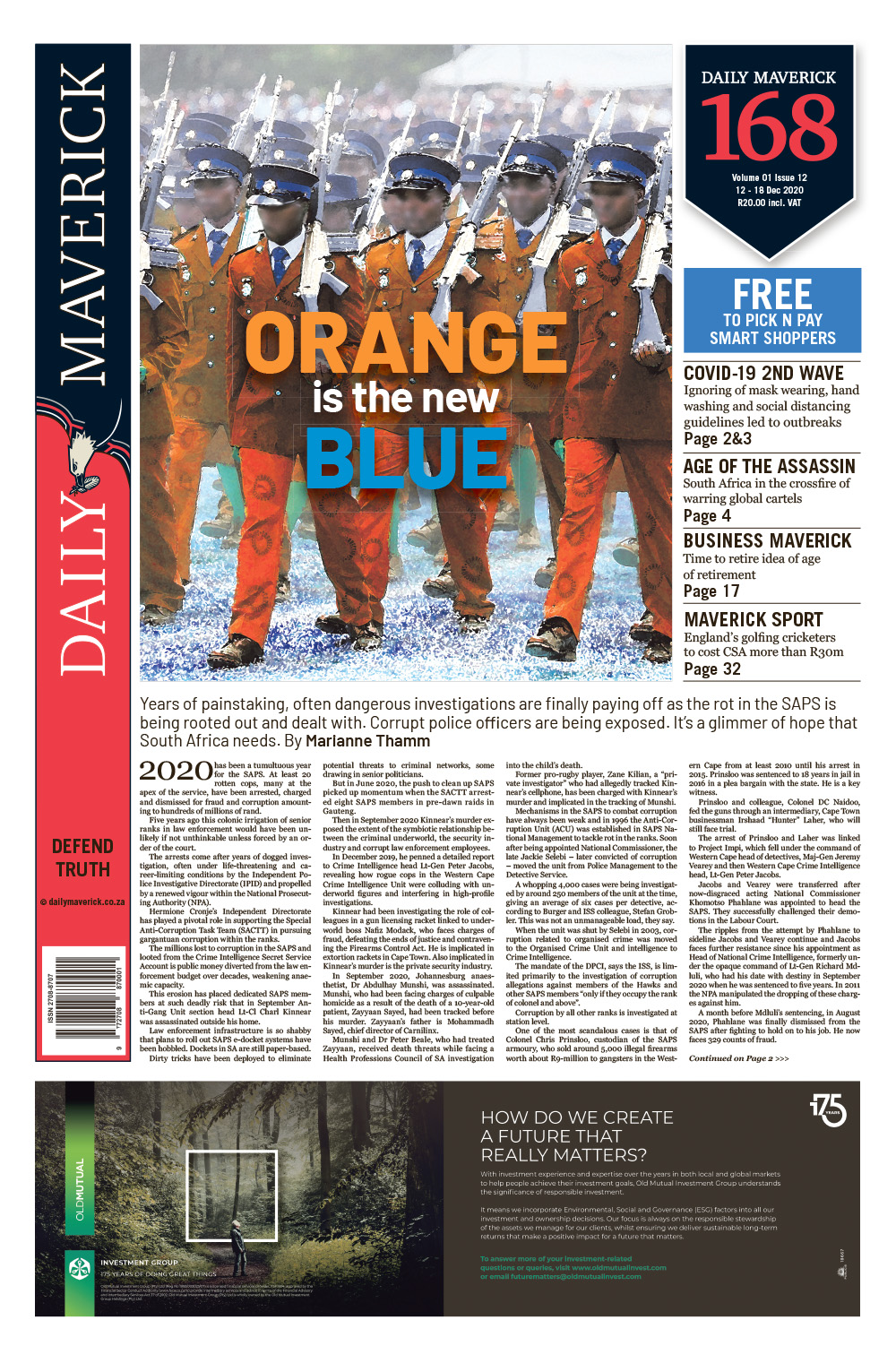
First published in the Daily Maverick 168 weekly newspaper.

Chilling at minus 20°C in airtight glass jars in a vault large enough to house 30 double-decker buses, there are nearly 2.5 billion seeds from across the world lying in cold storage here, including thousands of South Africa’s most precious wild seeds.

Depending on whether you are of a glass half-empty or half-full persuasion, this massive global facility can be seen either as a Doomsday vault or a modern Noah’s Ark. Either way, it was set up as an insurance policy to ensure the continuity of a rich variety of plant life should the parent stock become scarce or extinct in this era of relentless destruction of the shrinking world of nature.

Over the past 20 years, plant experts from around the world have stashed away seeds from more than 40,000 different species of trees and plants as part of the Millennium Seed Bank Partnership, the world’s largest off-site conservation project for wild plants.

South Africa, a country with an extraordinarily rich mixture of plant life, is one of the largest shareholders – having banked seeds from nearly 5,000 plant species in the underground vault near Wakehurst botanical gardens in Sussex.

Ideally, none of the shareholders want to make any withdrawals from this emergency savings bank. Yet South Africa has already had to call back some of the seeds that were deposited there 15 years ago.

The first local seeds to be withdrawn were from Marasmodes undulata, an inconspicuous shrub with yellow flowers first discovered in the Western Cape in 1946. But now it is one of South Africa’s most critically endangered species, restricted until recently to just one small patch of land in the Paarl Valley.

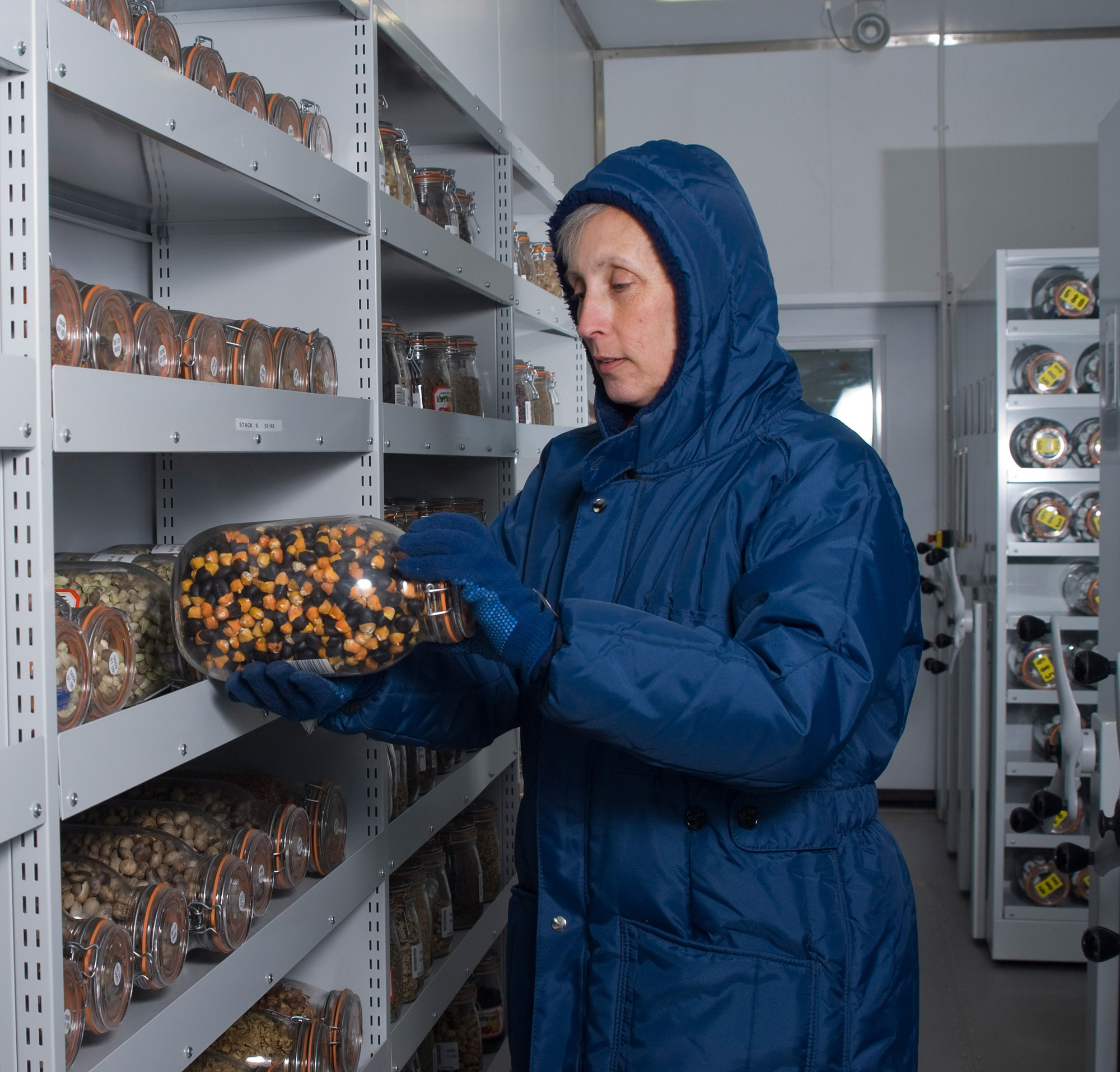
Beverley Maynard stores seeds in the Millennium Seed Bank vaults. Credit: RBG Kew

Luckily, a small number of these seeds were deposited in the Millennium Seed Bank in 2005 and earlier this year some were flown home from London after the plant’s last remaining patch of living space was scorched by a bushfire, leaving none left in the wild.

There are similar examples from across the world.

In Australia, over 1,000 seeds from a rare clover plant were collected in 2007 and sent to England, but 250 were sent back earlier this year to help restore thousands of hectares of vegetation scorched by intense bush fires near Adelaide. Earlier this year, a team of 145 expert authors from 50 countries also published a report that suggests that roughly one million animal and plant species are now threatened with extinction, many within decades.

The landmark report – by the Intergovernmental Science-Policy Platform on Biodiversity and Ecosystem Services (IPBES) – found that nature is declining at rates unprecedented in human history.

But this is not surprising considering that the world’s human population has more than doubled (from 3.7 to 7.6 billion) since 1970.

More than a third of the world’s land surface and nearly 75% of freshwater resources are now devoted to crop or livestock production. Three-quarters of the land environment is also classified as “severely altered” by human actions, while climate change is likely to accelerate the extinction trajectory for several species.

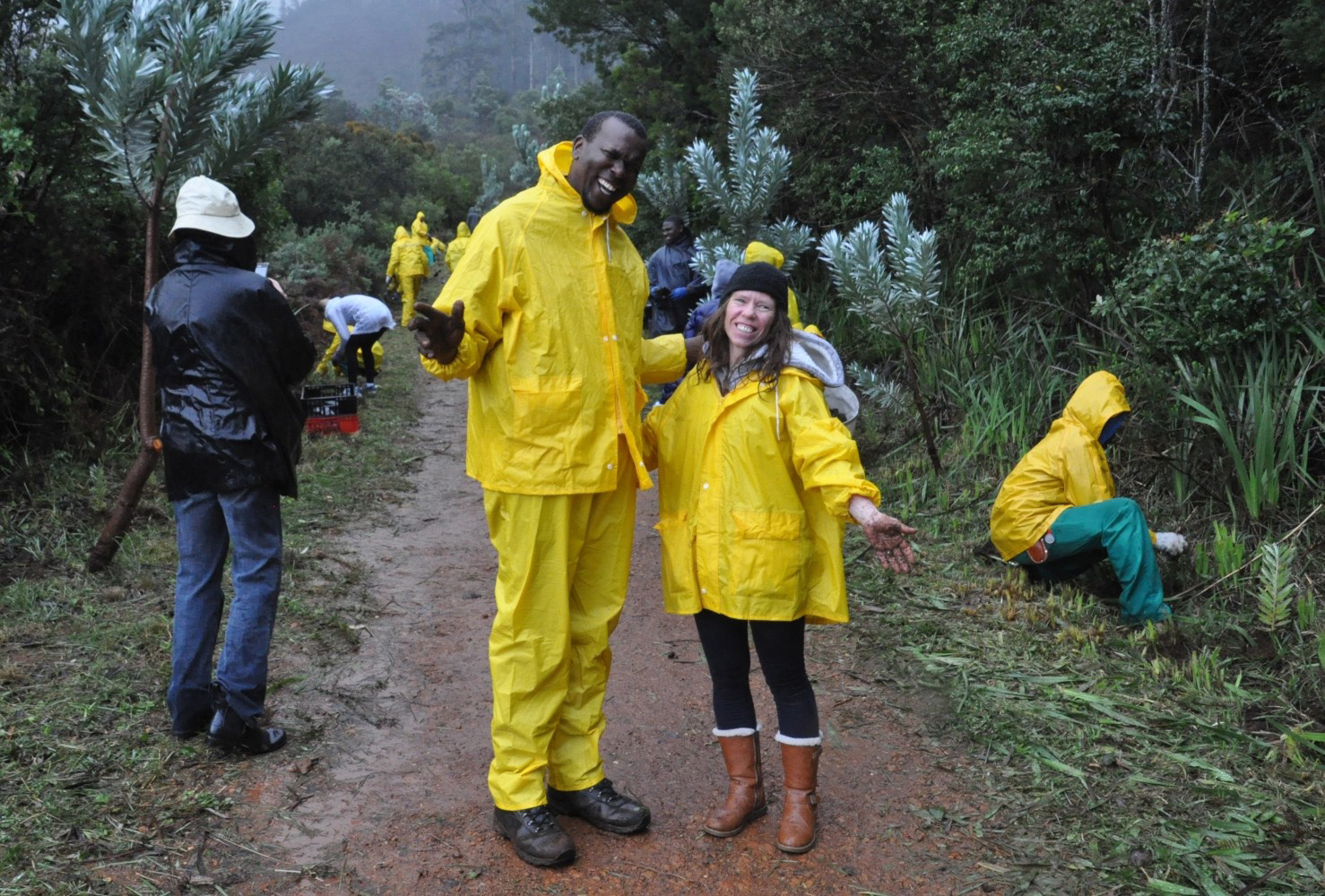
Horticulturist Mashudu Nndanduleni (left) and SANBI Seed Conservation Manager Victoria Wilman take a break from planting a row of rare silver trees (Leucadendron argenteum) in the Celia Forest near Tokai in the Western Cape. Credit SANBI

This is why planning for the Millennium Seed Bank Partnership began as far back as 1995, co-ordinated by the Royal Botanic Gardens, Kew, and funded initially by the UK’s National Lottery and several private benefactors including the Wellcome Trust and Orange Plc.

At the time, costs were estimated at around £80-million.

Opening the facility in November 2000, Prince Charles said: “I feel I am opening the Bank of England of the Botanical World, a place where this reserve currency – in this case life itself – is stored.”

But it’s not just an English project. Treaties have been signed with more than 50 nations and seeds collected from 190 nations and territories with the aim of storing at least 25% of the world’s orthodox wild plants by the end of this year.

In South Africa, plant experts have travelled across the country and banked 4,718 species in the global facility, says Victoria Wilman, Seed Conservation Manager for the SA National Biodiversity Institute (SANBI) at the Kirstenbosch National Botanical Garden.

After collection the seeds are dried slowly at low temperature before being cleaned, counted and put into airtight containers – in the hope that they will still be viable several hundred and possibly thousands of years from now.

While there are anecdotal records of seeds from ancient Egyptian tombs being successfully germinated, plant experts at Kew say the viability of seeds varies according to the species and the conditions they have been stored in.

By rapidly ageing batches of seeds at a range of high moisture content and high temperatures, and then plotting their loss of viability, some experts suggest that seeds from mung beans might live for 24,000 years and that teff grass seeds from Africa could still be viable for 15,000 years.

However, one of the few recorded real-life tests involved the 1987 successful germination of wheat and other cereals that had been placed in sealed glass vials in Vienna 110 years earlier.

More recently, scientists were able to germinate at least three seed varieties previously collected in South Africa in 1802. The seeds were found at the National Archives in London among the papers of a Dutch merchant whose ship was captured while returning from the Far East via the Cape of Good Hope.

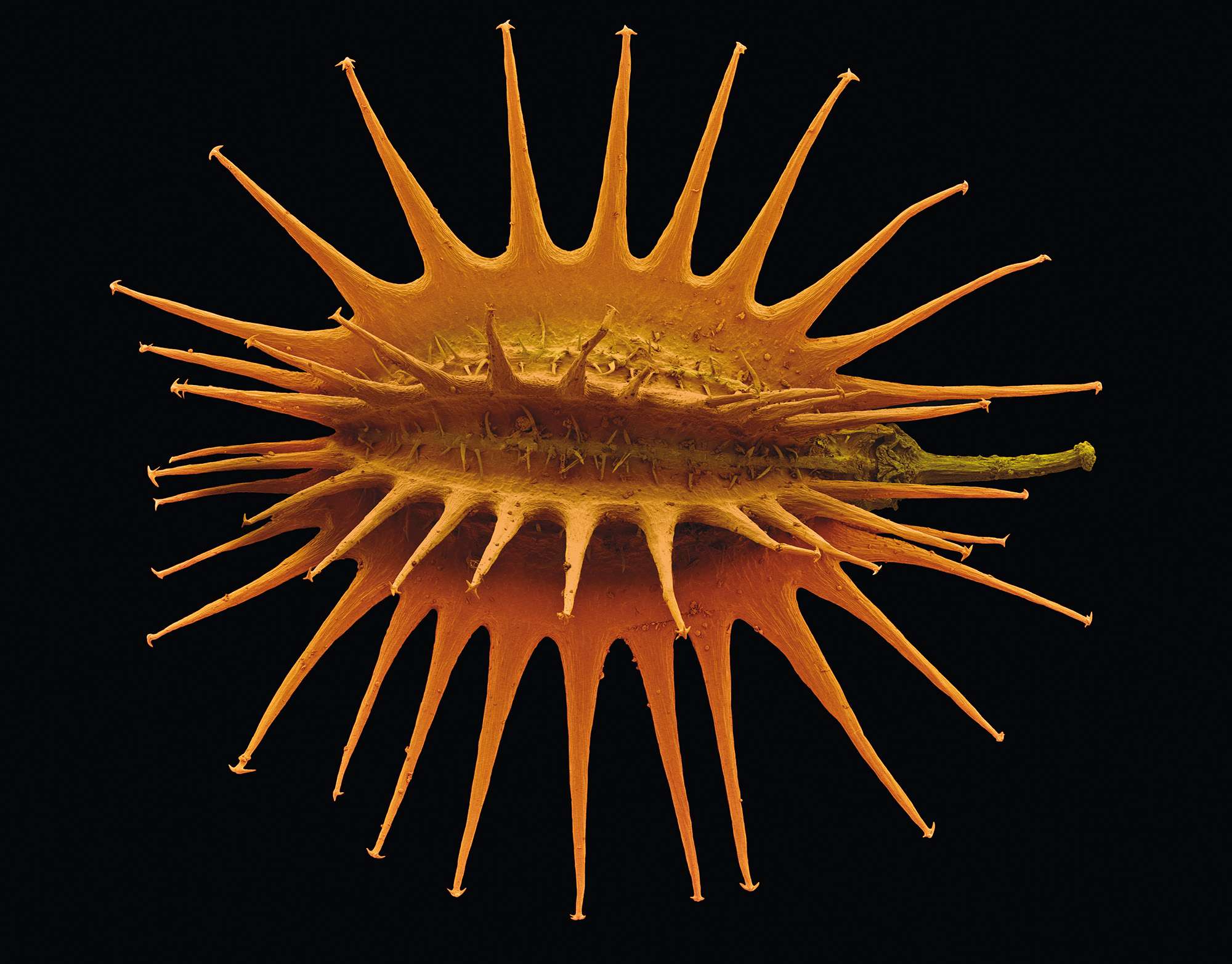
The seed from a wild carrot, Daucus carota. Credit Rob Kesseler

Another species came back to life by accident. The Chinese legume had been stashed in the British Museum in 1793 but when a fire broke out in 1940 it was “watered” by firemen and promptly germinated.

Wilman says SANBI is proud to be part of a worldwide conservation project that will help to safeguard local species from extinction.

“We have received so much support from the partnership, including funds, training and guidance, so that we can store our flora for the long term. It is a great feeling when you find a species that you have been searching for and can finally be sure that it is safely banked for the future.”

She says the project is particularly important for South Africa as the country is renowned for its rich floristic diversity – with at least 20,942 species having been recorded.

Two-thirds of these plants are endemic (found nowhere else in the world). South Africa also contains one of the world’s six floral Kingdoms, and also hosts three of the 35 globally recognised biological hotspots – the Maputaland-Pondoland, the Succulent Karoo and the Cape Floristic Region.

“South Africa is one of 17 megadiverse countries that hold more that 70% of the world’s biodiversity and due to the considerable work that has already been put into developing and implementing the Strategy for Plant Conservation, South Africa is considered one of the key countries for biodiversity conservation globally.”

But nearly a quarter of our plant species are considered to be threatened with extinction or at serious risk.

“Although all plant species deserve to be conserved, and it would be wonderful to have all our South African species in ex situ [off-site] collections, it is impossible to target all 20, 942 species at once. Even targeting just our 13, 754 endemic species is a tall order.

“Due to the fact that we are losing species at an alarming rate, and with limited resources and time available, priority targets must be set for species that require immediate attention for conservation and possible restoration,” says Wilman.

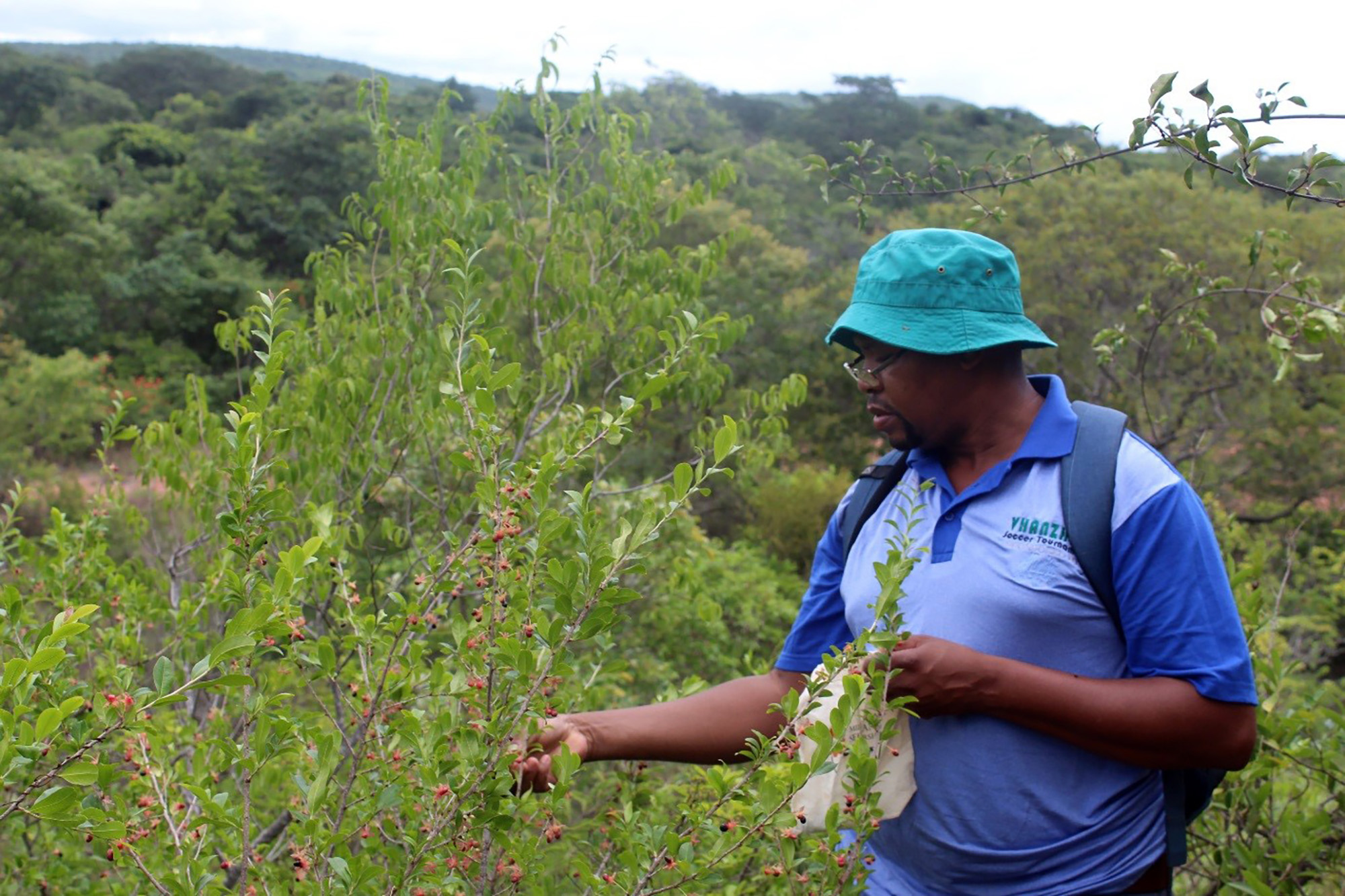
Lufuno Konanani collects seeds from the critically endangered Brackenridgea zanguebarica in Limpopo province. Credit SANBI

Richard Deverell, Director of the Royal Botanic Gardens, Kew, said: “As we face the toughest decade ever for our planet with species disappearing at an alarming rate, the work of the Millennium Seed Bank couldn’t be more important – even more so than we could have anticipated 20 years ago.

“The species safeguarded by the partnership since 2000 offer possibility and hope for future generations. They could help provide the next major food crop, develop a new cancer drug, or restore degraded habitats destroyed by climate change and deforestation.”

Elsewhere in the world, there are several smaller seed banks, while Norway also has a major repository to protect food and commercial crop species. The Svalbard Global Seed Vault, naturally cooled within chilly mountain rock in the Arctic Circle, opened in 2008 and now contains seed samples from nearly one-third of the world’s most important food crop varieties. DM168

Only a select few ground-breaking Daily Maverick 168 stories are published on our website. For all the most important stories of the week, get your copy of the Daily Maverick 168 newspaper at these Pick n Pay stores.

Gallery


Comments – share your knowledge and experience

Please note you must be a Maverick Insider to comment. Sign up here or sign in if you are already an Insider.

Everybody has an opinion but not everyone has the knowledge and the experience to contribute meaningfully to a discussion. That’s what we want from our members. Help us learn with your expertise and insights on articles that we publish. We encourage different, respectful viewpoints to further our understanding of the world. View our comments policy here.

No Comments, yet

Category: NewsTag: cradock, graaff reinet, hofmeyer, karoo, news
12 December 2020 by Guest

Emergency response: Doctors Without Borders urges government to send medics to Covid-19 hotspots

A Covid-19 patient in Livingstone Hospital in Nelson Mandela Bay. (Photo: Mike Holmes) MSF is running a Covid-19 ward in Nelson Mandela Bay and has appealed to the government to strengthen its national emergency response capacity to deploy doctors. The appeal was sent as Minister of Health Dr Zweli Mkhize announced that a second wave …


A Covid-19 patient in Livingstone Hospital in Nelson Mandela Bay. (Photo: Mike Holmes)

MSF is running a Covid-19 ward in Nelson Mandela Bay and has appealed to the government to strengthen its national emergency response capacity to deploy doctors. The appeal was sent as Minister of Health Dr Zweli Mkhize announced that a second wave of infections has hit South Africa. The Eastern Cape, Western Cape, KwaZulu-Natal and Gauteng have been identified as provinces where infection rates are surging.

Two big organisations operating in the Eastern Cape — as hospitals buckle under the weight of an increased patient load due to Covid-19 infections and an increased number of health workers falling ill or required to isolate themselves — this week highlighted the need for a rapid response to the human resources challenges brought about by the pandemic’s second wave.

While the latest outbreak of coronavirus infections in the Eastern Cape was isolated to Nelson Mandela Bay and the Sarah Baartman district (large parts of the Karoo, but also the towns of Kareedouw and popular holiday towns such as Jeffreys Bay) the latest epidemiological report for the province showed that between Wednesday 9 December and Thursday 10 December, 44% of new cases were from the Buffalo City Metro (East London), the Chris Hani district (including Komani, Cradock and Middelburg) and 17.7% from Alfred Nzo and the OR Tambo districts (in the former Transkei and Ciskei).

The provincial recovery rate stands at 89.6% and the case fatality rate at 2%. According to the epidemiological report, the number of Covid-19 related deaths has significantly increased in November and December.

The province has 9,519 active cases. Healthcare workers made up 6% of active cases; 153 healthcare workers have died since March.

“The second peak of the pandemic is more likely to exceed the first peak which occurred during the June-July period. The key risk factors are associated with the relaxation of the lockdown restrictions. These factors may include failure to use the non-pharmaceutical prevention strategies (wearing of masks, social distancing and hand washing or sanitation), mass gatherings (in funerals and memorials, parties, bashes with famous artists or DJs, etc.), and high mobility rates,” the report said.

To help the Nelson Mandela metro to cope with the projected influx of patients, Gift of the Givers is finalising a plan to pay the salaries of 26 paramedics to work at Livingstone Hospital and bolster the number of hands on deck, Dr Imtiaz Sooliman said on Thursday.

“When I asked for a list, there were only a few names,” he said. “Then I said okay. But I wanted to carry on with my plan. Then the word spread and every day there would be a phone call to say more and more paramedics are willing to come help,” Sooliman said.

He said the memorandum of understanding between the Eastern Cape Department of Health and Gift of the Givers was at an advanced stage.

“We will fund them to support current staff at Livingstone Hospital and the Nelson Mandela Bay Metro until the end of January, for now,” Sooliman said.

The pandemic could never be managed by the government alone, he said. 

“It requires the participation of all 60 million of us. Financial support, assistance with medical supplies, infrastructure upgrade and responsible behaviour is key.

Sooliman said he was receiving calls for assistance from everywhere in the Eastern Cape telling him that the hospitals were full, even though hospital managers and other senior personnel had been barred from providing numbers. 

“The casualty can’t cope. The queues are lengthening outside. We have to increase capacity. We have them sitting on chairs. We find many dead there. Funeral parlours, big and small, have never been this busy.” This, Sooliman said, came from conversations he had every day with healthcare workers.

Premier Oscar Mabuyane’s spokesperson, Mvusi Sicwetsha, said the premier was confident that the provincial health system would cope for the moment, but warned that it would not be able to withstand a rise in infections caused by large-scale irresponsible behaviour. 

He said there was a need for PPE, hand sanitiser, pulse oximeters, thermometers, scrubs and more beds, oxygen, high flow nasal oxygen machines, flow meters, oxygen gauges, splitters and oxygen masks — and even basics such as blankets and linen.

“It’s not a good place to be in for healthcare workers, but what strikes me immediately is the resilience, the inner strength, the commitment and the desire to serve, in spite of their own emotional and mental state. You witness the efforts to make it better in the face of all odds against them. You hear the compassion in the voices, witness the mercy in their souls, these are the healthcare workers on the frontline and the last line of defence between us and Covid-19.

“Our Gift of the Givers staff have witnessed CEOs and top management break down in tears, sobbing uncontrollably on receipt of the supplies.

He said they had delivered 120 extra beds to Bhisho Hospital with mattresses and 240 pillows and high flow nasal oxygen machines. “An infrastructure upgrade to provide accommodation for medical personnel is under consideration,” he said.

He said that in the past week, his team was completing a R750,000 upgrade to the Settlers Hospital in Makhanda — this would open on Tuesday, 15 December.

After sending a team of healthcare workers to help hospitals facing a Covid-19 crisis in the Eastern Cape, Médecins Sans Frontières (MSF), or Doctors Without Borders, is also urging the National Department of Health to improve its national emergency response capacity by ensuring that medical staff can be rapidly assigned to developing Covid-19 hotspots throughout the country, to fill critical staffing gaps.

According to MSF, the public health system in the Nelson Mandela Bay Metropolitan Municipality in the Eastern Cape was on the brink of collapse in November due to a catastrophic shortage of human resources unable to handle a surge in Covid-19 cases.

“Covid-19 is a fast-moving pandemic that is very human resource-intensive, whereas South Africa’s health system is bureaucratic and often hampered by staffing shortages. To save lives and provide essential care, a more agile way of responding to Covid-19 outbreaks is urgently needed,” medical coordinator for MSF in Port Elizabeth Dr Colin Pfaff said. 

The rapid assignment of doctors and nurses with Covid-19 experience was an effective way to prevent unnecessary deaths when a Covid-19 wave hit under-resourced areas, he said. 

“They need to be willing and able to immediately travel and rapidly integrate with existing facility medical teams, as the intense wave of infections will typically have passed in just a few weeks,” he added. 

A team of 20 MSF-employed doctors and nurses who were sent to Nelson Mandela Bay metro were rapidly integrated into Livingstone Hospital and the Rev Dr Elizabeth Mamisa Chabula-Nxiweni Field Hospital — a large Volkswagen manufacturing plant that has functioned as a Covid-19 field hospital since late June. 

“During the last week, there has been a reduction in the number of new Covid-19 cases registered in the Nelson Mandela Bay Metro and the situation in facilities has stabilised slightly, although promised human resources have been slow to materialise and the system remains deeply stressed,” Pfaff said.

“Meanwhile,” he said, “additional hotspots have emerged in parts of the Eastern and Western Cape provinces and MSF believes the likelihood of many more hotspots developing is high. With facilities across the country experiencing shortages of critical staff after a bruising first Covid-19 wave, a repeat of the Nelson Mandela Bay metro crisis in other parts of the country is a real risk.”

Eastern Cape Department of Health spokesperson Sizwe Kupelo insisted that six doctors had been appointed to assist at Livingstone Hospital.

He said from 27 November, 33 patients had been admitted to a ward with oxygen that had been converted from an underground parking garage as part of the province’s Covid-19 response. 

But hospital sources said there were only 20 beds that could be used in the basement, and the ward was mostly run by MSF.

Premier Oscar Mabuyane’s spokesperson, Mvusi Sicwetsha, said the premier was confident that the provincial health system would cope for the moment, but warned that it would not be able to withstand a rise in infections caused by large-scale irresponsible behaviour. 

“He appreciates the contribution of the health workers in helping people recover from infection. He is concerned that the reckless behaviour of some of our people puts the lives of our health workers at huge risk. Our health system, like any health system in the world, will not cope with high numbers of people requiring hospitalisation. That is why we are encouraging people to do everything in their power to prevent the spread of infections so that they don’t need hospitalisation.” DM/MC

Like what you’re reading? Sign up to the Maverick Citizen newsletter and get a weekly round-up sent to your inbox every Tuesday. Free. Because paywalls should not stop you from being informed.

Gallery


Comments – share your knowledge and experience

Please note you must be a Maverick Insider to comment. Sign up here or sign in if you are already an Insider.

Everybody has an opinion but not everyone has the knowledge and the experience to contribute meaningfully to a discussion. That’s what we want from our members. Help us learn with your expertise and insights on articles that we publish. We encourage different, respectful viewpoints to further our understanding of the world. View our comments policy here.

No Comments, yet

Category: NewsTag: cradock, news, online, south africa
12 December 2020 by Guest

Karoo Christmas Cake

Karoo Christmas cake enhanced with makataan, green fig preserve and masses of brannewyn. (Photo: Louis Pieterse, Kudu Studio) Add, to a traditional Christmas cake recipe, a touch of green fig preserve and some makataan, and you have a Platteland take on a rich, dark and brandy-sodden fruitcake. This recipe has been updated to reflect a …


Karoo Christmas cake enhanced with makataan, green fig preserve and masses of brannewyn. (Photo: Louis Pieterse, Kudu Studio)

Add, to a traditional Christmas cake recipe, a touch of green fig preserve and some makataan, and you have a Platteland take on a rich, dark and brandy-sodden fruitcake.

This recipe has been updated to reflect a missing step (when to fold in dry ingredients), with apologies.

Chef Mynhardt Joubert sent me a challenge recently, but he sent me more than that: at the front gate, by courier, arrived a large parcel which seemed a bit like a Christmas box. There was something about it.

Unwrapping it in the kitchen I found many delights. Packets of dried fruit and almonds, a bottle of vanilla essence, bicarbonate of soda, dates, red and green glacé cherries, baking powder, flour, even a bottle of KWV 10-year-old brandy. But there was more: the prize item in the box was square, well wrapped, and heavy. It was Chef Mynhardt’s own famous Christmas cake. I immediately poured brandy over it and stored it away. As one does.

I stored everything away in fact, contemplating, for a few weeks, how I would approach the challenge. And clearly that’s what it was: Mynhardt’s unspoken challenge: “Here’s what I did, let’s see what you can do?”

So here’s what I did. A nod, here, to two other people: my fellow Cradocker Heyla Meyer, whose wonderfully moist, luscious Christmas cake that we bought from her a year ago was truly inspirational. When I asked her for her secret she replied: “Tony, green fig preserve and makataan.” That’s the beloved syrupy wild watermelon preserve you find all over the Platteland. The other is Delia Sainsbury, whose classic Christmas cake I have made a few times over the years. While this is by no means her recipe, my “Christmas cake knowledge” has come mostly from her recipe and from cooking at my mother’s elbow as a little boy all those decades ago. So, yes, in fact, there are four people to thank. Thank you Mom, Heyla, Delia and most of all Mynhardt Joubert. So here’s my…

Karoo Christmas Cake

Start the day before you intend to bake the cake.

The method follows each group of ingredients.

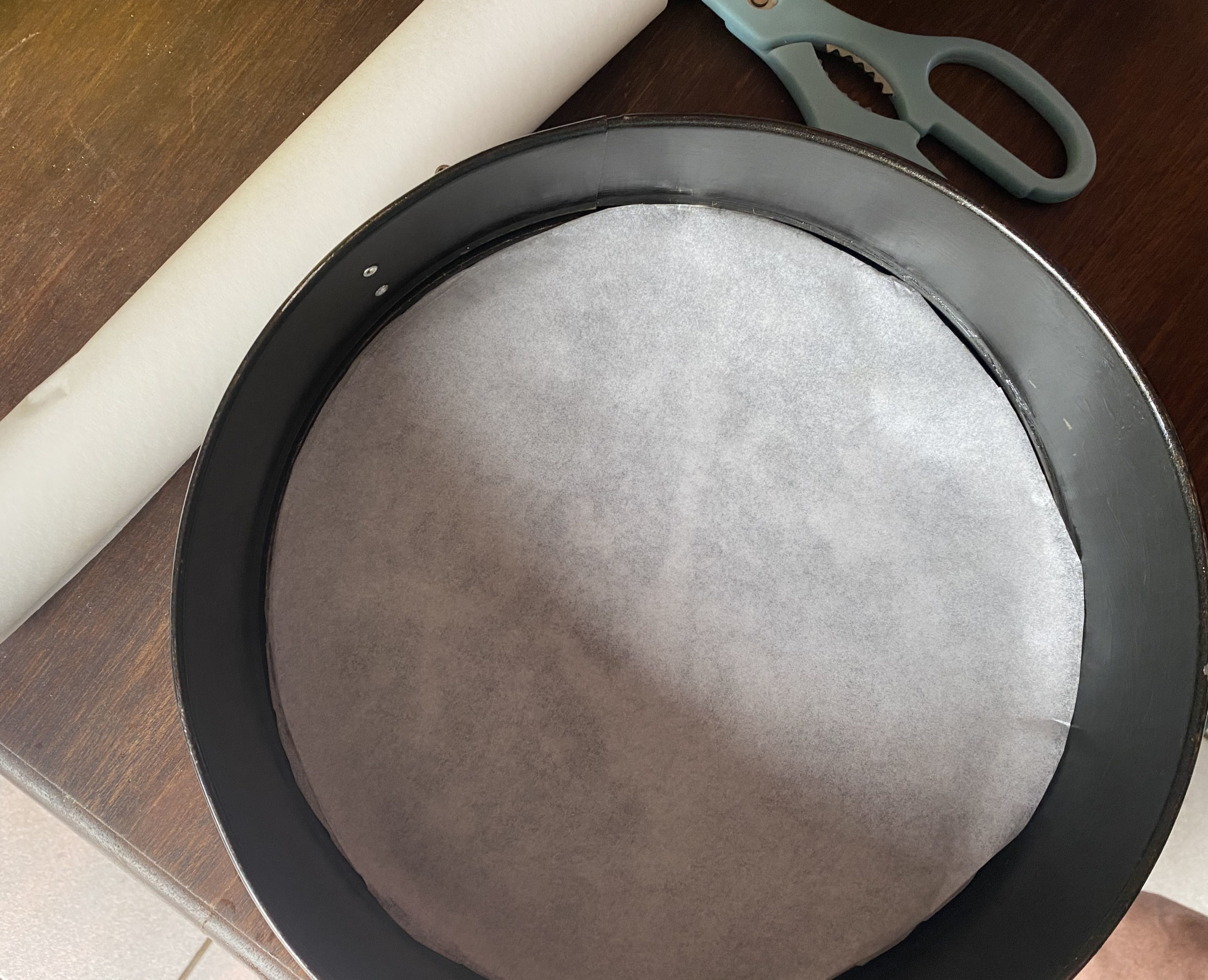
First prepare the tin. 

You’ll need:

1 x 24 cm springform cake tin

Non-stick baking paper

Brown paper

Stickytape

Butter for greasing

Method:

Grease the base and sides (inside, obviously) of the springform cake tin thoroughly with butter. Cut out four rounds of baking paper to fit the base of the tin. Fit two of them in snugly, one on top of the other. Keep the remaining two rounds of paper aside.

Line the base with two rounds of baking paper.

Cut out two long strips of baking paper to fit all the way around the inside of the tin, to come 3 or 4 cm above the top of the tin. Arrange both of these strips around the inside of the tin. When you spoon in the cake batter later it will hold the paper to the sides.

Now cut out a long piece of brown paper to fit all the way round the outside of the tin, which you can hold together with a bit of stickytape. All of this provides plenty of protection while the cake is baking for all those hours.

The day before:

You’ll need:

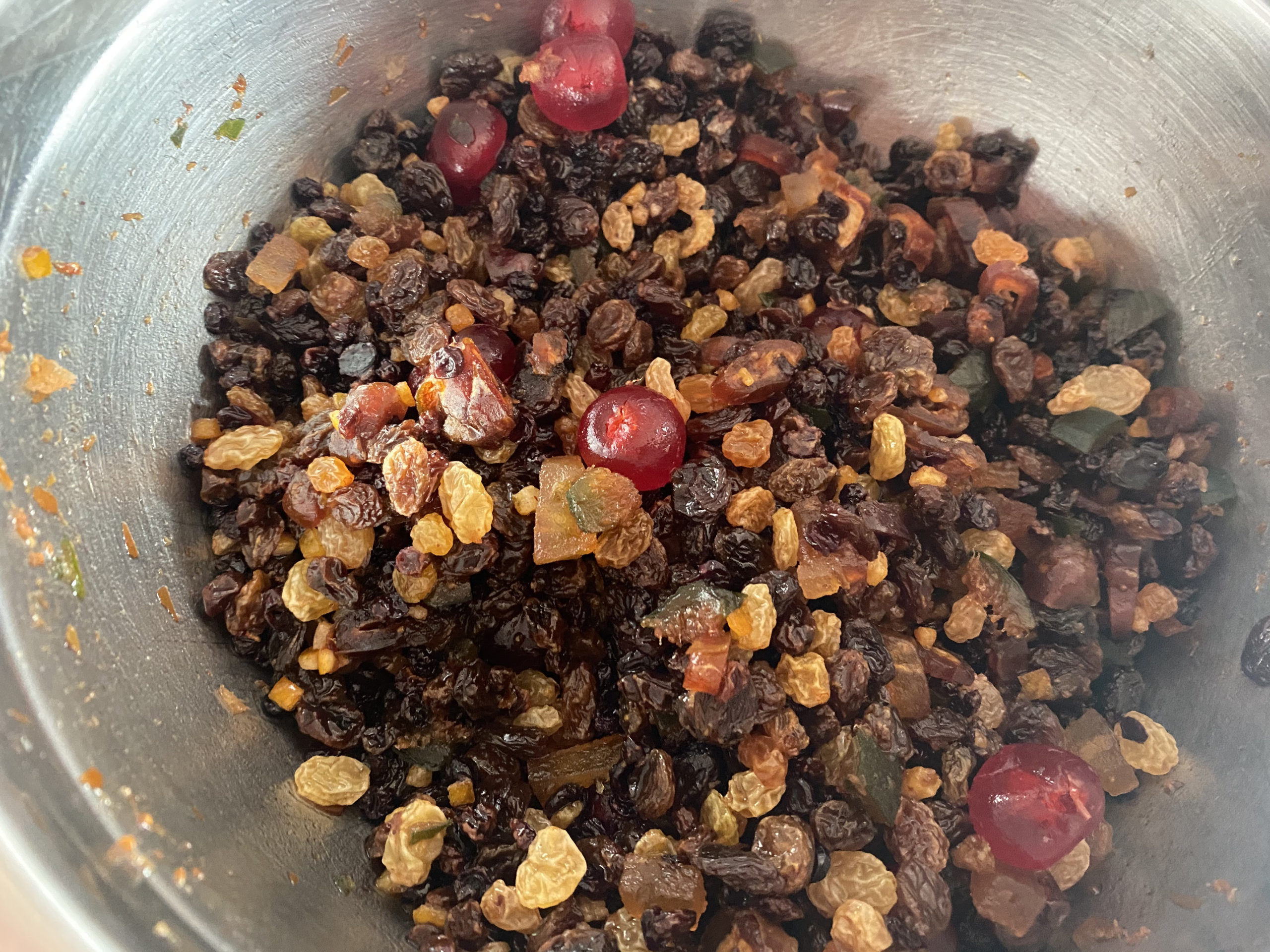
500 g cake mix (pitted raisins, sultanas and citrus peel)

250 g dried fruit mix (Thompson raisins, sultanas)

150 g sayer dates, chopped

200 g red glacé cherries, whole

100 g preserved green figs, chopped

80 g makataan (preserved wild watermelon), chopped

8 Tbsp KWV 10-year-old brandy

Method:

Leave to macerate in the fridge for 24 hours.

Combine all of the above in a large bowl, mix well, cover with cling film and refrigerate to macerate for 24 hours or more. If you’d rather buy packets of raisins, sultanas and citrus peel separately, weigh out 375 g each of raisins and sultanas, to amount to 750 g, and add 50 g dried citrus peel. You should find this in the baking section of your supermarket.

On the day:

First remove the above mixture from the fridge and leave aside to come to room temperature. Then preheat the oven to 150?. Now measure out the following.

You’ll need:

250 g plain cake flour

½ tsp grated nutmeg

½ tsp grated cinnamon

1/2 tsp mixed spice

½ tsp salt

Method:

Sift the flour into a large bowl with the spices and salt.

Next, you’ll need:

250 g unsalted butter at room temperature

250 g treacle sugar

4 jumbo eggs

Method:

In a separate large bowl, using a wooden spoon or balloon whisk, cream the butter and sugar together until light and pale. Crack the eggs into a separate bowl. Add a tablespoon at a time of the beaten eggs to the creamed butter and sugar mixture, beating with a wooden spoon, until all is combined.  Now fold in the flour and spice mixture.

Next, you’ll need:

60 g whole almonds, roughly chopped

1 Tbsp green fig syrup (the syrup from the 


jar of preserved figs)

1 lemon, the zest of (not the juice)

1 pink grapefruit, the zest of (not the juice)

More almonds to decorate the top of the cake

Method:

Fold the marinated fruit mix into the creamed butter mixture, in broad, light movements to keep the air in. Then fold in the chopped almonds, then zest, and finally the green fig syrup.

Your batter is ready.

Use a ladle to spoon the mixture into the tin, starting at the centre and moving outwards, so that the batter pushes the paper to the sides. Use the back of the ladle to even the batter out and fill any gaps, and to smooth the surface. Arrange whole almonds on top in a pattern of your choice (you can see what I did), pushing them down only slightly so that they hold.

Grab the remaining two rounds of baking paper and fold them in half. Cut a little semi-circle in the centre of the fold to make two little holes in the centre of each round. Place them one on top of the other on top of the cake. 

Put it in the oven and bake for up to 4 ½ hours. When it is done the top will bounce back or “resist” when you press it gently. Remove to a wire rack and do not touch for 40 minutes, then release the springform clamping mechanism. Leave it another half hour before removing the paper. Leave it for a few hours to cool completely. Use a skewer to make holes in it here and there, and pour brandy over the top, not too ungenerously. Wrap the cake in plenty of baking paper, and then again in plenty of foil, and store in a dark cupboard until Christmas. Once a week, unwrap it, pour more brandy over, wrap up and return to its cupboard. It will thank you for it. DM/TGIFood

Gallery


Comments – share your knowledge and experience

Please note you must be a Maverick Insider to comment. Sign up here or sign in if you are already an Insider.

Everybody has an opinion but not everyone has the knowledge and the experience to contribute meaningfully to a discussion. That’s what we want from our members. Help us learn with your expertise and insights on articles that we publish. We encourage different, respectful viewpoints to further our understanding of the world. View our comments policy here.

All Comments 2

  • kirsty says:

    I’m inspired!!! Now to find makataan …

  • Ingrid MacLaren says:

    After too many years of falaver and paffing over Christmas Cake Making – I have discovered Christmas Cake in the Slow Cooker. A revelation and a new chapter – try it, Tony! Love your column.

  • Category: NewsTag: cradock, graaff reinet, hofmeyer, karoo, news
    11 December 2020 by Guest

    Emergency response: Doctors without Borders urges government to send medics to Covid-19 hotspots

    A Covid-19 patient in Livingstone Hospital in Nelson Mandela Bay. (Photo: Mike Holmes) MSF is running a Covid-19 ward in Nelson Mandela Bay and has appealed to the government to strengthen its national emergency response capacity to deploy doctors. The appeal was sent as Minister of Health, Dr Zweli Mkhize, announced that a second wave …


    A Covid-19 patient in Livingstone Hospital in Nelson Mandela Bay. (Photo: Mike Holmes)

    MSF is running a Covid-19 ward in Nelson Mandela Bay and has appealed to the government to strengthen its national emergency response capacity to deploy doctors. The appeal was sent as Minister of Health, Dr Zweli Mkhize, announced that a second wave of infections has hit South Africa. The Eastern Cape, Western Cape, KwaZulu-Natal and Gauteng have been identified as provinces where infection rates are surging.

    Two big organisations operating in the Eastern Cape — as hospitals buckle under the weight of an increased patient load due to Covid-19 infections and an increased number of health workers falling ill or required to isolate themselves — this week highlighted the need for a rapid response to the human resources challenges brought about by the pandemic’s second wave.

    While the latest outbreak of coronavirus infections in the Eastern Cape was isolated to Nelson Mandela Bay and the Sarah Baartman district (large parts of the Karoo, but also the towns of Kareedouw and popular holiday towns such as Jeffreys Bay) the latest epidemiological report for the province showed that between Wednesday 9 December and Thursday 10 December, 44% of new cases were from the Buffalo City Metro (East London), the Chris Hani district (including Komani, Cradock and Middelburg) and 17.7% from Alfred Nzo and the OR Tambo districts (in the former Transkei and Ciskei).

    The provincial recovery rate stands at 89.6% and the case fatality rate at 2%. According to the epidemiological report, the number of Covid-19 related deaths has significantly increased in November and December.

    The province has 9,519 active cases. Healthcare workers made up 6% of active cases; 153 healthcare workers have died since March.

    “The second peak of the pandemic is more likely to exceed the first peak which occurred during the June-July period. The key risk factors are associated with the relaxation of the lockdown restrictions. These factors may include failure to use the non-pharmaceutical prevention strategies (wearing of masks, social distancing and hand washing or sanitation), mass gatherings (in funerals and memorials, parties, bashes with famous artists or DJs, etc.), and high mobility rates,” the report said.

    To help the Nelson Mandela metro to cope with the projected influx of patients, Gift of the Givers is finalising a plan to pay the salaries of 26 paramedics to work at Livingstone Hospital and bolster the number of hands on deck, Dr Imtiaz Sooliman said on Thursday.

    “When I asked for a list, there were only a few names,” he said. “Then I said OK. But I wanted to carry on with my plan. Then the word spread and every day there would be a phone call to say more and more paramedics are willing to come help,” Sooliman said.

    He said the memorandum of understanding between the Eastern Cape Department of Health and Gift of the Givers was at an advanced stage.

    “We will fund them to support current staff at Livingstone Hospital and the Nelson Mandela Bay Metro until the end of January, for now,” Sooliman said.

    The pandemic could never be managed by the government alone, he said. 

    “It requires the participation of all 60 million of us. Financial support, assistance with medical supplies, infrastructure upgrade and responsible behaviour is key.

    Sooliman said he was receiving calls for assistance from everywhere in the Eastern Cape telling him that the hospitals were full, even though hospital managers and other senior personnel had been barred from providing numbers. 

    “The casualty can’t cope. The queues are lengthening outside. We have to increase capacity. We have them sitting on chairs. We find many dead there. Funeral parlours, big and small, have never been this busy.” This, Sooliman said, came from conversations he had every day with healthcare workers.

    Premier Oscar Mabuyane’s spokesperson, Mvusi Sicwetsha, said the premier was confident that the provincial health system would cope for the moment, but warned that it would not be able to withstand a rise in infections caused by large-scale irresponsible behaviour. 

    He said there was a need for PPE, hand sanitiser, pulse oximeters, thermometers, scrubs and more beds, oxygen, high flow nasal oxygen machines, flow meters, oxygen gauges, splitters and oxygen masks — and even basics such as blankets and linen.

    “It’s not a good place to be in for healthcare workers, but what strikes me immediately is the resilience, the inner strength, the commitment and the desire to serve, in spite of their own emotional and mental state. You witness the efforts to make it better in the face of all odds against them. You hear the compassion in the voices, witness the mercy in their souls, these are the healthcare workers on the frontline and the last line of defence between us and Covid-19.

    “Our Gift of the Givers staff have witnessed CEOs and top management break down in tears, sobbing uncontrollably on receipt of the supplies.

    He said they had delivered 120 extra beds to Bhisho Hospital with mattresses and 240 pillows and high flow nasal oxygen machines. “An infrastructure upgrade to provide accommodation for medical personnel is under consideration,” he said.

    He said that in the past week, his team was completing a R750,000 upgrade to the Settlers Hospital in Makhanda — this would open on Tuesday, 15 December.

    After sending a team of healthcare workers to help hospitals facing a Covid-19 crisis in the Eastern Cape, Doctors Without Borders (MSF) is also urging the National Department of Health to improve its national emergency response capacity by ensuring that medical staff can be rapidly assigned to developing Covid-19 hotspots throughout the country, to fill critical staffing gaps.

    According to MSF, the public health system in the Nelson Mandela Bay Metropolitan Municipality in the Eastern Cape was on the brink of collapse in November due to a catastrophic shortage of human resources unable to handle a surge in Covid-19 cases.

    “Covid-19 is a fast-moving pandemic that is very human resource-intensive, whereas South Africa’s health system is bureaucratic and often hampered by staffing shortages. To save lives and provide essential care, a more agile way of responding to Covid-19 outbreaks is urgently needed,” medical coordinator for MSF in Port Elizabeth Dr Colin Pfaff said. 

    The rapid assignment of doctors and nurses with Covid-19 experience was an effective way to prevent unnecessary deaths when a Covid-19 wave hit under-resourced areas, he said. 

    “They need to be willing and able to immediately travel and rapidly integrate with existing facility medical teams, as the intense wave of infections will typically have passed in just a few weeks,” he added. 

    A team of 20 MSF-employed doctors and nurses who were sent to Nelson Mandela Bay metro were rapidly integrated into Livingstone Hospital and the Rev Dr Elizabeth Mamisa Chabula-Nxiweni Field Hospital — a large Volkswagen manufacturing plant that has functioned as a Covid-19 field hospital since late June. 

    “During the last week, there has been a reduction in the number of new Covid-19 cases registered in the Nelson Mandela Bay Metro and the situation in facilities has stabilised slightly, although promised human resources have been slow to materialise and the system remains deeply stressed,” Pfaff said.

    “Meanwhile,” he said, “additional hotspots have emerged in parts of the Eastern and Western Cape provinces and MSF believes the likelihood of many more hotspots developing is high. With facilities across the country experiencing shortages of critical staff after a bruising first Covid-19 wave, a repeat of the Nelson Mandela Bay metro crisis in other parts of the country is a real risk.”

    Eastern Cape Department of Health spokesperson Sizwe Kupelo insisted that six doctors had been appointed to assist at Livingstone Hospital.

    He said from 27 November, 33 patients had been admitted to a ward with oxygen that had been converted from an underground parking garage as part of the province’s Covid-19 response. 

    But hospital sources said there were only 20 beds that could be used in the basement, and the ward was mostly run by MSF.

    Premier Oscar Mabuyane’s spokesperson, Mvusi Sicwetsha, said the premier was confident that the provincial health system would cope for the moment, but warned that it would not be able to withstand a rise in infections caused by large-scale irresponsible behaviour. 

    “He appreciates the contribution of the health workers in helping people recover from infection. He is concerned that the reckless behaviour of some of our people puts the lives of our health workers at huge risk. Our health system, like any health system in the world, will not cope with high numbers of people requiring hospitalisation. That is why we are encouraging people to do everything in their power to prevent the spread of infections so that they don’t need hospitalisation.” DM/MC

    Like what you’re reading? Sign up to the Maverick Citizen newsletter and get a weekly round-up sent to your inbox every Tuesday. Free. Because paywalls should not stop you from being informed.

    Gallery


    Comments – share your knowledge and experience

    Please note you must be a Maverick Insider to comment. Sign up here or sign in if you are already an Insider.

    Everybody has an opinion but not everyone has the knowledge and the experience to contribute meaningfully to a discussion. That’s what we want from our members. Help us learn with your expertise and insights on articles that we publish. We encourage different, respectful viewpoints to further our understanding of the world. View our comments policy here.

    No Comments, yet

    Category: NewsTag: cradock, news, online, south africa
    11 December 2020 by Guest

    Junior infantry officer is first South African to complete Pakistani course

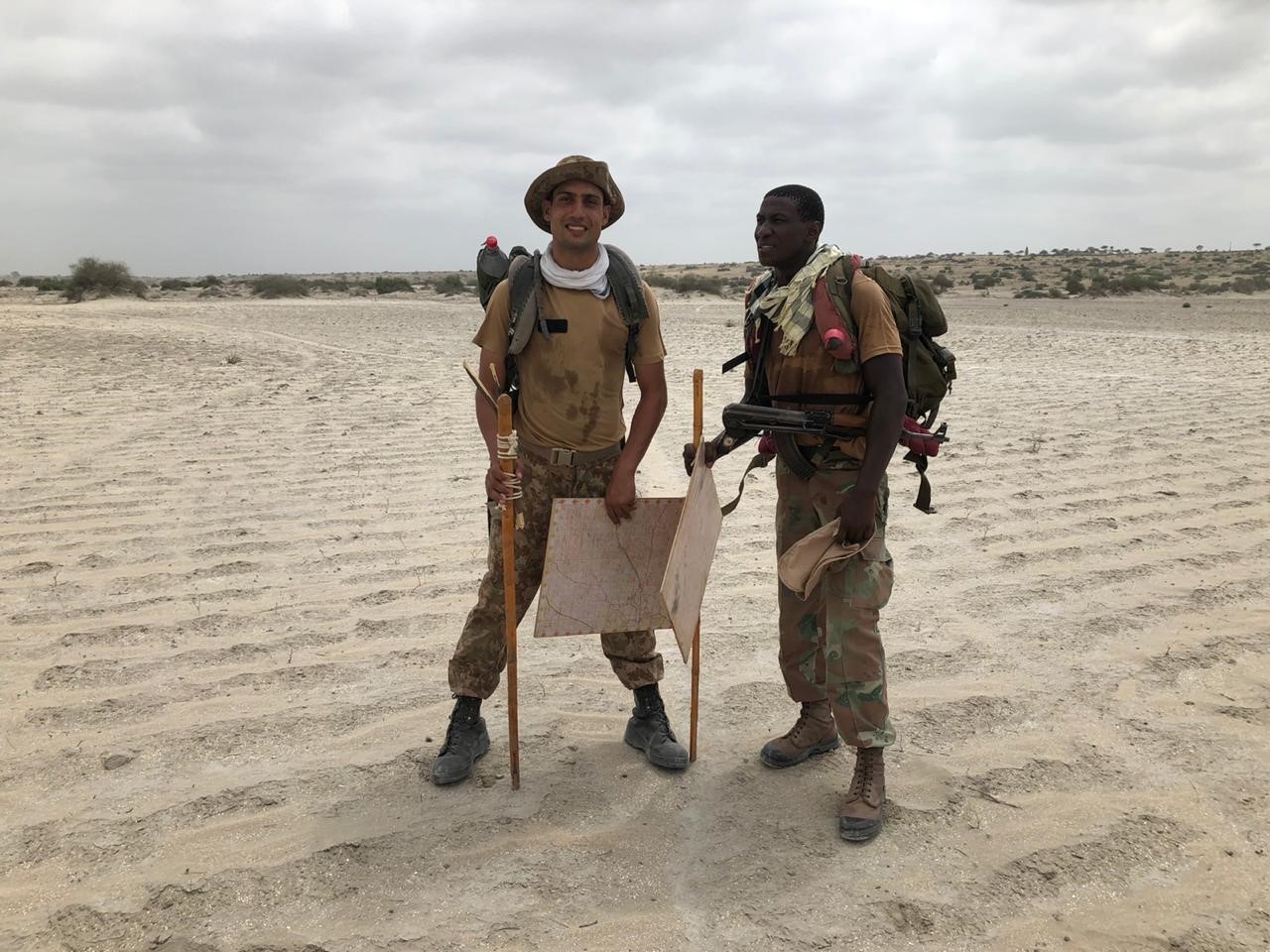
    Captain Caven Motsho with a fellow commando course officer. A South African junior infantry officer has the distinction of being the first to attend – and complete – an officer advanced commando course in Pakistan. Infantry School junior officer Captain Caven Khoshi Matsho was the selected officer of two prepared to attend the course. Both …

    Captain Caven Motsho with a fellow commando course officer.

    A South African junior infantry officer has the distinction of being the first to attend – and complete – an officer advanced commando course in Pakistan.

    Infantry School junior officer Captain Caven Khoshi Matsho was the selected officer of two prepared to attend the course. Both who put up their hands were stationed at the SA Army Infantry Formation’s leading training facility – Infantry School in Oudtshoorn, Western Cape.

    The aim of the officer advanced commando course is to recruit, train and empower young Pakistani officers and equip them with the necessary skills and knowledge to serve, protect and defend Pakistan against terrorists and any kind of national threat, according to Lieutenant Colonel Therese Marie Doman, SO1 Corporate Communication SA Army Infantry Formation.

    Modules those on the course underwent and were successful in included improvised explosive devices (IEDs); anti-terrorist training and mountain craft; advanced navigation; minor tactics and survival; watermanship; mountain and snow warfare; parachute training; desert warfare and a combined exercise.

    Providing feedback to the Infantry School Command Council, Matsho said the course was both strenuous and informative and he acquired new skills. The course was presented in Urdu with no interpreters which saw those on course assisting each other in understanding lectures, practical training and other course components.

    On arrival in Pakistan one of Matsho’s first observations regarded the South African uniform and boots as being unsuitable for terrain, weather and training.

    The snow warfare module was of particular interest to the lone South African, whose home base in the Karoo vastness does not often have this meteorological event. Snow warfare was combined with mountain warfare, and learners were equipped with the necessary skills and knowledge to operate and survive in snow. Snow operations including survival and safety measures were part of this module.

    South Africa and Pakistan enjoy close defence ties, having signed a government-to-government defence co-operation agreement which includes industrial co-operation in March 2017. The Memorandum of Understanding was signed by defence minister Nosiviwe Mapisa-Nqakula in Pakistan on the first official visit by a South African Minister of Defence and Military Veterans in democratic South Africa. She was preceded by General Solly Shoke, Chief of the South African National Defence Force, who visited various Pakistani military headquarters and facilities.

    South African delegations visited Pakistan on numerous occasions and Pakistani delegations have come to South Africa – Pakistani naval vessels  also visited. In 2019, as one example, the Chief of the Pakistan Air Force, Air Chief Marshal Mujahid Anwar Kha and Pakistan’s Chief of Army Staff (COAS) General Qamar Javed Bajwa paid friendly visits to South Africa.

    The Pakistani military sent students to the Army College in South Africa while Pakistan accepted South African officers for staff college training. Pakistan also trained South African personnel in special forces roles. Last year the SANDF said around 40 South African commanders were trained in Pakistan. This included counter-terrorism training.

    Pakistan has shown interest in South African military hardware, including Umkhonto surface-to-air missiles and 155 mm self-propelled artillery.

    Category: NewsTag: cradock, graaff reinet, hofmeyer, karoo, news
    9 December 2020 by Guest

    Cradock Four widow Nyameka Goniwe remembered as ‘a giant leader’

    By Baldwin Ndaba Aug 30, 2020 Share this article: ShareTweetShareShareShareEmailShare As the country marks the end of Women’s Month, tributes for seasoned freedom fighter and women’s rights activist Nyameka Goniwe continue to be pour in. Goniwe passed away on Saturday due to a suspected Covid-19 related illness. Her life history under apartheid era was one …

    By Baldwin Ndaba Aug 30, 2020

    Share this article:

    As the country marks the end of Women’s Month, tributes for seasoned freedom fighter and women’s rights activist Nyameka Goniwe continue to be pour in.

    Goniwe passed away on Saturday due to a suspected Covid-19 related illness.

    Her life history under apartheid era was one of misery, pain and a desire to see those who brutally murdered her husband Matthew Goniwe in June 1985 to be brought to book. Matthew was part of the Cradock Four.

    She, however, died without knowing the real killers.

    Historical records show that Nyameka and Matthew were married in 1975 and were often separated – not because of domestic fights – but police harassment and detentions.

    Like other women, she had to fend for their two children while the husband was incarcerated.

    Recounting her ordeal, Nyameka Goniwe previously told the Truth and Reconciliation Commission chaired by Bishop Emeritus Desmond Tutu and other Commissioners that: “The situation in the township worsened in their absence and violence escalated on a scale which was never experienced before. All school committees resigned.

    “The pressure forced the security police to release Matthew and his colleagues. They were released on the 10th of October 1984 and were given a hero’s welcome by the community.”

    Back then, Matthew’s unpopularity with the security forces intensified.

    He was rated and regarded as an enemy of the State.

    He was also denied the right to own a house by the Lingelihle Town Council for a long time, forcing him to live with his mother in law and his family, in an extended family home.

    His movements were closely monitored by the security police, especially when he had to leave town. The whole family bore the wrath of the security police which took the form of harassment, early morning house raids, constant surveillance, death threats, phone bugging, short term detention,” Goniwe said.

    She told the TRC that she last saw her husband alive on June 27, 1985, when he went to a UDF meeting in Port Elizabeth. All four, Goniwe, Fort Calata, Sparrow Mkhonto and Sicelo Mhlauli, who was later known as The Cradock Four, were abducted by the security police near Bluewater Bay shortly after their departure from Port Elizabeth and were then murdered by the security police.

    All of them suffered multiple stab wounds and were found a number of days later.

    Detailing the cause of his death, Nyameka Goniwe said: “He was also accused of mobilising the people of Cradock and the neighbouring towns under the banner of the then banned ANC. They hated him for raising the level of political awareness of people in rural areas. He was seen as a communist, a terrorist and therefore a dangerous man, who was a threat to the state.”

    In paying tribute to her life, Chris Hani District Municipality Mayor Wongama Gela described her as a selfless leader and councillor at the Inxuba Yethemba Local Municipality.

    “On behalf of Chris Hani District Municipality, we offer our heartfelt condolences and sympathy to her children Nobuzwe and Nyaniso and their beloved family at this difficult moment,” Gela said.

    “We also extend our deepest sympathy to the community of Inxuba Yethemba Local Municipality which Cllr Goniwe has worked with for so many years.

    “We have lost a colleague, a friend, a great leader and a patriot whose life was dedicated for the betterment of others.”

    Political Bureau

    Category: NewsTag: cradock, news, online, south africa
    9 December 2020 by Guest

    Drought-Ravaged Karoo, Eastern Cape, Receives Early Season Rainfall for First Time in Years

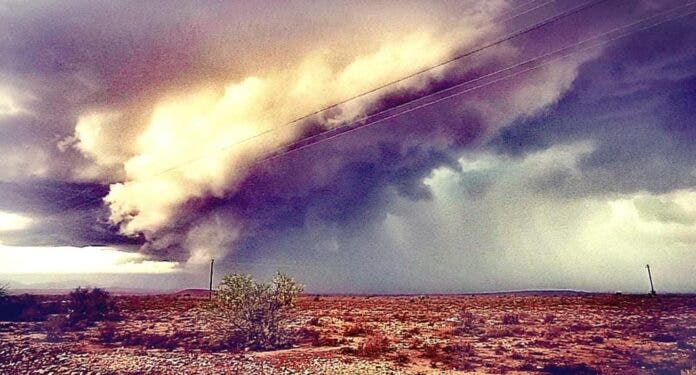
    Photo by Baraka Gifts and Decor in Steytlerville Residents of parts of the Karoo in South Africa, who have been experiencing a devastating drought, were celebrating yesterday as they received their first early downpour in over six years. Baraka Gifts and Decor in Steytlerville, in the Eastern Cape, described the sense of elation beautifully: I …

    karoo rainfall thunderstorm rains
    Photo by Baraka Gifts and Decor in Steytlerville

    Residents of parts of the Karoo in South Africa, who have been experiencing a devastating drought, were celebrating yesterday as they received their first early downpour in over six years.

    Baraka Gifts and Decor in Steytlerville, in the Eastern Cape, described the sense of elation beautifully:

    I was so very fortunate yesterday afternoon to experience a dramatic thunderstorm in the drought stricken Eastern Cape Karoo.
    Having grown up in Steytlerville myself, it brought back sweet nostalgic memories.
    The smell of the first drops on the barren scorched earth is so incredibly intense that it brought me close to tears of happiness.
    The fact that I was driving with my brother in law, who has gone through the hardship of almost 7 years of drought, made the moment very special.
    Some good rain fell in the district which is a good start to the rainy season. #thunderstorm
    #droughtrelief

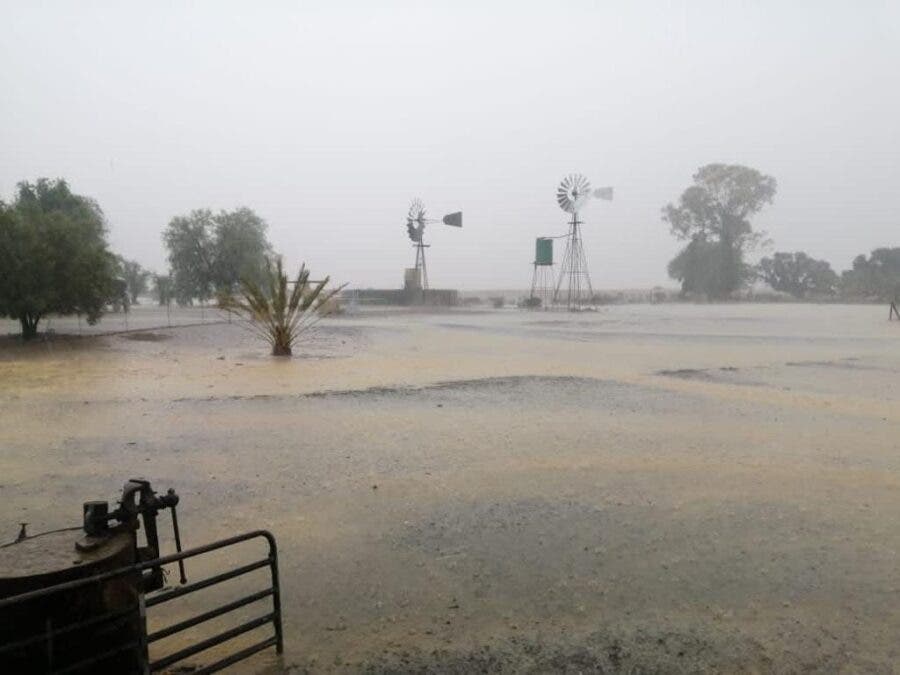
    Melanie Giezing in Williston / Brandvlei posted the following photo, saying it was the first time in seven years, and said “Dankie HERE u is groot!” (Thank You God, You are great!).

    karoo rain rainfall eastern cape south africa
    Wet and wild after the welcome downpour of rain in the Karoo. Photo: Melanie Giezing

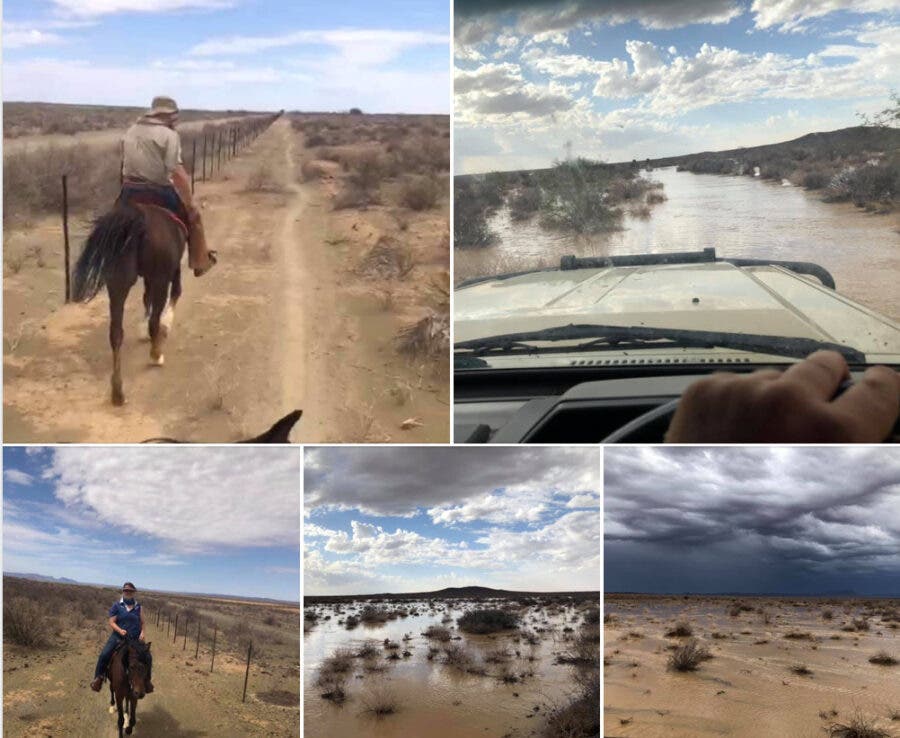
    Carel van der Merwe posted these awesome pics from Stofbakkies, between Van Wyksvlei and Carnarvon. Carel said that in the morning they were riding the horses in the unimaginably dry field, trying to move sheep that were so thin and weak from the long drought. Three hours later his morning prayer was answered. The ground was awash with 28mm of rain. “The first early season rain that we’ve received in six years,” said Carel.

    karoo rain rainfall before and after eastern cape
    Karoo rain – early in the morning before, and three hours later, after the rainfall. Photo: Carel van der Merwe

    #Grateful #KarooRainfall #KarooRain #LetItRain

    Category: NewsTag: cradock, graaff reinet, hofmeyer, karoo, news
    8 December 2020 by Guest

    UCI Esports World Championships 2020 – Preview | Cyclingnews

    The inaugural UCI Esports World Championships are coming on Wednesday and there’s a star-studded entry list for the races, set to be held in the Zwift world of Watopia.  The events, which were announced during the UCI Road World Championships in Yorkshire last year, will see plenty of real-world pros take on the 50-kilometre course, …

    The inaugural UCI Esports World Championships are coming on Wednesday and there’s a star-studded entry list for the races, set to be held in the Zwift world of Watopia. 

    The events, which were announced during the UCI Road World Championships in Yorkshire last year, will see plenty of real-world pros take on the 50-kilometre course, after a season which has seen a boom in online riding thanks to the COVID-19 pandemic and subsequent lockdowns.

    Here, we take a look at the competitors, the course, the powerups, and the rules of the 2020 UCI Esports World Championships.

    The riders

    Competitors represent 22 nations across the two races, with 78 riders in the men’s race and 54 in the women’s race. There are entries from South Africa, Canada, Colombia, USA, Japan, Australia and New Zealand, as well as the 15 European countries you’d expect to see on the start list.

    Van Vleuten, Van der Breggen, Pidcock, Bettiol and Urán to compete in inaugural Esports World Championships

    De Gendt given late wildcard place in Esport World Championships

    UCI Esports World Championships dates announced

    Zwift: your ultimate guide

    In the men’s race, Belgium has the largest squad with nine riders, while the USA (eight) and Australia (seven) follow. The largest women’s team is the USA (nine), with Australia, Germany and Great Britain all on six.

    The Belgian pair of Victor Campenaerts and Thomas De Gendt are among the notable men taking part, while Colombia also bring a strong team which includes Esteban Chaves and Rigoberto Urán.

    Other star names starting the men’s race include Tom Pidcock (Great Britain), 2019 Flanders winner Alberto Bettiol (Italy), Jack Haig (Australia), Edvald Boasson Hagen (Norway) and time trial specialist Lawson Craddock (USA).

    Double road Worlds champion Anna van der Breggen headlines a super-strong Dutch three-woman team along with Annemiek Van Vleuten and Kirsten Wild.

    They’ll be joined by Annika Langvad (Denmark), 14-time Paralympic gold winner Sarah Storey (Great Britain), Lisa Brennauer (Germany), climber Ashleigh Moolman Pasio (South Africa), and Lauren Stephens (USA).

    The route and rules

    The 50-kilometre course that both the men’s and women’s peloton will tackle takes in the figure-eight reverse course on the fictional Zwift island of Watopia. Total elevation gain is 483 metres with two climbs along the way – the Zwift KOM reverse (2.5km at 1.8 per cent) and the Zwift KOM (0.9km at 5 per cent), with a finish atop the KOM to round things off.

    If you’ve ridden on Zwift before, then you’ll likely be familiar with the route and the climbs, so you know exactly what the riders will be going through on their turbo trainers on Wednesday. The women’s race kicks off first at 2:40pm CET, while the men’s race starts at 3:45pm CET.

    Two of Zwift’s powerups will be available during the race – the Aero powerup and the Lightweight powerup. Aero makes you more aerodynamic for a 15-second spell, useful for a sprint or attack, while Lightweight reduces your weight by 10 per cent for 15 seconds, which will come in handy on the climbs.

    Each rider will compete on the same equipment, so there will be no power discrepancies from model to model. They have all received Tacx NEO 2T smart trainers to race on, ensuring a fair battle for the Esports rainbow jersey. In Zwift, all equipment is standardised too, so no TT helmets, disc wheels or the famous Tron bikes.

    Prize money comes in at €8,000 for the winner of each race, with the remaining two podium spots awarding €4,000 and €2,000, respectively. The champions will also receive a digital world champion’s jersey, which they will then be able to wear during sanctioned virtual races.

    How to watch

    The races will be streamed live on Zwift’s Youtube and Facebook channels. Remember, the women’s race kicks off at 2:40pm CET (8:40am EST), while the men’s race starts at 3:45pm CET (9:45am EST).

    If you live outside a broadcast zone or are on holiday outside your country and find that the live streams to be geo-restricted, you can get around this by getting access to them by simulating being back in your home country via a ‘virtual private network’, or VPN, for your laptop, tablet or mobile.

    TechRadar tested hundreds of VPNs and recommends the number-one VPN currently available as Express VPN. With ExpressVPN, you can watch on many devices at once including Smart TVs, Fire TV Stick, PC, Mac, iPhone, Android phone, iPads, tablets, etc. 

    Category: NewsTag: cradock, news, online, south africa
    8 December 2020 by Guest

    New Covid-19 cases in SA drop below 4 000 mark

    By IOL Reporter 9h ago Share this article: ShareTweetShareShareShareEmailShare Cape Town – A total of 3 313 new Covid-19-related cases were recorded in South Africa on Monday, with 43 more deaths. This after the country registered 4 645 new Covid-19 cases and 139 deaths on Sunday. The cumulative total of Covid-19 cases stood at 817 …

    By IOL Reporter 9h ago

    Share this article:

    Cape Town – A total of 3 313 new Covid-19-related cases were recorded in South Africa on Monday, with 43 more deaths.

    This after the country registered 4 645 new Covid-19 cases and 139 deaths on Sunday. The cumulative total of Covid-19 cases stood at 817 878 on Monday, Health Minister Zweli Mkhize said in a statement.

    The Free State recorded nine more deaths, Gauteng two, KwaZulu-Natal five, Northern Cape one and the Western Cape 26, which brings the total to 22 249 deaths. The number of recoveries has risen to 745 750.

    A cumulative 5 611 915 tests have been completed, of which 19 252 have been conducted since the last report.

    Data supplied by the Department of Health

    Despite warnings of a Covid-19 resurgence and that large gatherings should be avoided, Western Cape Local Government, Environmental Affairs and Development Planning MEC Anton Bredell confirmed on Monday that several parties had been held along the Garden Route and in the Central Karoo.

    These included a “Cooler Box Festival in Ladismith in the Central Karoo” and a private matric party in Knysna. Both have led to “multiple infections”.

    Meanwhile, the organisers of Rage Festivals say all events planned for 2020 and 2021 have been postponed until further notice after a Covid-19 superspreading event at Ballito in KwaZulu-Natal.

    “For now, all further Rage Festival events have been postponed until further notice as we consult with relevant officials and stakeholders.

    “We are devastated that despite all efforts before and during the festival and at all Rage-controlled venues, some attendees still contracted Covid-19.

    “We are complying fully with all authorities and stakeholders and will continue to do so,” said spokesperson Darren Sandras.

    Patrons at three taverns in Motherwell, a Covid-19 hot spot, in Nelson Mandela Bay ignored Covid-19 regulations at the weekend, potentially putting hundreds of people at risk of infection.

    One tavern was fined R3 000 for selling alcohol and operating after the new curfew, which runs from 10pm to 4am.

    IOL

    Category: NewsTag: cradock, graaff reinet, hofmeyer, karoo, news
    6 December 2020 by Guest

    Premier’s pledge as poachers lose appeal

    “This is a good day for the rhinos, and a good day for the communities in conservation in the Grahamstown area,” a relieved Dr William Fowlds commented after the High Court in Makhanda on Tuesday 24 November dismissed the appeal of convicted rhino poachers Jabulani, Forget and Sibusiso Ndlovu. And Premier Oscar Mabuyane has pledged …

    “This is a good day for the rhinos, and a good day for the communities in conservation in the Grahamstown area,” a relieved Dr William Fowlds commented after the High Court in Makhanda on Tuesday 24 November dismissed the appeal of convicted rhino poachers Jabulani, Forget and Sibusiso Ndlovu.

    And Premier Oscar Mabuyane has pledged the government’s continued support against poaching in the Eastern Cape. Mabuyane coined the phrase #NotInOurProvince almost exactly two years ago when he led an anti-poaching march ahead of sentencing in the Ndlovu trial. Today, he told Grocott’s Mail, “As the people of the province, in all our sectors, we are united in fighting rhino poachers and we will continue fighting rhino poachers.”

    In a complex case heard over a period of three years, the Ndlovus faced various charges connected with 10 rhino poaching incidents  over three years at farms and nature reserves in Albany, Jansenville, Graaff Reinet and Cradock. Each incident carried five counts. Judge Jeremy Pickering convicted them on most of the charges.

    The trio’s modus operandi was to dart the animals and remove their horns while they were immobilised but fully conscious. Wildlife veterinarian Fowlds attended to most of the Ndlovus’ poaching scenes and in his testimony described the extraordinarily cruelty of the animals’ deaths as their horns were gouged out of their skulls to extract the maximum amount.

    “It’s very uplifting for all those people out there on the front lines, keeping rhinos safe, as well as those who have to work with the aftermath of these very brutal and tragic poaching scenes,” Fowlds told Grocott’s Mail after the appeal verdict was handed down yesterday.

    Senior Counsel, Advocate Terry Price represented the Ndlovus in their trial, as well as their appeal which was on two grounds – that the evidence police seized from the men’s chalet on 17 June 2016 should not be admitted because it was unlawfully obtained; and that the effective 25-year sentences handed down were excessively long.

    Senior State Prosecutor Buks Coetzee appeared for the State during the trial and the appeal.  Judge Jeremy Pickering was the trial judge. He dismissed the initial application to appeal. Following a petition to the Supreme Court of Appeal, leave to appeal to a full bench was granted. The appeal bench comprised Judges David Viljoen, Judith Roberson and Rob Griffiths.

    The appeal application argued that evidence obtained by the police during an unprocedural search at Makana Resort on 17 June 2016 should not have been admitted. This evidence included a freshly removed rhino horn, tranquilliser dart gun, darts, tranquilliser, a bow saw, .22 blank ammunition, knives, side cutters, a cordless drill and six cellphones.

    Price argued that because the police entered the men’s chalet without a search warrant, not only had their constitutional rights been violated and so they were denied a fair trial, but the reputation of the Court and the justice system would be in question.

    Public interest

    The appeal Bench supported Judge Pickering’s ruling in the “trial within a trial” that had determined the evidence seized in the chalet was admissible.

    Among other points, the Judges quoted from a landmark Constitutional Court ruling (Zuma), affirming that the right to a fair trial didn’t only comprise “a number of discrete sub-rights” but a “comprehensive and integrated right” established on a case by case basis.

    The Bench noted that Judge Pickering had fully acknowledged that the search was unprocedural, but had contextualised it in the rapidly unfolding events of that night and the two preceding days. The Judge had emphasised public interest in the matter as well as the impact of not admitting the evidence.

    “Between 2012 and the date of the trial, 6 913 rhinos were slaughtered for their horns, of which 91 were poached in the Eastern Cape… the [Supreme Court of Appeal] recognised the threat which the poaching of rhinos poses to our biodiversity heritage and the protection of the animal as an endangered species. It held that the imposition of lenient sentences would send out the wrong message.”

    The Bench also reiterated Judge Pickering’s emphasis in his judgment of the sheer brutality of the rhinos’ deaths as their horns were removed while they were alive, and the fact that most had succumbed to loss of blood and terrible pain. It noted the public outrage.

    On the men’s sentence, the appeal bench noted Judge Pickering’s detailed reasoning in handing down sentences that totalled more than 400 years, but which would run concurrently to achieve effective sentences of 25 years.

    Incredible detail

    “We are very pleased with the outcome of the appeal,” said Fowlds. “It justifies the incredible detail Judge Pickering went into during the extended trial. We were concerned that the justice system had the potential to create a loophole on technicalities. But it seems the original ruling was judged to be sound.”

    Ayesha Cantor, of the Kragga Kamma Game Park outside Port Elizabeth, travelled to Makhanda for the judgment.

    “If [the Ndlovus]had walked out today, it would have been signing the rights for rhinos’ exctinction in South Africa,” Cantor said. Kragga Kamma lost a white rhino, Bella, to poachers in June 2018. The alleged perpetrators were arrested and are yet to stand trial.

    “For the rhino community, this is a big day. We really can say #NotInOurProvince”.

    Ikhala Veterinary Clinic Veterinary Nurse Candice Momberg, who like Fowlds has attended many of the poaching scenes, and followed the trial closely, was elated.

    “I am very proud of our Province’s law enforcement and justice systems,” Momberg said. “Incredibly proud.”

    Commenting today on the appeal judgment, Premier Mabuyane said, “Government welcomes the decision of the court because the crime that [the Ndlovus]were convicted for is a serious crime. We hope this sends a strong message to any person who may still be involved in this criminality.

    “As the people of the province, in all our sectors, we are united in fighting rhino poachers and we will continue fighting rhino poachers to protect our flora and fauna. This is a victory for law enforcement because of the role they played in arresting these criminals.”

    The appeal judgment handed down on 24 November 2020 noted that the application for leave to appeal against the convictions and sentences of Jabulani, Sibusiso and Forget Ndlovu was unsuccessful. The appeal was heard 17 August 2020.

    Category: NewsTag: cradock, news, online, south africa
    6 December 2020 by Guest

    RoadTrip: Celebrating 70 years of the Volksiebus and its rich heritage in South Africa | Wheels

    • VW’s Volksiebus has been on sale for seven decades. • In 1955, the first T1 Transporter rolled off the production line in South Africa. • One of the most infamous Volksiebuses is ‘Sophie’, a bus with a rich history. • For more motoring stories, go to www.Wheels24.co.za The city of Hanover in Germany is home to Bulli …

    • VW’s Volksiebus has been on sale for seven decades.

    • In 1955, the first T1 Transporter rolled off the production line in South Africa.

    • One of the most infamous Volksiebuses is ‘Sophie’, a bus with a rich history.

    • For more motoring stories, go to www.Wheels24.co.za


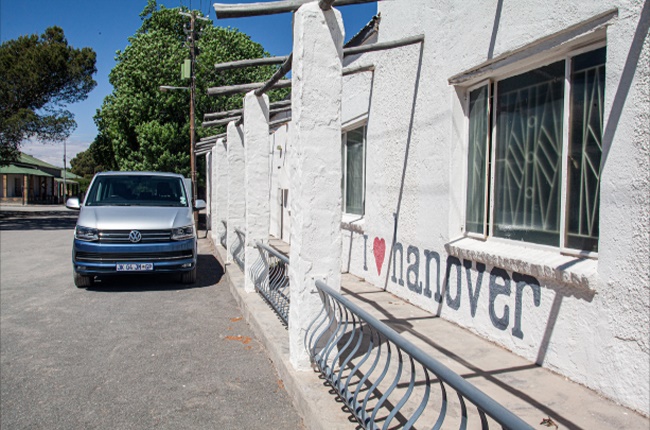
    The city of Hanover in Germany is home to Bulli (colloquially known in Mzansi as the Volkswagen Microbus, Kombi, or Volksiebus) and Conti – the German tyre giant Continental AG. To celebrate 70 years of VW Bus and its association with Conti, we journeyed to the dusty Northern Cape town of Hanover in a T6 Caravelle.

    The first Volkswagen Type 2, universally recognised as the Transporter, rolled off the assembly line seven decades ago. Since then, the Bulli, or Kombi Bus, has become an icon of the motoring world. So, to celebrate its 70th anniversary, as well as the nearly 150 years of Continental (founded in Hanover in 1871), we decided to undertake a road trip to the small Karoo town named after the German city.

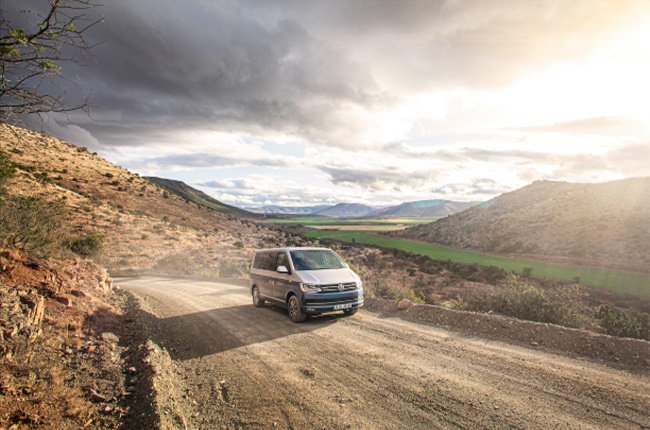
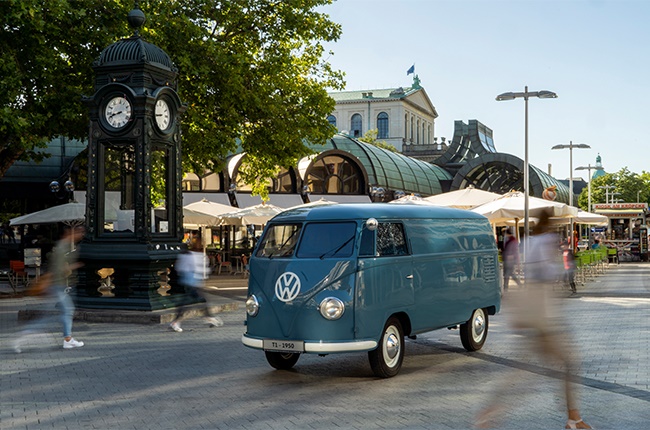
    After attending the recent launch of the latest VW T6.1 Caravelle at Kuzuko Lodge in the Eastern Cape, we took custody of a T6 Caravelle BiTDI Highline 4Motion DSG from Volkswagen South Africa, splendidly presented with a California-style two-tone blue and white paint coat, for our journey. We duly named her “Sophie”, as a tribute to Sofie, one of the oldest T1 Transporters still around (she was built in August 1950 in Wolfsburg) and nowadays a proud possession of the Volkswagen Commercial Vehicles (VWCV) Oldtimer collection in Hanover, Germany.

    Much like in Hanover – where the VW Commercial Vehicles plant at Hannover-Stöcken even shares a power-plant with the Continental tyre factory – the local VW works in Uitenhage is not far from the Conti plant in Port Elizabeth. 

    Volkswagen T6.1 Caravelle

    The Conti collaboration

    Interestingly, Continental tyres were first fitted as Original Equipment to the Volkswagen T1 “Splitti” in the 1950s. These diagonal ply tyres were known as the Continental 6.40-15, and since then VW has been an original equipment customer of Continental in various forms over the decades that followed; and still is today.

    The local tyre company, originally called General Tire and Rubber Company SA, was established in 1947 – a year after the SAMAD plant (now Volkswagen) was opened, and 35 years ago, in 1985, the first Continental branded the local plant produced tyres. Continental Tyre SA is now a wholly-owned subsidiary of the Continental Group.

    The ContiCrossContact LX Sport rubber on our Caravelle – with a 90% road, 10% off-road bias and explicitly designed for mid-sized and large SUVs – was purposely chosen, as we anticipated many a gravel road on our way to the wide-open plains of the Karoo. 

    Shod with the new Conti tyres, Sophie first made her way to Uitenhage for a visit the AutoPavilion at the Volkswagen plant. Here we were met by curator Buyile Gqubule, an iconic T1 split-windscreen “Micro Bus De Luxe” – unofficially known as the “Samba bus” – with its all-round windows, distinctive roof windows, and a folding sunroof,  and one of the very last T3 Caravelle models produced in South Africa. 

    Volkswagen T6.1 Caravelle

    A rich South African heritage

    The first T1 Transporter assembled in Uitenhage came off the line in 1955, and for 47 years local production of the legendary Microbus (later also dubbed the Volksiebus) continued uninterrupted until June 2002. In total, 264 934 Transporters were assembled locally. The T3 (also available with Syncro all-wheel-drivetrain) was the last to be built locally and also the last rear-engine Volkswagen model. It was produced here for 24 years and became a particular favourite with South Africans. Facelifted after 1991 (when German production of this model came to an end), the exclusively South African Microbus and Caravelle models received 2.5-litre five-cylinder Audi-power, upgraded to 2.6-litre five-cylinder units in 1995.

    While manoeuvring the vehicles into position for our heritage photoshoot, one could again admire that distinctive five-cylinder engine sound of the T3 and be reminded as to why the versatile Volksiebus and its famous predecessors became deeply entrenched in local automotive folklore. Leaving Uitenhage, we followed the undulating R72 – passing places with names like Hamburg and Kayser’s Beach, reminders of the period when early German settlers inhabited this region of the Eastern Cape – on our way to East London. What immediately caught our attention on this stretch of road was how quiet the ContiCrossContacts were. There was no road or tyre noise to speak of, aiding our smooth and serene progress.

    Our route from Buffalo City the next morning initially hugged the N2 towards King William’s Town and included a visit to the village of Berlin. Rundown, with a graveyard of dilapidated toilets and potholed roads greeting you on entry, the little town is a huge disappointment compared to its European namesake. We then followed the R63 through Adelaide and Bedford before turning on to the N10 towards Cradock and Hanover. With 132kW and 400Nm of torque available (against 146kW and 450Nm in the new T6.1), Sophie quietly and contently devoured the long ribbon of tar. 

    However, on inclines and when overtaking, the power difference compared to the T6.1 was perceptible, with the DSG sometimes hunting to find the right ratio, but the CrossContact LX Sport rubber continued to impress on the broken tar roads. Close to the mountainous Blomfontein area near Cradock, we also found our own “Tierkloof Pass” (for those who remember the Bus and ‘vellies’ ads with David Kramer). Here, the 4Motion system proved a welcome addition on the slippery, rough gravel surface, and the Conti rubber provided more than enough grip to overcome some mild obstacles.

    The choice of CrossContact tyres for the road conditions encountered on our journey was the correct one, but for those who do not plan to travel on dirt, the correct tyre for the Caravelle would be the ContiPremiumContact 5 – a purely road-biased tyre with a rating of 100% tar surface.

    Volkswagen T6.1 Caravelle

    On the ‘higher ridge’

    In German, Hanover means “on the higher ridge”, and Trappieskop, towering over the flat Karoo landscape, offers a panoramic view of the dusty little town. Claimed to be the most central place in the country, Hanover is fed by The Fountain, a powerful spring in town that releases about 205 000 litres of water per day. The name of the town originated from a request from a local farmer, Gert Johannes Wilhelm Gouws, the grandson of Sterren Gauche, to name the village Hanover as his grandfather, who had come to Africa in search of his fortune, came from that city in Germany.

    Sophie looked quite “at home” parked in front of the tall church in the centre of the town to pay homage to Hanover and the legacy of two companies from the German city that has become household names in South Africa, and still contribute hugely to the ongoing industrialisation of the country.

    Our experience with Sophie on the road to Hanover again substantiated why the versatile, comfortable, and very competent Kombi Bus has, over the last 70 years, become a firm South African favourite. And with its latest updates, it will indeed remain a faithful road trip companion for the foreseeable future. Preparations for this future has already started in Hanover with arrangements to produce the ID.BUZZ already in full swing, starting from 2022. In addition to the T-model range and the ID. BUZZ, the Hanover plant will also produce three fully electric D-SUV models for other brands within the VW Group. 

    Volkswagen T6.1 Caravelle

    The tale of Sofie

    Seventy years ago, a first-generation (T1) dove-blue panel van with chassis number 20-1880 rolled off the production line in the Wolfsburg plant. It was delivered to Hildesheim, and for 23 years it dashed around the roads and narrow lanes of the plant in the small town before going into (early) retirement when the company sold the vehicle to a collector.

    For nearly 23 years, the Transporter spent time in the collections of various VW enthusiasts. The last owner tried to sell the vehicle via a German magazine, without success until a Danish collector became aware of the advertisement. After learning that the vehicle has the lowest Bulli chassis number known at that time, he bought it sight unseen.

    Volkswagen T6.1 Caravelle

    So, in 1992, at the proud old age of 42 and with less than 100 000km on the clock, the van was taken to Demark. It also got a name; with a nod to the first T1 ever delivered to the Danish state, christened ‘Sofie’. From 2000 to 2003 Sofie was fully restored and covered 20 000km driving around Europe. 

    However, the collector was getting old and wanted to sell Sofie. Offers from collectors swamped him, but a 2014 visit by the Crown Prince of Denmark, accompanied by the Danish VW importer, to the Volkswagen Commercial Vehicles plant in Hanover changed the course of Sofie’s future.

    The importer in passing mentioned there was a 1950 van in Denmark looking for a new home, and the VWCV Oldtimer department immediately contacted the Danish collector. He was thrilled by the idea of Sofie potentially becoming an essential part of the Volkswagen Commercial Vehicles collection, and so Sofie “came home” the same year. 

    Since then, Sofie has made countless people happy and brought back many memories. Be it at the Wolfsburg plant, in Hildesheim or in Hanover, as soon as Sofie drives up people clamour for selfies. She is now an undisputed star of the Kombi Bus cult.

    KEEP UPDATED on the latest Wheels news by subscribing to our FREE newsletter

    RoadTrip Dec 2020 Jan 2021 cover

    Category: NewsTag: cradock, graaff reinet, hofmeyer, karoo, news
    5 December 2020 by Guest

    Potato prices soar after cold Limpopo winter

    Already hard-pressed consumers are feeling the pinch as the price of potatoes has drastically gone up — sometimes up by a staggering 140%… This article is reserved for DispatchLIVE subscribers. Get access to ALL DispatchLIVE content from only R45.00 per month. Already subscribed? Simply sign in below. Already registered on HeraldLIVE, BusinessLIVE, TimesLIVE or SowetanLIVE? …

    Already hard-pressed consumers are feeling the pinch as the price of potatoes has drastically gone up — sometimes up by a staggering 140%…

    This article is reserved for DispatchLIVE subscribers.

    Get access to ALL DispatchLIVE content from only R45.00 per month.

    Already subscribed? Simply sign in below.

    Already registered on HeraldLIVE, BusinessLIVE, TimesLIVE or SowetanLIVE? Sign in with the same details.

    helpdesk@dispatchlive.co.za or call 0860 52 52 00.

    Would you like to comment on this article or view other readers’ comments? Register (it’s quick and free) or sign in now.

    Please read our Comment Policy before commenting.

    Please enable JavaScript to view the comments powered by Disqus.

    Category: NewsTag: cradock, news, online, south africa
    5 December 2020 by Guest

    Covid-19 hotspot alert for Cape Town as virus resurges

    The Western Cape Government said it is deeply concerned about the growing number of Covid-19 infections and hospitalisations in the province, which can now be considered as an established resurgence. The provincial government said that a ‘resurgence’ is when the number of active cases increase, week-on-week, by more than 20%. Over the last week alone, …

    The Western Cape Government said it is deeply concerned about the growing number of Covid-19 infections and hospitalisations in the province, which can now be considered as an established resurgence.

    The provincial government said that a ‘resurgence’ is when the number of active cases increase, week-on-week, by more than 20%.

    Over the last week alone, the province has witnessed a 52.1% jump in new cases, with an established pattern over time, it said.

    “There is also now established community transmission of the virus again in this province, which means that it is spreading within communities at a faster rate.”

    This growth is primarily driven by two districts in the Western Cape: the Garden Route and the Cape Metro.

    “Last week, we issued a hotspot alert for the Garden Route, following an alarming growth of cases in the area. This surge has continued to gain momentum and there are now more active cases in George and Knysna sub-districts than at any point in the pandemic to date. ”

    The City of Cape Town is following a similar trajectory to this region and looks to be about 10-14 days behind. The Western Cape government is therefore also issuing a hotspot alert for the metro.

    “It is important to highlight that the growth in cases in the city is being recorded in every sub-district and is not being driven by any one area. This is verified by waste-water treatment testing.

    “While the growth in cases province-wide has mainly been driven by these two districts, we are also worried about the Cape Winelands, which is starting to record a concerning number of new cases.

    “The Overberg District, Central Karoo District and West Coast District are being closely monitored given their proximity to these hotspots.”

    Increase in positive tests 

    The established Covid-19 resurgence in the Western Cape is also reflected in the proportion of positive tests, which has now grown to 16%. This is comparable to the test positivity rate experienced in the Western Cape in early May 2020.

    “My biggest concern is for our health platform, which is under growing pressure. We need to ensure that every person gets healthcare when they need it,” said premier Alan Winde.

    “Hospitalisations reached a low of under 500 in September, and they have now reached 904 as of yesterday. There are currently 431 people in public hospitals and 473 in private hospitals in the Western Cape.”

    In the last 24-hour reporting period alone, Winde said that the number of people being hospitalised for Covid-19 increased by a staggering 54 people.

    “Our Brackengate Hospital of Hope, went from having just a few patients in September, to 109 as of today.

    “In fact, since the start of November, Covid-19 hospitalisations across the province have increased by 63%. The private sector has increased by 94%, while the public sector has increased by 39%. ”

    Critical care admissions have increased by 75% since the start of November. This is particularly concerning as an admission to a critical care unit is an indication of severe illness that might lead to death.

    “We need every person in the Western Cape to help prevent a Lockdown and to ensure that there are enough empty beds in our hospitals for those who need them,” said Winde.

    “We must be under no illusion as to how serious the situation is, and how quickly it can deteriorate further. ”

    Fuller hospitals 

    The Western Cape Government has intentionally reintroduced key healthcare services to facilities because we need to provide comprehensive care to everyone who needs it, not just those with Covid-19.

    This means the province’s hospitals are already fuller than they were earlier this year, during the first wave of hospitalizations.

    “We want to avoid at all costs having to once again de-escalate these essential services because this will have a detrimental impact on the health of our people. We have to save all lives, including those who don’t have Covid-19,” said Winde.

    “We also cannot afford a Lockdown again, as is being witnessed in many European countries right now. Our economy simply cannot afford it. A lockdown would kill jobs and cause our humanitarian disaster to worsen. This will also cost lives in the future. ”

    This means that the only option available is to bring the situation under control through individual actions.

    “We have to do everything possible to ensure that we do not get infected by Covid-19 and that we do not spread Covid-19,” he said.

    National cases 

    South Africa’s national Covid-19 death toll reached the 21,000 mark after 115 more people lost their lives on Tuesday (24 November).

    Of the additional deaths, 45 were recorded in the Eastern Cape, 20 in Free State, 19 in Gauteng, 16 in the Western Cape, 10 in Kwa-Zulu-Natal and five in the Northern Cape.

    This brings the total number of fatalities to 21,083 since the Covid-19 pandemic started in March.

    A total of 2,493 daily cases were reported, taking the total reported to 772,252. Recoveries have climbed to 716,444, leaving the country with a balance of 34,725 active cases.

    According to the Health minister’s latest statistics, the Eastern Cape has the highest number of active cases at 8,512, followed by the Western Cape 7,880 and Free State 7,280.

    KwaZulu-Natal has 5,645 active cases, Northern Cape 3,269, North West 1,230, Mpumalanga 373, Limpopo 373 and Gauteng 243.

    “The cumulative number of tests conducted to date is 5,325,631 with 20,288 new tests conducted since the last report,” said Health minister Zweli Mkhize.

    The World Health Organisation (WHO) is reporting 58,900,547 global confirmed cases of Covid-19, including 1,393,305 deaths.


    Read: South Africa has moved from ICU to high-care: economist

    Category: NewsTag: cradock, graaff reinet, hofmeyer, karoo, news
    3 December 2020 by Guest

    Alternative Tree Farming System Collaborative Sustainable Programme Launched

    Billionaire Jim Simons Places Bet on 3 High-Yield Dividend Stocks A rising tide lifts all boats, as President John Kennedy said, and we’re seeing it now on Wall Street, as both the SP 500 and the NASDAQ are near record high levels. The gains are broad-based and real, and reflect a growing optimism now that …

    Billionaire Jim Simons Places Bet on 3 High-Yield Dividend Stocks

    A rising tide lifts all boats, as President John Kennedy said, and we’re seeing it now on Wall Street, as both the SP 500 and the NASDAQ are near record high levels. The gains are broad-based and real, and reflect a growing optimism now that the election is behind us and a COVID-19 vaccine is in sight.So let’s look back, all the way to 1973, when economist Burton Malkiel told us that “a blindfolded monkey throwing darts at a newspaper’s financial pages could select a portfolio that would do just as well as one carefully selected by the experts.” He was pointing out the effect of random forces on a large enough sample – and the stock market, with over 7,000 publicly traded equities, and even more thousands of active traders working daily, is definitely a large enough sample.But that was before mathematician and code-breaker Jim Simons taught us all how to crunch the numbers. Simons recognized that people are not monkeys – and so have access to information that transcends random effects. He invented quantitative trading, and changed the investment landscape forever.And back in the present, Simons revealed in his most recent 13F filings three new stock positions that bear a closer look. These are buy-rated stocks that boast at least a 5% dividend yield and go up from there. We used TipRanks database to find out what else makes these picks so compelling.Plains GP Holdings (PAGP)First up is Plains GP, an oil and gas midstream holding company. Plains controls assets in the oil and gas transport sector, where it moves the hydrocarbons from the well head production sites to the refineries, storage tank farms, and transport facilities. The company assets include nearly 19,000 miles of pipelines, 8,000 crude oil railroad tankers, nearly 2,500 trucks and tractor-trailers, and, on the rivers, 20 transport tugs and 50 barges. These assets move oil and gas into and out of 148 million barrels worth of storage capacity.PAGP took a hard hit earlier this year from declines in the price of both oil and gas, and from reduced demand during the pandemic-inspired economic shutdowns. By Q2, revenue was down by more than half, to $3.23 billion. The Q3 top line shows the beginning of a recovery, with revenues coming in at $5.83 billion. Q3 EPS was flat sequentially, at 9 cents.The company’s stock price, as might be expected from the financial performance, has failed to gain much traction since it fell last winter at the start of the corona crisis. Shares in PAGP are down 52% so far this year.The low share price, however, presents investors with an opportunity. Clearly, Jim Simons would agree. His fund staked a position in PAGP by buying 1,045,521 shares of the stock. The holding is worth $8.44 million at the current share price.Plains GP has kept up its commitment to the dividend. The company cut the payment from 36 cents per share to 18 cents for the April payment, but has kept it at that level since then. The cut kept the yield from exploding as share price fell, and kept the payment affordable at current income levels. The current payment annualizes to 72 cents per common share, and gives a yield of 8.3%.Raymond James analyst Justin Jenkins likes Plains for its ability to generate cash. He writes, “PAGP’s cash flow profile has actually improved this year. While 2021 will see more headwinds to EBITDA than 2020, lower capex and cost-cutting measures implemented since the pandemic still drive an FCF inflection. We now model Plains generating an all-in FCF surplus […] We continue to believe the partnership’s outlook is much better than recent investor sentiment in the stock.”In line with these comments, Jenkins rates PAGP a Buy. His $9 price target suggests it has room to grow ~10% from current levels. (To watch Jenkins’ track record, click here)Overall, there are three recent reviews of PAGP on record, and all are Buys – making the analyst consensus here a unanimous Strong Buy. The stock is selling for $8.17, and its $10 average price target implies a one-year upside of 22%. (See PAGP stock analysis on TipRanks)Granite Point Mortgage Trust (GPMT)Next up, Granite Point Mortgage Trust, is a mortgage loan company serving a US customer base. The company invests in senior floating-rate commercial mortgages, as well as originating and managing such loans. The company’s portfolio is valued at more than $1.8 billion.GPMT is showing some solid messages in recent financial performance. The company beat the forecasts on earnings, reporting 27 cents per share against a 20-cent estimate, for a 35% beat. Revenues were up year-over-year, and the company finished the quarter with over $353 million in cash and cash equivalents.That foundation allowed GPMT to keep its dividend, although the company did adjust the payment to 20 cents per common share. At that rate, it annualizes to 80 cents and yields a hefty 8.3%. This compares favorably to financial sector peers – and is more than 4x higher than the average dividend found among SP listed companies. Granite Point is another of Jim Simons’ new positions. The quant billionaire bought up 155,800 shares of this real estate investment trust (REIT), for a stake that’s now worth $1.48 million. Stephen Laws, covering this stock for Raymond James, sees GPMT as a potential winner for dividend investors. He writes, “We expect net interest income to continue to benefit from LIBOR loans in floors, and are increasing our core earnings estimates to reflect this. While GPMT reinstated the quarterly dividend of $0.20 per share, the company still has roughly $29 million of undistributed taxable income at September 30. Given this, we anticipate a special dividend of $0.40 per share to be declared prior to year-end.”The 5-star analyst rates the stock an Outperform (i.e. Buy), and his $11 price target implies 16% growth over the next months. (To watch Laws’ track record, click here)This is another stock with a unanimous analyst rating – although the two recent Buys make the consensus view a Moderate Buy. The average price target matches Laws’, at $11, and indicates a 16% upside from the current trading price of $9.60. (See GPMT stock analysis on TipRanks)Phillips 66 (PSX)Last on our list of Simons’ new purchases is Phillips 66, the oil and gas giant. With over $107 billion in annual revenues, and more than $58 billion in total assets, Phillips 66 is deeply involved in oil production, refining, and marketing. The company also has a large presence in the petrochemical industry.The low prices, economic shutdowns, and unpredictable demand have put pressure on PSX’s share price this year, and the stock has only partly rebounded from last winter’s swoon. PSX is down 40% year-to-date, but it’s up 54% from its late-March trough.In the third quarter, Phillips 66 saw an EPS loss of 1 cent – but that was far better than the 80-cent lost which had been forecast. Revenues for the quarter came in at $15.93 billion, up 45% from the previous quarter.The company pays out 90 cents per common share, and has an 8-year history of keeping a reliable payment with occasional increases. The annualized payment of $3.60 gives a yield of 5.4%, well above the utility sector average yield of 3.3%.Simons, for his part, was impressed enough by this stock to purchase 120,800 shares. That’s a holding now worth $7.47 million.In his note on PSX, Scotiabank’s Paul Cheng notes several key points, including some that may seem counterintuitive. “Passing of Election Day may actually trigger new buying in the group even with a Biden win. Contrary to the widespread belief, the sector has historically outperformed the general market in the first year of a new Democrat Administration… Cyclical sectors could be in demand again as investors re-focus their attention from the election to vaccine availability,” Cheng opined. The analyst added, “…relative to other refiners, PSX should benefit more from a rising oil price environment given their large chemical and NGL operations.”To this end, Cheng rates PSX an Outperform (i.e. Buy). He sets a $79 price target, indicating an upside potential of 25% for the next 12 months. (To watch Cheng’s track record, click here)All in all, Phillips 66 get a broad-based thumbs-up from Wall Street – as clear from the 11 Buy ratings on the stock, giving it a Strong Buy analyst consensus. (See PSX stock analysis on TipRanks)To find good ideas for dividend stocks trading at attractive valuations, visit TipRanks’ Best Stocks to Buy, a newly launched tool that unites all of TipRanks’ equity insights.Disclaimer: The opinions expressed in this article are solely those of the featured analysts. The content is intended to be used for informational purposes only. It is very important to do your own analysis before making any investment.

    Category: NewsTag: cradock, news, online, south africa
    3 December 2020 by Guest

    Meyer and De Villiers’ KAROO SUITES At Cape Town Drive-in Theatre Postponed Until Early 2021

    Deon Meyer and Coenie de Villiers’ popular Karoo Suite shows, scheduled at the Atlantic Studios drive-in theatre for 10, 12 and 13 December 2020, will be moved out to early 2021. The decision to postpone was taken within the context of the sharp rise in Covid-19 infections in the Western Cape. De Villiers says, “The …

    Deon Meyer and Coenie de Villiers’ popular Karoo Suite shows, scheduled at the Atlantic Studios drive-in theatre for 10, 12 and 13 December 2020, will be moved out to early 2021. The decision to postpone was taken within the context of the sharp rise in Covid-19 infections in the Western Cape.

    De Villiers says, “The severity of the pandemic’s impact cannot be emphasised enough. It is our civil duty to do everything in our power to curb the pandemic. New performance dates will be announced in the media as soon as possible.”

    According to Prof. Brian Figaji, chair of the Suidoosterfees board, all good things are worth waiting for. “Given the current situation in the Western Cape and the reinstatement of a curfew, we have no choice but to postpone the productions. The Suidoosterfees and its partners – the Jakes Gerwel Foundation, KKNK, CTMA and Atlantic Studios – remain as committed as ever to the project. We would like to emphasise that the performances are postponed, not cancelled.”

    People who have purchased tickets for the shows, can contact Computicket directly for refunds, or they can email the Suidoosterfees at Francois.Abrahams@media24.com to have tickets reallocated for 2021. Current ticketholders will be notified of new dates as soon as they become available. New dates will also be announced in the media and on social media platforms of the shows’ project partners.

    Cape Town’s executive mayor, Dan Plato, reassures residents and visitors that shows will continue once the pandemic has been contained. “We are aware of the enormous pressures on the arts industry, and we remain committed with the Suidoosterfees to continue delivering ground-breaking work.”

    Deon Meyer and Coenie de Villiers have long been devoted to the development of young people with talent. Proceeds from ticket sales will be invested in the expansion of the Suidoosterfees and the Jakes Gerwel Foundation’s songwriting mentorship programme, with future workshops extended to the Karoo and Cape Town. Participants of the development programme will have the opportunity to perform at the Suidoosterfees and KKNK.

    For more information, contact Themba Mzondi at the 078 113 5216/ themba@sceproductions.co.za

    More Hot Stories For You

    Category: NewsTag: cradock, graaff reinet, hofmeyer, karoo, news
    2 December 2020 by Guest

    ANC approaches BLA for assistance to prosecute apartheid-era suspects

    The ANC has written to the Black Lawyers Association (BLA) to make available their expertise to prosecute individuals who never came forward to testify or who were refused amnesty during the Truth and Reconciliation Commission (TRC).  The ANC has been heavily criticised over the years by family members of apartheid victims for failing to push …

    The ANC has written to the Black Lawyers Association (BLA) to make available their expertise to prosecute individuals who never came forward to testify or who were refused amnesty during the Truth and Reconciliation Commission (TRC). 

    The ANC has been heavily criticised over the years by family members of apartheid victims for failing to push for the prosecution of apartheid criminals. 

    The ANC’s Jessie Duarte has been put in charge of the project.

    Category: NewsTag: cradock, news, online, south africa
    2 December 2020 by Guest

    South Africa’s Karoo ‘tequila’ takes the world by storm

    In the global village of today nothing is sacred, so it’s not surprising that the world’s best scotch comes from Japan or that ‘tequila’ is being distilled in the Karoo. A Scotsman is sitting on a bank of the River Spey in the Highlands of Scotland. He is weeping as he reads the 2020 World …

    In the global village of today nothing is sacred, so it’s not surprising that the world’s best scotch comes from Japan or that ‘tequila’ is being distilled in the Karoo.

    A Scotsman is sitting on a bank of the River Spey in the Highlands of Scotland. He is weeping as he reads the 2020 World Whisky Awards and learns that  Hakushu, a Japanese whiskey, has been named the world’s best single malt.

    Quality spirits that taste like the real thing

    Leonista
    Leonista is made from the agave which grows in abundance in the Karoo. Image: Supplied

    As he reaches into his sporran for a tissue, a sympathetic tourist asks why he is so mournful. He explains that Scotland’s leading distilleries and the magical waters of the Spey had failed Scotland. A Japanese amber liquid was now the world’s best single malt. 

    “Agh,” says the tourist (who happens to be from Bloemfontein).” Don’t let it worry you too much. Imagine being Mexican and finding out that a woman in the Karoo has begun exporting tequila. Whisky is whisky and cactus are cactus, ou maat.”

    And there you have it. A global village in which scotch is no longer scotch and champagne doesn’t come from just 76,000 acres in the north-eastern corner of France. Worst of all, port needn’t be Portuguese and sherry doesn’t have to come from Jerez in Andalusia, Spain.

    Why you can’t call SA ‘tequila’ by that name

    agave
    Agave spirit from the Karoo is made similarly to how tequila is in Mexico. Image: Supplied

    But, thanks to the politicians and marketers, who cling to the belief that national interest trumps  ‘local is better’, nobody these days can produce tipple and call it scotch, sherry, port or champagne.  This does save some dented national pride even though the imitator’s product tastes identical (or in the case of many brands of SA booze, better than the original) to the educated palate.      

    But, as the tourist says, “cactus is cactus” so why shouldn’t tequila come from the Karoo for that matter? The common denominator is agave cactus, and whether it is grown in the Jalisco region of Mexico or the arid areas around Graaff-Reinet makes no difference.

    So, because local ‘tequila’ can’t be called tequila, it is called Leonista and instead of Mayan-like decals and designs, it has a modern leopard artwork as a label. 

    SA’s version of tequila a quality organic product

    agave
    A closeup of the Karoo agave. Image: Supplied

    The major difference is that the distiller is not your archetype moustachioed, blanket-wrapped Mexican, but businesswoman Sarah Kennan who decided while visiting Mexico that anything done there could be done here.  

    Before you could say “hairless chihuahua”, people were running around tapping the Karoo’s agave cactus and South Africa had a quality, certified organic product. 

    All that is needed now is for South Africans to learn how to drink it properly. I am sure many of us have shuddered at the wannabee single malt drinker who ostentatiously orders a single malt and then splashes in some Coke. 

    Best way to drink tequila

    Leonista
    Three versions of Leonista’s pure agave spirit. Image: Supplied

    It’s the same with quality tequila. It should be sipped over a block of ice or in a margarita or used as a base for a cocktail, Kennan said, and she should know.

    Despite the word tequila being taboo, Leonista is selling up a storm and its Leonista Blanco recently took gold in the US-based SIP Awards. Around the world fans now include the Japanese, Dutch, Taiwanese, Zimbabweans (who need the distraction) and Australians. 

    Leonista is available as a Blanco, Reposado, Honey Reposado and Reposado Black at various liquor stores or directly from the Leonista website.

    DMCA.com Protection Status

    Category: NewsTag: cradock, graaff reinet, hofmeyer, karoo, news
    30 November 2020 by Guest

    SA cyclist Grant Lottering to attempt solo ride of 2000km

    With only 100 hours to take on 2 000km, including 22 300m of climbing, extreme endurance cyclist and Laureus Sport for Good Ambassador, Grant Lottering, will have to overcome his #xtremeSA2020 Im’possible Tour, in a ride of staggering proportions. Grant Lottering’s Im’possible Tour Yes, Lottering will depart from Nottingham Road, KwaZulu-Natal on 1 December 2020 …

    With only 100 hours to take on 2 000km, including 22 300m of climbing, extreme endurance cyclist and Laureus Sport for Good Ambassador, Grant Lottering, will have to overcome his #xtremeSA2020 Im’possible Tour, in a ride of staggering proportions.

    Grant Lottering’s Im’possible Tour

    Yes, Lottering will depart from Nottingham Road, KwaZulu-Natal on 1 December 2020 for a non-stop solo ride through the Eastern and Western Cape to finish on Sunday, 6 December in the Ceres Valley, Wellington.

    Every year, Grant Lottering’s Im’possible Tours involve mountains and climbing. It resembles the mountains people, and especially children, face daily.

    “Given what we have all gone through in 2020 with this pandemic, particularly financially and emotionally, I think it will be fitting that my #xtremeSA2020 Im’possible Tour is representative of the huge challenges we have all faced this year,” says Lottering.

    The ‘most brutal solo fundraising event’ ever?

    In 2019, Lottering completed his first local Im’possible Tour, riding 1 314km from Patensie in the Eastern Cape to Paarl in the Franschhoek Valley in the Western Cape on a mountain bike and road bike. Lottering climbed 12 200m in a total elapsed time of 74 hours, and a ride time of 66hrs 21min. With over 60 000 people following his attempt, Lottering’s 2019 tour was widely regarded as the most brutal solo fundraising ride ever attempted in South Africa.

    Details of his 2020 Im’possible Tour

    Lottering will start his all-gravel, and 6th annual Im’possible Tour, in Nottingham Road, KwaZulu-Natal. Heading west towards Rhodes, he will climb over the Pitseng Pass in the foothills of the mighty Drakensberg Mountains, Naude’s Nek (the second-highest dirt road in South Africa) and Carlislehoekspruit passes, past Tiffendel Ski Resort, all above 2 500m in elevation, before winding his way down towards Cradock and Patensie in the Eastern Cape. By the time Lottering enters the infamous Baviaans Kloof toward the Karoo Town of  Willowmore, he would have already covered just over 1 000km, including 11 000m of climbing.

    From Willowmore, he will head down to Knysna in the Western Cape via the Prince Alfred Pass. He will then cycle to George via the seven passes road – a 75km long trip that takes you past seven gorges cut deep by rivers flowing to the sea – and then on to Prince Albert over the famous Montagu Pass. Lottering will head on to Meiringspoort before facing the brutal Swartberg Pass – this after a leg-breaking 1 500km with 19 000m of climbing already in his legs. After descending the Swartberg Pass, Lottering will head towards Calitzdorp, van Wyksdorp, Ladismith and through the Karoo towards Touws River, and the Ceres Valley, to finish at Imbuko Wines in Wellington.

    Lottering, who founded his first Im’possible Tour following a near-fatal cycling accident during a race in Italy in 2013, and was told riding a bike again would be near impossible, hopes that what he will be attempting on the bike will give people a renewed inspiration to be resilient, to persevere, believe and never to give up.

    DMCA.com Protection Status

    Category: NewsTag: cradock, news, online, south africa
    30 November 2020 by Guest

    South Africa: Gift of the Givers’ Imtiaz Sooliman – the Eastern Cape Is in Deep Crisis

    The province was in serious trouble following a huge outbreak of coronavirus infections in Nelson Mandela Bay and the Karoo, with the wave rapidly spreading to other parts of the province. On Wednesday and Thursday, accompanied by his team and truckloads of personal protective equipment (PPE), Dr Imtiaz Sooliman arrived in Nelson Mandela Bay with …

    The province was in serious trouble following a huge outbreak of coronavirus infections in Nelson Mandela Bay and the Karoo, with the wave rapidly spreading to other parts of the province.

    On Wednesday and Thursday, accompanied by his team and truckloads of personal protective equipment (PPE), Dr Imtiaz Sooliman arrived in Nelson Mandela Bay with a blank cheque for the metro’s frontline workers, a plan and a message to the government: Just give me 24 hours.

    “I said to the doctors and nurses at the frontline: Give me your list. Tell me what you need. Add coffee. Add tea. Add Milo. Add cookies. You are treasured and we see you. The Eastern Cape is in very serious trouble. The statistics are not telling the full picture. This is much worse than the first wave. Tell us what you need. I will get everything… “

    Three hours later he sent them shopping. “I said everything was approved. Go and buy exactly the right things that you need.”

    The list he received clearly showed the lack of support the Nelson Mandela Bay hospitals were receiving. The teams needed coveralls, disposable gowns, shoes and…

    Category: NewsTag: cradock, graaff reinet, hofmeyer, karoo, news
    • Previous
    • Page 1
    • Interim pages omitted …
    • Page 4
    • Page 5
    • Page 6
    • Page 7
    • Page 8
    • Interim pages omitted …
    • Page 152
    • Next
    WE LOVE CRADOCK.

    COPYRIGHT MyCradock · DESIGN BY REACH TRUST
    All Rights Reserved · Powered by Straton Solar