• Skip to main content
  • Skip to header right navigation
  • Skip to site footer

My Cradock

My Cradock

Cradock News Classifieds and Directory

  • Home
  • About
  • Accommodation
  • Business
  • Events
  • Free Business Advert
  • Submit News
You are here: Home / Archives for graaff reinet

graaff reinet

10 October 2020 by Guest

‘The bullet is the easy way out’ – SANParks slammed over killing of Karoo lions

South African National Parks (SANParks) has come under fire for its decision to ‘put down’ seven lions in the Karoo National Park. A pride of seven lions in the Karoo National Park was shot dead after escaping from the park and killing 10 sheep from a neighbouring farm. SANParks has defended the decision to put …

South African National Parks (SANParks) has come under fire for its decision to ‘put down’ seven lions in the Karoo National Park.

A pride of seven lions in the Karoo National Park was shot dead after escaping from the park and killing 10 sheep from a neighbouring farm.

SANParks has defended the decision to put down the lions which it management deemed to be “damage-causing animals”.

In a statement issued last week, the conversation group said that the decision “was not taken in haste nor lightly”.

Wildlife activist Linda Park has slammed SANParks for failing to address the root causes of the incident.

She says poor fencing and population control are among the core issues that park management must be held responsible for.

Park, the director of animal rights group Voice4Lions, says SANParks took the easy way out by killing the lions.

She says other nature reserve authorities, including Ezemvelo Nature Reserve in Gauteng and CapeNature in the Western Cape, are also guilty of similar shortcomings.

They are dealing with the symptoms, and very badly at that, instead of dealing with the cause of these issues.

Linda Park, Director – Voice4Lions

Lions carrying captivity in fenced areas is crucial. In these smaller parks, lions breed [a lot], your numbers go up exponentially and you have a problem. You are going to have dispersments of young males. Groups of females often go out.

Linda Park, Director – Voice4Lions

Your cause is poor fencing, population management which isn’t happening, sterilisation which should be happening in small parks to control the breeding, and there is also a reduction in prey when you have a higher carrying capacity than you should.

Linda Park, Director – Voice4Lions

Instead of addressing the cause of the animals, they shoot them and kill them off. But there’s a bigger picture there.

Linda Park, Director – Voice4Lions

We know that there’s very little space left in the wild for lions due mainly to habitat loss. It’s incumbent upon us to recongise the mess that we are responsible for this and to manage the mess that we have made.

Linda Park, Director – Voice4Lions

SANParks have taken the easy way out to just kill the animals, issue a statement and be done with it. In this day and age, it’s unacceptable.

Linda Park, Director – Voice4Lions

Listen to the discussion on Afternoon Drive with John Maytham:


More from Local

Former President Jacob Zuma at the state capture commission on 17 July 2019


Great White shark 123rf 123rflifestyle


clowns-without-borders-sajpg


Rugby ball on field 123rf


dagga-weed-marijuana-joint-smoke-smoking-123rf


Senekal


school-learner-child-pupil-writing-notebook-classroom-pencil-stationery-123rf


Public Protector Busisiwe Mkhwebane.


FlySafair


Shamila Batohi


Category: NewsTag: cradock, graaff reinet, hofmeyer, karoo, news
8 October 2020 by Guest

Mining Weekly Council for Geoscience starts deep drilling in Karoo Basin

The Council for Geoscience (CGS) on September 21 launched Phase 2 of the Karoo Deep Drilling and Geo-environmental Base Programme (KDD), in Beaufort West. The council, as mandated by the Department of Minerals and Energy, in 2016 initiated the research programme to investigate the resource potential of the Karoo basin, which is anticipated to have …

The Council for Geoscience (CGS) on September 21 launched Phase 2 of the Karoo Deep Drilling and Geo-environmental Base Programme (KDD), in Beaufort West.

The council, as mandated by the Department of Minerals and Energy, in 2016 initiated the research programme to investigate the resource potential of the Karoo basin, which is anticipated to have between 30-trillion and 500-trillion cubic feet (tcf) of shale gas, and possibly uranium, methane or coal resources, according to the Petroleum Agency of South Africa.

The United States Energy Information Administration in 2013 estimated that South Africa has the eighth-largest shale gas reserve in the world, at about 390 tcf of technically recoverable shale gas.

The KDD programme is also targeted at identifying the potential environmental impacts that could arise from shale gas development in the Karoo.

The KDD will provide scientific evidence to inform policy development and regulatory frameworks on shale gas exploration and extraction, which CGS CEO Mosa Mabuza says can be a significant addition to South Africa’s energy mix and the economy as a whole.

Shale gas is a natural gas consisting primarily of methane and about 20% higher hydrocarbons, such as ethane.

Finding domestic gas feedstock will diversify South Africa’s energy mix and reduce carbon emissions. However, South Africa cannot make an environmental assessment of the Karoo’s shale gas exploitation by hydraulic fracturing within the current legal framework.

Therefore, the KDD serves as a baseline study for future shale gas research work and plays a vital role in the review of petroleum regulations.

Phase 2 of the programme involves CGS establishing a geo-environmental baseline and putting in place environmental monitoring mechanisms.

The council had contracted Major Drilling to undertake drilling for a 3.5-km-deep vertical stratigraphic core borehole over the next 10 to 12 months. This borehole is aimed at intersecting the formation earmarked to have the highest potential for shale gas.

CGS also aims for the drilling to intersect deep brackish groundwater to understand its location and advise how it can be managed to avoid contamination with fresh water during further exploration and exploitation activities.

During Phase 1 of the KDD, CGS consulted with local communities, the Beaufort West municipality and other interested parties, and have since been given the “thumbs up” to proceed with the programme.

Phase 1 comprised geological and structural mapping activities at a regional scale, including hydrogeology, airborne and ground geophysics, environmental screening and seismic monitoring.

Environmental consultants were part of the CGS’s stakeholder engagement process and had given the green light for the council to proceed with Phase 2 of the programme.

The initial drilling stages of the project had already proven beneficial to the Beaufort West communities, with CGS having discovered five 169-m-deep shallow observation wells in November 2017 – two of which have the capacity to yield good quality groundwater of up to 33-million litres a month.

This discovery coincided with the unprecedented drought that the Western Cape experienced at the time. CGS subsequently donated the two boreholes to the Beaufort West municipality to alleviate the humanitarian crisis.

To date, the municipality had pumped almost 400-million litres of water to the people of Beaufort West.

Phases 3 and 4 of the KDD will involve borehole results analyses and post-drilling monitoring.

GREAT DEBATE
There remains concern about the impact of shale gas exploration and production in South Africa and questions about whether South Africa has sufficient viable shale gas reserves.

Nelson Mandela University Africa Earth Observatory’s Maarten de Wit in the South African Journal of Science in 2011 wrote about his concerns around shale gas discovery and extraction in South Africa.

At the time, he said it was not known with any degree of certainty how much gas may be beneath the Karoo and that, even if there was enough, it was uncertain whether the gas could be tapped without damaging other subsurface resources.

“Conservationists argue that extraction of the gas will leave massive irreparable environmental scars on one of South Africa’s iconic landscapes, while there may well be human health hazards pending from associated chemical pollution.”

However, he also acknowledges that gas is generally considered to be a cleaner source of energy than coal. This is especially welcome, given carbon emission targets that South Africa has, in light of climate change.

De Wit stated that shale gas is a bridging fuel toward renewable energy sources and an opportunity to wean the country’s grid off coal. “This approach will require holistic valuations that are yet to be attempted in either of the Karoo camps.”

Professor Bob Scholes of the University of the Witwatersrand’s Global Change Institute says studies by the Academy of Science of South Africa suggest that it is increasingly unlikely that economically and technically viable gas can be found in the Karoo.

In the absence of new exploration and testing up to now, the upper limit of gas in the Central Karoo had been estimated at 20 tcf.

Scholes points out that this is a tiny resource by global standards. In terms of energy content, 20 tcf of gas is about 40 times smaller than the known remaining coal reserves in South Africa.

Conventional gas reserves offshore of Mozambique have been estimated at 75 tcf, he adds.

Nonetheless, even a small viable gas find in South Africa can transform the national energy economy.

Mabuza tells Engineering News Mining Weekly that even 1 tcf of gas can be economically exploited and benefit the national power grid and the economy. He expressed confidence in the KDD proving the safety and viability of the Karoo’s shale gas resource over the next few years.

*Arnoldi visited one of the drilling sites in Beaufort West as a guest of the CGS.

Category: NewsTag: cradock, graaff reinet, hofmeyer, karoo, news
7 October 2020 by Guest

South Africa: Sanparks Puts Down Seven Karoo NP Lions That Posed Threat to Humans and Livestock

South African National Parks (SANParks) has put down seven lions from the Karoo National Park on the grounds that they posed a threat to livestock and humans. A public outcry may be in the offing, but the incident underscores the challenges of managing populations of dangerous megafauna. SANParks said in a statement on Friday 2 …

South African National Parks (SANParks) has put down seven lions from the Karoo National Park on the grounds that they posed a threat to livestock and humans. A public outcry may be in the offing, but the incident underscores the challenges of managing populations of dangerous megafauna.

SANParks said in a statement on Friday 2 October that the decision was “not taken in haste.” The park has 14 lions remaining.

The all-female group had escaped the park and killed sheep on a neighbouring farm and was “a threat to human beings,” SANParks said. “The pride had familiarised themselves with a specific area from which they escaped and one of the members of the pride had developed a habit of digging underneath fences.”

“… lions that pose threats to livestock and people have a high level of urgency and are executed after a thorough assessment and observation of the circumstances over time,” the statement said.

The incident has echoes of Sylvester the lion’s escapades.

A Tale of Two Cats, Cecil and Sylvester

Sylvester had two breakouts from the park, the first in 2015 that triggered a madcap 24-day chase and left a trail of dead sheep in its wake….

Category: NewsTag: cradock, graaff reinet, hofmeyer, karoo, news
5 October 2020 by Guest

Karoo National Park: Outrage as seven escaped lions ‘killed by rangers’

Our offices are for administrative purposes only, no visitors will be accepted without an appointment. South Africa– Blue Sky Publications (Pty) Ltd T/A TheSouthAfrican Number: 2005/028472/07. Address: Regus Business Centre 1st Floor, Block B, North Park, Black River Park, 2 Fir Street, Observatory, Cape Town, 7925, South Africa Postal: Blue Sky Publications (Pty) Ltd T/A …

Our offices are for administrative purposes only, no visitors will be accepted without an appointment.

South Africa– Blue Sky Publications (Pty) Ltd T/A TheSouthAfrican Number: 2005/028472/07.
Address: Regus Business Centre
1st Floor, Block B, North Park, Black River Park, 2 Fir Street, Observatory, Cape Town, 7925, South Africa
Postal: Blue Sky Publications (Pty) Ltd T/A TheSouthAfrican, PO Box 44354, Claremont, 7735, South Africa

United Kingdom– Blue Sky Publications Ltd – Company Registration Number: 04683692.
Address: Riverbank House, 1 Putney Bridge Approach, London, SW6 4TJ

Category: NewsTag: cradock, graaff reinet, hofmeyer, karoo, news
4 October 2020 by Guest

Why SANParks shot dead 7 ‘problem lions’ in Karoo

SANParks defended its decision to put down seven lions because they were constantly escaping.  No other reserve would take the lions. As the lions became less afraid of humans, they became a risk to people living around the reserve.  The SA National Parks (SANParks) defended its decision to euthanise seven lions at the Karoo National …

  • SANParks defended its decision to put down seven lions because they were constantly escaping. 
  • No other reserve would take the lions.
  • As the lions became less afraid of humans, they became a risk to people living around the reserve. 

The SA National Parks (SANParks) defended its decision to euthanise seven lions at the Karoo National Park in the face of outrage over its actions. 

Spokesperson Reynold Thakhuli explained that one of the big cats had already figured out how they could get in and out, and which spots along the fence were easiest to dig under, in order to go hunting on the other side.

On Monday, the seven lions made a break for it in the high mountainous areas – twice in 24 hours – killing 10 sheep near the reserve in the Beaufort West area.

READ | 7 lions shot after escaping from reserve twice, killing 10 sheep

Rangers rounded up the lions and slept in the mountain to keep an eye on them.

But they escaped again, to go back to the carcasses.

Shot 

A decision was made, and the lions were shot dead from a helicopter because it was too dangerous to go on foot. 

The lions were regularly killing sheep in the surrounding area and they were also losing their fear of humans. 

SANParks was worried that their next prey could be a person.  

Shooting the lions elicited outrage from some conservationists, who said other steps should have been taken – like fixing the fence.

READ | Huge uproar from wildlife organisations following killing of 7 ‘problem’ lions in Karoo

Thakhuli said the decision was not taken lightly, and SANParks had even tried to donate the lions to other parks and reserves, but nobody had space.

A tough call had to be made. 

It was clear there was a high probability of the lions leaving again and posing a risk to livestock and people.

“SANParks is obligated and has a legal duty to respond and mitigate such risks,” he continued. 

He explained that lions are opportunistic, prefer easy prey, are fast learners and could become habitual livestock raiders. 

Problem lions

According to SANParks’ Large Mammal Ecologists, various drivers contribute to the behaviour of problem lions: one being that male lions disperse when they are adults, and the prides move around and compete for food. This is not a problem because there is no fencing and other land use between reserves, but the Karoo National Park is bordered by people. 

Left unchecked, populations within reserves can increase by 22% a year – and, if the lions do not get enough food, there is a risk they will break out of the reserve. 

South Africa is among the top five African range states that conserve lions. 

There are 3 500 wild lions, and in 59 state and private small reserves, there are 700. 

The Karoo National Park has 14 lions left, consisting of three to four groups, with two active satellite collars and VHF monitored collars. 

Category: NewsTag: cradock, graaff reinet, hofmeyer, karoo, news
2 October 2020 by Guest

Huge uproar from wildlife organisations following killing of 7 ‘problem’ lions in Karoo

Animal welfare organisations have condemned the killing of seven lions at the Karoo National Park on Tuesday. The lions were shot from a helicopter after they escaped from the park twice and killed 10 sheep. Other plans could have been made, the organisations say. The killing of seven “damage-causing” lions at the Karoo National Park …

  • Animal welfare organisations have condemned the
    killing of seven lions at the Karoo National Park on Tuesday.
  • The lions were shot from a helicopter after they
    escaped from the park twice and killed 10 sheep.
  • Other plans could have been made, the organisations
    say.


The killing of seven “damage-causing”
lions at the Karoo National Park outside Beaufort West in the Western Cape has
drawn hefty reactions from a number of wildlife organisations.

The lions were shot dead from a helicopter on
Tuesday
after two escapes in a 24-hour period. They also killed 10
sheep on a neighbouring farm.

SANParks spokesperson Rey Thakhuli said the pride
was considered a “damage-causing group of animals” that was
concentrated in the high mountainous areas next to the northern boundary of the
park, causing a serious risk to human life and livestock, News24 reported on Wednesday.

But on Thursday, animal welfare organisations
reacted with shock at the killing of the pride.

READ | 7 lions shot after escaping from
reserve twice, killing 10 sheep

Fiona Miles, director of FOUR PAWS in South Africa,
said Tuesday was a “very tragic day for the wild lion population of South
Africa”.

“The existing damage-causing animal policy
guidelines state that problem animals are usually a man-induced problem and
management action should be focused on finding a non-lethal option where there
is no immediate life-threatening situations. By maintaining quality standards
and regular fence and perimeter checks, this could have been avoided.”

Miles said the onus was on parks to ensure proper
predator-proof fencing was erected to minimise conflict with neighbouring
communities.

Enormous impact on ecosystem

“More instances of this nature will occur if
there is not a commitment undertaken to fix the long-term issue with fencing.
Appropriate preventative steps should have been taken after the first escape of
the lion pride given the likely probability for a second attempt.

Miles said: 

“With no human life in immediate threat, the
measures taken by slaying a tribe has been excessive and should never have
occurred in the first place. With proper management, this situation could and
should have been avoided at all cost,” Miles said.

Audrey Delsink, director of wildlife at Humane
Society International – Africa, told News24: “With fewer than 25 000 wild
lions left on the continent, Africa’s lions are in crisis.”

Death should be last resort

Delsink said: 

“We trust that this was the case and, if so,
we are deeply disappointed that no other alternatives such as recapture and/or
relocation to another venue were feasible or possible. African lions need
support and non-lethal conflict mitigation strategies should prevail,”
Delsink said.

When approached for comment, SANParks’ Fayroush
Ludick said there were plans to host a webinar to address the issue. Once the
details are available, it will be added.

Did you know you can comment on this article? Subscribe to News24 and add your voice to the conversation.

Category: NewsTag: cradock, graaff reinet, hofmeyer, karoo, news
1 October 2020 by Guest

7 lions shot after escaping from reserve twice, killing 10 sheep

A pride of seven “damage-causing” lions was shot dead after they escaped from the Karoo National Park twice in 24 hours. The lions killed 10 sheep on a neighbouring farm and later returned to the carcasses. The park said the lions were put down because they posed a danger to humans and livestock. A pride …

  • A pride of seven “damage-causing” lions was shot dead after they escaped from the Karoo National Park twice in 24 hours.
  • The lions killed 10 sheep on a neighbouring farm and later returned to the carcasses.
  • The park said the lions were put down because they posed a danger to humans and livestock.

A pride of seven lions from the Karoo National Park outside Beaufort West in the Western Cape was put down on Tuesday after two escapes in a 24-hour period.

In the first incident, in the early hours of Monday morning, three lions from the pride of seven escaped from the park’s northern boundary along the Nuweveld Mountain range onto private property, said Rey Thakhuli, SANParks’ acting head of communications.

READ | Conservationist West Mathewson killed by his lions as wife allegedly watched helplessly

They subsequently killed 10 sheep on the neighbouring farm.

“Rangers were immediately despatched and succeeded in chasing the animals back to the park. They then slept on the mountain in case the lions returned to the carcasses, which they did during the night,” Thakhuli said.

He said SANParks’ predator management policy made provision for the control of damage-causing animals.

“In an attempt to deter human-predator conflict and conservation, a management decision was taken to react quickly and put down the entire pride.

Damage-causing animals

“Because of the very difficult mountainous terrain, rangers could not get close to the animals on foot. A helicopter was subsequently brought in to assist in putting down the two sub-adult males, three sub-adult females and two adult females.”

Thakhuli said the pride was considered a “damage-causing group of animals” who was concentrated in the high mountainous areas next to the northern boundary of the park, causing a serious risk to human life and livestock.

Park management was in constant contact with the property owner, who was kept up to date with proceedings, he added.

Do you want to know more about this topic? Sign up for one of News24’s 33 newsletters to receive the information you want in your inbox. Special newsletters are available to subscribers.

Category: NewsTag: cradock, graaff reinet, hofmeyer, karoo, news
29 September 2020 by Guest

Karoo Creations: Making every day a duvet day

Ryna Cloete working wool. (Photo: Karoo Creations) When he was 14, Aubrey Williams’ grandmother Lil taught him to sew on her old Singer sewing machine. Nearly thirty years later, these skills came in handy when Williams and his husband Lionel Millard turned their old Victorian Karoo Hotel into a wool duvet factory under lockdown. Aubrey …


Ryna Cloete working wool. (Photo: Karoo Creations)

When he was 14, Aubrey Williams’ grandmother Lil taught him to sew on her old Singer sewing machine. Nearly thirty years later, these skills came in handy when Williams and his husband Lionel Millard turned their old Victorian Karoo Hotel into a wool duvet factory under lockdown.

Aubrey Williams and Lionel Millard moved from Johannesburg to the Northern Cape town of Richmond in 2019. With ten years’ experience in Joburg hospitality, their plan was to renovate and re-open the town’s historic hotel that had been partially damaged by a tornado while standing abandoned for decades.

A year later, Covid-19 hit. Under lockdown regulations, their brand-new Richmond Karoo Small Hotel was forced to shut its doors.

“We didn’t know where the hell we were going to get money, basically to just feed ourselves,” Williams tells Maverick Citizen.

“So, we were like, what can we do? Well we’re in the middle of sheep country, so we sourced around and found a supplier for wool that was still operating. We got a fabric supplier and started making duvets, and, ja, it took off like rockets. It was absolutely phenomenal. I mean, in three months, we were making more turnover with the duvets than we ever did with the hotel.”

And so, the Richmond Karoo Small Hotel became a wool duvet factory, with operations based in its grand wood-paneled dining room. The hotel is one of two double-storey buildings in Richmond, the tallest building in the town apart from the church spire.

“During hard lockdown, I was sewing and sewing,” recalls Williams. “I roped Lionel in and so he was separating wool and packing it out, so, ja, it was a big change from making breakfast and socialising with guests.”

Williams and Millard are both 44. They have been a couple for 16 years, after meeting on the internet.

Aubrey Williams co-founded Karoo Creations with his husband Lionel Millard and their dog Sir Knuckles. (Photo: Karoo Creations)
Aubrey Williams. (Photo: Karoo Creations)

“When we started out the duvets, I was working on this really old Empisal machine,” says Williams. “But we’ve plowed profits back into the business. Now I’ve got two industrial sewing machines and we’ve gone from a hundred stitches a minute to 3,700. Man, it’s like going from a lawn-mower to a Ferrari.”

What’s more, after the initial hard lockdown, the hotel’s two housekeepers were redeployed as duvet makers.

“We had to let our two staff members go with the initial level five lockdown. In that time we sold, I think it was about ten duvets, of which we basically did everything ourselves. But as the orders started picking up, we said to them: ‘Ryna, Jacqui, okay come back!’ We were like: ‘Masks on, here is the hand sanitiser.’ We were observing all the protocols.”

Fuelled by a Facebook page, a website and word-of-mouth, their business Karoo Creations gathered momentum like a desert storm, with orders and deliveries countrywide.

“Actually, all we’ve done is to launch a little Facebook page,” says Williams, modestly. “Our Facebook page, it’s not really a marketing thing. We just tell our story, you know, for example how we only switched off the sewing machines at one o’clock in the morning. It’s more to take people along on our journey. I launched the website too, which I built myself because that was my background before going into hospitality. I was service delivery manager for the Standard Bank Group; my team built all their websites across the globe. So I have a bit of web design experience.”

Karoo Creations wool duvets being made at the The Richmond Karoo Small Hotel.
(Photo: Karoo Creations)
Karoo Creations wool duvets being made at the The Richmond Karoo Small Hotel.
(Photo: Karoo Creations)

Their duvets, available in different sizes and weights, are priced between R750 and R8,100.

“So right now we have Ryna and Jacqui working every day,” says Williams. “Then with big orders, we bring in one or two temp ladies. The wool comes in these long, long strands that we have to separate, pack into little parcels and then put onto an industrial scale. So it’s very labour intensive. Obviously, I’m in the factory, I do all the sewing myself. We’ve really honed our process now. We used to be able to get one duvet out every three days, now we’re doing four duvets in a day. And, Lionel, before he joined me in the hospitality business, was with Discovery Health as their training coordinator handling logistics behind all their training. So, for our new business, he does the admin — the orders, the packaging, liaising with the couriers, ordering all of our supplies, and so on. Basically, he’s our admin backbone.”

How did they manage to be successful, so quick? Williams pauses to think, taking a drag on a menthol cigarette.

“Well we’re one of three wool duvet providers in South Africa, the others are in Cape Town and Chrissiesmeer,” he says. “Clients say their allergies have disappeared. They’re not sweating anymore. Basically it’s just down to the product, I think.”

Surrounded by arid plains and koppies, Richmond is a seven and a half hour drive from Joburg and seven hours from Cape Town – the perfect cross-country halfway stop, says Williams.

Closing down inter-province travel hit the town hard.

“Look, we rely predominantly on passing trade from the N1,” he says. “We’ve got a whole lot of guest houses here and it decimated them. I don’t know if some of them are going to open again. It’s been really, really tough.”

In the far-flung town, Karoo Creations has become a beacon of inspiration; an example of entrepreneurial pivot in a time of economic collapse. While bookings at the Richmond Karoo Small Hotel are picking up again, the husband-team remains committed to their budding wool duvet business.

During the interview, Williams refers to sustainability several times. No sheep are harmed in the making of their duvets, he says.

“Sheep have to be shorn once a year, especially here in the Karoo with the [high] temperature,” he explains. “Obviously it’s done by hand. And what a lot of people don’t realise is this: the shearer, as soon as they nick a sheep or give a sheep a cut, that fleece cannot be used because of the blood that’s on it. So it actually affects the shearer’s pocket if he hurts the sheep, as the farmer will not pay for that wool. So given that their pocket is affected, they go for quality instead of speed.”

He adds that many of the local shearers are trained at the Herding Academy, South Africa’s only sheep-shearing school funded by the billionaire Rupert family near Graaff-Reinet, 130km to the south.

Richmond consists of a few restaurants and guesthouses; a Spar, a bottle store, a hardware store and a Standard Bank, clustered astride an underground river next to the N1. This is slow living.

“It’s a very different type of life,” says Williams. “When you take a walk to the Spar, which is about 200m away, it takes an hour because everybody stops to talk. You sit and have a coffee with this person on their stoep, then you see that person in the street, then you bump into another person at the Spar.

“The town was established in 1847, so it’s a very old town with all of that beautiful Karoo architecture. I mean Loop Street, which is sort of the main street, has beautiful gentrified houses and restaurants. We’ve got the Vetmuis Plaaskombuis, which is right next door to our hotel. They offer traditional Karoo food, absolutely stunning gifts and beautiful confectionery, and just amazing service. Then we’ve got Die Krip Restaurant, an old horse and cow barn. So when when you sit at the bar there you’re actually sitting on old horse saddles, and it’s got the original crypt where the cows used to eat.”

Williams points out that the town’s NG Kerk is believed to have the most elevated pulpit in South Africa. “When our dominee preaches on Sundays, he is the highest dominee in the country,” he says, laughing. The dominee, Theo Badenhorst, happens to be the father of Afrikaans rock star Francois van Coke. Badenhorst moved to Richmond shortly after Williams and Millard.

It was a tragedy that sparked the couple’s move into the Karoo. Two years before, criminals held up a wedding party at their luxury lodge on Johannesburg’s West Rand. It was time for change. Now both their parents are moving to Richmond, too.

“Obviously our first few months here was epically stressful,” says Williams. “It was an adjustment and the hotel was very damaged. But now that we’re into this way of life, I honestly would not change it for the world. Even going to Graaff-Reinet for shopping, when we go through a traffic light and there’s a bit of traffic congestion, I get stressed out! I get stressed out with the crowds.”

Richmond has changed the couple’s priorities. “There’s no such thing as ‘Ooh, who’s wearing what and, ooh, who’s driving what car?’ Look, it might not be for everybody. But I think when you hit that midlife crisis in your forties, this is the life,” says Williams. “It’s totally blissful.” DM/ ML/ MC


Gallery


Comments – share your knowledge and experience

Please note you must be a Maverick Insider to comment. Sign up here or sign in if you are already an Insider.

Everybody has an opinion but not everyone has the knowledge and the experience to contribute meaningfully to a discussion. That’s what we want from our members. Help us learn with your expertise and insights on articles that we publish. We encourage different, respectful viewpoints to further our understanding of the world. View our comments policy here.

No Comments, yet

Category: NewsTag: cradock, graaff reinet, hofmeyer, karoo, news
28 September 2020 by Guest

Tourism Month: 5 things to do in Boland and it’s surrounding areas

By Travel Reporter Sep 18, 2020 Share this article: ShareTweetShareShareShareEmailShare Now that travellers’ can explore to their heart’s content, why not take a trip to Boland in the Western Cape, which is famed for its spectacular scenery. Centred around the Boland mountains and towns such as Worcester, Robertson and Paarl, the town is ideal for …

By Travel Reporter Sep 18, 2020

Share this article:

Now that travellers’ can explore to their heart’s content, why not take a trip to Boland in the Western Cape, which is famed for its spectacular scenery.

Centred around the Boland mountains and towns such as Worcester, Robertson and Paarl, the town is ideal for those who want to escape from the hustle and bustle of city life.

Here five things to do in Boland and it’s surrounding areas:

Karoo Desert National Botanical Garden in Worcester

Karoo Desert National Botanical Garden, the only succulent botanical garden in the southern hemisphere, is home to over 400 indigenous plants from the arid and semi-arid regions of southern Africa, as well as 70 different bird species and many small mammals.

Originally established in 1921 near Matjiesfontein, the garden was moved to Worcester in 1945. While the garden is enjoyed all year round, the best time to visit is during spring when thousands of annuals and vivid vygies start flowering.

Six Dogs Distillery in De Wet

Nestled between the Breede River and Hex River valleys, you will find Six Dogs Distillery that produces three gins – Six Dogs Karoo, Six Dogs Blue and Six Dogs Pinotage Stained. As the distillery is located near Worcester, where many estates produce South Africa’s signature grape variety, the grapes of the 2020 vintage come from a neighbouring wine farmer. Book a tasting at the distillery to try this truly South African tipple for yourself.

Visit sixdogs.co.za

Rio Largo in Scherpenheuwel

Olive estate Rio Largo produces high quality, proudly South African olive oils in the scenic Scherpenheuwel valley between Worcester and Robertson. Owners Nick and Brenda Wilkinson bought the estate in 2010 and, thanks to their passion and expertise, have produced award-winning olive oil since acquisition.

Find out for yourself how age-old practices, modern technology and the ideal South African terroir produce the perfect, proudly South African product.

Visit riolargo.co.za

Protea Farm in Montagu

Protea Farm, located outside of Montague, is famed for its legendary tractor trips, potjiekos and scenic views. Hop on board a tractor that meanders up the Langeberg mountain, past proteas that grow in abundance, and take in the sweeping views of the Koo and Robertson valleys as you near the top. The tractor trips have been going since 1985.

The farm itself, full of apple and pear orchards, offers four self-catering cottages if you want to stay overnight. Other activities include hiking, mountain biking and swimming in the lake.

Visit proteafarm.co.za

Karoo 1 Hotel Village in De Doorns

With original buildings dating back to 1756, the Karoo 1 Hotel is a sensitively restored farm in Touwsriver. The Country Gourmet Restaurant serves true Karoo dishes that have won the hearts of numerous guests.

Visit karoo1.com

Category: NewsTag: cradock, graaff reinet, hofmeyer, karoo, news
26 September 2020 by Guest

WATCH: Western Cape launches exciting Karoo Crossing Route

By Travel Reporter 21h ago Share this article: ShareTweetShareShareShareEmailShare The Karoo Crossing Route in the Cape Karoo gem of Prince Albert is the fifth route in the Cape Cycle Routes network, which is a Western Cape Government initiative. The Karoo Crossing stretches from Knysna to Calitzdorp or vice versa. It takes cyclists on a 358km …

By Travel Reporter 21h ago

Share this article:

The Karoo Crossing Route in the Cape Karoo gem of Prince Albert is the fifth route in the Cape Cycle Routes network, which is a Western Cape Government initiative.

The Karoo Crossing stretches from Knysna to Calitzdorp or vice versa. It takes cyclists on a 358km journey as they start – or end – their ride at a location in Knysna on the edge of a vast estuary that flows into the Indian Ocean through two giant sandstone heads.

This route will allow cyclists to journey through the Central and Klein Karoo passing through historic towns boasting beautiful Victorian, Cape Dutch and Georgian architecture and along winding mountain passes boasting fascinating legends.

They will also get to check out the rock art paintings and engravings dating back thousands of years.

Minister of Finance and Economic Opportunities, David Maynier said

they aim to showcase the great attractions and experiences in small towns and rural communities across the Western Cape.

Premier of the Western Cape Alan Winde said the route allows for commuters and tourists to enjoy the wide-open spaces of the Western Cape.

“With the summer season approaching, we encourage people to get out and explore the province by venturing off the beaten track and to stop along the way and enjoy some of the best of small town hospitality.

“This will help support the tourism and hospitality sector which is a significant job creator, especially in our non-rural areas, and help us to save jobs in the province,” he said.

Executive Mayor of Prince Albert Goliath Lottering added that the initiative is a boost for the area.

” For the Prince Albert community and for the municipality, this is really a great initiative and going forward we want to build around it because our economic drivers in this area are tourism and agriculture,” he said.

Visit www.capecycleroutes.co.za

Category: NewsTag: cradock, graaff reinet, hofmeyer, karoo, news
25 September 2020 by Guest

South Africa: Western Cape Launches New Karoo Crossing Cycle Route

Today Premier Alan Winde and Minister of Finance and Economic Opportunities, David Maynier, launched the Karoo Crossing Route in the Cape Karoo gem of Prince Albert. The Karoo Crossing is the fifth route in the Cape Cycle Routes network, which is a Western Cape Government initiative, marketed by Wesgro, the Tourism, Trade and Investment Agency …

Today Premier Alan Winde and Minister of Finance and Economic Opportunities, David Maynier, launched the Karoo Crossing Route in the Cape Karoo gem of Prince Albert. The Karoo Crossing is the fifth route in the Cape Cycle Routes network, which is a Western Cape Government initiative, marketed by Wesgro, the Tourism, Trade and Investment Agency for Cape Town and the Western Cape.

The Karoo Crossing stretches from Knysna to Calitzdorp or vice versa and takes cyclists on a 358km journey as they start – or end – their ride at a location in Knysna on the edge of a vast estuary which flows into the Indian Ocean through two giant sandstone heads.

This route has unique charm and every road sign leading to a town by gravel or tarred road will give cyclists the opportunity to journey through the Central and Klein Karoo passing through historic towns boasting beautiful Victorian, Cape Dutch and Georgian architecture and along winding mountain passes boasting fascinating legends. They will also have the opportunity to appreciate the heritage of the Karoo told through rock art paintings and engravings dating back thousands of years. And as the sun sets over the open Karoo landscape, cyclists can make their way under the starry night sky, discovering that the Karoo is equally as beautiful at night as during the day.

With today’s launch, the Cape Cycle Route network now consists of five cycling routes that have been carefully developed and spread throughout the province to attract visitors to explore some of the smaller towns and lesser-known attractions that the Western Cape have to offer.

During the event, Premier Winde and Minister Maynier also handed out ten bicycles to the Prince Albert Community Trust as part of the Provincial Sustainable Transport Programme, run by the Department of Transport and Public Works and which aims to provide access to bicycles to improve access and mobility of users. This project is implemented through a consortium of partners which include Qhubeka Charity, the Pedal Power Association and the Bicycling Empowerment Network.

The Prince Albert Community Trust is a developmental agency that focuses on children and youth to empower them to create a new life trajectory.

Minister Maynier said: “It is wonderful to be here today at the opening of the Karoo Crossing which is the fifth leg of the Cape Cycle Routes tour in the Western Cape. And our aim here is not only to attract more adventure tourists, but also to showcase the great attractions and experiences in small towns and rural communities across the Western Cape.”

Sign up for free AllAfrica Newsletters

Get the latest in African news delivered straight to your inbox

By submitting above, you agree to our privacy policy.


Success!

Almost finished…

We need to confirm your email address.

To complete the process, please follow the instructions in the email we just sent you.


Error!

There was a problem processing your submission. Please try again later.

Premier Winde said: “The route we launched in the Karoo today is the fifth in a series of cycle routes across the province which allow for commuters and tourists to enjoy the wide-open spaces of the Western Cape. With the summer season approaching, we encourage people to get out and explore the province by venturing off the beaten track and to stop along the way and enjoy some of the best of small town hospitality. This will help support the tourism and hospitality sector which is a significant job creator, especially in our non-rural areas, and help us to save jobs in the province.”

Executive Mayor of Prince Albert, Goliath Lottering, said: “The initiative is a great one, after the devastating effects of the lockdown since March 2020. It is definitely a very positive thing for the community when we do cycling in this area as we will definitely attract a lot of tourists. Today is already a boost for us, having so many people in town, who have slept over and spent some money at the local restaurants. For the Prince Albert community and for the municipality this is really a great initiative and going forward we want to build around it because our economic drivers in this area are tourism and agriculture.”

Category: NewsTag: cradock, graaff reinet, hofmeyer, karoo, news
23 September 2020 by Guest

Council for Geoscience starts deep drilling in Karoo Basin

The Council for Geoscience (CGS) on September 21 launched Phase 2 of the Karoo Deep Drilling and Geo-environmental Base Programme (KDD), in Beaufort West. The council, as mandated by the Department of Minerals and Energy, in 2016 initiated the research programme to investigate the resource potential of the Karoo basin, which is anticipated to have …

The Council for Geoscience (CGS) on September 21 launched Phase 2 of the Karoo Deep Drilling and Geo-environmental Base Programme (KDD), in Beaufort West.

The council, as mandated by the Department of Minerals and Energy, in 2016 initiated the research programme to investigate the resource potential of the Karoo basin, which is anticipated to have between 30-trillion and 500-trillion cubic feet (tcf) of shale gas, and possibly uranium, methane or coal resources, according to the Petroleum Agency of South Africa.

The United States Energy Information Administration in 2013 estimated that South Africa has the eighth-largest shale gas reserve in the world, at about 390 tcf of technically recoverable shale gas.

The KDD programme is also targeted at identifying the potential environmental impacts that could arise from shale gas development in the Karoo.

The KDD will provide scientific evidence to inform policy development and regulatory frameworks on shale gas exploration and extraction, which CGS CEO Mosa Mabuza says can be a significant addition to South Africa’s energy mix and the economy as a whole.

Shale gas is a natural gas consisting primarily of methane and about 20% higher hydrocarbons, such as ethane.

Finding domestic gas feedstock will diversify South Africa’s energy mix and reduce carbon emissions. However, South Africa cannot make an environmental assessment of the Karoo’s shale gas exploitation by hydraulic fracturing within the current legal framework.

Therefore, the KDD serves as a baseline study for future shale gas research work and plays a vital role in the review of petroleum regulations.

Phase 2 of the programme involves CGS establishing a geo-environmental baseline and putting in place environmental monitoring mechanisms.

The council had contracted Major Drilling to undertake drilling for a 3.5-km-deep vertical stratigraphic core borehole over the next 10 to 12 months. This borehole is aimed at intersecting the formation earmarked to have the highest potential for shale gas.

CGS also aims for the drilling to intersect deep brackish groundwater to understand its location and advise how it can be managed to avoid contamination with fresh water during further exploration and exploitation activities.

During Phase 1 of the KDD, CGS consulted with local communities, the Beaufort West municipality and other interested parties, and have since been given the “thumbs up” to proceed with the programme.

Phase 1 comprised geological and structural mapping activities at a regional scale, including hydrogeology, airborne and ground geophysics, environmental screening and seismic monitoring.

Environmental consultants were part of the CGS’s stakeholder engagement process and had given the green light for the council to proceed with Phase 2 of the programme.

The initial drilling stages of the project had already proven beneficial to the Beaufort West communities, with CGS having discovered five 169-m-deep shallow observation wells in November 2017 – two of which have the capacity to yield good quality groundwater of up to 33-million litres a month.

This discovery coincided with the unprecedented drought that the Western Cape experienced at the time. CGS subsequently donated the two boreholes to the Beaufort West municipality to alleviate the humanitarian crisis.

To date, the municipality had pumped almost 400-million litres of water to the people of Beaufort West.

Phases 3 and 4 of the KDD will involve borehole results analyses and post-drilling monitoring.

GREAT DEBATE
There remains concern about the impact of shale gas exploration and production in South Africa and questions about whether South Africa has sufficient viable shale gas reserves.

Nelson Mandela University Africa Earth Observatory’s Maarten de Wit in the South African Journal of Science in 2011 wrote about his concerns around shale gas discovery and extraction in South Africa.

At the time, he said it was not known with any degree of certainty how much gas may be beneath the Karoo and that, even if there was enough, it was uncertain whether the gas could be tapped without damaging other subsurface resources.

“Conservationists argue that extraction of the gas will leave massive irreparable environmental scars on one of South Africa’s iconic landscapes, while there may well be human health hazards pending from associated chemical pollution.”

However, he also acknowledges that gas is generally considered to be a cleaner source of energy than coal. This is especially welcome, given carbon emission targets that South Africa has, in light of climate change.

De Wit stated that shale gas is a bridging fuel toward renewable energy sources and an opportunity to wean the country’s grid off coal. “This approach will require holistic valuations that are yet to be attempted in either of the Karoo camps.”

Professor Bob Scholes of the University of the Witwatersrand’s Global Change Institute says studies by the Academy of Science of South Africa suggest that it is increasingly unlikely that economically and technically viable gas can be found in the Karoo.

In the absence of new exploration and testing up to now, the upper limit of gas in the Central Karoo had been estimated at 20 tcf.

Scholes points out that this is a tiny resource by global standards. In terms of energy content, 20 tcf of gas is about 40 times smaller than the known remaining coal reserves in South Africa.

Conventional gas reserves offshore of Mozambique have been estimated at 75 tcf, he adds.

Nonetheless, even a small viable gas find in South Africa can transform the national energy economy.

Mabuza tells Engineering News Mining Weekly that even 1 tcf of gas can be economically exploited and benefit the national power grid and the economy. He expressed confidence in the KDD proving the safety and viability of the Karoo’s shale gas resource over the next few years.

*Arnoldi visited one of the drilling sites in Beaufort West as a guest of the CGS.

Category: NewsTag: cradock, graaff reinet, hofmeyer, karoo, news
22 September 2020 by Guest

Amanzimtoti couple explore the Platteland of South Africa

A  Warner Beach couple spoilt themselves with a road trip of about 2 500km into the interior of South Africa in 12 days after the constraints of lockdown. Dale, 64, and David Clendennen, 69, make a habit of rewarding themselves for working hard with a memorable trip each year. Five years ago they traversed Southern …

A  Warner Beach couple spoilt themselves with a road trip of about 2 500km into the interior of South Africa in 12 days after the constraints of lockdown. Dale, 64, and David Clendennen, 69, make a habit of rewarding themselves for working hard with a memorable trip each year. Five years ago they traversed Southern Namibia, the West Coast and Karoo and 10 years ago, Mozambique. “But we prefer to travel South Africa,” said Dale.

The couple left on 1 September and headed through Kestel, Bethlehem and Clarens for their first overnight stop at friends in Fouriesburg. “That took us five hours, the maximum we drive in a day. We always try and start or end a road trip with our friends Rob and Debbie Broker in Fouriesburg. David and Rob have known each other since school days.”

On the way to Rhodes via the Wartrail and New England region.

They then pointed their Subaru towards Philippolis, a small town in the Free State and one of the first colonial settlements in the Free State. “All the little towns are so sad. The shops haven’t opened yet and they desperately need tourists. From Fouriesburg to Ficksburg the roads are not in good condition so you can’t drive fast. The dirt roads in the Free State we drove on were in good condition.” They stopped at Luckhoff, before waving goodbye to the Free State on their way to Orania in the Northern Cape. “We’ve always wanted to see Orania.

That, and seeing the Orange River again, was the basis of this trip. Orania is fantastic! The first thing that hits you is how clean it is. We got a free tour around the town. They have a technicon and they are building a hospital and university. There are two schools and everyone in the town works to contribute to the economy. It was even safe to drink the tap water! Everyone was very welcoming.”

Tenahead Lodge on Naude’s Nek Pass in the Eastern Cape Highlands.

READ ALSO: Kotzes tackle the trip of a lifetime

They travelled through Da Aar in the Eastern region of the Karoo in pouring rain to overnight at a farmstay about 30km from Middelburg. “It was completely off the grid, 5km from the main farmhouse. All you heard was the windmill and guinea fowl.

Some of the farm buildings have an amazing history. The shed was the barracks during the Anglo Boer War and is now used for fodder storage and sheep-shearing, and there’s blockhouse that is now a lapa.” Next up was Aliwal North, where they stayed in a Herbert Baker-styled house that was built in 1908. The original owner was an engineer who built a hydro-electric system that powered the whole town. His great grandson now runs the farm and the accommodation establishment.

Vrederus Wild Trout Guest Farm, which is halfway between Rhodes and Maclear just off Naude’s Nek Pass.

The Eastern Cape Highlands is close to Dale’s heart and, although they have visited the region before, this part was new to them and they headed to the little dorpie of Rhodes. For five days they drove on dirt roads to appreciate the beauty of the area, before heading to the magnificent Tenahead Mountain Lodge, nestled along the border of Lesotho and about 35km from Rhodes. Built halfway along the Naude’s Nek Pass by a couple from Holland, they used stonemasons from Lesotho to fashion the impressive lodge from locally-sourced stone.

The Naude’s Nek Pass is named after the two Naude brothers who lived on either side of the mountain. Tired of traversing around to visit each other, they let their horses lead and the road was built over those tracks. Situated 2 500 metres above sea level and surrounded by the majesty of the Drakensberg, Witteberg and Maluti mountains, Tenahead is the highest altitude five-star lodge in SA.

Conville Guest House in Aliwal North that housed a barracks during the Anglo Boer War.

READ ALSO:  Family’s six-month trans-SA trek leads them to Amanzimtoti

“The distance from Rhodes village to Tenahead Mountain Lodge is 34km and took us one and a quarter hours along Naude’s Nek Pass. We spent two nights there and it was extremely restful. It has the most amazing views with the Bell River running through the property.” Then it was onto Vrederus Wild Trout Guest Farm which is just off the Naude’s Nek Pass midway between Rhodes and Maclear to overnight. The next day they set off to overnight at the Cederberg Guest Farm near Cederville, before winding their way home to land back in Warner Beach on Saturday, 12 September.

The Homestead – Hillston Guest Farm Schoombee near Middelburg in the Eastern Cape.

Dale, who started a Facebook page ‘South Africa My Best’ in 2013 to document their travels and the beauty of SA, took about 2 800 photos of their recent trip. With more than 9 000 followers, she has had requests from Canada, Australia, New Zealand and fellow South African’s to check itineraries and suggest places of interest for overseas visitors. “There are so many things happening in the Platteland – we South Africans need to forget about travelling overseas and keep our money here. There is genuine fellowship in all the small towns. That’s why I love travelling our country and why I started my Facebook page.” Their next plan is a mini road trip to visit the Matatiele area and stay at Resthaven Guest House, where the owner’s local knowledge of the region will be invaluable to learn more. Watch this space or follow Dale’s Facebook page ‘South Africa My Best’.

Complete emptiness, as far as the eye can see, in the Eastern Cape.

  DID YOU KNOW? Click on the words highlighted in red to read more on this and related topics. To receive news links via WhatsApp or Telegram, send an invite to 061 694 6047 The South Coast Sun is also on Facebook, Twitter, Instagram and Pinterest – why not join us there?

Feel free to let us know by commenting on our Facebook page or you can contact our newsroom on 031 903 2341 and speak to a journalist. (Comments posted on this issue may be used for publication in the Sun)

Category: NewsTag: cradock, graaff reinet, hofmeyer, karoo, news
20 September 2020 by Guest

Snow and rain in the Cape: a winter as good as it gets for Boland fruit farmers

We require you to complete all the text fields marked with *. Your Name   * Your Email   * Message Recipient’s name Recipient’s email   * Click here to Book Accommodation in Cradock, Graaf Reinett, Hofmeyer or surrounds. Article source: https://www.freshplaza.com/article/9243477/snow-and-rain-in-the-cape-a-winter-as-good-as-it-gets-for-boland-fruit-farmers/

We require you to complete all the text fields marked with *.

Your Name

  *

Your Email

  *

Message

Recipient’s name

Recipient’s email

  *

Category: NewsTag: cradock, graaff reinet, hofmeyer, karoo, news
19 September 2020 by Guest

Tourism Month: 5 things to do in Boland and it’s surrounding areas

By Travel Reporter 17h ago Share this article: ShareTweetShareShareShareEmailShare Now that travellers’ can explore to their heart’s content, why not take a trip to Boland in the Western Cape, which is famed for its spectacular scenery. Centred around the Boland mountains and towns such as Worcester, Robertson and Paarl, the town is ideal for those …

By Travel Reporter 17h ago

Share this article:

Now that travellers’ can explore to their heart’s content, why not take a trip to Boland in the Western Cape, which is famed for its spectacular scenery.

Centred around the Boland mountains and towns such as Worcester, Robertson and Paarl, the town is ideal for those who want to escape from the hustle and bustle of city life.

Here five things to do in Boland and it’s surrounding areas:

Karoo Desert National Botanical Garden in Worcester

Karoo Desert National Botanical Garden, the only succulent botanical garden in the southern hemisphere, is home to over 400 indigenous plants from the arid and semi-arid regions of southern Africa, as well as 70 different bird species and many small mammals.

Originally established in 1921 near Matjiesfontein, the garden was moved to Worcester in 1945. While the garden is enjoyed all year round, the best time to visit is during spring when thousands of annuals and vivid vygies start flowering.

Six Dogs Distillery in De Wet

Nestled between the Breede River and Hex River valleys, you will find Six Dogs Distillery that produces three gins – Six Dogs Karoo, Six Dogs Blue and Six Dogs Pinotage Stained. As the distillery is located near Worcester, where many estates produce South Africa’s signature grape variety, the grapes of the 2020 vintage come from a neighbouring wine farmer. Book a tasting at the distillery to try this truly South African tipple for yourself.

Visit sixdogs.co.za

Rio Largo in Scherpenheuwel

Olive estate Rio Largo produces high quality, proudly South African olive oils in the scenic Scherpenheuwel valley between Worcester and Robertson. Owners Nick and Brenda Wilkinson bought the estate in 2010 and, thanks to their passion and expertise, have produced award-winning olive oil since acquisition.

Find out for yourself how age-old practices, modern technology and the ideal South African terroir produce the perfect, proudly South African product.

Visit riolargo.co.za

Protea Farm in Montagu

Protea Farm, located outside of Montague, is famed for its legendary tractor trips, potjiekos and scenic views. Hop on board a tractor that meanders up the Langeberg mountain, past proteas that grow in abundance, and take in the sweeping views of the Koo and Robertson valleys as you near the top. The tractor trips have been going since 1985.

The farm itself, full of apple and pear orchards, offers four self-catering cottages if you want to stay overnight. Other activities include hiking, mountain biking and swimming in the lake.

Visit proteafarm.co.za

Karoo 1 Hotel Village in De Doorns

With original buildings dating back to 1756, the Karoo 1 Hotel is a sensitively restored farm in Touwsriver. The Country Gourmet Restaurant serves true Karoo dishes that have won the hearts of numerous guests.

Visit karoo1.com

Category: NewsTag: cradock, graaff reinet, hofmeyer, karoo, news
17 September 2020 by Guest

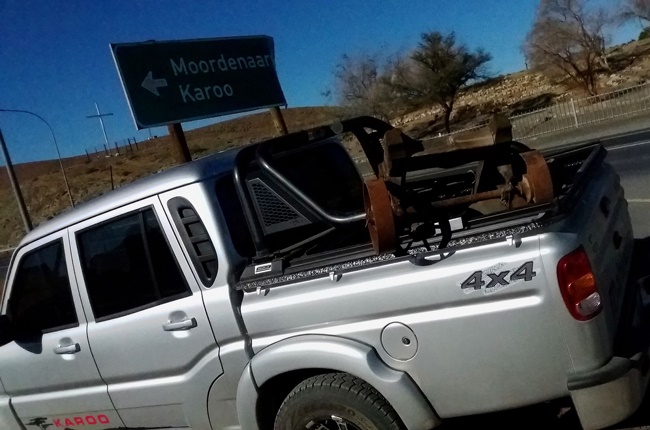
RoadTrip | Visiting the Moordenaars Karoo and learning ‘Indian history’ in Mahindra’s Pik Up

• The Moordernaars Karoo is explored in a Mahindra Pik Up. • The Karoo plays home to ‘interesting Indian history theories’. • The Mahindra Pik Up is an Indian bakkie built in South Africa. • For more motoring stories, go to www.Wheels24.co.za The curse of the habitual road tripper is to forever pass signs that point enticingly at …

• The Moordernaars Karoo is explored in a Mahindra Pik Up.

• The Karoo plays home to ‘interesting Indian history theories’.

• The Mahindra Pik Up is an Indian bakkie built in South Africa.

• For more motoring stories, go to www.Wheels24.co.za

The curse of the habitual road tripper is to forever pass signs that point enticingly at mysterious destinations but to forsake the temptation of travelling those roads through the pressure of time or, perhaps, because you are travelling in an unsuitable vehicle for the anticipated terrain.

I have travelled the N1 northwards from Cape Town across the Du Toitskloof Mountains to Worcester and further scores of times over the past 30 years. And, every time I entered Laingsburg, I have been intrigued by the sign pointing off to the left: Moordenaars Karoo.

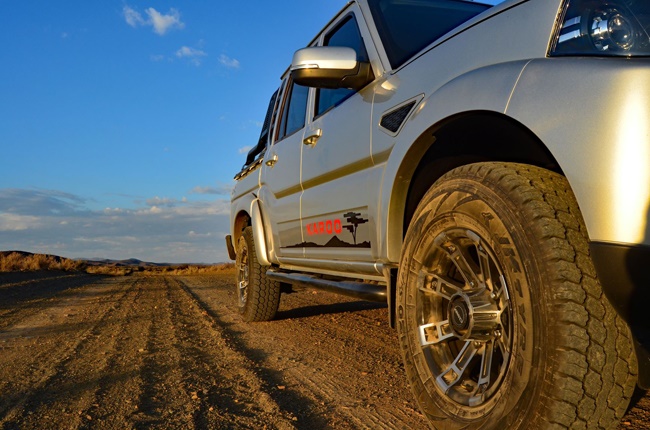
One day, I have always thought as I drove further into the hinterland or returned to the Mother City, that one day… That day arrived towards the end of June and, sitting beside me in the top-of-the-range Mahindra Pik-Up S11 double-cab 4×4 bakkie – in an appropriately named special edition Karoo guise – was maverick Czech-born historian, Dr Cyril Hromnik.

The combination of Indian vehicle, academic, and Moordenaars Karoo on this, the eve of the Winter solstice (the shortest day of the year) was no coincidence. Dr Hromnik’s life’s work and unbridled passion have been to prove how the Dravida, antediluvian traders of Indian origin, made it this far South down the African hinterland.

In 1981, Dr Hromnik published Indo-Africa: towards a new understanding of the history of sub-Saharan Africa, a contentious work postulating that Southern Africa “was explored and settled, especially in those areas rich in gold and other minerals, by people of Indian origin in the centuries, if not millennia, before Christ and by Indonesians at the beginning of the Christian era.”

The flyleaf encapsulation of the book continues: “This statement is at complete variance with recent histories where Africa is presented as a continent evolving in isolation, her peoples believed to be of Negroid stock with no significant outside genetic contribution and her languages looked upon as the result of internal linguistic and cultural evolution.”

To read the original article, click here.

Mahindra Pik Up

2020 Mahindra Pik Up S11 Karoo 4×4 (Jim Freeman / RoadTrip)

The Dravidians

The Slovak maintains that Indian traders, termed ‘Dravidians’, landed in what is now Mozambique and trekked inland after hearing reports that gold was to be found around what is now Barberton in Mpumalanga. While there, they bred with Bushman women, giving rise to a new progeny – that shared physical characteristics of the Bushman but were considerably taller – called the Quena or Otentottu, later corrupted to ‘Hottentot’.

In time, both the Dravidians and Quena moved on, but not before some of the latter had become adherents of Dravidian religion, wrote the historian (who, incidentally, worked as a cowboy in Eastern Europe before fleeing Czechoslovakia in 1968 after the Soviet invasion of his homeland). 

According to him the Quena, retaining the cosmological-based religion, built stone structures, ancient walls, and erected monoliths aligning with prominent features in the landscape; massive timepieces to map the cyclic trajectory of the sun and moon, and to fulfil critical spiritual functions.

READ: Celebrating 30 years of Madiba’s freedom with a countrywide sojourn in a Merc GLS

His theories were duly heard by David Luscombe, owner of the 27 000-hectare farm, Faber’s Kraal, (also called Geelbek) on the road from Laingsburg to Sutherland. For years, Luscombe had been perplexed by the presence of a few structures on the farm, and he sought the opinion of Dr Hromnik.

Having researched the origins of the Quena and Bantu-speaking peoples for more than 25 years, and with his knowledge of ancient Indian religion, he postulated these structures, some straight walls and others circular in shape, all formed part of a cosmological and spiritual complex.

It was the start of a warm friendship and partnership that has brought hundreds of people from around the world to the Moordenaars Karoo in time for the two annual solstices (the longest and shortest days) and equinoxes (when the days and nights are of equal duration) over the years.


Have you ever explored the Moordenaars Karoo? What’s your experience been like? Email us with your story and images.


Mahindra Pik Up

2020 Mahindra Pik Up S11 Karoo 4×4 (Jim Freeman / RoadTrip)

Karoo to Karoo

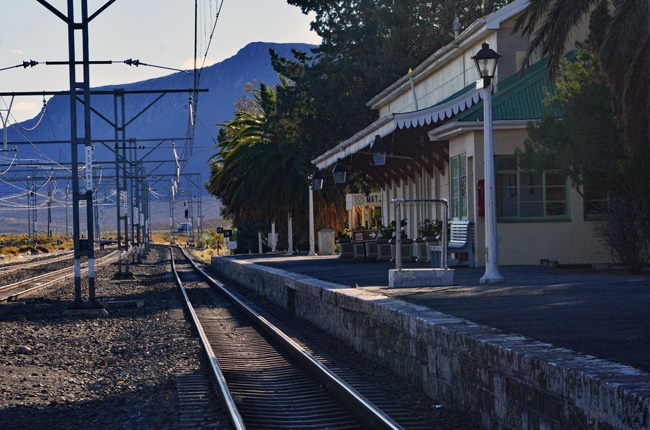
I listened to the story as the 2.2-litre turbocharged Mahindra sprinted up the N1 towards Laingsburg. We only paused outside De Doorns at the Velskoen Padstal to buy cups of coffee and supplies for the next few days. The Matroosberg was dusted with snow and the air crisp and clean.

Though the Mahindra is large and imposing – the 4×4 double-cab is capable of carrying a one-ton cargo in its deliciously deep load-box – it was surprisingly light on its feet and frugal on juice, with a manufacturer-stated fuel consumption of 7.9-litres/100km. Whatever the actual consumption, I was able to do the 650km round trip (including quite a bit of fairly strenuous off-road work) from Stellenbosch to Laingsburg and back before the reserve-light came on.

READ: Finding a diamant close to home in Hyundai’s new Venue

Road noise, something about which owners of earlier model Pik Ups have complained, was negligible, even at 120km/h. This was a blessing, as Dr Hromnik was softly explaining how names of other landscape features in the Moordenaars Karoo – places like Ramkop and Kanonfontein – were phonetically adapted from the words rama and kanai that (supposedly) had their roots in India. This linked the Quena people with possibly the oldest civilised ancestry on Earth. 

The smooth new six-speed automatic transmission helped the vehicle to maintain cruising speed without effort. In fact, I had to engage cruise control to avoid continually exceeding the speed limit. The interior, with comfortable seats and a central console featuring a seven-inch touchscreen infotainment system (with a linked reverse-view camera that came in handy when parking the high vehicle), was plush enough.

The only obvious indication that the technology employed is not precisely state-of-the-art was the 12V cigarette lighter-style socket for recharging your mobile phone, rather than a USB-port. Still, given its price, I was left feeling that the vehicle offered a hell of a lot of bang-for-my-bucks. And I had not even taken it off the tar yet!

Mahindra Pik Up

2020 Mahindra Pik Up S11 Karoo 4×4 (Jim Freeman / RoadTrip)

The enduring enigma

The structures we have come to see on the farm of David Luscombe are not the only mystery surrounding the Moordenaars Karoo. It stretches from close to Matjiesfontein in the West, almost till Prince Albert Road in the East, close to Sutherland in the North, and just short of Ladismith and Calitzdorp in the South, with Laingsburg right in its centre. The latter is the biggest enigma where the name originates from. 

Legend has it that in earlier times wanted criminals and murderers used the area as refuge, while another explanation offered is that the name was derived from the harsh, murderous climate of the region.

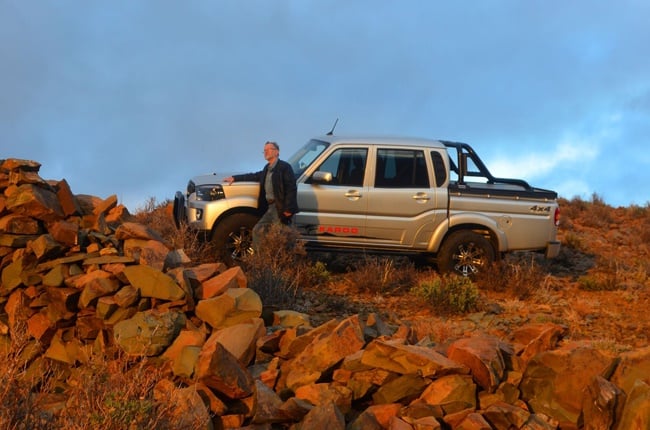
By now we have pulled in at Faber’s Kraal, which Luscombe has made available to us. It was about two hours before sunset on this, the shortest day of the year. Dr Hromnik drew my attention to an insignificant heap of stone near the Luscombe farmhouse. It depicted an arrowhead, he said, and pointed southwest towards a V-shape gap in the Witteberge, where the sun sets during the Summer solstice.

READ: BMW’s X7 gets up close with stunning wildlife at MalaMala

After unpacking, I took the vehicle into the veld to catch the golden light and wide-open expanses on camera. A chill wind hissing through the scrub and gorse was the only sound breaking the eerie silence. The stars were coming out, and by that time, Dr Hromnik had a fire going in the braai area. 

A windbreak surrounded the area, and I decided right then I will sleep under the heavens, regardless of how cold it might become. With the historian off to bed, I packed more wood on the fire, cracked open a bottle of KWVs 10-year-old potstill brandy, and snuggled into my sleeping bag to revel in the surroundings and the moment. 

It was still dark when Dr Hromnik woke me. There was not even time for a coffee before we set out to view the sunrise. Snapping from fast asleep to engaging low-range to cross sandy riverbeds, ascend and descend steep banks, and climb kopjes scarred with deep, hidden dongas – all the while trying to avoid ripping the tyres’ sidewalls on viciously sharp scree in the dark – was a shock to the system. The Mahindra handled it with much more aplomb than I did.

Mahindra Pik Up

2020 Mahindra Pik Up S11 Karoo 4×4 (Jim Freeman / RoadTrip)

Winter solstice

Day was just breaking when we arrived at a dead-straight dry-stone wall: rocks collected and stacked carefully atop one another for more than a hundred metres, a metre wide, and up to a nearly two metres high in places – literally in the middle of nowhere. The edifice could have served no agricultural purpose (it is useless as either windbreak or livestock pen) so why, I asked Dr Hromnik, is it here? 

This, he explained, was a place of worship; its positioning based on alignment with certain stars and the sun. At specific times of the year (equinoxes and solstices), a holy man would have greeted a dawn such as this from right here. He pointed to a roughly square rock just in front of him, careful not to show disrespect by putting a foot on it.

READ: Suzuki’s little S-Presso and SA’s homegrown Rooibos tea has a lot in common

Then he turned around, gesturing towards two breast-like hills still veiled in darkness. “There is where the sun will set tonight – in the cleavage formed by the kopjes. Called Parambu by the Dravidian gold seekers and their Quena progeny, the same kopjes were named Pramkoppies by the early Dutch,” he said with a slight laugh.

But why specifically here, I asked. He shrugged, as if to say it was just two more mysteries in an ancient land.

KEEP UPDATED on the latest Wheels news by subscribing to our FREE newsletter.

Category: NewsTag: cradock, graaff reinet, hofmeyer, karoo, news
16 September 2020 by Guest

ZEDER INVESTMENTS LIMITED – Zaad Concludes Agreement To Form JV Dedicated To Field Seeds In South Africa With Vilmorin & Cie And Seed Co – SENS

Zaad Concludes Agreement To Form JV Dedicated To Field Seeds In South Africa With Vilmorin Cie And Seed Co ZEDER INVESTMENTS LIMITED (Incorporated in the Republic of South Africa) (Registration number: 2006/019240/06) Share code: ZED ISIN: ZAE000088431 (“Zeder” or “the Company”) VOLUNTARY ANNOUNCEMENT – ZAAD CONCLUDES AGREEMENT TO FORM JOINT VENTURE DEDICATED TO FIELD SEEDS …


Zaad Concludes Agreement To Form JV Dedicated To Field Seeds In South Africa With Vilmorin Cie And Seed Co

ZEDER INVESTMENTS LIMITED
(Incorporated in the Republic of South Africa)
(Registration number: 2006/019240/06)
Share code: ZED
ISIN: ZAE000088431
(“Zeder” or “the Company”)

VOLUNTARY ANNOUNCEMENT – ZAAD CONCLUDES AGREEMENT TO FORM JOINT
VENTURE DEDICATED TO FIELD SEEDS IN SOUTH AFRICA WITH VILMORIN CIE
AND SEED CO

Zeder is an investor in the broad agribusiness and related industries. Its portfolio consists of
strategic interests in leading companies that provide it with a diversified exposure across the
agribusiness spectrum.

Shareholders of Zeder are advised that Zeder’s subsidiary, Zaad Holdings Proprietary Limited
(“Zaad”), through its subsidiary Klein Karoo Seed Marketing Proprietary Limited (“Klein Karoo
Seed”), has concluded an agreement to establish a joint venture in South Africa dedicated to
field seeds, particularly corn (“Joint Venture”). This Joint Venture groups together all the
South African field seed activities of Klein Karoo Seed, Vilmorin Cie (which is the holding
company of Limagrain Europe and incorporated in France) (“Vilmorin Cie”) and Seed Co
SA Proprietary Limited (“Seed Co”). The Joint Venture is called Limagrain Zaad South Africa
Proprietary Limited and is controlled by Vilmorin Cie.

Over the past number of years, Zeder has established and positioned Zaad as a strategic
holding company that invests and operates in the specialised agri-inputs industry with a focus
on emerging markets, especially Africa. Through acquisitions and organic growth, it has
aggregated and developed attractive businesses and currently owns, develops, imports and
distributes a broad range of agricultural seeds in Africa, Europe and other international
emerging markets. In recent years, Zaad has added strategic plant nutrition and
agrochemicals to its portfolio to complement its product offering, particularly in emerging
markets with the Farm-Ag and Hygrotech acquisitions.

Klein Karoo Seed is a South African seed company which has been firmly established in the
country since its establishment in 2002 and Seed Co is a leading African seed company, of
which Vilmorin Cie is the reference shareholder.

The Joint Venture will be one of the leading players in South Africa, proposing a specific multi-
crop approach and benefiting from critical mass in an already highly consolidated field seed
market. It has a combined headcount of around 300 employees. It covers South Africa, as well
as Lesotho, Eswatini and Namibia, which also require temperate genetics for corn.

The Joint Venture combines the strengths of the three companies and will be able to capitalise
on high level of synergies, in terms of research, production, product portfolio, sales
organisation and marketing, within the three well-known brands.

The Joint Venture is primarily dedicated to corn seeds (white and yellow), an essential crop in
South Africa (with nearly 3 million hectares cultivated, it is the largest African market in terms
of value). Moreover, the Joint Venture stands out in the market by offering a wide product
range, including soybean, sunflower, wheat, sorghum and forage, as a complement to corn.

Fully integrated into Vilmorin Cie’s worldwide field seeds research organisation, it will also
be able to benefit from genetic resources from the Americas and Europe to increase the
efficiency of its research work.

The establishment of the Joint Venture is perfectly in line with Zaad and Zeder’s field seeds
strategy and is a concrete demonstration of its capacity to develop solid partnerships
internationally, as well as its desire to pursue its development in Africa, which has considerable
growth potential.

Stellenbosch
14 September 2020

Sponsor and Transaction Adviser to Zeder and Zaad
PSG Capital

Date: 14-09-2020 12:15:00
Produced by the JSE SENS Department. The SENS service is an information dissemination service administered by the JSE Limited (‘JSE’).
The JSE does not, whether expressly, tacitly or implicitly, represent, warrant or in any way guarantee the truth, accuracy or completeness of
the information published on SENS. The JSE, their officers, employees and agents accept no liability for (or in respect of) any direct,
indirect, incidental or consequential loss or damage of any kind or nature, howsoever arising, from the use of SENS or the use of, or reliance on,
information disseminated through SENS.

Category: NewsTag: cradock, graaff reinet, hofmeyer, karoo, news
14 September 2020 by Guest

A Tale of Two Cats, Cecil and Sylvester

An undated handout photo provided by the Zimbabwe Parks and Wildlife Management Authority on 28 July 2015 shows Cecil the lion. Photo: An undated handout photo provided by the Zimbabwe Parks and Wildlife Management Authority on 28 July 2015 shows Cecil Wednesday, 1 July marked the fifth anniversary of the death of Cecil the Lion, …


An undated handout photo provided by the Zimbabwe Parks and Wildlife Management Authority on 28 July 2015 shows Cecil the lion. Photo: An undated handout photo provided by the Zimbabwe Parks and Wildlife Management Authority on 28 July 2015 shows Cecil

Wednesday, 1 July marked the fifth anniversary of the death of Cecil the Lion, the feline felled in Zimbabwe by a US bow hunter. And it is five years since a South African lion named Sylvester was recaptured in dramatic fashion after his escape from Karoo National Park. The tale of these cats is also a tale about wildlife policies, in this case, fencing, the option of choice in South Africa, the only industrialised economy which is home to the Big Five. And it highlights why affluent westerners may cry for lions, but local communities do not.


In winter, shivering temperatures often greet the dawn in South Africa’s Karoo. Sometimes frost covers the earth, a dappled ivory carpet that slowly recedes before the rising sun, revealing the starkness of the landscape: bare, flat-topped sandstone mountains tower above plains speckled with rock-strewn soil and improbable patches of vegetation — stunted clumps of bush in some places, grasslands in others. Aloes dot some of the hills, with crimson blossoms sprouting from gnarled stems. Acacia trees spiked with thorns take root in dry river-beds, trails of oasis-like green. But the general image is one of vast, open and mostly treeless terrain. A seemingly endless blue sky provides the canopy, transformed at night into a dazzling array of stars.

This central plateau of South Africa receives little rain, and in summer it can be baked by temperatures that soar above 40ºC. Yet it is hardly lifeless, with one of the planet’s richest natural histories. Today’s winter frosts were once permanent, the landlocked in the icy grip of glaciers. Around 270 million years ago, as the glaciers washed away with the shifting of the continents, living creatures invaded and evolution ran riot. Among the newcomers were protomammals, the ancestors of all mammals that walk the planet today, including Homo sapiens.

Fast forward to recent history, and the Karoo has continued to be home to an astonishing and flourishing assortment of life, carving intricate niches out of an environment that is not as unforgiving as it appears. The scattered vegetation that takes hold is rich in nutrients, providing sustenance to creatures big and small. Etched in stone, the rock engravings of the San Bushmen depict eland, rhino and elephant.

(The Karoo, photo by Daily Maverick)

The region’s faunal reputation really lay in its teeming masses of springbok, the dainty tan and white antelope that is the symbol of South Africa’s national rugby team. The springbok Karoo migrations were legendary, evoking the countless procession of bison that once defined the American hinterland and the wildebeest passage across the Serengeti. The last mass-migration reported was in 1896, but the guns of South Africa’s white settlers had reduced the numbers greatly, along with fencing for livestock, bringing one of nature’s grand spectacles to an end.

(The Karoo, photo by Daily Maverick)

Yet in their day, this zoological phenomenon highlighted the ability of wildlife to thrive in this thirsty land. In 1849, the small Karoo town of Beaufort West was overwhelmed for three days by a heaving mass of springbok, which may have numbered millions, on the move. Utter desolation was left in its wake: the surrounding foliage, never abundant in this harsh corner of Africa, had been completely stripped, the Karoo’s vulnerability laid more bare than the melting of frost before an ascending sun. 

The springbok horde that descended on Beaufort West, more pulverising than its hulking human namesakes on the rugby pitch, would have been followed by an array of predators and scavengers, including leopard, hyena, and jackal. But in 1849, the springbok would not have been shadowed by lion. The last wild lion recorded in the region was shot at the nearby settlement of Leeu-Gamka in 1842. Ironically, Leeu and Gamka, the names of rivers in the area, are derived respectively from words for lion used in Afrikaans and San. Decades before the mesmerising springbok migration was brought to a halt in the Karoo, one of the species’ key adversaries had been completely eradicated from the territory. Sparsely populated by humans to this day, much of the Karoo had been effectively “dewilded” by the middle of the 19th century.

So it came as a stunning jolt on a chilly June morning in 2015 when Kobus Swanepoel, a Karoo farm manager and hunting guide, found a fresh lion track in a dry riverbed on the ranch he was then renting. Swanepoel, who was 33 at the time, knew lion spoor when he saw it. A seasoned outdoorsman and accomplished hunter, he had spent several years in the bushveld of South Africa’s northern Limpopo province, a wild region where the big cats occasionally crossed over from neighbouring Botswana, or escaped from large fenced reserves. A lion’s impression in the soil is pretty unmistakable, the egg-shaped marks of its four toes protruding from a rounded imprint resembling a misshapen pumpkin.

“As I came down the road, I saw the track,” Swanepoel told me two years later, pointing to the riverbed as he geared down his diesel pick-up truck. Clambering out as the truck came to a juddering halt, Swanepoel walked to a spot where the dirt road rose out of the bed, a jumble of rocks, boulders and river sand fringed by acacia. Fresh spoor of a different kind was visible there now, one of a horse, the other from a kudu. The soil was thin, and it was hard to imagine anything leaving evidence of its passage. But my wife and I had run along a parallel dirt road earlier that day, and I had noticed the tracks we left. And a horse, kudu and lion are all big — the cat in this case being a three-year-old male, not yet fully grown but still tipping the scales at a good 140 kg.

“I reckoned it was a big female or a male not fully grown,” Swanepoel told me. 

Swanepoel knew immediately where this feline had originated — 3km away lay the fenced boundary of the Karoo National Park, where lions had been reintroduced in 2010 after an absence from the region of almost 170 years. This followed a long tradition in South African conservation of returning alpha animals to their previous ranges and habitats, an important precursor to the current “rewilding movement”. This lion, it would transpire, had been born in the park in 2012 — and its birth, the first in the park since the big cats’ reintroduction, marked another modern Karoo feline milestone. But the life of a male lion is rough, and read in tooth and claw. At a certain age, it will be driven from the pride, and bigger, more dominant males will not tolerate its presence. At 768  square kilometres, the park is not exactly small, but lions require a lot of space. And big animals in the park are contained by sturdy fencing — or, at least, they are supposed to be contained.

This lion — which acquired the moniker “Sylvester” — had been in a life-and-death struggle with a coalition of older male lions that were harassing him. A few days before his breakout, there had been unusually heavy rains for that time of the year, and a channel of water had forged a gully and raised part of the fence. Sylvester snatched the opportunity to escape his tormenters.

Swanepoel was unaware at the time of this chain of events — he just knew there was a lion on the loose on the farm where he and his family were residing, and that could spell big trouble. The farmworkers in the vicinity, many of whom would have been outside on foot or riding with donkey-pulled carts — still a common mode of transport for the rural poor in these parts in the 21st century — were vulnerable. Livestock was another concern: the region is famed for its sheep. And then there was the matter of the school and boarding house, which lay barely 3km from the lion’s track. It was 8am and about 40 primary-aged children, including Swanepoel’s two sons, were just starting their school day. And when Swanepoel began tracking the cat through the riverbed, it was headed straight for the school.

 “He stayed in the riverbed so it was pretty easy to follow,” Swanepoel told me. He drove on the road parallel to the riverbed, jumping out every couple of hundred metres to run down to it and check on the cat’s direction. I asked if moving through the dense foliage of the acacia was unnerving.

“You don’t want to encounter a cat in there,” he said matter-of-factly. Swanepoel was probably putting his faith in the hands of his God. During the course of our conversations, it emerged that he was a devout Christian.

And whether or not it was divine intervention, Sylvester’s spoor revealed that the children had had a close call. The boarding house was a drab green dwelling, surrounded at least by a high wire fence. On the day I visited, a Saturday, around a dozen of the boarders, mostly children, were playing, watched over by a matronly middle-aged woman. One could only imagine the horror that would have ensued had a lion suddenly materialised there. The school, just a stone’s throw away, consisted of a pair of modest, prefabricated units, and only had a short wire fence around its small yard. Neither fence would have presented much of an obstacle to a hungry lion. And Sylvester’s prints had come within 200 metres of the boarding house and school. But he had then abruptly turned tail and headed away on a route that would take him into the surrounding hills — a group of chattering kids can attract a predator, or startle it.

“He probably heard the children waking and the noise so he turned from the boarding house, he turned around on his tracks and he changed direction north-east and went over the mountain,” Swanepoel said.

Swanepoel alerted the park authorities, and at first they doubted his story. “So I said they should send me trackers, which they did. So I showed them the tracks and they said ‘yes, it’s a lion’ and we took it from there.” The trackers they sent were San, historically a much-abused people whose communities have mostly abandoned their traditional, hunter-gatherer way of life. But those who retain their ancestors’ traditions, or at least some of them, are renowned for their uncanny ability to track game, a rare skill that draws on generations of intricate knowledge of the wildlife that once represented their means of survival.

Yet Sylvester remained ahead of the growing throng, which was confounded on two fronts: one being the harsh setting of the Karoo, where the big cat often melted into hillside crevices. The other was the conflicting clock patterns of the pursued and the pursuers: lions are nocturnal and mostly move at night. Human trackers by contrast can only work effectively when the sun is in the sky.

The trackers were armed and Swanepoel fetched his .375, a heavy-calibre rifle, also used for elephant hunting, that is known for its “stopping power” — meaning it can stop big, charging beasts in their tracks. The trio then set out for an arduous day of tracking that would take them up an imposing hillside and over a treacherous trail just beneath a sheer, rocky ridge along the top. Gazing up at it, I could see it had been no easy hike.

Swanepoel, a compact man with a salt-and-pepper beard and open manner, cuts a ruggedly fit figure in the way of people who spend their lives outdoors. Clad in an olive-green shirt and trousers, with a checkered bandana around his neck, he had been guiding kudu hunters earlier in the day and was showing me highlights of the Sylvester trail on a late afternoon. He certainly looked like he could easily track an animal through such rough territory, but in the photos he showed me from that day I almost failed to recognise him, his face and frame both being far rounder.

“I was fat then,” he told me with a laugh. “It was tough following Sylvester.”

Sylvester would prove elusive on that day, and for many to follow. Swanepoel and his fellow trackers caught one heart-stopping glimpse of the cat, about 20 metres ahead in a thicket, as a helicopter that had been deployed in the search thumped overhead. But they had no direct contact with the pilot, and the chase continued. In one spot they saw that the cat had attempted to bring down a warthog, but failed to do so. Expert trackers can discern the drama of the bush by reading signs on the ground that would be meaningless to almost anyone else. In places where the soil was scant, the trackers would detect the faintest nick of a claw on a rock, and know they were still hot on the trail. But darkness fell and the trail would cool off.

Swanepoel helped with the search for three days, but eventually had to get back to his responsibilities. But the hunt for Sylvester, who embarked on a sheep-killing spree, would grow feverish. A spokesman for South African National Parks (SANParks) told me that the posse eventually included several police units, conservation officials from two provinces, four veterinarians, a dog-handler from Botswana with two helpers and six dogs, and several trackers and volunteers from the local farming community. For aerial support, SANParks dispatched a helicopter and a local aviation training school provided a gyrocopter and microlight.

Yet Sylvester remained ahead of the growing throng, which was confounded on two fronts: one being the harsh setting of the Karoo, where the big cat often melted into hillside crevices. The other was the conflicting clock patterns of the pursued and the pursuers: lions are nocturnal and mostly move at night. Human trackers by contrast can only work effectively when the sun is in the sky.

“In daytime, lions try to lay low,” Swanepoel told me. “And Sylvester was foreign in this area and he wasn’t secure and he was trying to get away as far as possible from the other male lions. So you start tracking early, with the first light in the morning, and sometimes you lose the track. But let’s say you track 15 to 20km maximum per day, that’s about how much he walked last night. So he might be 5km from you or more when it gets dark. And then he is moving again.”

Meanwhile, Sylvester was leaving a mounting body count of livestock in his wake. The final toll, by the reckoning of SANParks, was 28 dead sheep, plus a kudu. The worst incident came on day three of his flight for freedom, when he slaughtered 16 sheep at once. Raised in a national park where he freely hunted a range of wild game, Sylvester had never come across such easy prey before. One shudders to think what may have transpired if he had travelled that extra 200m on that first morning to a playground bustling with school children.

The children at the farm school where Sylvester the Lion twice came within 200 metres of. (Photo by Christa Cameron)

Finally, on 29 June, Sylvester was pinned down on the craggy ridge of a mountain a mile above sea level and darted with a tranquilliser from a helicopter in a hair-raising operation that left no room for error. He had been on the lam for 24 days. During that time, he had covered about 300km in total, though the mountain where the dart knocked him out was not far from the park as the crow flies.

“(Sylvester) had to be loaded into a sling underneath the chopper while lying immobilised on the mountainside. This was the most dangerous part of the operation as the helicopter blades were not more than two metres from the mountain edge,” SANParks said in a statement. I wrote a brief story for Reuters, the news agency I worked for at the time, about the escapade, and an editor in London came up with a light-hearted headline: “Sylvester the lion’s big adventure ends with a helicopter ride in South African mountains.” Sylvester’s tale quickly faded from the news cycle. But a new story involving a lion with a human name was about to erupt. And the world had not heard the last of Sylvester.

****

Shortly after Sylvester’s recapture, another male lion, 2,000km to the north in neighbouring Zimbabwe, also left the protective confines of his reserve. He was not fleeing the aggression of other male lions, however, and there was no fence standing in his way. Simply by crossing a railway track he was no longer in a protected area. This particular lion presided over a pride in Zimbabwe’s Hwange National Park. Much was known about this big cat’s life because he was the subject of a study by the University of Oxford’s Wildlife Conservation Research Unit (WCRU), which was gathering data in a bid to understand the threats faced by lions. In 2008, when he was aged about six, he was tranquillised and fitted with a satellite-tracking radio collar. It would emit signals every two hours, providing his GPS co-ordinates. He was also a favourite with tourists who visited the park.

His data code was MAGM1, but he was better-known by his English nickname, Cecil.

On 1 July 2015, Theo Bronkhorst, a Zimbabwean professional hunting guide, came upon an elephant carcass while guiding an American dentist named Walter Palmer on a farm adjacent to Hwange. They decided to use it for bait, which is the typical way predators are hunted — you don’t stalk a stalker. According to Bronkhorst, a blind was built and the hunting party settled in for a night of waiting.

Around 10pm, a lioness floated past the blind. Then Cecil strode into view.

“He was a magnificent animal,” Bronkhorst would later tell the British newspaper The Telegraph. Indeed he was. At 13 years old, Cecil was a huge specimen, an apex predator at the pinnacle of the food chain, his massive head framed by an impressive black and tan mane. He had literally clawed his way to the top, spurred by an ancient call, but with his movements meticulously tracked by 21st-century GPS technology. Cecil had been grievously wounded in a previous battle in which his brother had been killed, but had soldiered on, taking the helm of one pride, then being beaten off, only to form another.

This was what Palmer had been waiting for — a trophy. He proceeded to shoot his quarry with a bow, but the shot was bad.

Tracking a wounded lion at night is not advisable, so the party turned in for the night and began their search in the light of the following day. The details remain sketchy, but what we know is that Cecil was eventually found about 250m from where he was wounded, and was “dispatched”. Oxford scientists say he was killed about 11 hours after the initial arrow was shot. That was when Bronkhorst and Palmer discovered his radio collar, and realised that they had slain a protected animal.

Initial media reports also asserted that Cecil had been “lured” out of the park by the bait, which WCRU researchers have said was not true — Cecil was already out of the park when the party found the dead elephant. Questions have also been raised about the fate of the radio collar, and Palmer’s knowledge of the hunt’s legality, which was the crux of the matter from a legal point of view — there was no “quota” for a lion in the area. But the overall story is pretty clear: an American dentist from Minnesota, a hunting enthusiast with deep pockets willing to pay big bucks to bag big game, had killed a lion in Zimbabwe with a bow and arrow — one of many such kills.

According to WCRU, Cecil was one of 65 lions killed by trophy hunters in the area from 1999 to 2015, 45 of which were equipped with radio collars. Indeed, two other satellite-collared lions with human nicknames were also killed by hunters in the same area in 2015. But Cecil was popular with park officials and tourists who visited Hwange. And Zimbabwean officials began an investigation into the matter.

The story of Cecil’s demise slowly leaked out that July, and really took off on 27 July, when Palmer was named as Cecil’s killer. It received an added jolt on 28 July, when US talk show host Jimmy Kimmel took to the airwaves and made an impassioned statement about the incident, choking back tears as he assured Africans that “not all Americans are like this jackhole” — the jackhole in question being Palmer of course, whose practice was already being besieged by protesters. Kimmel also made reference to WCRU’s work and encouraged his viewers to support it by visiting its website. In the following hour, an estimated 4.4 million people did just that, overwhelming its website and Oxford University’s, triggering their collapse.

Cecil’s story rumbled on, with huge media coverage of its various twists and turns, including Bronkhorst’s court appearances and the decision by Zimbabwean authorities not to charge Palmer — a man who deserved no less than hanging, according to some social media posts. Zimbabwe would also finally decide in November of 2016 not to proceed with the case against Bronkhorst.

Cecil, in the meantime, became a secular martyr to a number of conservation causes held dear by many in the affluent West, and in April 2016 was named by Time magazine as “The Most Influential Animal in the World”. Money for conservation causes have been raised in his name and there is even a “Cecil the Lion Tribute Page” featuring portraits of the late cat. In a subsequent paper, Oxford researchers measured the media coverage of the Cecil saga, which peaked at 12,000 stories a day in editorial media; social media topped out at 87,533 “mentions”. The authors of the paper asked if Cecil would be a passing “moment” or a “movement”, making the plausible argument that his death triggered the largest reaction to an event “in the history of wildlife conservation”.

****

The response from Africa was pointedly different.

Asked by reporters for comment on the Cecil episode, Zimbabwe’s acting information minister at the time, Prisca Mupfumira, snapped: “What lion?”

In response to demand from rural villages, Zambia had quietly reopened its lion hunting season in May 2015 after a two-year closure. Tourism Minister Jean Kapata, speaking to Reuters in Lusaka about the issue in the wake of the Cecil uproar, said a community leader in her home area had recently been eaten by a lion — driving home a point often missed by Western commentators. 

A few days after Kimmel’s emotional outburst, Goodwell Nzou, a Zimbabwean doctoral student studying molecular medicine in the United States, penned an opinion piece in The New York Times entitled “In Zimbabwe, We Don’t Cry for Lions”. He wrote that the American outrage over the incident had provoked “the starkest cultural contradiction I’d experienced during my five years studying in the United States”.

“Did all those Americans signing petitions understand that lions actually kill people? That all the talk about Cecil being “beloved” or a “local favorite” was media hype? Did Jimmy Kimmel choke up because Cecil was murdered or because he confused him with Simba from The Lion King,” Nzou asked.

Hollywood offers another striking, and far more realistic take, on our relationship with big cats. In Martin Scorsese’s classic 1979 Vietnam War movie Apocalypse Now, there is a wildly unexpected scene that begins with a hunt for mangos in the rainforest.

The character called “Chef” sets off to search for the fruit to add to a sparse larder on board his military gunboat, which is making its way up the river to an unknown destination. He is accompanied by Green Beret Captain Benjamin Willard, played by Martin Sheen. The dark greens of the jungle and monstrous trees give the setting an almost prehistoric feel — and the threat that lurks is indeed prehistoric. As Chef babbles on about the unappetising side of industrial-scale cooking, Willard is alerted to potential danger by birds crying out in alarm. The pair, now in combat-ready mode, quietly move forward through the shadows, massive leaves speckled by sunlight eerily shrouding their path. Assault rifles at the ready, the men stop metres in front of a dark thicket. From within the bush, a figure appears, and then jarringly comes into focus: a roaring tiger charges from the bush! 

The tiger is only on the screen for a split second — Williard fires several rounds and then flees, following a traumatised chef who discharges some wild shots while screaming “A fucking tiger! A fucking tiger!” Back on the boat, Chef completely loses it — this is his PTSD moment, the one where this crazy war has finally pushed him over the edge. This is a man who over the course of the movie has seen a mad Lieutenant Colonel — memorably played by Robert Duval — launch a military assault on a beach because there is good surfing to be had in its waves.

While undertaking this operation with helicopter gunships, the Lieutenant Colonel has Wagner’s stirring The Ride of the Valkyries blared loudly from a chopper. Civilians including women and children are massacred, all because some crazed officer wants to surf. Chef is tightly wound and some of the events appear to unsettle him — but his shipmates, who have all had to catch a military escort with the madman, are also bug-eyed at times. The Duval character also famously proclaims his love for the “smell of napalm in the morning…” The Lieutenant Colonel is completely unhinged. But ultimately Chef and the rest of his crew seem relatively unfazed by these events — they are on a clear path of mental instability, but have not yet strayed off it to the lip of the cliff.

At the end of the fucking day, Chef just wants to cook.

But coming face to face with a big cat that wanted to eat him was a line he could not cross. It was incomprehensible in its horror. Of all the shocking incidents he witnessed and experienced, this was the one that shocked him to the core, triggering a meltdown.

“I don’t fucking need it, I don’t want it! … All I want to do is fucking cook!” he wails on the boat as he rips his shirt off and has a tearful breakdown. Manically, he says “Bye tiger! Bye tiger!”, as the boat speeds away.

Chef, played by Frederick Forrest, said something else after he scrambled to the embrace of his gunboat. “Never get out of the boat!” he screams. “Never get out of the boat!”

When it comes to megafauna, we instinctively erect barriers — in this case the water. 

There was no barrier to Cecil’s movements, nor was there one for the cat that terrorised Nzou’s village. And the stark terror that plunged Chef into the abyss — the kind that comes in the form of a large, man-eating cat — was what stalked Nzou’s village.

“When I was nine years old, a solitary lion prowled villages near my home. After it killed a few chickens, some goats and finally a cow, we were warned to walk to school in groups and stop playing outside. My sisters no longer went alone to the river to collect water or wash dishes; my mother waited for my father and older brothers, armed with machetes, axes and spears, to escort her into the bush to collect firewood. A week later, my mother gathered me with nine of my siblings to explain that her uncle had been attacked but escaped with nothing more than an injured leg. The lion sucked the life out of the village: No one socialised by fires at night; no one dared stroll over to a neighbour’s homestead.”

From the local community’s perspective, Kimmel was shedding crocodile tears. Indeed, Western campaigns over the plight of big animals on a continent with such pressing social concerns can seem downright callous to Africans, who, to paraphrase a US political slogan that has been brought into sharp relief by the killing of George Floyd, would say “Black Lives Matter More than Animal Lives.”

If you think this is misplaced, consider this: 22,000 rural Africans slaughtered for political reasons by one of the continent’s vile regimes. That should surely provoke more outrage than the killing of one lion by an American dentist. Such an atrocity — the “Matabeleland Massacre”, perpetuated in the 1980s by the North Korean-trained Fifth Brigade of the Zimbabwean army under the command of the now late autocrat Robert Mugabe — actually took place not far from the area where Cecil met his end. Yet this crime against humanity was barely noticed at the time, or since, by the wider public in the West.

Admittedly, it took place decades before the rise of the internet and the web-based social media revolution. But even today, monstrous crimes in Africa have not elicited a response from the Western public to match the reaction triggered by Cecil’s killing. Perhaps we simply see incidents such as the Matabeleland Massacre or the Darfur conflict as the natural order of things in Africa. As the late cultural critic Susan Sontag noted in her book Regarding the Pain of Others:

“Postcolonial Africa exists in the consciousness of the general public in the rich world — besides through its sexy music — mainly as a succession of unforgettable photographs of large-eyed victims… They confirm that this is the sort of thing which happens in that place. The ubiquity of those photographs, and those horrors, cannot help but nourish the belief in the inevitability of tragedy in the benighted or backward — that is, poor — parts of the world.”

Or consider this: it has been almost five years since Cecil was killed. In that time, at least hundreds of rural Africans have been killed or maimed by dangerous wildlife. I have attempted to collect data on the issue and it is patchy to say the least, but hundreds is not an unreasonable estimate and it may well exceed that. Many of these victims will be women and children. But aside from their family, friends and neighbours, who knows their names? Where is the public outcry over their fate? What American late-night talk show hosts are shedding tears for them?

It seems little has changed since 1907, when British engineer John Henry Patterson’s The Man-Eaters of Tsavo was published. The subject of three movies, the book is a gripping account of Patterson’s efforts to hunt down a pair of lions that terrorised the work crews building a bridge over the Tsavo River in Kenya in 1898.

“Well had the man-eaters earned (their)… fame,” Patterson wrote. “They had devoured between them no less than 28 Indians” … “in addition to scores of unfortunate African natives of whom no official record was kept.” The African victims were nameless and not even worth counting. They remain so in the 21st century.

In his New York Times Op-Ed, Nzou noted:

“We Zimbabweans are left shaking our heads, wondering why Americans care more about African animals than about African people.” Why indeed?

****

Many conservationists would take offence at the allegation that they were more concerned about animals than Africans, and the taint of racism such an assertion implies. I have interviewed scores of conservationists over the course of my career as a journalist, and the impression that emerges is one of an activism that draws on well-intentioned desires to make our planet a better place — for people, animals and the wider environment.

It is an activism that can certainly be emotive — and at times exploitative — but one that is often (though not always) grounded firmly in science while seeking to advance our knowledge of the natural world. It also draws heavily on the Enlightenment and the West’s historical intellectual and cultural heritage: the growing realisation in the 17th and 18th centuries that animals could feel pain; the Darwinian revolution, which highlighted our biological kinship to the wider animal world; the related discovery that species could go extinct, and the gradual dawning that our actions could be a cause; and our unmooring from the natural world, brought about by the twin forces of urbanisation and industrialisation, which in turn gave rise to our penchant for romanticising it.

The answer is straightforward, but its history is deep and complex. South Africa under apartheid was the only industrialised nation in history that had big, dangerous African wildlife living within its borders and ranging over its territory. Its solution, a political one that responded to the affluent, white community that had the vote, was to contain the beasts in fenced-off, protected areas.

There was also an ugly undercurrent to the Cecil drama which was mostly submerged from the public view. Nzou told me in an interview by phone that he had received death threats after his letter was published: death threats directed at a young man who was disabled, with the lower part of his right leg amputated because of a snake bite he suffered as a child.

“There were threats by email, on Facebook, and a letter to the university saying that I did not deserve to be alive because what the world needed more of is animals, not people,” he told me. Someone said his mother should die because she was having too many children — an unsubtle message. Nzou understandably did not want to reveal the university in the United States where he was completing his PHD.

And it did not stop there.

In the wake of the Cecil circus, South Africa’s Environment Minister at the time, Edna Molewa, was subjected to a torrent of racist abuse on Twitter because her ministry and the ANC government supported the hunting industry. Molewa, who died in late 2018, was a black, middle-aged woman whom I always found to be cheerful and approachable, with a firm grasp of policy — something that could not be said about all of her colleagues.

At some point in 2016 she had signed off from Twitter, and a member of her staff told me about the hounding she had received from anonymous trolls — trolls who hurled racist insults at her.

“They called her a black bitch and worse, and said she was responsible for killing innocent animals,” said her staff member. Eventually, I asked Molewa about it on the sidelines of a World Economic Forum conference in Durban, and she was still visibly upset.

“It was terrible. And these cowards don’t show themselves,” she told me. That’s how racist and misogynist trolls work, as several contributors to this publication know.

These incidents were not isolated, and indeed follow a racist pattern that has often defined conservation movements and personalities in Africa. One famous example is Joy Adamson, who shot to worldwide fame for her 1960 book Born Free, which detailed how she raised a lioness in Kenya before releasing it back to the wild — another precursor to the rewilding campaigns that have become popular today. Adamson, as the commentator George Monbiot and others have noted, was in reality a vicious and unpleasant racist, a character trait that played no part in the radiant portrayal of her in the Oscar-winning film based on the book.

She so grievously mistreated her black staff that it came as no surprise that a former servant murdered her. To Adamson, African people were subhumans who stood in the way of her own conservation initiatives, their lives clearly mattering less than those of animals. At one point, she demanded that colonial authorities in Kenya give her 30,000ha of land that belonged to Africans so that her beloved big cats could roam there. To her, that may not have seemed unreasonable: many conservation areas in Africa have involved the forced removal of the local communities to make way for animals.

The great English historian Keith Thomas, commenting on a fashion among some historians in the 1980s to view the anti-slavery movement of the 19th century as a diversion of activist energies from the plight of the English working class, noted that the same could be said of the movement against animal cruelty at that time:

“It too buttressed the new industrial system by representing inhumanity to beasts as something that belonged to more uncivilised regimes in the past …”

Late 19th-century campaigns against cruelty to women and children, aimed almost exclusively at working-class households and neighbourhoods, were often outgrowths of the SPCA — the Society for the Prevention of Cruelty to Animals. Concern for animal welfare, it seems, at times preceded empathy for the miseries of poor humans.

There are echoes of these trends today. In South Africa, for example, campaigns against rhino poaching or animal cruelty are almost always led by members of the white middle class: a diversion of energy from what most Africans would see as the more vital issues of poverty, AIDS and a host of other social and economic ills, which the Covid-19 pandemic has made even more pressing.

In the novel Inheriting the Earth, the South African writer Jill Nudelman vividly captures this conflict of cultures. In a hectoring tone, a white woman who runs her own small NGO admonishes a poor, rural black man for mistreating his donkey — his one source of income that hauls the firewood which he sells.

“Why is he so thin? You don’t feed him enough. You must feed your donkey,” she says. To which an onlooker responds: “What must we do? He’s a poor man. We’re all poor men. We can’t take food away from the people to give to our animals.” The scene is fictional, but it is a slice of South African reality, where many affluent whites, to paraphrase Thomas, regard inhumanity to beasts as a relic of an uncivilised past — in short, a barbaric flaw of the black majority that needs to be rectified.

The wider world of writing also provides a more telling example of this cultural divide. African wildlife in recent decades has been the subject of literally hundreds of books. Dozens stand on one of the bookshelves in my house. Every single one has been written by a white author, often a foreigner to the continent, like myself.

One exception is the recently published Changing a Leopard’s Spots, an engaging book co-authored by wildlife trackers Alex van den Heever and Renias Mhlongo. In the African literary canon, fauna figures prominently in oral traditions, such as “trickster tales”, where animals are stand-ins for humans in fables where the weak often outwit the strong — a storytelling heritage carried on by slaves in the Americas, where such scenarios had an obvious appeal. But in the late 20th and 21st centuries, current African wildlife issues are mostly the concern of middle-class, white South Africans and their counterparts elsewhere. They are not a significant African concern, at least in the realm of writing. That, surely, is an indication of where priorities lie.

****

One useful point of departure — or a way to find some common ground on such issues — lies in a largely ignored detail about the twin tales of Cecil and Sylvester. This simple fact escaped most of the commentary, but its consequences are profound.

Sylvester’s park in South Africa was enclosed by a fence: Cecil’s wasn’t. Sylvester set off a massive cat hunt because he slipped past the boundary. That was not an issue with Cecil, who periodically left his park. So do many other lions, making them a threat to rural communities. Yet this is a seemingly tolerable situation in Zimbabwe, whereas in South Africa it is regarded as intolerable. Why is this the case?

The answer is straightforward, but its history is deep and complex. South Africa under apartheid was the only industrialised nation in history that had big, dangerous African wildlife living within its borders and ranging over its territory. Its solution, a political one that responded to the affluent, white community that had the vote, was to contain the beasts in fenced-off, protected areas.

The Cecil moment had indeed become a movement, one that perhaps paid no small part in saving Sylvester. SANParks eventually ceded to the public outcry and another home was found for Sylvester in the Addo Elephant Park in the Eastern Cape, a larger park where he was less likely to come into mortal combat with other males. SANParks says as of June 2020, he remains a contented resident there.

This includes the famed Kruger National Park, which is the size of Israel, and also has capital-intensive agriculture such as sugar cane and other crops along its border. As a conservation strategy, this is hugely expensive. But the broader point here is that middle-class, affluent and industrialised economies will simply not tolerate in their midst the threatening presence of African megafauna. And it is a conservation tool that has been kept in place by the ANC government which took power in South Africa in 1994. It is here that we begin to find common ground between Africans and non-Africans on the issue of the big animals that pose a potential danger to humans. It is our common human desire to avoid encountering such wildlife in situations where they can threaten us.

“Never get off the boat!” — that is our instinct. But instead of seeking shelter on the water, we create islands — islands of habitat, for that is precisely what fenced reserves are. This has ecological consequences that are still playing themselves out. But conservation science is also coming out in defence of the fence. And human-wildlife conflict, or HWC, has always defined, and been defined, by boundaries — in this case, literally between us and them. 

I spoke by telephone to Craig Packer, an ecologist at the University of Minnesota, about this issue. He is widely regarded as the world’s foremost expert on lions.

“Africa can be divided into two broad categories: places that get lots of rain and arid regions. In agricultural areas there is no question that fencing is the best solution because people are then okay with wildlife because it is on the other side of the fences and not threatening their crops,” he said.

“In arid areas things are more complex and fencing needs to be more strategic, around hot spots of human activity.” Among other things, this is because wildlife needs access to migration routes to water when things are really dry.

Packer and other scientists are completing a paper looking at this very issue across the continent to identify where fencing is appropriate. While not as extensive as South Africa, fencing to contain and protect dangerous wildlife is now being used in at least seven African countries. It must be said that funding such initiatives will not be easy in the immediate aftermath of the global economic meltdown triggered by the Covid-19 pandemic.

Raising fences raises people above what I have dubbed elsewhere the “faunal poverty line”. It raises the dignity of people who live on the other side of the fence, enabling them to go about their daily routines without facing the prehistoric threat posed by megafauna while providing a measure of protection to the animals within. It is not a perfect solution: rhinos and elephants are poached in the Kruger, and Sylvester is hardly the only lion to have gone under a South African fence in recent years. But it is the best one we have. When big critters are about, we prefer to stay on the boat. 

****

The story wasn’t over for Sylvester — he made headlines again, in March 2016, when he broke out of the Karoo National Park a second time. But this time round, he was wearing a satellite collar like Cecil’s, making him far easier to pursue. After three days, he was darted again. Now regarded as a “problem animal”, park officials announced he would be put down. Coming in the wake of the Cecil fiasco, this sparked a hue and cry among (mostly white) South Africans, who started online petitions calling for SANParks to spare him.

The Cecil moment had indeed become a movement, one that perhaps paid no small part in saving Sylvester. SANParks eventually ceded to the public outcry and another home was found for Sylvester in the Addo Elephant Park in the Eastern Cape, a larger park where he was less likely to come into mortal combat with other males. SANParks says as of June 2020, he remains a contented resident there.

One of the many petitions said:

“Sylvester the lion will be put down once captured. This beautiful animal has not killed a single human.” It also quoted a parks official as saying: “The likelihood of him encountering a human being is slim.” Why then, the outraged author asked, should he be put down?

Yet Sylvester’s likelihood of encountering a human was not actually so slender — which explained the urgency behind the operation to recapture him. The petitioners were unaware of the trail that Sylvester took, one that gave Swanepoel an unnerving sense of déjà vu.

On the day he was showing me around, he casually mentioned that Sylvester on his second breakout had initially followed the precise route he had taken before.

“He came down into the same spot in the river bed and once again, his spoor showed that he had come about 200 metres from the school before he turned,” Swanepoel told me. The children had once again had a close shave.

Elsewhere in Africa, children are not so fortunate. OBP/DM

Gallery


Category: NewsTag: cradock, graaff reinet, hofmeyer, karoo, news
13 September 2020 by Guest

South Africa: Escape From Lockdown and Something New Under the Karoo Sun

Doodvreters, anybody? No? I didn’t know what they were either. I do now. Graaff-Reinet again, after five months of lockdown and as many moons of scarcely leaving the front gate. And what do we find? Doodvreters. That’s what. Now look, I’m not as young as I was (who is?), so I don’t expect to encounter …

Doodvreters, anybody? No? I didn’t know what they were either. I do now.

Graaff-Reinet again, after five months of lockdown and as many moons of scarcely leaving the front gate. And what do we find? Doodvreters. That’s what.

Now look, I’m not as young as I was (who is?), so I don’t expect to encounter new things all that often. Yet there they are, in the fridge at Merino, my favourite Graaffies butchery. Slim – bacon-thin – rashers of brisket, spiced and ready for the braai. Literally as skinny as a bacon rasher. And the lady with the overall and mask urges: “You must cook them on the braai, but very quickly sir, very quick.”

I google, and there is nothing. A worldwide dearth of gen about doodvreters. So I need to rely on you lot out there to enlighten us further please. Let me know at [email protected] and we’ll make doodvreters famous.

I also bought a lovely slab of brisket, so that is headed either for the new buffet casserole this weekend or the potjie (keep an eye on our daily Lockdown Recipes next week to find out which).

Our first respite from lockdown was the Drostdy, the…

Category: NewsTag: cradock, graaff reinet, hofmeyer, karoo, news
11 September 2020 by Guest

Challenges mount for ostrich farmers in South Africa

Due to prolonged droughts, the uncertainty created by the Covid-19 pandemic, and continuing power outages, the ostrich farmers anticipate a challenging production. “…there is currently no production of any crops whatsoever. This creates a big problem for ostrich producers as there is no lucerne, which is a big component of the rations for ostriches. Feed …

Due to prolonged droughts, the uncertainty created by the Covid-19 pandemic, and continuing power outages, the ostrich farmers anticipate a challenging production.

“…there is currently no production of any crops whatsoever. This creates a big problem for ostrich producers as there is no lucerne, which is a big component of the rations for ostriches. Feed has to be transported from far, which puts great financial pressure on producers,” Joey Potgieter, chairperson of Agri Klein Karoo, told South Africa’s Farmer’s Weekly, adding that the region was entering its 6th year of drought.

In addition, the price of ostrich products has halved, adding to the concerns of farmers. About 70-75% of the world’s feathers were imported by companies in China, according to Potgieter. Since the closing of borders earlier this year, the feather market has plummeted. “Where we usually received R1,600 for the feathers of a slaughtered bird, the price is now R800 per bird.”

A complex battlefield: Mycotoxins in the GIT
Mycotoxin management has the utmost priority for animal producers worldwide.

Furthermore, slaughter quotas for the 2020/2021 production year have been introduced to reduce ostrich meat volumes in the market. South Africa produces more than 65% of the world production of ostrich products, according to Piet Kleyn of the SA Ostrich Business Chamber, reports the Independent Online, adding that the country has about 360 registered ostrich holdings although the number of those actively producing is likely fewer than 200. The country’s production of around 150,000 ostriches per year is, however, expected to be subdued. According to Potgieter, most of South Africa’s ostrich meat was exported to Europe, but due to the “stop-go situation” exports as a result of avian influenza outbreaks, many ostrich meat providers have forfeited their shelf space in European supermarkets.

Category: NewsTag: cradock, graaff reinet, hofmeyer, karoo, news
  • Previous
  • Page 1
  • Interim pages omitted …
  • Page 3
  • Page 4
  • Page 5
  • Page 6
  • Page 7
  • Interim pages omitted …
  • Page 93
  • Next
WE LOVE CRADOCK.

COPYRIGHT MyCradock · DESIGN BY REACH TRUST
All Rights Reserved · Powered by Straton Solar