• Skip to main content
  • Skip to header right navigation
  • Skip to site footer

My Cradock

My Cradock

Cradock News Classifieds and Directory

  • Home
  • About
  • Accommodation
  • Business
  • Events
  • Free Business Advert
  • Submit News
You are here: Home / Archives for image

image

2 November 2016 by Alan

Image from page 290 of “The crescent and the cross; or, Romance and realities of eastern travel” (1846)

Image from page 290 of “The crescent and the cross; or, Romance and realities of eastern travel” (1846) Image by Internet Archive Book Images Identifier: crescentcrossor01warbuoft Title: The crescent and the cross; or, Romance and realities of eastern travel Year: 1846 (1840s) Authors: Warburton, Eliot, 1810-1852 Subjects: Middle East — Description and travel Egypt — …

Image from page 290 of “The crescent and the cross; or, Romance and realities of eastern travel” (1846)
Valley of Desolation
Image by Internet Archive Book Images
Identifier: crescentcrossor01warbuoft
Title: The crescent and the cross; or, Romance and realities of eastern travel
Year: 1846 (1840s)
Authors: Warburton, Eliot, 1810-1852
Subjects: Middle East — Description and travel Egypt — Description and travel
Publisher: London H. Colburn
Contributing Library: Robarts – University of Toronto
Digitizing Sponsor: MSN

View Book Page: Book Viewer
About This Book: Catalog Entry
View All Images: All Images From Book

Click here to view book online to see this illustration in context in a browseable online version of this book.

Text Appearing Before Image:
tedof skins, tamarinds in dry cakes, and ebony clubs.We bought some precious stones, teetii of tlie hippo-potanms, and kurbashes, which are whips made of VOL. I. N 266 ABYSSINIAN MERCHANT. thongs cut from his horny hide. He told us, on hisreturn he should take back silks, jewellery, and cutlery,to the interior, and that articles of English manu-facture were inquired for by the remotest savages withwhom he dealt. We proceeded, in company with our travelled friend,to explore a temple that was nearly buried in sand.There are about twenty columns, some painted, somesculptured, and we determined on sending to WadyHaifa for men to excavate it. A change of windcoming on, however, changed our purpose ; and wetook an affectionate leave of our mercantile friend,(who, we found out afterwards, had taken us in, inevery article we had purchased from him). The men now fairly betook themselves to theiroars, and, raising their wild, enthusiastic song, beganthe homeward voyage. ANTIQUITIES OF MBIA. 267

Text Appearing After Image:
ENTRANCE TO THE GREAT TRMPLE AT IPSAMBOUL. CHAPTER XXVI. ANTIQUITIES OF NUBIA. Here Desolation keeps unbroken sabbath, Mid caves, and temples, palace?, and sepulchres; Ideal images in sculptured forms. Thoughts hewn in columns, or in caverned hill. In honour of their deities and of their dead. James Montgomery. We rowed all day, and floated all nifjht at therivers will, from the time we commenced our northerncourse. The reader by this time must be as tired ofriver scenery, palms, villages, and deserts, as, to saythe truth, we began to be ourselves. I shall, there-fore, only allude, as we pass, to the architecturalmarvels that fringe this unique river. n2 268 IPSAMBOUL. Towards evening, on the second day, after leavingWady Haifa, we repassed the extraordinary group ofpyramidal and other rocky mountains I have men-tioned in ascending the river, and then arrived at thechief wonder of Nubia, if not of all the Valley of theNile. The correct name of this rock-temple is Abou-Symbal; but it i

Note About Images
Please note that these images are extracted from scanned page images that may have been digitally enhanced for readability – coloration and appearance of these illustrations may not perfectly resemble the original work.

This Valley of Desolation image was automatically curated and published with WP Robot plugin – CLICK HERE to learn more about WP Robot for Wordpress – a massive time and money saver.

Category: ImagesTag: 1846, crescent, cross, Eastern, from, image, page, realities, Romance, Travel
8 October 2016 by Alan

Image from page 81 of “The fishes of the east Atlantic coast, that are caught with hook and line” (1884)

Image from page 81 of “The fishes of the east Atlantic coast, that are caught with hook and line” (1884) Image by Internet Archive Book Images Identifier: fishesofeastatla00vand Title: The fishes of the east Atlantic coast, that are caught with hook and line Year: 1884 (1880s) Authors: Van Doren, Louis Otis, 1863- Clarke, Samuel C …

Image from page 81 of “The fishes of the east Atlantic coast, that are caught with hook and line” (1884)
The Great Fish River museum
Image by Internet Archive Book Images
Identifier: fishesofeastatla00vand
Title: The fishes of the east Atlantic coast, that are caught with hook and line
Year: 1884 (1880s)
Authors: Van Doren, Louis Otis, 1863- Clarke, Samuel C Kenworthy, Charles James
Subjects: Fishes — Atlantic Coast Fishing — United States
Publisher: New York, The American angler
Contributing Library: Harvard University, Museum of Comparative Zoology, Ernst Mayr Library
Digitizing Sponsor: Harvard University, Museum of Comparative Zoology, Ernst Mayr Library

View Book Page: Book Viewer
About This Book: Catalog Entry
View All Images: All Images From Book

Click here to view book online to see this illustration in context in a browseable online version of this book.

Text Appearing Before Image:
d while taking Lhe coin out of his mouth hegrasped it between his finger and thumb, and to this day the had-dock bears the marks of the impress of tne apostles thumb andforefinger. They are two black maiks about the size of a three-cent piece immediately behind the head, just where an angler to-daywould grasp a fish to extract the hook from its jaws. The haddock has a distinct black line running along its sides; thesame lateral line in the codfish is white. As regards coloration thehaddock is darker than the codfish. It is a more tasty fish also, andis usually smoked before being brought to market. A celebratedkind of smoked haddock comes from Scotland and th y are knownas • finnan baddies. The haddock is caught pruicipally in winter 76 FISHES OF THE EAST ATLANTIC COAST. by professional fishermen in the neighborhood of Cape Cod, thoughthe extent coastwise of the haddock run, is from Delaware Bay upto northern Maine. The baits used are chopped herrings and some-times salted menhaden.

Text Appearing After Image:
CHAPTER XVI. The Menhaden—Alosa menhaden—(Gill.) This seemingly -worthless fish is one of the most important of allthe salt water fishes. There is not one of us, be he a fisherman ornot, who is not interested in the mossbunker. They swarm all alongthe coast, even some distance up the rivers every summer, and uponthe regularity and perpetuity of that migration depends to a greatextent the fish supply of the Eastern Coast cities. The magnetthat draws the great armies of bluefish to our waters is the vastshoals of menhaden that precede them. The best bait for stripedbass in surf-fishing, and, in fact, the material of all chumming,, isthe mossbunker. I have seen great collections of these menhadenascending the Soimd, and next day following a school of porpoises,rolling, tossing and diving in merry style through the water. The great use the menhaden are put to is in making fish oil, andright here lies a very threatening danger to our coast fishing. S^inenets are made that cover acres,

Note About Images
Please note that these images are extracted from scanned page images that may have been digitally enhanced for readability – coloration and appearance of these illustrations may not perfectly resemble the original work.

This The Great Fish River museum image was automatically curated and published with WP Robot plugin – CLICK HERE to learn more about WP Robot for Wordpress – a massive time and money saver.

Category: ImagesTag: 1884, Atlantic, caught, coast, east, fishes, from, hook, image, line, page
24 September 2016 by Alan

Image from page 203 of “The sportsman’s British bird book” (1908)

Image from page 203 of “The sportsman’s British bird book” (1908) Image by Internet Archive Book Images Identifier: sportsmansbritis00lyde Title: The sportsman’s British bird book Year: 1908 (1900s) Authors: Lydekker, Richard, 1849-1915 Subjects: Game and game-birds — Great Britain Birds — Great Britain Publisher: London : Rowland Ward Contributing Library: American Museum of Natural History …

Image from page 203 of “The sportsman’s British bird book” (1908)
The Great Fish River museum
Image by Internet Archive Book Images
Identifier: sportsmansbritis00lyde
Title: The sportsman’s British bird book
Year: 1908 (1900s)
Authors: Lydekker, Richard, 1849-1915
Subjects: Game and game-birds — Great Britain Birds — Great Britain
Publisher: London : Rowland Ward
Contributing Library: American Museum of Natural History Library
Digitizing Sponsor: Biodiversity Heritage Library

View Book Page: Book Viewer
About This Book: Catalog Entry
View All Images: All Images From Book

Click here to view book online to see this illustration in context in a browseable online version of this book.

Text Appearing Before Image:
t {St. sinensis) and the black-shafted ternlct {St. saundejsi). To the British Isles the little tern isa common summer-visitor, arriving early in May and departing in • See W. E. Clarke, Irans. iVorfolk Nat. Hist. Soc. vol. viii. p. 752 (1903). I So GULL GROUP September or early October, and buildini^ in colonies all round thecoasts, although less commonly so than in former years in many partsof the north of England and Scotland. In 1907 a nest was taken inNorth Uist ; and the species also breeds in other parts of the OuterHebrides. In Ireland its chief breeding-resorts are situated on thecoasts of Leinster, Ulster, and Connaught. Although throughout the British Isles the breeding-haunts of thisspecies are restricted to the coasts, where beaches and sand-banks areselected, in India the little tern, like the other ternlets, breeds chiefly ontidal estuaries, the banks of large rivers, and salt-water lagoons, whereit feeds chiefly on fish. In general habits these terns are very similar

Text Appearing After Image:
MOUNTED IN THE ROWLAND WARD STi I. ITT I. K TKKN. to their larger relatives, although their smaller dimensions give themthe appearance of being sti.U more active birds. Generally the eggs—two, or less commonly, three in number—are laid in a mere hollowin the bare sand, but in some cases the margin is said to be surroundedwith a ring of broken cockle or other shells. The eggs range from i^to nearly i^ inches in length, and are as variable in colouring as thoseof the Sandwich tern, but are more regular in shape, being nearly oval.From pale cream to drab or buff is the usual range of the ground-colour, upon which arc bold markings in the shape of variable spotsand blotches of different shades of dark brown, with well-developedunderlying purplish marks. Three instances (one of two birds) of the occurrence of the noddy(Afious stolidus) in the British Islands have been recorded, but it doesnot seem that any one of them is altogether free from a certain element GREAT SKUA i8i of doubt ;

Note About Images
Please note that these images are extracted from scanned page images that may have been digitally enhanced for readability – coloration and appearance of these illustrations may not perfectly resemble the original work.

This The Great Fish River museum image was automatically curated and published with WP Robot plugin – CLICK HERE to learn more about WP Robot for Wordpress – a massive time and money saver.

Category: ImagesTag: 1908, bird, book, British, from, image, page, sportsman's
7 September 2016 by Alan

Image from page 38 of “Relics from the Rockies.” (1894)

Image from page 38 of “Relics from the Rockies.” (1894) Image by Internet Archive Book Images Identifier: relicsfromrockie00hhta Title: Relics from the Rockies. Year: 1894 (1890s) Authors: H.H. Tammen Company. Subjects: Mail-order business–Catalogs Taxidermy–Catalogs Trade catalogs–Mail-order business Trade catalogs–Taxidermy. Publisher: H.H. Tammen Company, Denver, Col. Contributing Library: Winterthur Museum Library Digitizing Sponsor: Lyrasis Members and …

Image from page 38 of “Relics from the Rockies.” (1894)
The Great Fish River museum
Image by Internet Archive Book Images
Identifier: relicsfromrockie00hhta
Title: Relics from the Rockies.
Year: 1894 (1890s)
Authors: H.H. Tammen Company.
Subjects: Mail-order business–Catalogs Taxidermy–Catalogs Trade catalogs–Mail-order business Trade catalogs–Taxidermy.
Publisher: H.H. Tammen Company, Denver, Col.
Contributing Library: Winterthur Museum Library
Digitizing Sponsor: Lyrasis Members and Sloan Foundation

View Book Page: Book Viewer
About This Book: Catalog Entry
View All Images: All Images From Book

Click here to view book online to see this illustration in context in a browseable online version of this book.

Text Appearing Before Image:
and express charges. This discount only holds good on this list. Polished Agates, Tiger Eye and Labradorite. The Agates average a little larger than the en-graving illustrates. In length and width, the aver-age thickness is one-half to one inch. These spec-imens have^ the surface polished only, and makeunique paper weights or beautiful cabinet speci-mens. THE LIST. Ribbon Agate 85 cts Crystal Agate 90 cts Clouded Agate 75 cts Green Moss Agate 80 cts Red Striped Agate 90 cts Black Striped Agate 85 cts llHlnfflHlSlliSSA^ -HSHH Labradorite, showing beautiful green and blue flashes, or fire, each 10 III Tiger Eye (Crocidolite), each 1 50 «™ Carnelian Agate 80 cts Fortification Agate 95 cts Each of these specimens weighs about one-half apound, except the Labradorite, which weighs from— ;;mm four to six ounces. If you purchase this collection at one time you need only send .75. A saving toyou of 65 cts.Ribbon Agate. Address H. H. TAMMEN, Sixteenth and Curtis Streets, Denver, Colo.

Text Appearing After Image:
38 RELICS FROM THE ROCKIES. A WONDERFUL AND NEW DISCOVERY. At a great expense and labor have we obtained a limited supply of Fossil Fish, beingbeautiful and perfect impressions of various fish found in the banks of Green river, near Raw-lins, Wyoming Territory, occurring in curious formations of rocks, which give all this region itscharacteristic features, and the name of Green River Schales. The sediments are arranged inregular layers, quite varied in shades of color, from cream white to green and brown limestone.In between some of these layers occur the Fossil Fish, of which we have the following varieties,at prices named : tU;+tttr;v:::?;^g5|^

Note About Images
Please note that these images are extracted from scanned page images that may have been digitally enhanced for readability – coloration and appearance of these illustrations may not perfectly resemble the original work.

This The Great Fish River museum image was automatically curated and published with WP Robot plugin – CLICK HERE to learn more about WP Robot for Wordpress – a massive time and money saver.

Category: ImagesTag: 1894, from, image, page, Relics, Rockies.
31 August 2016 by Alan

Image from page 42 of “The museum of natural history, with introductory essay on the natural history of the primeval world : being a popular account of the structure, habits, and classification of the various departments of the animal kingdom, quadrupeds, – The Great Fish River Museum

Image from page 42 of “The museum of natural history, with introductory essay on the natural history of the primeval world : being a popular account of the structure, habits, and classification of the various departments of the animal kingdom, quadrupeds, Image by Internet Archive Book Images Identifier: museumofnaturalh21869rich Title: The museum of natural history, …

Image from page 42 of “The museum of natural history, with introductory essay on the natural history of the primeval world : being a popular account of the structure, habits, and classification of the various departments of the animal kingdom, quadrupeds,
The Great Fish River museum
Image by Internet Archive Book Images
Identifier: museumofnaturalh21869rich
Title: The museum of natural history, with introductory essay on the natural history of the primeval world : being a popular account of the structure, habits, and classification of the various departments of the animal kingdom, quadrupeds, birds, reptiles, fishes, shells, and insects, including the insects destructive to agriculture
Year: 1869 (1860s)
Authors: Richardson, John, Sir, 1787-1865 Dallas, W. S. (William Sweetland), 1824-1890 Cobbold, T. Spencer (Thomas Spencer), 1828-1886 Baird, William, 1803-1872 White, Adam, 1817-1879 Kellogg, Remington, 1892-1969, former owner. DSI Library of Congress, former owner. DSI
Subjects: Zoology
Publisher: London Glasgow Edinburgh : William MacKenzie
Contributing Library: Smithsonian Libraries
Digitizing Sponsor: Smithsonian Libraries

View Book Page: Book Viewer
About This Book: Catalog Entry
View All Images: All Images From Book

Click here to view book online to see this illustration in context in a browseable online version of this book.

Text Appearing Before Image:
on contiinies in our owu time through thenever-ceasing labours of the corallines, whose opera-lions, as shown in the atolh of the Pacific, may bedestined one day to create a new continent. We pass now to the sub-period known as the MiddleOolitic. Then first appeared on the fluent earth cer-tain new types of hemipterous insects, and the Beeswandered from flower to flower in quest of honied trea-sures. Then, too, among the Lepidoplcra, came thebright glancing wings of the Butterflies, and among theNeuroptera, the sparkling Dragon-flies shot throughthe warm air like sparks of light. The Pterodactylestill perched on its leafy bouglis; in the ocean-watersroamed the voracious Tchthyosaurus and Plesiosanrus;on the marshy shore wallowed the huge Megalosaurus;the gigantic Chelonia haunted the river banks, and thewoods and plains were tenanted by Tguanodons, Am-phitheria, and Phascolotheria. At this epoch, moreover, flourished a reptile alliedto the marvellous and apparently anomalous Pterodac-

Text Appearing After Image:
Ramplioryncluis restored. One quarter natural size. tyle. This was the RampJiorhynchus, distinguishedfrom the latter by its long tail. In size it resembledthe e.Nisting crow. Its powers of flight, however, werevery limited; it did not really fly, but making use ofthe natural parachute formed by the membrane whichcoiuiected its fingers with its body, it flung itself froma height upon its prey. Of another family of reptiles, abundant in the MiddleOolite, we had a glimpse in the earlier age of the GreatOolite, the Tdcosaurtis, which a German writer has de-scribed as the great baron of the kingdom of Neptune,armed to the teeth, and clothed in an impenetrablepanoply; the true pirate or freebooter of the primevalseas. In its anatomical structure it bore a close resem-blance to the existing Gavial, or Gangetic crocodile,but certain modifications peculiarly adapted it for amarine life. Both surfaces of the vertebriB were slightlyconcave. Its hind legs were singularly large and strong,the ante

Note About Images
Please note that these images are extracted from scanned page images that may have been digitally enhanced for readability – coloration and appearance of these illustrations may not perfectly resemble the original work.

This The Great Fish River museum image was automatically curated and published with WP Robot plugin – CLICK HERE to learn more about WP Robot for Wordpress – a massive time and money saver.

Category: ImagesTag: account, animal, being, classification, departments, essay, Fish, from, great, habits, History, image, introductory, Kingdom, Museum, Natural, page, popular, primeval, quadrupeds, River, structure, various, world
25 August 2016 by Alan

Image from page 369 of “The birds of Illinois and Wisconsin” (1909)

Image from page 369 of “The birds of Illinois and Wisconsin” (1909) Image by Internet Archive Book Images Identifier: birdsofillinoisw00cory Title: The birds of Illinois and Wisconsin Year: 1909 (1900s) Authors: Cory, Charles B. (Charles Barney), 1857-1921 Subjects: Birds — Illinois Birds — Wisconsin Publisher: Chicago Contributing Library: American Museum of Natural History Library Digitizing …

Image from page 369 of “The birds of Illinois and Wisconsin” (1909)
The Great Fish River museum
Image by Internet Archive Book Images
Identifier: birdsofillinoisw00cory
Title: The birds of Illinois and Wisconsin
Year: 1909 (1900s)
Authors: Cory, Charles B. (Charles Barney), 1857-1921
Subjects: Birds — Illinois Birds — Wisconsin
Publisher: Chicago
Contributing Library: American Museum of Natural History Library
Digitizing Sponsor: Biodiversity Heritage Library

View Book Page: Book Viewer
About This Book: Catalog Entry
View All Images: All Images From Book

Click here to view book online to see this illustration in context in a browseable online version of this book.

Text Appearing Before Image:
s; wing, about 18; bill, about 8.50; tar-sus, 8. The Wood Ibis is apparently not uncommon in late summer insouthern Illinois, where it was frequently observed by Prof. Ridgway,near Mt. Carmel, and Mr. J. Hurter (Bull. Nutt. Orn. Club, 1881, p.124) found it numerous in August, 1888, in Madison Co., 111., nearSt. Louis. Dr. Hoy (1853) records a specimen in the Museum of theWisconsin State Historical Society at Madison, which was shot nearMilwaukee, in September, 1852. Kumlien and Hollister consider it avery rare midsummer straggler in Wisconsin and say that in a letterto L. Kumlien, Dr. Hoy stated he had procured a specimen at Racinein September, 1868. They also record a third specimen killed onRock River between Janesville and Edgerton. (Birds of Wisconsin,1903- P- 33-) Suborder HERODII. Herons, Egrets, Bitterns, etc. Family ARDEID^^. Herons and Bitterns. About 70 known species belong to this family distributed through-out the world. Many of the true herons are gregarious, while others

Text Appearing After Image:
Great Blue Heron. Least Bittern. American Bittern. Jan., 1909. Birds of Illinois and Wisconsin — Cory. 363 are only occasionally so, if at all. When undisturbed they usuallynest in colonies or rookeries, as their breeding places are some-times called, three or four species often occupying the same tree. The Bitterns are not gregarious in the true sense of the word,although during the breeding season numbers of nests of the smallerspecies may often be found in close proximity to each other. TheAmerican Bittern is more solitary in its habits. When feeding theyfrequent the shores of rivers and ponds as well as marshes andlagoons. The food consists largely of fish, frogs, and small reptiles,which they catch with great dexterity. Subfamily BOTAURINiE. Bitterns.Genus BOTAURUS Stephens.79. Botaurus lentiginosus (Montag.).American Bittern. Local names: Stake-driver. Thunder-pump. Distr.: Temperate North America, south to Guatemala, Cuba,and Jamaica. Adult: Upper parts, brown; wing coverts,

Note About Images
Please note that these images are extracted from scanned page images that may have been digitally enhanced for readability – coloration and appearance of these illustrations may not perfectly resemble the original work.

This The Great Fish River museum image was automatically curated and published with WP Robot plugin – CLICK HERE to learn more about WP Robot for Wordpress – a massive time and money saver.

Category: ImagesTag: 1909, birds, from, Illinois, image, page, Wisconsin
20 August 2016 by Alan

Image from page 428 of “The history of birds : their varieties and oddities, comprising graphic descriptions of nearly all known species of birds, with fishes and insects, the world over, and illustrating their varied habits, modes of life, and distinguis – The Great Fish River Museum

Image from page 428 of “The history of birds : their varieties and oddities, comprising graphic descriptions of nearly all known species of birds, with fishes and insects, the world over, and illustrating their varied habits, modes of life, and distinguis Image by Internet Archive Book Images Identifier: historyofbirdsth00bing Title: The history of birds : …

Image from page 428 of “The history of birds : their varieties and oddities, comprising graphic descriptions of nearly all known species of birds, with fishes and insects, the world over, and illustrating their varied habits, modes of life, and distinguis
The Great Fish River museum
Image by Internet Archive Book Images
Identifier: historyofbirdsth00bing
Title: The history of birds : their varieties and oddities, comprising graphic descriptions of nearly all known species of birds, with fishes and insects, the world over, and illustrating their varied habits, modes of life, and distinguishing peculiarities by means of delightful anecdotes and spirited engravings
Year: 1880 (1880s)
Authors: Bingley, William, 1774-1823
Subjects: Birds Zoology
Publisher: Philadelphia : Edgewood Publishing Co.
Contributing Library: American Museum of Natural History Library
Digitizing Sponsor: Biodiversity Heritage Library

View Book Page: Book Viewer
About This Book: Catalog Entry
View All Images: All Images From Book

Click here to view book online to see this illustration in context in a browseable online version of this book.

Text Appearing Before Image:
variably refusing all except living animals, or such asare not in the least degree putrid. And the fishermen assert, thatthey are never to be caught with baits which have been bitten byother fish. In many parts of England, Turbot and Holibut are sold indiscrimi-nately for each other. They are, however, perfectly distinct; theupper parts of the former being marked with large, unequal, andobtuse tubercles; while those of the latter are quite smooth, andcovered with oblong soft scales, that adhere firmly to the body. Theeyes of the Turbot also are on the left, whilst those of the Holibut areon the right of the head. Holibuts are sometimes caught of such immense size, on the north-em coasts of England, as to weigh from two to three hundred pounds.Olafsen speaks of having seen one in Iceland, which measured fivtjells in length. The Greenlanders employ the membrane of the stomach of th«Holibut, in place of glass for their windows. THE TURBOT, AND nOLIEUT. 425 riiTinimOTraiiTT.;!?^^ filllib

Text Appearing After Image:
The Turbot is most active in the night tim., when perhaps is cncm e.are les^ vi<.ilant; and in the .lay time it lies at the bottom with its cl a Ls deTppermost, and is consequently difficult to bo ^^-^-^-f^f ,.,/^ ^said that when apprehensive of danger it will remain periectly still. 426 THE BEAKED CH^TODON TOE PLAISE AND FLOUNDER. The general habits both of the Plaise and Flounder, reseinble thoseof all the other flat-fish. These fish areeach found in great abundance in mostof the European seas. Flounders oftenascend rivers, and occasionally even sofar as to be beyond the immediateinfluence of the tides.

Note About Images
Please note that these images are extracted from scanned page images that may have been digitally enhanced for readability – coloration and appearance of these illustrations may not perfectly resemble the original work.

This The Great Fish River museum image was automatically curated and published with WP Robot plugin – CLICK HERE to learn more about WP Robot for Wordpress – a massive time and money saver.

Category: ImagesTag: birds, comprising, descriptions, distinguis, Fish, fishes, from, graphic, great, habits, History, illustrating, image, insects, known, Life, modes, Museum, nearly, oddities, over, page, River, species, their, varied, varieties, world
22 July 2016 by Alan

Image from page 165 of “The museum of natural history, with introductory essay on the natural history of the primeval world : being a popular account of the structure, habits, and classification of the various departments of the animal kingdom, quadrupeds – The Great Fish River Museum

Image from page 165 of “The museum of natural history, with introductory essay on the natural history of the primeval world : being a popular account of the structure, habits, and classification of the various departments of the animal kingdom, quadrupeds Image by Internet Archive Book Images Identifier: museumofnaturalh31869rich Title: The museum of natural history, …

Image from page 165 of “The museum of natural history, with introductory essay on the natural history of the primeval world : being a popular account of the structure, habits, and classification of the various departments of the animal kingdom, quadrupeds
The Great Fish River museum
Image by Internet Archive Book Images
Identifier: museumofnaturalh31869rich
Title: The museum of natural history, with introductory essay on the natural history of the primeval world : being a popular account of the structure, habits, and classification of the various departments of the animal kingdom, quadrupeds, birds, reptiles, fishes, shells, and insects, including the insects destructive to agriculture
Year: 1869 (1860s)
Authors: Richardson, John, Sir, 1787-1865 Dallas, W. S. (William Sweetland), 1824-1890 Cobbold, T. Spencer (Thomas Spencer), 1828-1886 Baird, William, 1803-1872 White, Adam, 1817-1879 Kellogg, Remington, 1892-1969, former owner. DSI Library of Congress, former owner. DSI
Subjects: Zoology
Publisher: London Glasgow Edinburgh : William MacKenzie
Contributing Library: Smithsonian Libraries
Digitizing Sponsor: Smithsonian Libraries

View Book Page: Book Viewer
About This Book: Catalog Entry
View All Images: All Images From Book

Click here to view book online to see this illustration in context in a browseable online version of this book.

Text Appearing Before Image:
mals with more ardour, andthe practice of towing small nets after ships has becomefrequent, the Scopeles have been discovered in all partsof the ocean. They are very brilliant little fislics,ornamented by rows of enchased spots on the sides,that look like strings of pearls. Family XIL—GALAXIDANS {Galaxidai). This small family belongs to the fresh waters ofAustralia, Tasmania, New Zealand, the Falklands, andPatagonia, and has received from Europeans visitingor settling in those countries the name of Trouts.The Galaxidans have in fact to the nninstructed eye theaspect of the river trout, being similarly spotted onthe sides; but they have no scales, and want the adiposefin. The premaxillaries do not reach the corner of themouth, but neither does the maxillary form that partof the margin of the orifice, a thick fold of the ujiperlip interposing. Strong teeth arm the jaws, some ofthem so much more prominent than the others as toobtain the name of canines ; and strong curved ones Fig, 39.

Text Appearing After Image:
Gag-tootbed Galaiias (Galaxias brocchus). exist on the roof of the mouth and on the tongue.All the members of the family are comprised in thegenus Galaxias. Family XIII.—HYODONTS {IlyodontUla;). This is a group of three genera which Linna;uswould have merged in his great genua Clupea, and which, together with the family that immediatelysucceeds it, is still a part of the Clupeoids of somomore modern ichthyologists. The Ilyodonts havecompressed bodies ; acutely-keeled bellies; without ser-ratures; and pancreatic caeca, though few in number.Their stomachs are siphonal; and their mouths areparticularly well armed with teeth on tlie jaws, vomer,palatines, presphenoids, lingual and hyoid bones. They Mackoptebous Abdomisals.- -FISHES.- -Amidass. 151 arc handsome small fishes, of comparatively little cco-iiomio value. Tlie genera are—Osieoglosswn; Ischnosovia; and Hi/odon;sncli species as inhabit the waters of the United States beingcalled Gold-eyes, Toothed Herrings, Moon-eyed Herrings,

Note About Images
Please note that these images are extracted from scanned page images that may have been digitally enhanced for readability – coloration and appearance of these illustrations may not perfectly resemble the original work.

This The Great Fish River museum image was automatically curated and published with WP Robot plugin – CLICK HERE to learn more about WP Robot for Wordpress – a massive time and money saver.

Category: ImagesTag: account, animal, being, classification, departments, essay, Fish, from, great, habits, History, image, introductory, Kingdom, Museum, Natural, page, popular, primeval, quadrupeds, River, structure, various, world
18 July 2016 by Alan

Image from page 533 of “A history of the game birds, wild-fowl and shore birds of Massachusetts and adjacent states… with observations on their…recent decrease in numbers; also the means for conserving those still in existence” (1912)

Image from page 533 of “A history of the game birds, wild-fowl and shore birds of Massachusetts and adjacent states… with observations on their…recent decrease in numbers; also the means for conserving those still in existence” (1912) Image by Internet Archive Book Images Identifier: historyofgame00forb Title: www.flickr.com/photos/internetarchivebookimages/tags/book… Year: 1912 (1910s) Authors: Forbush, Edward Howe, 1858-1929 …

Image from page 533 of “A history of the game birds, wild-fowl and shore birds of Massachusetts and adjacent states… with observations on their…recent decrease in numbers; also the means for conserving those still in existence” (1912)
The Great Fish River museum
Image by Internet Archive Book Images
Identifier: historyofgame00forb
Title: www.flickr.com/photos/internetarchivebookimages/tags/book…
Year: 1912 (1910s)
Authors: Forbush, Edward Howe, 1858-1929 Massachusetts. State Board of Agriculture Beecroft, Willey Ingraham, 1870- Job, Herbert Keightley, 1864-1933
Subjects: Game and game-birds — Massachusetts Game and game-birds — New England Birds — Massachusetts Birds — Conservation
Publisher: [Boston, Wright & Potter printing company, state printers
Contributing Library: American Museum of Natural History Library
Digitizing Sponsor: Biodiversity Heritage Library

View Book Page: Book Viewer
About This Book: Catalog Entry
View All Images: All Images From Book

Click here to view book online to see this illustration in context in a browseable online version of this book.

Text Appearing Before Image:
e sky in theirexalted and unswerving flight, sweeping along at a speedexceeding that of the fastest express train, traversing a conti-nent on the wings of the wind, their long lines glistening likesilver in the bright sunlight, they present the grandest andmost impressive spectacle in bird life to be found on this con-tinent. When at last they find their haven of rest they swingin wide, majestic circuits, spying out their landfall, until, theirspiral reconnoissance ended and their apprehensions quiteallayed, they sail gently down to the grateful waters, to rest,drink, bathe and feed at ease. Fifty years ago in the far west great flocks of these birds, aquarter of a mile in length, were seen massed like blankets ofsnow on the river banks. On the water they move lightlyand gracefully. Their long necks and great size, taken inconnection with the mirage effects, sometimes seen in theirhaunts, deceive the eye, until in the distance they present theappearance of a fleet of ships under sail.

Text Appearing After Image:
-5^5:^.1/^^ *^^*^^^ o^^P,, ((.?^. PLATE XXI. —WHOOPING CRANE. Once a migrant through New England, now extirpated and nearlyextinct. (From a drawmg by Annie E. Chase.) SPECIES EXTINCT OR EXTIRPATED. 477 The Trumpeter is well able to protect itself and its youngfrom the smaller prowlers, for it can deliver a terrible blowwith its powerful wing. Although it lays five to seven eggs,some mortality must overtake the young, for comparativelyfew young birds of the year are seen in the fall flights. TheBald Eagle sometimes surprises it in flight, and, hurtling fromabove, strikes it to the earth; otherwise it seems to have fewnatural enemies powerful and swift enough to destroy it. Little is known definitely about the food of the Trumpeter.Dr. Hatch says that it feeds chiefly on vegetation, bothaquatic and terrestrial. It feeds like all Swans, by immersingits head and neck and taking its food from the bottom. Itsfood consists largely of water plants, but it also takes shell-fish and crustac

Note About Images
Please note that these images are extracted from scanned page images that may have been digitally enhanced for readability – coloration and appearance of these illustrations may not perfectly resemble the original work.

This The Great Fish River museum image was automatically curated and published with WP Robot plugin – CLICK HERE to learn more about WP Robot for Wordpress – a massive time and money saver.

Category: ImagesTag: 1912, adjacent, also, birds, conserving, decrease, existence, from, Game, History, image, Massachusetts, means, numbers, observations, page, shore, states..., still, their...recent, those, wildfowl
14 July 2016 by Alan

Image from page 365 of “The Repository of arts, literature, commerce, manufactures, fashions and politics” (1809)

Image from page 365 of “The Repository of arts, literature, commerce, manufactures, fashions and politics” (1809) Image by Internet Archive Book Images Identifier: repositoryofarts410acke Title: The Repository of arts, literature, commerce, manufactures, fashions and politics Year: 1809 (1800s) Authors: Ackermann, Rudolph, 1764-1834 Subjects: Fashion Art, Decorative Publisher: London : Published by R. Ackermann … Sherwood …

Image from page 365 of “The Repository of arts, literature, commerce, manufactures, fashions and politics” (1809)
The Great Fish River museum
Image by Internet Archive Book Images
Identifier: repositoryofarts410acke
Title: The Repository of arts, literature, commerce, manufactures, fashions and politics
Year: 1809 (1800s)
Authors: Ackermann, Rudolph, 1764-1834
Subjects: Fashion Art, Decorative
Publisher: London : Published by R. Ackermann … Sherwood & Co. and Walker & Co. … and Simpkin & Marshall …
Contributing Library: Philadelphia Museum of Art, Library
Digitizing Sponsor: Lyrasis Members and Sloan Foundation

View Book Page: Book Viewer
About This Book: Catalog Entry
View All Images: All Images From Book

Click here to view book online to see this illustration in context in a browseable online version of this book.

Text Appearing Before Image:
un from Loanda tothat place being commonly made in onemonth, or 35 days; and from the passagebeingsoshort,scarcelyany mortality takesplace amongst the slaves, which is alwaysthe case whenever the voyage is long.The provinces of Banza, or St. Salvador,and Sondy, furnish the best slaves for ex-portation ; whereas those from the otherprovinces of Congo, namely, Baniba,Pemba, and Sogno, from not being inur-ed to labour, frequently die from change,of air and climate. The numberof slaves kept by the Por-tuguese inhabitants at Loanda, Colombo,St. Salvador, and, indeed, wherever theyhave settlements, is matter of just asto-nishment; middling pt-ople keep from 50to 200 each; several of the richest have3000; and one of the religious societiesat Loanda possesses more than 12,000, ofdifferent nations, comprising smiths, join-ers, turners, mason.s, and other handi-crafts. None of these are sent to Brazil,but such only as are taken in war, or soldby the great men of the country. MF.RCATOn & Co.

Text Appearing After Image:
V^,v^, ^ 293 Plate 27.—BRITISH SPORTS. ROACH. The roacli usually weighs froma pound to a pound and a half. Itshue is silvery, with a cast of dullyellow, more dusky on the upperpart, and the fins are red. Tlie analfin has twelve rays, and the ventralrays are of a blood-red colour. Itis from the predominance of this co-lour that it has received, in French,the name of rougety from which itsEnglish appellation is derived. This fish frequents deep, still,and clear rivers, often appearing inlarge shoals, preceded by one ormore, apparently stationed as a kindof guard. It spawns about the mid-dle of May, and is very prolific.Its flesh is white, firm, and welltasted, but not held in great repute. Roach are generally found in thesame situations as perch ; they fre-quent deep rivers with sandy bot-toms, and particularly aflrct the vi-cinity of ships sterns. The seasonfor angling for them is from May toOctober, during the whole of theday, and at the depth of from sixto twelve inches. The baits

Note About Images
Please note that these images are extracted from scanned page images that may have been digitally enhanced for readability – coloration and appearance of these illustrations may not perfectly resemble the original work.

This The Great Fish River museum image was automatically curated and published with WP Robot plugin – CLICK HERE to learn more about WP Robot for Wordpress – a massive time and money saver.

Category: ImagesTag: 1809, arts, commerce, fashions, from, image, literature, manufactures, page, politics, Repository
10 April 2016 by Alan

Image from page 260 of “The Andes and the Amazon :|bor across the continent of South America” (1876) – The Great Fish River Museum

Image from page 260 of “The Andes and the Amazon :|bor across the continent of South America” (1876) Image by Internet Archive Book Images Identifier: andesamazonborac76orto Title: The Andes and the Amazon :|bor across the continent of South America Year: 1876 (1870s) Authors: Orton, James Subjects: Publisher: New York: Harper Contributing Library: Natural History Museum …

Image from page 260 of “The Andes and the Amazon :|bor across the continent of South America” (1876)
The Great Fish River museum
Image by Internet Archive Book Images
Identifier: andesamazonborac76orto
Title: The Andes and the Amazon :|bor across the continent of South America
Year: 1876 (1870s)
Authors: Orton, James
Subjects:
Publisher: New York: Harper
Contributing Library: Natural History Museum Library, London
Digitizing Sponsor: Natural History Museum Library, London

View Book Page: Book Viewer
About This Book: Catalog Entry
View All Images: All Images From Book

Click here to view book online to see this illustration in context in a browseable online version of this book.

Text Appearing Before Image:
ewhat it was when Wallace and Bates entered it twentyyears ago. It is the largest city on the largest river in theworld, and the capital of a province ten times the size ofNew York State. The enterprising, wealthy class consistsof Portuguese and pure Brazilians, with a few English,Germans, French, and North Americans. The multitude isan amalgamation of Portuguese, Indian, and Negro. Thediversity of races, and the mingled dialects of the Ama-zon and Europe, make an attractive street scene. Side byside we see the corpulent Brazilian planter, the swarthyPortuguese trader, the merry Negro porter, and the apa-thetic Indian boatman. Some of the more recent off-spring are dressed a la Adam before the fall; numberswear only a shirt or skirt; the negro girls who go aboutthe streets with trays of sweetmeats, on their heads areloosely yet prettily dressed in pure white, with massivegilded chains and earrings; but the middle and upperclasses generally follow Paris fashions. The mechanic Paea. 259

Text Appearing After Image:
Fruit Peddlers. arts are in tlie hands of free Ne-groes and Indians, mulattoes andmaraelncos.* Commerce is car-ried on almost exclusively byPorti:guese and other foreigners.Dry-goods come chiefly fromEngland and France; groceriesfrom Portugal; flour and hard-ware from the United States.The principal exports are rub-ber, cacao, coffee,t sugar, cotton,Brazil nuts, sarsaparilla, vanilla, farina, copaiba, tobacco,rum, hides, fish, parrots, and monkeys.:{: Para exceeds inthe number of its indigenous commodities any other portin the world, but the trade at jDresent is insignificant whenwe consider the vast extent and resources of the country.The city can never have a rival at the mouth of the Ama-zon, and is destined to become a great emporium. ButBrazilian legislation stands in the way. Heavy import du-ties are charged—from 35 to 45 per cent.; and on the 1stof January, 1868, it was ordered that 15 per cent, must bepaid in English gold. The consequence has been that goldhas risen from 28

Note About Images
Please note that these images are extracted from scanned page images that may have been digitally enhanced for readability – coloration and appearance of these illustrations may not perfectly resemble the original work.

This The Great Fish River museum image was automatically curated and published with WP Robot plugin – CLICK HERE to learn more about WP Robot for Wordpress – a massive time and money saver.

Category: ImagesTag: 1876, across, Amazon, America, Andes, continent, Fish, from, great, image, Museum, page, River, South, |bor
6 April 2016 by Alan

Image from page 59 of “The Wilson bulletin” (1894) – The Great Fish River Museum

Image from page 59 of “The Wilson bulletin” (1894) Image by Internet Archive Book Images Identifier: wilsonbulletin22agas Title: The Wilson bulletin Year: 1894 (1890s) Authors: Agassiz Association. Wilson Ornithological Chapter Wilson Ornithological Society Wilson Ornithological Club Nebraska Ornithologists’ Union Subjects: Birds Publisher: Columbus, Ohio : Wilson Ornithological Society Contributing Library: American Museum of Natural History …

Image from page 59 of “The Wilson bulletin” (1894)
The Great Fish River museum
Image by Internet Archive Book Images
Identifier: wilsonbulletin22agas
Title: The Wilson bulletin
Year: 1894 (1890s)
Authors: Agassiz Association. Wilson Ornithological Chapter Wilson Ornithological Society Wilson Ornithological Club Nebraska Ornithologists’ Union
Subjects: Birds
Publisher: Columbus, Ohio : Wilson Ornithological Society
Contributing Library: American Museum of Natural History Library
Digitizing Sponsor: Biodiversity Heritage Library

View Book Page: Book Viewer
About This Book: Catalog Entry
View All Images: All Images From Book

Click here to view book online to see this illustration in context in a browseable online version of this book.

Text Appearing Before Image:
his trip. W^e saw Florida Blue Jays about Apalachicola, but I wassurprised to find them absent around Lake Wimlico. Not onewas seen during the six days, but their absence is probably ex-plained by the absence of oak trees and the consecjuent absenceof acorns. Pied-billed Grebes were much rarer than I expected to findthem, since they are so common in West Florida during thewinter months. The rarest privilege of the trip from the standpoint of abird student was our experience with the Sandhill Cranes.Every morning at daybreak we could hear their sonorouscroakings. 44 The Wilson Buixetin—No. 70. A few species of birds were observed about Apalachicola.which we did not see up about Lake Wimlico, such as Wil-sons Snipe, Brown Pelican, Ground Dove, Pipit, Fish Crow,Red-winged Blackbird, and Boat-tailed Grackle, but they arenot included in the list, which is undoubtedly far from com-plete, as it contains only those birds that we were fortunateenousfh to observe from December 25 to 31, 1909.

Text Appearing After Image:
Ospre.vs (Iaudion Jialiactiis carolinensis) Nest ou IndianBayou, near Lake Wimlico. Florida. (Photo by G. Cl.vdeFisher, Dec. 20. 1909.) (1) Coly)iibiis auritus.—Horned Grebe. One seen. (2) Podilyiiibiis podiccps.—Pied-billed Grebe. Two seenon Indian Bayou. (3) Larus argcntafus.—Herring- Gull. Several seen onthe way up the river. (4) Ai.v sponsa.—Wood Duck. Not rare. Fisher—On Florida Winter Birds. 45 (5) Aythia affiins.—Lesser Scaup Duck. A few flockson the lake. Other ducks were seen, but no others were posi-tively identified. (6) Ardca Jicrodias.—Great Blue Heron. A few seen. (7) Grns anicricana.—Sandhill Crane. Comon. Heardevery morning at daybreak and often during the day. Fromtwo to six often seen flying about. An adult female taken onDecember 2^, since mounted, and now in the Palmer Collegecollection. The trachea of this specimen was dissected out,and found to contain a peculiar and elaborate curve mostlyencased in the breast-bone. (8) Fulica ainericana.—Coot.

Note About Images
Please note that these images are extracted from scanned page images that may have been digitally enhanced for readability – coloration and appearance of these illustrations may not perfectly resemble the original work.

This The Great Fish River museum image was automatically curated and published with WP Robot plugin – CLICK HERE to learn more about WP Robot for Wordpress – a massive time and money saver.

Category: ImagesTag: 1894, bulletin, Fish, from, great, image, Museum, page, River, Wilson
29 March 2016 by Alan

Image from page 66 of “Alabama bird day book” (1915) – The Great Fish River Museum

Image from page 66 of “Alabama bird day book” (1915) Image by Internet Archive Book Images Identifier: alabamabirddaybo1915alab Title: Alabama bird day book Year: 1915 (1910s) Authors: Alabama. Dept. of Game and Fish Alabama. Dept. of Conservation Subjects: Birds Publisher: Montgomery, Ala. : Dept. of Game and Fish Contributing Library: Harvard University, Museum of Comparative …

Image from page 66 of “Alabama bird day book” (1915)
The Great Fish River museum
Image by Internet Archive Book Images
Identifier: alabamabirddaybo1915alab
Title: Alabama bird day book
Year: 1915 (1910s)
Authors: Alabama. Dept. of Game and Fish Alabama. Dept. of Conservation
Subjects: Birds
Publisher: Montgomery, Ala. : Dept. of Game and Fish
Contributing Library: Harvard University, Museum of Comparative Zoology, Ernst Mayr Library
Digitizing Sponsor: Harvard University, Museum of Comparative Zoology, Ernst Mayr Library

View Book Page: Book Viewer
About This Book: Catalog Entry
View All Images: All Images From Book

Click here to view book online to see this illustration in context in a browseable online version of this book.

Text Appearing Before Image:
ee the glint of summer sun,And twilight, when the day is done;The sober peace of musing cowsWho on the meadow grasses browse;The radiant glory of the mornThat sweeps across the nodding corn.A thousand happy fancies startWhen thou are nestling near my heart. 0 pumpkin pie! I hear the breezeThat whispered in the maple trees; 1 see the swaying fields of wheat,And hear the birdsongs, clear and sweet;And, low across the land at night, I catch the ballad of delight—The chant the cricket sings in glee;And summer comes again to me.O pumpkin pie! Thus dost thou castThy joyous glamour oer the past. O pumpkin pie! Within thy breastThese gladsome summer fancies rest;The golden sunshine and the dewHave paid their tribute through and through.The song the lark trilled in the airWithin thy form is echoed there; For all these things of joy to meWere caught and firmly held by thee. 0 pumpkin pie! For all thou didst 1 welcome thee unto my midst! —Copyright by Wilbur D. Nesbit. i* V 0 r:: :T~. >v_

Text Appearing After Image:
I AMERICAN BALD EAGLE. COPYRIGHT 1900, BY A. W. MUMFOH0, CHICAGO Alabama, ipi5. 51 AMERICAN BALD EAGLE T HE Eagle does not acquire its white head and tail under itsfourth year. The head is fully feathered, and the nameBald refers solely to its white appearance. Up to threeyears of age it is of the same general color as the goldenEagle, and to distinguish the two species it is necessary to look atthe lowest joint of the leg. If it is naked, the bird is a Bald Eagle,but if it is covered with feathers quite down to the toes, it is agolden agle. As a rule—to which there are numerous exceptions—the BaldEagle is found along rivers, and the shores of lakes and ponds con-taining fish. Fish are its favorite food, and lambs are purely sup-plementary. As a regular thing, it catches fish out of the water,with neatness and despatch; but when it sees an osprey fly by with alarge fish in its talons, the Eagle does not hesitate to levy tribute onthe subject bird. Taken thus at a great disadvantag

Note About Images
Please note that these images are extracted from scanned page images that may have been digitally enhanced for readability – coloration and appearance of these illustrations may not perfectly resemble the original work.

This The Great Fish River museum image was automatically curated and published with WP Robot plugin – CLICK HERE to learn more about WP Robot for Wordpress – a massive time and money saver.
Category: ImagesTag: 1915, Alabama, bird, book, Fish, from, great, image, Museum, page, River
15 February 2016 by Alan

Image from page 422 of “American fishes; a popular treatise upon the game and food fishes of North America, with especial reference to habits and methods of capture” (1888)

Image from page 422 of “American fishes; a popular treatise upon the game and food fishes of North America, with especial reference to habits and methods of capture” (1888) Image by Internet Archive Book Images Identifier: americanfishespo1888good Title: American fishes; a popular treatise upon the game and food fishes of North America, with especial reference …

Image from page 422 of “American fishes; a popular treatise upon the game and food fishes of North America, with especial reference to habits and methods of capture” (1888)
The Great Fish River museum
Image by Internet Archive Book Images
Identifier: americanfishespo1888good
Title: American fishes; a popular treatise upon the game and food fishes of North America, with especial reference to habits and methods of capture
Year: 1888 (1880s)
Authors: Goode, G. Brown (George Brown), 1851-1896
Subjects: Fishes — North America
Publisher: New York, Standard book company
Contributing Library: Harvard University, Museum of Comparative Zoology, Ernst Mayr Library
Digitizing Sponsor: Harvard University, Museum of Comparative Zoology, Ernst Mayr Library

View Book Page: Book Viewer
About This Book: Catalog Entry
View All Images: All Images From Book

Click here to view book online to see this illustration in context in a browseable online version of this book.

Text Appearing Before Image:
>ifm

Text Appearing After Image:
TUE ELKUlEAN SUAD. It is very closely allied to the European species, but is a much finer fish.The English care little for their shad, though in France the same speciesis highly esteemed. The following account of our Shad is from the pen of Col. MarshallMacDonald, who has made it a subject of special study for many years : The Shad is found along the whole Atlantic coast of the United States,and its capture constitutes one of the most important fisheries in all thestreams draining into the Atlantic between the Gulf of St. Lawrence andthe St. Johns River, Florida. It is but rarely seen on the Atlantic coast of Nova Scotia, but occurs inthe Gulf of St. Lawrence, the various rivers of which it ascends as farnorth as the Miramichi, which seems to be its limit in that direction, nonehaving been seen in the Bay of Chaleur. Throughout its entire range the Shad is found in sufficient quantities togive rise to fisheries of great commercial value. There is no run of Shadin any of the rivers dra

Note About Images
Please note that these images are extracted from scanned page images that may have been digitally enhanced for readability – coloration and appearance of these illustrations may not perfectly resemble the original work.

This The Great Fish River museum image was automatically curated and published with WP Robot plugin – CLICK HERE to learn more about WP Robot for Wordpress – a massive time and money saver.

Category: ImagesTag: 1888, America, American, capture, especial, fishes, food, from, Game, habits, image, methods, North, page, popular, reference, treatise, upon
6 January 2016 by Alan

Image from page 480 of “The Andes and the Amazon :|bor across the continent of South America” (1876)

Image from page 480 of “The Andes and the Amazon :|bor across the continent of South America” (1876) Image by Internet Archive Book Images Identifier: andesamazonborac76orto Title: The Andes and the Amazon :|bor across the continent of South America Year: 1876 (1870s) Authors: Orton, James Subjects: Publisher: New York: Harper Contributing Library: Natural History Museum …

Image from page 480 of “The Andes and the Amazon :|bor across the continent of South America” (1876)
The Great Fish River museum
Image by Internet Archive Book Images
Identifier: andesamazonborac76orto
Title: The Andes and the Amazon :|bor across the continent of South America
Year: 1876 (1870s)
Authors: Orton, James
Subjects:
Publisher: New York: Harper
Contributing Library: Natural History Museum Library, London
Digitizing Sponsor: Natural History Museum Library, London

View Book Page: Book Viewer
About This Book: Catalog Entry
View All Images: All Images From Book

Click here to view book online to see this illustration in context in a browseable online version of this book.

Text Appearing Before Image:
variety. The great majority * Alligators are better travelers, being found .nbove the Falls of the Ma-deira, far up the Mamore and Beni. t Consequently the females almost exclusively are taken. The males aresmaller, and go by different names. Thus, the male of the large turtle iscalled Capitari; of the Tracaja, Anaiurt, or Taricaia, in Peru. (See p. 297.) Amazonian Fishes. 479 belong to the Cat-fish family (Siluridce), naked with bar-bels, and mainly to the group Pimelodina. The Lorica-7-ias, or cuirassed Silurids, are also comparatively numer-ous. Scale-fish seem tobe most abundant above the fallson the tributaries, and the skin-fish below. They are usu-ally captured by poisoning the water (as with baibasco ),and by means of spears, arrows, and hooks. A novel meth-od I witnessed on the Tapajos: two Indians di-agged a ca-noe lengthwise down stream, while a third followed afterwith a long palm-branch which provoked the fishes to leapout of the water, most of which fell into the canoe.

Text Appearing After Image:
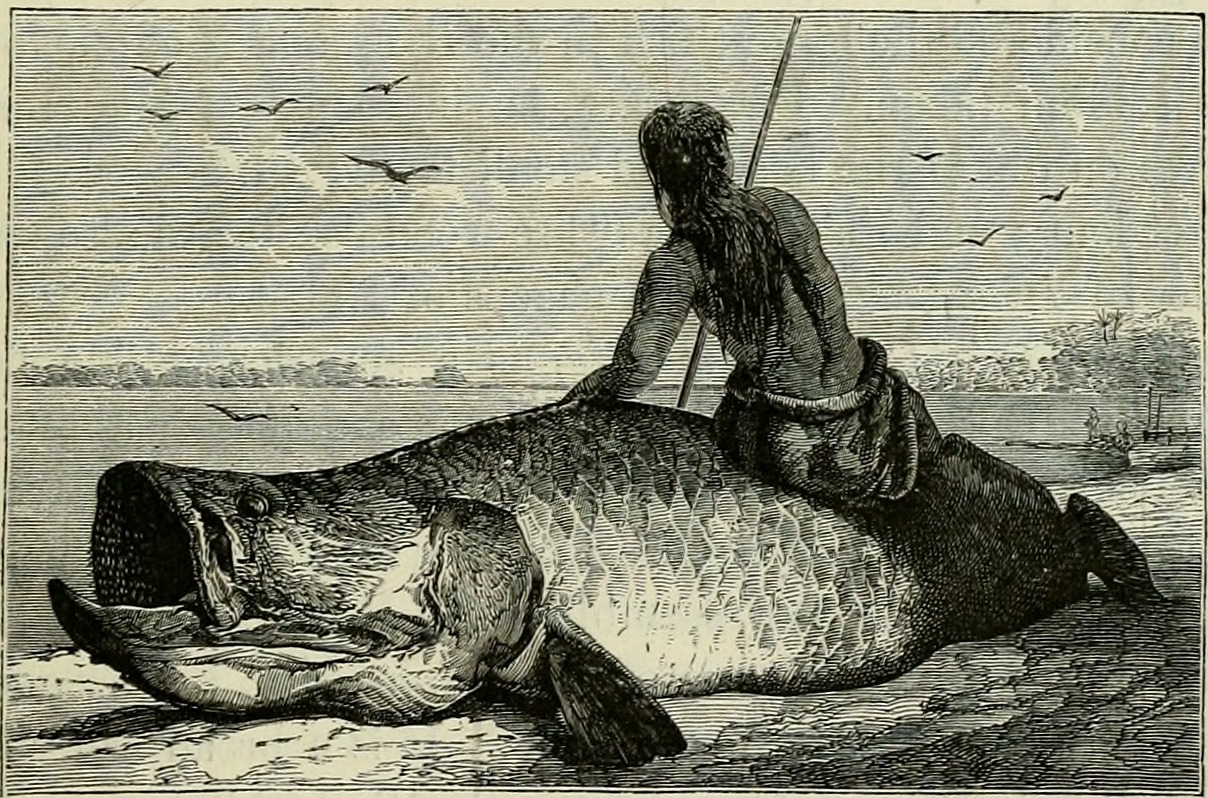
The Pira-rucd. Pii-a-rucii, Payshi, or Anatto {Arapaima gigas), the Cod-fish of the Amazons, is the unixersal diet on the river, and,after rubber and cacao, the most important article of trade.It is sometimes found, but rarely, ten feet long, weighing300 pounds. It is covered with large, hard, red scales;has a smooth head, wide mouth, no barbels, and bands ofrasp-like teeth in various parts of the mouth. It aboundsin iagunes and clear water. Places, usually dry sand-banks. 480 The Andes and the Amazons. where salting this fish for the market is made a business,are called feitorias—about the only factories on the river.The fish is coarse, and not relished by foreigners. Pescada, a scaly, silvery fish, attaining six pounds, hasa delicious, white, flaky flesh, resembling fresh Cod-fish;abounds in the Solimoens and Tapajos. Tambaqui, calledGamitana on the Maranon {Myletes, one of the Gharaci-nidoB), is a very fine, large fish, found from the Negro tothe Ucayali. It is often a yard long,

Note About Images
Please note that these images are extracted from scanned page images that may have been digitally enhanced for readability – coloration and appearance of these illustrations may not perfectly resemble the original work.

This The Great Fish River museum image was automatically curated and published with WP Robot plugin – CLICK HERE to learn more about WP Robot for Wordpress – a massive time and money saver.

Category: ImagesTag: 1876, across, Amazon, America, Andes, continent, from, image, page, South, |bor
11 December 2015 by Alan

Image from page 279 of “The world through a woman’s eyes” (1896)

Image from page 279 of “The world through a woman’s eyes” (1896) Image by Internet Archive Book Images Identifier: cu31924023481892 Title: The world through a woman’s eyes Year: 1896 (1890s) Authors: Ackermann, Jessie A Subjects: Women Publisher: Chicago : [s.n.] Contributing Library: Cornell University Library Digitizing Sponsor: MSN View Book Page: Book Viewer About This …

Image from page 279 of “The world through a woman’s eyes” (1896)
Olive Schreiner House
Image by Internet Archive Book Images
Identifier: cu31924023481892
Title: The world through a woman’s eyes
Year: 1896 (1890s)
Authors: Ackermann, Jessie A
Subjects: Women
Publisher: Chicago : [s.n.]
Contributing Library: Cornell University Library
Digitizing Sponsor: MSN

View Book Page: Book Viewer
About This Book: Catalog Entry
View All Images: All Images From Book

Click here to view book online to see this illustration in context in a browseable online version of this book.

Text Appearing Before Image:
ch had notthen been developed into a question, but wasaccepted, as it had been handed down to us, as adivine institution, and therefore the only form thatcould be recognized—because of these strange ideas Ihad a great desire to see the writer. When the suc-cess of the book was assured and the real name of itsauthor had become known, I was filled with a greaterdesire than ever to look into the face of the womanwho had penned this somewhat weird production.The opportunity came to me during my sojourn inAfrica when I visited Olive Schreiner in her home. Her book being without a frontispiece of the writer,the only idea to be formed of her personal appearancemust of necessity be based on the characteristics ofthe book. These being so unusual, it was but naturalto expect to see a somewhat unusual appearing indi-vidual. With these thoughts in my mind I left thetrain at a station a short distance from Craddock, andfound the carriage waiting to convey me to the farm,some three miles distant.

Text Appearing After Image:
Olive Sciireiner. AFRICA. 277 Viewing the surrounding country as we drovealong, I did not see how any place in that regioncould be called a farm. My whole being just tingledwith suppressed interrogation-points, as I wonderedwhat such barren land could produce. Arrived atthe farm, a little body flitted from the house to thegate to welcome me, and in less than five minutes Iwas truly at home with this interesting, chatty littlewonian. Mrs. Schreiner is under average height, with darkhair, arranged in that careless style so becoming togenius. Her dark, sparkling eyes light up her facewith wonderful brightness as she expresses the inter-est she feels in all things ; for, from this place whereone seems almost buried, she keeps in perfect touchwith the outside world and its doings. This kindof life, that would narrow down and dwarf the verysoul of some women, is to her a perpetual feast. The house is of the style of the farm-houses of thatcountry—comfortable, but scarcely presenting the s

Note About Images
Please note that these images are extracted from scanned page images that may have been digitally enhanced for readability – coloration and appearance of these illustrations may not perfectly resemble the original work.

This Olive Schreiner House image was automatically curated and published with WP Robot plugin – CLICK HERE to learn more about WP Robot for Wordpress – a massive time and money saver.

Category: ImagesTag: 1896, eyes, from, image, page, through, woman's, world
10 December 2015 by Alan

Image from page 283 of “The world through a woman’s eyes” (1896) – Olive Schreiner House

Image from page 283 of “The world through a woman’s eyes” (1896) Image by Internet Archive Book Images Identifier: cu31924023481892 Title: The world through a woman’s eyes Year: 1896 (1890s) Authors: Ackermann, Jessie A Subjects: Women Publisher: Chicago : [s.n.] Contributing Library: Cornell University Library Digitizing Sponsor: MSN View Book Page: Book Viewer About This …

Image from page 283 of “The world through a woman’s eyes” (1896)
Olive Schreiner House
Image by Internet Archive Book Images
Identifier: cu31924023481892
Title: The world through a woman’s eyes
Year: 1896 (1890s)
Authors: Ackermann, Jessie A
Subjects: Women
Publisher: Chicago : [s.n.]
Contributing Library: Cornell University Library
Digitizing Sponsor: MSN

View Book Page: Book Viewer
About This Book: Catalog Entry
View All Images: All Images From Book

Click here to view book online to see this illustration in context in a browseable online version of this book.

Text Appearing Before Image:
the country. As we stood in the door of her house, Mrs.Schreiner pointed toward the hills with great enthu-siasm, told of the animals that prowl among thebushes, and seemed to revel in the beauty (?) of alandscape that to me breathed only of endless waste.She was, if anything, even more enthusiastic in herdelight in the great karroo. I just love it, said she, for its mighty vast-ness. I am filled with awe when I look upon itsalmost boundless stretches, spreading over miles ofuninhabited regions. I have almost a reverence forit. Then, pointing in the direction which we thenfaced, she added, Away over there, in a smallhouse, I wrote my story of An African Farm; itwas the majesty of the almost limitless karroo thatgave me my inspiration. I did not discuss the theology or social features ofthe book, which I fully intended to do, for she talkedon about the country and of things generally inwhich she is so well informed, that time wore apace,and I was obliged to depart without having gained

Text Appearing After Image:
Fish River, Sclireiner Farm. Africa. 281 the information whether or not the book expressedher own personal views. Later I was told that shewas but nineteen years of age when this remarkableproduction was brought out. It is said that from herpublishers she received the small amount of fourteenpounds, to which, however, they added large sumswhen the book proved such an astonishing success. The next in interest was Olive Schreiners hus-band, as he is generally called in South Africa.Mr. Schreiner, previous to his marriage with Olive,was a Mr. Conwright; but finding his wife unwillingto give up a name that had become known through-out the world, he took hers ; a proceeding made easyin that country by simply announcing in the papersfor a certain time that after such a date Mr. JohnSmith will be known as Mr. John Smith Brown, orGreen, as the case may be. Numerous criticismshave been passed pro and con on his unusual course,and I venture to say that sentiment generally is muchagainst a man l

Note About Images
Please note that these images are extracted from scanned page images that may have been digitally enhanced for readability – coloration and appearance of these illustrations may not perfectly resemble the original work.

This Olive Schreiner House image was automatically curated and published with WP Robot plugin – CLICK HERE to learn more about WP Robot for Wordpress – a massive time and money saver.

Category: ImagesTag: 1896, eyes, from, House, image, Olive, page, Schreiner, through, woman's, world
10 December 2015 by Alan

Image from page 150 of “Our wonderful navy; the story of the sure shield in peace and war” (1919) – Hunting In Cradock

Image from page 150 of “Our wonderful navy; the story of the sure shield in peace and war” (1919) Image by Internet Archive Book Images Identifier: ourwonderfulnavy00marg Title: Our wonderful navy; the story of the sure shield in peace and war Year: 1919 (1910s) Authors: Margerison, John S Subjects: World War, 1914-1918 World War, 1914-1918 …

Image from page 150 of “Our wonderful navy; the story of the sure shield in peace and war” (1919)
Hunting in Cradock
Image by Internet Archive Book Images
Identifier: ourwonderfulnavy00marg
Title: Our wonderful navy; the story of the sure shield in peace and war
Year: 1919 (1910s)
Authors: Margerison, John S
Subjects: World War, 1914-1918 World War, 1914-1918
Publisher: London, Cassell and Co., Ltd
Contributing Library: Robarts – University of Toronto
Digitizing Sponsor: University of Toronto

View Book Page: Book Viewer
About This Book: Catalog Entry
View All Images: All Images From Book

Click here to view book online to see this illustration in context in a browseable online version of this book.

Text Appearing Before Image:
At half-pastfive she stopped with a heavy list to starboard, though here and therea gun still fired at times. Carnarvon, who had now arrived, Invincibleand Inflexible closed on her, and at six oclock, with her colours stillflying, she turned turtle and sank. The three British ships immediatelyset about rescuing survivors—and then went back to harbour tocomplete coaling, having removed from the face of the seas the terrorsof the Pacific. Meanwhile, Cornwall and Glasgow had dealt faithfully with Leipzig,sinking her, while Kent had done the same for Niirnberg. Out of thefive ships that fought Cradock only one now was left, hunted, a fugitive,to join the elusive Karlsruhe in being the only German surface warshipsoutside the Kiel Canal. So ended the power of Germany in the Pacific,so were avenged Cradock and his gallants, and, his task accomplished,Sturdee brought home his squadron to divide themselves once morein the places where they belonged, and where there was still work tobe done.

Text Appearing After Image:
CHAPTER XVIIITHE BATTLE OF DOGGER BANK DURING the early days of the war, the German Navy did itsbest to bring liome the war to the people who inhabited ourEast Coast towns. At carefully selected intervals certainheavy ships would dash out of their hiding places in the mouths ofthe Rivers Ems and Weser, and, racing across the North Sea, fireshells into any undefended to^\Ti they happened to strike. The Hartlepools and Scarborough suffered rather badly in oneof these raids, and on January 24th, 1915, Yarmouth was subjectedto bombardment by a fast battle-cruiser squadron. It so happened, however, that on this occasion Vice-AdmiralBeatty was patrolling the North Sea, and when at 7.30 in the morn-ing the flash of guns was observed to the south-west of his position,he immediately worked his fleet up to full speed, ordering his lightcioiisers to go ahead and reconnoitre. Aurora, one of them, reportedshortly afterwards that she was engaged with the enemy, so Beattyshaped his course to get bet

Note About Images
Please note that these images are extracted from scanned page images that may have been digitally enhanced for readability – coloration and appearance of these illustrations may not perfectly resemble the original work.

This Hunting in Cradock image was automatically curated and published with WP Robot plugin – CLICK HERE to learn more about WP Robot for Wordpress – a massive time and money saver.

Category: ImagesTag: 1919, cradock, from, Hunting, image, navy, page, peace, shield, story, sure, wonderful
4 December 2015 by Alan

Image from page 1110 of “The Street railway journal” (1884)

Image from page 1110 of “The Street railway journal” (1884) Image by Internet Archive Book Images Identifier: streetrailwayjo101894newy Title: The Street railway journal Year: 1884 (1880s) Authors: Subjects: Street-railroads Electric railroads Transportation Publisher: New York : McGraw Pub. Co. Contributing Library: Smithsonian Libraries Digitizing Sponsor: Smithsonian Libraries View Book Page: Book Viewer About This Book: …

Image from page 1110 of “The Street railway journal” (1884)
Hunting in Cradock
Image by Internet Archive Book Images
Identifier: streetrailwayjo101894newy
Title: The Street railway journal
Year: 1884 (1880s)
Authors:
Subjects: Street-railroads Electric railroads Transportation
Publisher: New York : McGraw Pub. Co.
Contributing Library: Smithsonian Libraries
Digitizing Sponsor: Smithsonian Libraries

View Book Page: Book Viewer
About This Book: Catalog Entry
View All Images: All Images From Book

Click here to view book online to see this illustration in context in a browseable online version of this book.

Text Appearing Before Image:
ORDERS RECEIVEPROMPT ATTENTION. lit- OF EVERY DESCRIPTION. Crucible Cast Steel Cables for Cable Railways a Specialty. SEMAPHORE STRAND AND EXTRA FLEXIBLE STEEL RHEOSTAT CABLES. Hard and Soft Drawn BARE AND INSULATED COPPER WIRE For Electric Railways.HARD DRAWN TROLLEY WIRE, FEEDER WIRES, ARC AND INCANDESCENT LIGHT WIRE, ETC.Makers of the SALAMANDER Fire and Water-Proof Insulated Wire. STEEL MILLS AND FACTORIES .-—WORCESTER, MASS.; WAUKEGAN, ILL, OFFICES AND WAREHOUSES: WORCESTER, MASS.; NEW YORK, N. Y.; CHICAGO, ILL. ; SAN FRANCISCO, CAL. ; HOUSTON, TEXAS. C. AaZ. hunt company, 45 BRO^H>WA.Y, NEW YORK. MANUFACTURERS OF THE HUNT NOISELESS CONVEYOR i I

Text Appearing After Image:
For HANDLING COAL AND ASHESAT ELECTRIC LIGHT ANDPOWER HOUSES. Hunt Conveyor arranged forhandling both coal and ashes atEdison Electric Illuminating Co.s^ Third District Station, Brooklyn, N. Y. 98046 Copyrighted. 80 THE STREET RAILWAY JOURNAL. [Vol. X. No. d GEORGE CRADOCK & CO. Wire Rope Works and Wire Drawing Mills, WAKEFIELD, ENGLAND.LONDON OFFICES, 7 East India Avenue, E. C. – HEAD OFFICES, Wakefield. TELEGRAPHIC ADDRESS, CRADOCK, JPAKEPIELD. A It C ANI> ENGINEERING TELEGRAPH CODES ILSKK. Chicago Exhibition—Award Received. MANUFACTURERS OF EVERY DESCRIPTION OF Steel and Iron Wire Ropes, FOR CABLE TRAMWAYS, MINES, COLLIERIES, AERIAL ROPEWAYS,CRANES, HOISTS AND AGRICULTURAL PURPOSES. Our Cable Tramway Ropes, made on Lang.s Lay, and of our own ImprovedPatent Crucible Steel Wire, have given specially good results. Following illustra-tions, taken from Cables, show condition after being in service: Cable supplied The Melbourne Tramway & Omnibus Company, Melbourne,Australia

Note About Images
Please note that these images are extracted from scanned page images that may have been digitally enhanced for readability – coloration and appearance of these illustrations may not perfectly resemble the original work.

This Hunting in Cradock image was automatically curated and published with WP Robot plugin – CLICK HERE to learn more about WP Robot for Wordpress – a massive time and money saver.

Category: ImagesTag: 1110, 1884, from, image, journal, page, Railway, Street
24 November 2015 by Alan

Image from page 34 of “British sport past and present” (1909) – Hunting In Cradock

Image from page 34 of “British sport past and present” (1909) Image by Internet Archive Book Images Identifier: britishsportpast09cumi Title: British sport past and present Year: 1909 (1900s) Authors: Cuming, E. D. (Edward William Dirom), 1862-1941 Subjects: Horses Hunting Hunting Publisher: London : Hodder and Stoughton Contributing Library: Webster Family Library of Veterinary Medicine Digitizing …

Image from page 34 of “British sport past and present” (1909)
Hunting in Cradock
Image by Internet Archive Book Images
Identifier: britishsportpast09cumi
Title: British sport past and present
Year: 1909 (1900s)
Authors: Cuming, E. D. (Edward William Dirom), 1862-1941
Subjects: Horses Hunting Hunting
Publisher: London : Hodder and Stoughton
Contributing Library: Webster Family Library of Veterinary Medicine
Digitizing Sponsor: Tufts University

View Book Page: Book Viewer
About This Book: Catalog Entry
View All Images: All Images From Book

Click here to view book online to see this illustration in context in a browseable online version of this book.

Text Appearing Before Image:
push through, andexhibit to the field their glossy skins and spotted sides. Oh,you beauties! exclaims some old Meltonian, rapturouslyfond of the sport. Two minutes more elapse ; another houndslips out of cover, and takes a short turn outside, with his noseto the ground and his stern lashing his side—thinking, no doubt,he might touch on a drag, should Reynard have been abroadin the night. Hounds have no business to think, thinks thesecond whipper-in, who observes him ; but one crack of hiswhip, with Rasselas, Rasselas, where are you going, Rasselas ?Get to cover, Rasselas ; and Rasselas immediately disappears.Five minutes more pass away. No fox here, says one.Dont be in a hurry, cries Mr. Cradock,- they are drawing 1 Master from 1817 to 1821, and again from 1823 to 1827. – This gentleman resided within the limits of the Quorn hunt, and kindly super-intended the management of the covers. He has lately paid the debt of nature(Authors note). 8 Foxhounds, showing Rounded andUnrounded Ear

Text Appearing After Image:

Note About Images
Please note that these images are extracted from scanned page images that may have been digitally enhanced for readability – coloration and appearance of these illustrations may not perfectly resemble the original work.

This Hunting in Cradock image was automatically curated and published with WP Robot plugin – CLICK HERE to learn more about WP Robot for Wordpress – a massive time and money saver.

Category: ImagesTag: 1909, British, cradock, from, Hunting, image, page, past, present, sport
  • Previous
  • Page 1
  • Interim pages omitted …
  • Page 4
  • Page 5
  • Page 6
  • Page 7
  • Next
WE LOVE CRADOCK.

COPYRIGHT MyCradock · DESIGN BY REACH TRUST
All Rights Reserved · Powered by Straton Solar